

The global beauty market just crossed $639 billion. Online beauty sales are growing six times faster than in-store. And if you're running a beauty brand on Shopify, you're sitting in the middle of one of the fastest-moving sectors in ecommerce.
But here's the thing. Most beauty brands pour money into the latest marketing trend while ignoring the operational backbone that keeps customers coming back. The brands winning in 2026 aren't just chasing trends. They're building the infrastructure to support them.
This post breaks down 10 beauty ecommerce trends that actually matter this year, with real numbers and practical ways to act on each one. Whether you're running a skincare DTC brand, a cosmetics line on Shopify, or a multi-brand beauty retailer, these trends will shape how you sell, support, and retain customers through 2026 and beyond.
Hear what AI support calls sound like for your store. Just paste your Shopify URL and get sample calls in under 20 seconds, no email required. Listen to demo calls for my store.
Beauty ecommerce by the numbers
Before getting into trends, here's where the market stands right now.
| Metric | Figure | Source |
|---|---|---|
| Global beauty market | $639.5 billion | DemandSage |
| Online beauty sales | ~$257.5 billion | ClickPost/Statista |
| U.S. online beauty sales (2026) | $30.73 billion | Statista |
| E-commerce vs. in-store growth | 6x faster | BusinessWire |
| Online share of beauty sales | 26% (2024), projected 33% by 2030 | ClickPost |
| Mobile checkout share | 59% | ClickPost |
| Skincare share of online market | 44% | IMRG |
The beauty market grew 10% year-over-year according to BusinessWire, driven primarily by ecommerce expansion. Online penetration climbed from just 14% in 2015 to 26% in 2024. Analysts project it'll hit 33% by 2030.
The U.S. alone is expected to generate $30.73 billion in online beauty sales this year, according to Statista. And the ecommerce beauty CAGR of 8.4% means this growth isn't slowing down anytime soon. Sales are projected to reach $338.9 billion globally by 2029.
For a deeper look at ecommerce trends in 2026 across all verticals, we covered the broader landscape separately. But beauty has its own dynamics, and they're worth understanding on their own.
10 beauty ecommerce trends shaping 2026
1. AI-powered personalization is replacing generic recommendations
Half of beauty consumers already receive product recommendations from generative AI, according to NielsenIQ's 2026 State of Beauty report. That number is climbing fast.
Olay's Skin Advisor is a good example. Their AI tool has served over 6 million users, and 94% say the recommendations were appropriate for their skin. That's not a gimmick. That's a conversion engine.
For beauty brands, ecommerce personalization now goes beyond "you might also like" widgets. It means:
- AI-driven quizzes: Skin type, concerns, and lifestyle questions that produce personalized routines (not just product suggestions)
- Smart recommendation engines: Using purchase history, browsing behavior, and even ingredient preferences to surface the right products
- Conversational AI: Customers asking questions about ingredients, routines, and compatibility, and getting real answers by phone or chat
That last point is where most brands fall behind. Customers don't just want to be recommended a serum. They want to ask whether it plays well with their retinol. AI shopping assistants are closing that gap, handling product questions across channels including phone calls.
If you're on Shopify and want to see what AI phone support looks like for a beauty store, try Ringly.io free for 14 days. Setup takes about three minutes.
2. Social commerce is now a real revenue channel
Social commerce stopped being experimental somewhere around the time TikTok Shop crossed $1 billion in beauty sales alone. Today, 68% of online beauty purchases are influenced by social feeds, and 53% of consumers have purchased directly through a social platform.
Here's what's changed. It's not just about brand awareness anymore. Sephora and Gap have launched their own creator platforms because they've realized Gen Z discovers, engages with, and buys through creator ecosystems. TikTok Shop and Instagram Checkout together accounted for $9.2 billion in social commerce transactions in early 2026.
For beauty brands, this means:
- UGC is more trusted than ads: 92% of consumers trust organic user-generated content over traditional advertising
- Creator partnerships are infrastructure: Not a one-off campaign, but an ongoing sales channel that drives repeat purchases
- Shoppable content is the new product page: Tutorials, GRWM videos, and reviews with embedded checkout links convert better than static listings
- More channels = more support volume: Every new social storefront generates customer questions about orders, returns, and products
The operational challenge is real. Running TikTok Shop, Instagram Checkout, and your own Shopify site simultaneously creates a customer service headache. Orders come from everywhere. Customers reach out everywhere. And they expect the same level of support regardless of where they bought.
If you're scaling across social channels, your ecommerce marketing strategy needs to include support infrastructure, not just ad spend.
3. Live shopping is going mainstream
The live commerce market is growing at a 39.9% CAGR, and beauty is one of its biggest categories. Live shopping events generated $5 billion in beauty sales in 2023. By 2027, digital sales (including live streaming and social commerce) are projected to make up 60% of total beauty sales.
What makes live shopping work for beauty:
- Real-time product demos: Foundation swatches, skincare routines, and shade comparisons done live
- Instant Q&A: Viewers ask questions and get answers before buying
- Scarcity and urgency: Limited-time offers during streams drive impulse purchases
- Trust through authenticity: Watching someone actually use a product beats any product photo
The brands doing this well are blending entertainment with education. It's part product launch, part tutorial, part community event. And the conversion rates are significantly higher than static product pages.
For Shopify beauty stores getting started, even a weekly Instagram Live or TikTok Live session demonstrating your products can drive meaningful sales. You don't need a production studio. A ring light, your products, and genuine expertise go a long way. The key is consistency and showing up when your audience is online.
4. Clean beauty and sustainability are now baseline expectations
This isn't a trend anymore. It's a requirement.
According to a 2026 BusinessWire report, 77% of consumers value brands that are sustainable or environmentally responsible. In beauty, that translates to ingredient transparency, eco-friendly packaging, and responsible sourcing.
What's new in 2026:
- Biotech-derived ingredients: Lab-grown alternatives to traditional ingredients that improve consistency and traceability
- Ingredient transparency as default: Consumers expect to know exactly what's in a product and why. Vague claims like "clean" or "natural" aren't enough.
- Evidence-based marketing: Brands that can't back up their claims with real data lose credibility fast
This creates an interesting support challenge. Educated consumers ask more specific questions. "Is this cruelty-free?" has evolved into "What's the source of your squalane?" and "Does this formulation contain any palm oil derivatives?"
Your support team (or your AI phone agent) needs to handle these questions with precision. Generic scripts won't cut it.
Brands that get this right see it in their conversion rates. When a customer asks about an ingredient and gets a confident, accurate answer, they buy. When they get a vague response or no response at all, they leave. In beauty, product knowledge is customer service.
5. Mobile-first checkout is non-negotiable
59% of beauty digital checkouts happen on mobile. That's the majority of your transactions running through a small screen.
The numbers paint a clear picture:
- 72% cart abandonment rate: Mobile shoppers are impatient. Any friction kills the sale.
- 2-4% average conversion rate: There's massive room for improvement
- 11% abandon over payment methods: If you don't offer Apple Pay, Google Pay, and buy-now-pay-later options, you're losing customers
For beauty brands specifically, mobile commerce means rethinking the entire shopping experience. Product images need to load fast. Shade selectors need to work on touchscreens. Checkout needs to be three taps or fewer.
And when mobile shoppers hit a problem, they want instant help. That's where click-to-call buttons become critical. A shopper browsing your store on their phone is already holding the device they'd use to call you. Making phone support one tap away can recover sales that would otherwise disappear.
Think about it from the customer's perspective. They're comparing two serums on their phone. They have a question about ingredients. If your site has a visible phone number or click-to-call button, they tap it and get an answer in 30 seconds. If it doesn't, they bounce to a competitor who makes it easier. Adding a phone number to your Shopify store is one of the simplest changes you can make with one of the highest returns.
The cart abandonment problem in beauty is especially acute because purchase decisions are often emotional and research-heavy. A customer who abandons their cart because they couldn't get a quick answer about a product is much harder to win back than one who simply got distracted.
6. Skincare dominates and keeps growing
Skincare accounts for 44% of the online beauty market and it's not slowing down. Haircare is the other standout, posting 30%+ year-over-year growth in early 2026 according to IMRG data.
Two big shifts within skincare:
- Skin longevity: Moving from niche biohacker territory to mainstream consumer demand. People want products that support long-term skin health, not just quick fixes. Peptides, PDRN, and barrier-focused formulations are driving this.
- Subscription and replenishment: Skincare is a natural fit for subscription models. Customers use the same cleanser, moisturizer, and SPF daily. Auto-replenishment drives retention and predictable revenue.
For Shopify beauty stores, this means investing in customer retention strategies specific to skincare. Subscription management, proactive reorder reminders, and personalized routine adjustments all keep customers coming back.
The subscription angle is especially powerful for beauty because the replenishment cycle is predictable. A customer who loves your moisturizer will need another jar in 6-8 weeks. If you can make reordering effortless (and handle subscription changes, pauses, and skips without friction), you've built a revenue stream that doesn't depend on constantly acquiring new customers. That's where subscription cancellation management becomes critical. The goal is to save the subscriber, not just process the cancellation.
7. AR try-ons are reducing returns
Virtual try-on technology has gotten genuinely useful. Customers can test foundation shades, lipstick colors, and even eyeshadow looks through their phone camera before buying.
Why this matters for beauty ecommerce:
- Returns are expensive: Most returned beauty products can't be restocked due to hygiene concerns. Every return is close to a total loss.
- Shade mismatch is the #1 driver: When a foundation doesn't match, you don't just lose the sale. You often lose the customer.
- AI-powered matching works: With 94% satisfaction rates on AI skin analysis tools, the technology is past the "gimmick" phase
Brands investing in AR try-ons and AI shade matching are seeing lower return rates and higher customer confidence at checkout.
And when a customer does need help with a shade recommendation, having support that actually understands your product line (whether human or AI) makes a real difference. This is where order tracking and return handling need to work together. A customer who can easily swap a wrong shade for the right one stays loyal. A customer who has to fight through a complicated return process takes their money elsewhere.
8. Gen Alpha and Gen Z are rewriting the rules
Here's a stat that should get your attention. Gen Alpha households are responsible for 49% of mass skincare growth in the US, according to NielsenIQ. Facial moisturizers alone saw a 36.2% sales increase driven largely by younger consumers.
These aren't future customers. They're buying now (or heavily influencing household purchases).
What this means for beauty ecommerce:
- Creator-first discovery: Gen Z finds brands through TikTok creators, not Google ads
- Quality over quantity: Younger shoppers are moving away from haul culture toward fewer, better products
- Digital-native expectations: They expect fast responses, self-service options, and support across every channel
- Multilingual support matters: Beauty ecommerce is global, and younger shoppers expect to interact in their preferred language
The support expectations of Gen Z and Gen Alpha are fundamentally different from older demographics. They don't want to wait on hold. They don't want to send an email and wait 24 hours. They want instant answers, whether that's through chat, social, or a quick phone call.
Gen Alpha's beauty spending is projected to grow by over $103 billion by 2034, according to Mintel research. That's not a demographic you can afford to ignore. And their parents (often the actual purchasers) are equally demanding. 81% of kids report influencing skincare purchases, compared to 61% of parents who acknowledge that influence. If your store isn't set up to handle questions from a younger, digital-native audience, you're missing where the growth is coming from.
For health and wellness ecommerce brands, many of these generational shifts apply equally. The overlap between beauty, skincare, and wellness is getting harder to separate.
9. Omnichannel customers spend 30% more
Customers who shop across multiple channels deliver roughly 30% higher lifetime value than single-channel shoppers. For beauty brands, that means your DTC site, marketplace presence, and social storefronts aren't competing with each other. They're reinforcing each other.
A few things driving this:
- Brand loyalty is shifting: 52% of shoppers are more eager to discover new brands than pre-covid, which means retention matters more than ever
- APAC leads online penetration: If you're thinking about international expansion, Asia-Pacific beauty markets are moving fastest
- Price is losing to brand: After a period where price dominated purchase decisions, brand importance is returning to 2021-2023 levels
Building a customer retention strategy that works across channels is no longer optional. Loyalty programs, personalized communications, and consistent support experiences across every touchpoint all contribute to that 30% LTV premium.
For beauty brands on Shopify, this often starts with making sure your customer experience optimization is consistent everywhere. A customer who buys through TikTok Shop should get the same quality support as someone who ordered directly from your site. That consistency builds trust, and trust drives the repeat purchases that skincare and beauty brands depend on.
10. Customer experience is becoming the real differentiator
This is the trend that ties everything together.
89% of customers will switch to a competitor after just one bad support experience. Yet only 34.8% of skincare stores on Shopify even list a phone number on their website.
That gap is where revenue leaks out. Beauty customers call about:
- Ingredient questions: "Will this work with my tretinoin?"
- Shade matching: "I'm NC25 in MAC, what's my match in your line?"
- Order issues: Tracking, delivery windows, missing items
- Returns and exchanges: "The shade doesn't match, can I swap?"
- Subscription management: Pausing, skipping, or canceling
Most DTC beauty brands put their entire support budget into chat widgets and email queues. But complex skincare questions often need a real conversation. Customers don't want to type out their entire skincare routine in a chat box.
The solution isn't hiring a 10-person support team. It's using AI that actually understands beauty. AI phone agents can look up orders, process returns, answer ingredient questions, and escalate to a human when needed. All in 40+ languages, 24/7.
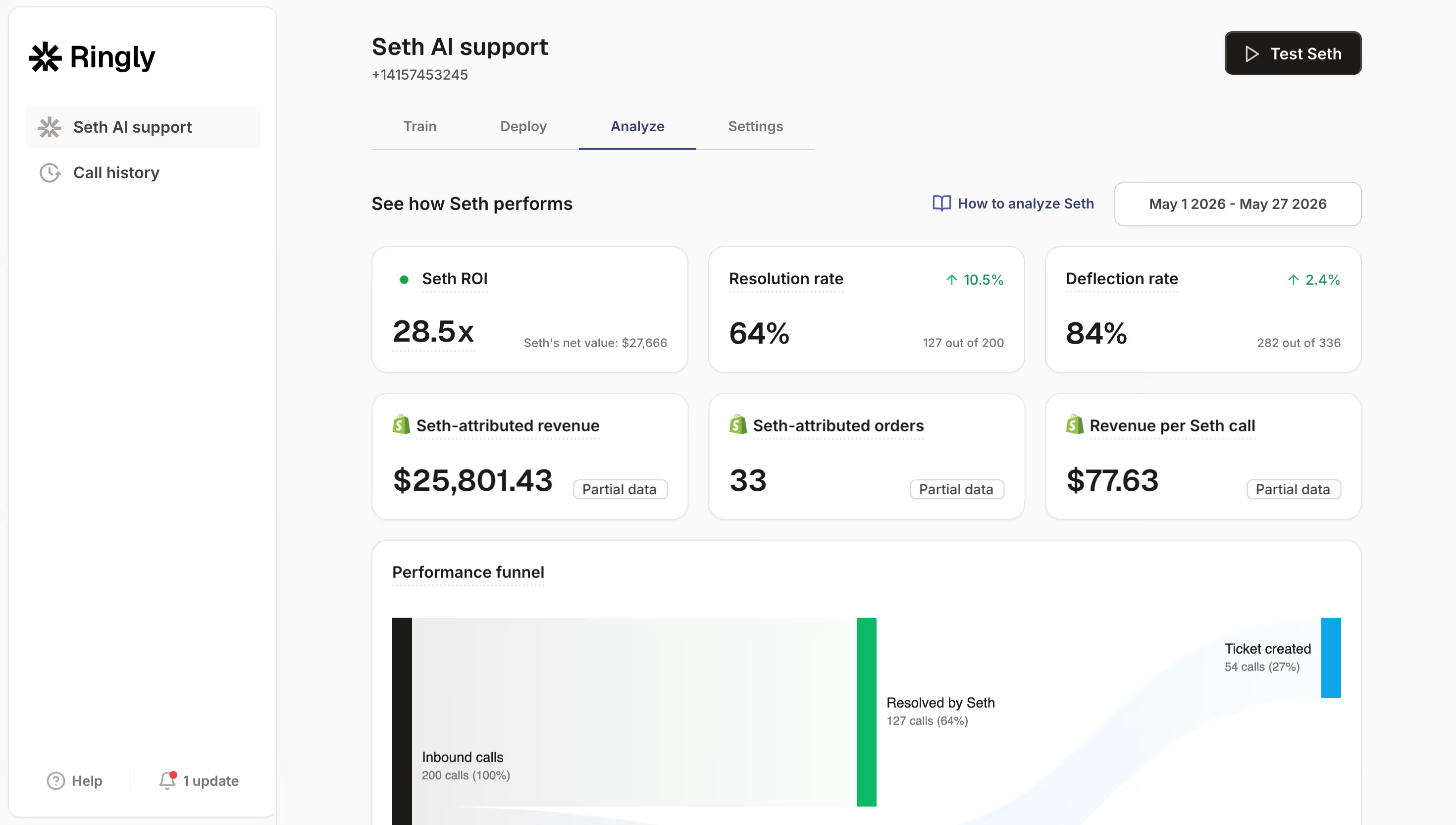
Ringly.io's AI agent, Seth, is built specifically for this. It connects directly to your Shopify store, pulls real-time order data, and handles the WISMO calls ("where is my order?") that eat up most of a beauty brand's support time. For the more complex calls (ingredient concerns, personalized routine advice), Seth uses your product knowledge base to give accurate answers. And it resolves about 73% of calls without ever needing a human.
The cost comparison makes it obvious. A dedicated support agent costs $3,000-5,000/month. An AI phone agent costs a fraction of that and never takes a sick day.
See what AI phone support looks like for beauty stores. Try it free for 14 days, no credit card required.
How to prepare your beauty store for these trends
You don't need to tackle all 10 at once. Here's a practical priority list based on what we've seen work for beauty brands on Shopify. Start with the foundations, then layer in growth channels.
Start with your customer experience stack:
- Audit your support channels: Can customers actually reach you by phone? Do you offer after-hours support? How fast do you respond?
- Add AI-powered phone support: An AI phone agent can handle 70%+ of routine calls (order tracking, returns, product questions) while your team focuses on complex issues
- Optimize for mobile: Test your entire purchase flow on a phone. Every extra step costs you conversions.
Then build your growth engine:
- Invest in personalization: Start with a skin quiz or routine builder. Even a simple one converts better than no personalization.
- Launch on social commerce: If you're not on TikTok Shop yet, you're leaving money on the table for beauty products
- Build creator relationships: Find 10-20 micro-creators who genuinely use your products. Long-term partnerships beat one-off sponsorships.
- Test live shopping: Even one weekly live session can drive meaningful sales. Start with product demonstrations and ingredient education.
Track what matters:
- Customer lifetime value, not just acquisition cost. CLV tells you which customers and channels are actually profitable.
- Retention rate, not just conversion rate. Keeping existing customers costs far less than acquiring new ones.
- Support satisfaction, not just ticket volume
- Return rate by channel, to see where shade-matching or product education is failing. Track your refund rate closely.
- Response time, because beauty customers expect fast answers. Benchmark your response times against industry standards.
The brands that outperform in 2026 will be the ones that treat customer experience as a growth channel, not a cost center. Every support interaction is a chance to build trust, prevent a return, or upsell a complementary product.
Frequently asked questions
What are the biggest beauty ecommerce trends in 2026?
AI-powered personalization, social commerce (especially TikTok Shop), live shopping, and mobile-first checkout are the biggest shifts. Clean beauty and sustainability have moved from trend to baseline expectation. The overarching theme is that customer experience now matters as much as product quality.
How big is the beauty ecommerce market?
The global beauty market is worth $639.5 billion, with online sales around $257.5 billion. U.S. online beauty sales are projected to hit $30.73 billion in 2026. Online beauty is growing at an 8.4% CAGR, significantly faster than in-store retail. E-commerce now accounts for 26% of total beauty sales and is projected to reach 33% by 2030.
Is social commerce really working for beauty brands?
Yes. TikTok Shop alone crossed $1 billion in beauty sales, and 68% of online beauty purchases are influenced by social feeds. The key is treating social commerce as a proper sales channel with its own support infrastructure, not just a brand awareness play.
How can small beauty brands compete with big players online?
Focus on what large brands struggle with: personal customer relationships, niche expertise, and fast response times. A small brand that answers every call and knows its products inside out will outperform a large brand with a 48-hour email response time. AI tools can give you enterprise-level support at a fraction of the cost.
What role does AI play in beauty ecommerce?
AI powers personalization (skin quizzes, recommendation engines), virtual try-ons (shade matching, AR), customer support (AI phone agents, chatbots), and inventory management. The most immediate ROI for most beauty brands comes from AI-powered customer support and personalized product recommendations.
How important is phone support for beauty ecommerce stores?
More important than most brands realize. Only 34.8% of skincare Shopify stores list a phone number, yet beauty products generate complex questions about ingredients, compatibility, and shade matching that are hard to resolve over chat. Adding phone support (even AI-powered) can reduce returns and increase customer confidence.
The bottom line
The beauty brands pulling ahead in 2026 have something in common. They're not just riding the latest marketing trend. They're building the operational infrastructure to actually support their growth.
That means AI-powered personalization, yes. Social commerce, absolutely. But also the less glamorous stuff: fast customer support, smooth returns, knowledgeable product guidance, and a mobile experience that doesn't lose customers at checkout.
The beauty brands that will scale without breaking are the ones investing in both sides of the equation. Great marketing gets customers in the door. Great customer experience keeps them there.
Start where the impact is highest. For most beauty brands, that's customer experience. Get that right, and every other trend on this list becomes easier to act on.
Try Ringly.io free for 14 days and get AI phone support answering beauty product questions in under three minutes.