

Personalization separates stores that convert from stores that bleed traffic. We pulled together 45 ecommerce personalization statistics from McKinsey, Epsilon, Twilio Segment, and other sources so you can see exactly where the industry stands in 2026.
Hear what AI support calls sound like for your store. Just paste your Shopify URL and get sample calls in under 20 seconds, no email required. Listen to demo calls for my store.
Key highlights
- 80% of consumers are more likely to buy when a brand personalizes the experience (Epsilon)
- Personalization drives 5-25% revenue lift depending on the industry (McKinsey)
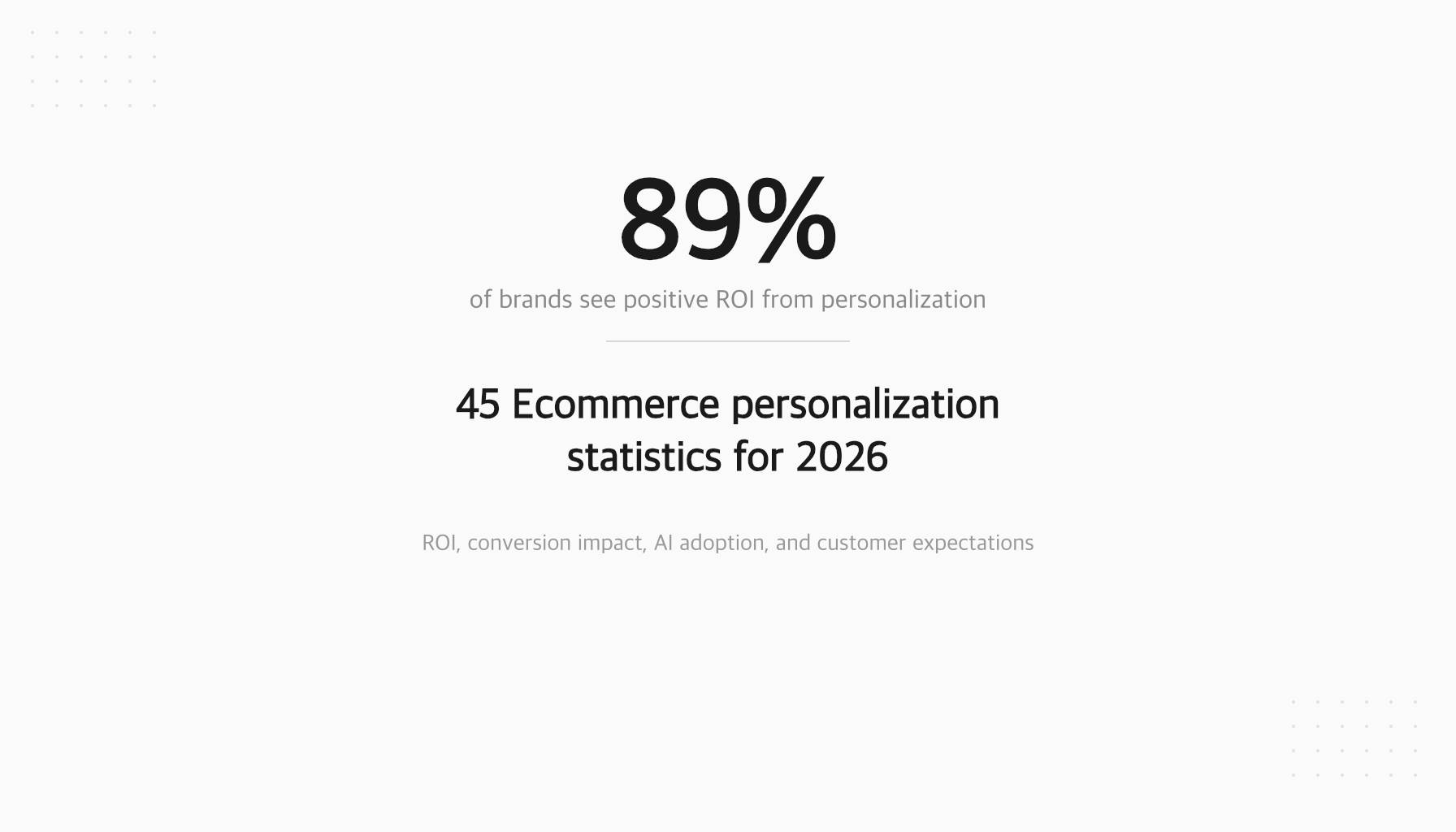
- 89% of marketers report positive ROI from personalization (Amra & Elma)
- Product recommendations generate 26% of ecommerce revenue despite being just 7% of traffic (Clerk.io)
- 87% of brands plan to increase personalization spending in 2026 (StackAdapt)
- Personalized CTAs convert 202% better than generic ones (Involve.me)
Customer expectations and behavior
Your customers expect you to know them. That's not an opinion. It's backed by data from every major research firm tracking ecommerce customer experience.
80% of consumers are more likely to purchase when brands offer personalized experiences. This finding from Epsilon's landmark study remains one of the most cited stats in ecommerce for good reason. (Epsilon)
71% of consumers expect companies to deliver personalized interactions. And 76% get frustrated when it doesn't happen. That frustration translates directly into lost sales. (McKinsey)
91% of consumers are more likely to shop with brands that provide relevant recommendations. Generic browsing experiences are a thing of the past. If you're not surfacing what's relevant, your competition will. (Envive)
82% of consumers are willing to share data for a more customized experience. Privacy concerns are real, but most shoppers will trade some data for a better experience. (WiserNotify)
56% of customers expect offers to always be personalized. Not sometimes. Always. (DemandSage)
60% of shoppers become repeat buyers after a personalized experience. Personalization doesn't just close the first sale. It builds the habit of coming back. (WiserReview)
The gap between what customers expect and what brands deliver is still wide. Twilio Segment found that 85% of companies believe they provide personalized experiences, but only 60% of customers agree. That 25-point disconnect is a massive opportunity for stores that close it.
Revenue and ROI impact
Here's where it gets interesting for anyone watching their margins. Personalization isn't just a customer retention play. It's a direct revenue driver.
Personalization drives 5-15% revenue lift for most companies. McKinsey's research consistently shows this range, with top performers pushing even higher. (McKinsey)
Fast-growing companies drive 40% more of their revenue from personalization than slower-growing peers. The correlation between growth rate and personalization investment is clear. (McKinsey)
89% of marketers see a positive ROI from personalization campaigns. Less than one in ten say it isn't working for them. (Amra & Elma)
Companies with advanced personalization see returns of $20 for every $1 spent. That's a 20x return. Even at more conservative levels, the payback crushes most other marketing investments. (Amra & Elma)
Personalization improves marketing-spend efficiency by 10-30%. So you're not just making more. You're wasting less. (McKinsey)
Shifting to top-quartile personalization would generate over $1 trillion in value across US industries. The total addressable opportunity is enormous, and most of it is still untapped. (McKinsey)
62% of business leaders say personalization has improved customer retention. And 80% report higher consumer spending when experiences are tailored. Retention and revenue, both at once. (Involve.me)
If your ecommerce marketing budget is tight, personalization gives you more output from the same spend. The ROI data is hard to argue with.
Conversion rate impact
Conversions are the metric that pays the bills. And personalization moves the needle more than almost anything else you can do on your Shopify store.
Personalized CTAs perform 202% better than generic alternatives. A call-to-action tailored to where someone is in the buying journey outperforms a one-size-fits-all button by more than 3x. (Involve.me)
Hyper-personalization can increase conversion rates by up to 60%. IDC research shows that campaigns using real-time behavioral data massively outperform traditional approaches. (Trask)
AI-powered personalization boosts conversions by up to 30%. Not every store will hit 60%, but a 30% lift from AI-driven tactics is realistic and repeatable. (WiserNotify)
Personalized recommendations produce 4x more conversions than non-personalized ones. If you're showing the same product grid to everyone, you're leaving money on the table. (Practical Ecommerce)
63% of marketers see a conversion rate increase after using personalized content. The remaining 37% are likely doing it wrong (or not measuring it properly). (SEO Vendor)
Personalization strategies on ecommerce platforms lead to a 20% increase in sales. That's not a theoretical number. It's what stores actually report after implementing personalization. (WiserNotify)
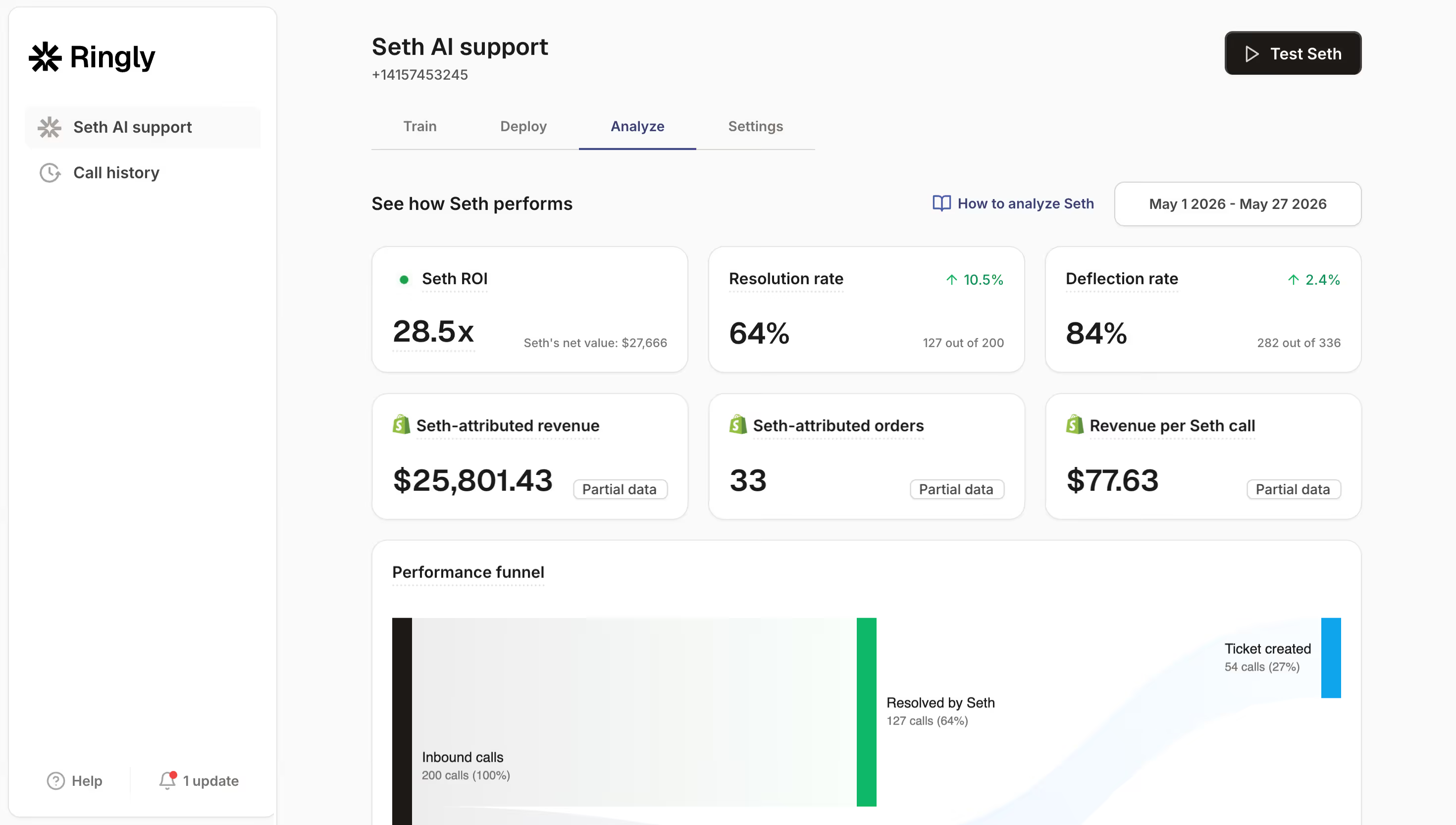
Personalization extends to phone support too. When an AI phone agent can pull up a caller's order history and address them by name, conversion on support calls goes up. That's the kind of personalized experience that builds real loyalty.
If you run a Shopify store, Ringly.io handles phone support with personalized, data-driven conversations. Try it free for 14 days.
Product recommendations
Product recommendations might be the most direct application of personalization. They account for a disproportionate share of revenue, and the data proves it.
Product recommendations account for 7% of ecommerce traffic but generate 24% of orders and 26% of revenue. That's an outsized impact from a small slice of page real estate. (Clerk.io)
Amazon generates 35% of its purchases from personalized recommendations. Amazon didn't become the world's biggest online retailer by accident. Their recommendation engine is a core revenue driver. (Clerk.io)
Recommendation engines contribute up to 31% of total ecommerce revenue. For some stores, nearly a third of all revenue comes from "you might also like" sections. (Clerk.io)
Sessions with recommendation engagement show a 369% increase in average order value. When a shopper clicks on a recommended product, they spend dramatically more. (Envive)
Product recommendations can boost sales by up to 59%. And that's across all store sizes, not just enterprise operations. (Clerk.io)
81% of shoppers say they're likely to purchase after receiving a personalized recommendation via email. The recommendation doesn't have to live on your site. It works in email campaigns too. (WiserReview)
Product recommendations are one of the highest-ROI personalization tactics you can implement. Whether it's on-site widgets, email flows, or even during phone support calls, surfacing the right product at the right time drives revenue.
Email personalization
Email remains the highest-ROI channel in ecommerce. Adding personalization makes it even more effective.
Personalized emails deliver 6x higher transaction rates. That's not a typo. Six times. Generic blasts don't come close. (Involve.me)
Personalized emails achieve a 29% higher open rate and 41% higher click-through rate. Both metrics improve, which compounds into significantly more sales. (Drip)
Brands have seen a 760% increase in revenue from segmented, personalized email campaigns. Campaign Monitor's data shows that segmentation and personalization together are a revenue multiplier. (Involve.me)
Personalized email campaigns generate 122% higher ROI than non-personalized ones. If you're spending on email, personalizing that spend more than doubles your return. (Idomoo)
Personalized emails raise repeat purchases by 60%. First-time buyers come back when you follow up with something relevant, not a generic newsletter. (WiserReview)
Behavior-based email automation generates 320% more revenue. Abandoned cart emails, browse abandonment flows, post-purchase sequences. These automated, behavior-triggered emails dramatically outperform scheduled sends. (WebToffee)
The playbook here is clear. Segment your list, trigger emails based on behavior, and personalize the content. It works across ecommerce customer service follow-ups, upsell sequences, and re-engagement campaigns.
AI adoption and technology investment
AI has moved from experimental to essential in personalization. The adoption numbers for 2026 show a market that's all-in.
92% of companies now use AI-driven personalization to drive growth. That's near-universal adoption among companies with a personalization strategy. (WiserNotify)
87% of brands plan to increase their personalization spend in 2026. Budget allocations are growing, not shrinking. (StackAdapt)
Marketers now allocate approximately 40% of their budgets to personalization, up from 22% in 2023. That's nearly double in three years. (Involve.me)
89% of companies implementing AI personalization report positive ROI with an average payback period of 9 months. Nine months to break even, then pure upside. (Envive)
Nearly 70% of ecommerce companies will be using AI solutions by 2026. For personalizing experiences, forecasting demand, and preventing fraud. (Shopify)
86% of business leaders expect a significant shift from reactive to predictive personalization. The move is from "show them what they clicked on" to "show them what they're about to want." (Twilio Segment)
AI personalization isn't limited to product pages and emails. AI voice agents now use customer data to personalize phone calls in real time, pulling up order details, purchase history, and preferences during the conversation. That's the kind of AI customer service that actually feels personal.
Want to see how AI phone support handles your customers? Get sample calls for your store in under 20 seconds.
Market size and growth
The personalization industry keeps getting bigger. Investment is pouring in because the returns justify it.
The customer experience personalization software industry is projected to reach $11.6 billion by 2026. Up from $7.6 billion in 2021. (Statista)
The global recommendation engine market is projected to reach $15.13 billion by 2026. Up from $2.12 billion in 2020. That's 7x growth in six years. (Clerk.io)
The hyper-personalization market is expected to reach $80.2 billion by 2032, growing at 18.1% CAGR. Hyper-personalization (real-time, AI-driven, cross-channel) is the fastest-growing segment. (Precision Business Insights)
The personalization software market is estimated at $3.43 billion in 2026, expanding to $17.01 billion by 2035 at 19.49% CAGR. Regardless of which market definition you use, every estimate shows double-digit annual growth. (360 Research Reports)
These numbers reflect a simple truth: personalization works, companies know it, and they're investing accordingly. The ecommerce trends for 2026 all point in the same direction.
Cart abandonment and retention
Personalization doesn't just help you acquire customers. It helps you keep them (and recover the ones who almost left).
Dynamic pricing reduces cart abandonment by 9%. Showing a shopper a price that reflects their behavior and history nudges them toward checkout. (ConvertCart)
Price-drop alerts reduce cart abandonment by 14%. Telling someone "that item you wanted just got cheaper" is one of the most effective recovery tactics available. (ConvertCart)
Personalized product recommendations reduce cart abandonment by up to 4.35%. Even small percentage improvements on a 70% abandonment rate translate to real revenue. (ConvertCart)
76% of consumers are more likely to purchase from, 78% more likely to repurchase from, and 78% more likely to recommend brands that personalize. Acquisition, retention, and referral all improve with personalization. That's the full funnel. (McKinsey)
Reducing cart abandonment is about removing friction at the right moment. Personalized recovery emails, exit-intent offers based on browsing behavior, and even a follow-up phone call from an AI phone agent that knows the customer's cart contents can recover sales that would otherwise be lost.
What this means for ecommerce brands
The data paints a consistent picture. Brands that personalize grow faster, convert better, and retain more customers. The 89% positive ROI figure isn't a coincidence. It reflects a fundamental shift in what shoppers expect.
For Shopify store owners, the practical takeaway is to start where the data shows the biggest impact. Product recommendations, personalized email flows, and behavior-driven automation are the highest-ROI starting points. You don't need a massive budget. You need the right data and the right triggers.
Personalization extends beyond your website and email. Your phone support is a touchpoint too. When a customer calls with a question about their order, they expect the person (or AI) on the other end to know who they are. AI voice agents can pull up order history, address the caller by name, and resolve issues without the customer repeating themselves. That's personalization where it matters most: when someone is actually talking to you.
The stores that win in 2026 won't just personalize their homepage. They'll personalize every channel, including phone, live chat, email, and on-site. If you run a Shopify store, Ringly.io handles 73% of support calls automatically using your store data to personalize every interaction. Try free for 14 days.
Frequently asked questions
What is ecommerce personalization?
Ecommerce personalization is the practice of tailoring shopping experiences to individual customers based on their behavior, preferences, and data. This includes product recommendations, personalized emails, dynamic pricing, and customized on-site content. The goal is to show each shopper the most relevant products and messages.
How much revenue does personalization drive?
According to McKinsey, personalization typically drives a 5-15% revenue lift. Fast-growing companies generate 40% more revenue from personalization than their slower-growing competitors. Some brands report even higher gains, with advanced implementations returning $20 for every $1 invested.
What percentage of consumers expect personalized experiences?
71% of consumers expect companies to deliver personalized interactions, according to McKinsey. Epsilon found that 80% are more likely to buy when a brand personalizes the experience. And 76% say they get frustrated when interactions feel generic.
Is personalization worth the investment?
Yes. 89% of marketers report positive ROI from personalization efforts. Companies with advanced personalization see returns of up to $20 per $1 spent, and the average payback period for AI-powered personalization tools is 9 months.
How do product recommendations affect ecommerce sales?
Product recommendations account for just 7% of site traffic but generate 24% of orders and 26% of revenue. Sessions where shoppers engage with recommendations show a 369% increase in average order value. Amazon attributes 35% of its purchases to its recommendation engine.
What role does AI play in ecommerce personalization?
92% of companies now use AI-driven personalization. AI enables real-time product recommendations, predictive search, dynamic pricing, and personalized customer service. Nearly 70% of ecommerce companies will be using AI solutions by 2026. AI also powers voice agents for customer support, allowing stores to personalize phone interactions.
How does email personalization impact ecommerce?
Personalized emails deliver 6x higher transaction rates and generate 122% higher ROI than generic campaigns. Behavior-based email automation produces 320% more revenue. Brands that segment and personalize their email campaigns have seen up to 760% increases in revenue.
How can small Shopify stores use personalization?
Start with the highest-impact tactics: product recommendation widgets, personalized email flows triggered by browsing and purchase behavior, and segmented campaigns. Many Shopify marketing apps include built-in personalization features. For phone support, AI phone agents can personalize calls using your store data without any custom development.