

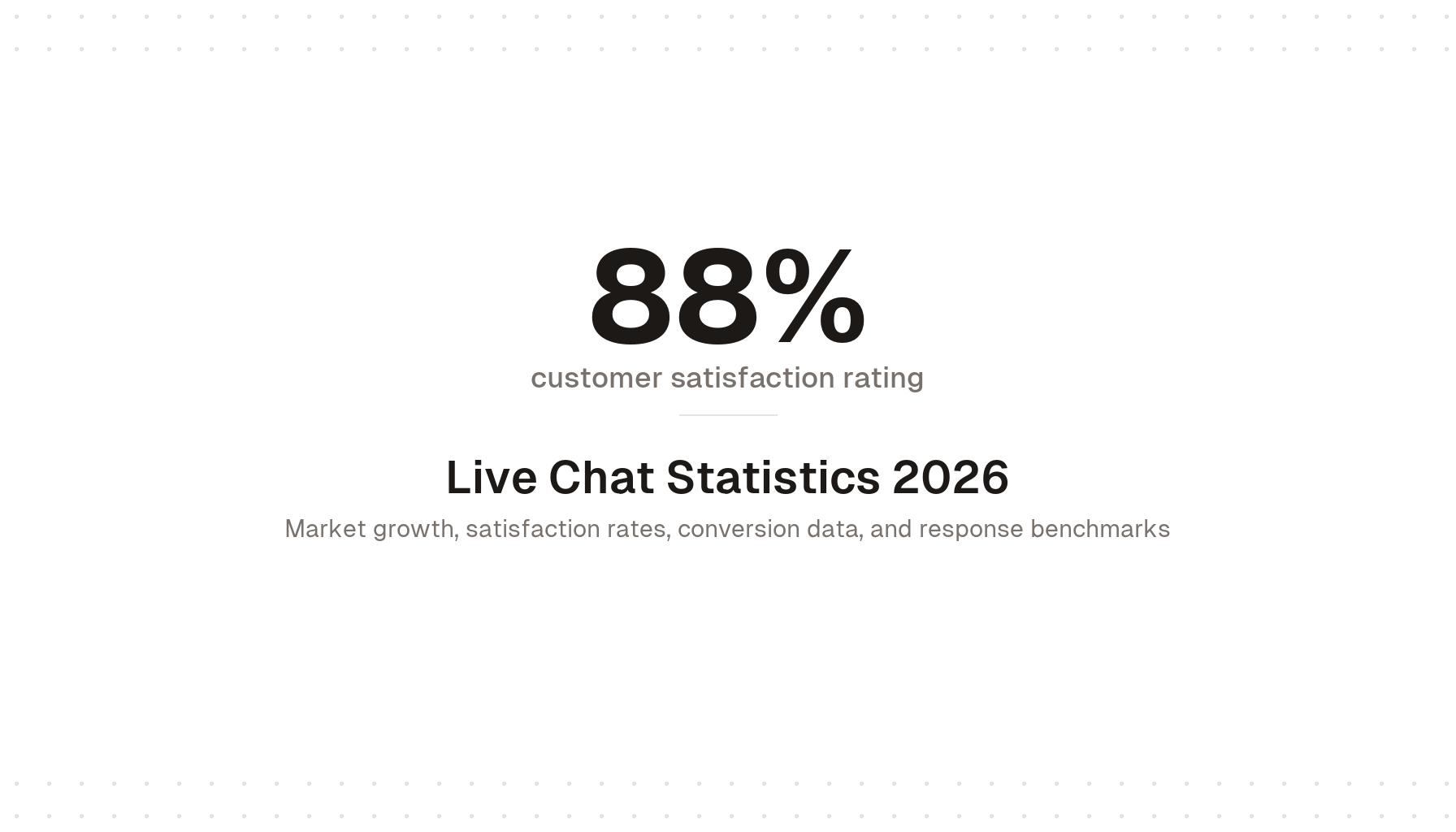
Live chat isn't a "nice to have" anymore. It's one of the highest-rated support channels, with an 88% average customer satisfaction score according to the American Customer Satisfaction Index. And for ecommerce brands, it directly drives conversions: visitors who chat are 2.8 times more likely to buy.
We compiled 45 of the most important live chat statistics for 2026, pulling data from Forrester, Gartner, LiveChat, SuperOffice, and other major research sources. Whether you're evaluating live chat software for the first time or trying to benchmark your current setup, these numbers will help you make better decisions.
Hear what AI support calls sound like for your store. Just paste your Shopify URL and get sample calls in under 20 seconds, no email required. Listen to demo calls for my store.
Key highlights
- 88% average satisfaction rating for live chat, making it the top-rated digital support channel (American Customer Satisfaction Index)
- $2.17 billion projected market value for live chat software by 2033 (LiveChat)
- 20% conversion increase for businesses that add live chat to their websites (Invesp)
- 2.8x more likely to convert for visitors who engage in live chat before purchasing (ICMI)
- 73.6% of chats now happen on mobile devices, not desktop (LiveChat)
- $3-$4 per chat interaction vs $6-$7 for a phone call (SuperOffice)
Live chat market size and growth
The live chat market is growing steadily, driven by ecommerce expansion and rising customer expectations for real-time support.
1. The global live chat software market was worth $1.1 billion in 2024 and is projected to reach $2.17 billion by 2033. (LiveChat)
2. Allied Market Research projects the live chat market will hit $1.7 billion by 2030, growing at an 8.8% CAGR. (Allied Market Research)
3. Over 515,000 websites currently have live chat embedded on their pages. (Tidio)
4. 53% of retailers now offer live chat support, up from 45% in recent years. (LiveChat)
5. The AI chatbot market (closely tied to live chat) is expected to grow from $9.57 billion in 2025 to $11.80 billion in 2026. (Chatbot.com)
The growth rate tells the story. Live chat software is on track to roughly double within a decade. And with ecommerce trends in 2026 pushing toward faster, more personalized support, that growth is only accelerating.
Customer satisfaction and preferences
Live chat consistently scores among the highest-rated support channels. Here's what customers actually think about it.
6. Live chat earns an 88% average satisfaction rating, the highest of any digital support channel. (American Customer Satisfaction Index)
7. 87% of live chat conversations receive a positive customer satisfaction rating. (LiveChat)
8. 82% of customers were satisfied with their live chat experience, compared to 61% for email and 44% for phone. (Comm100 via SuperOffice)
9. 41% of consumers prefer live chat over email, phone, or social media for support. (GoSquared via LiveChat)
10. 56% of customers aged 18 to 34 favor live chat over phone calls. (Freshworks)
11. 73% of customers say live chat is the most satisfying way to communicate with a business. (invespCRO via BoldDesk)
12. 94% of customers who were proactively invited to a chat session reported being satisfied. This kind of proactive approach also improves customer experience scores across the board. (Vitaldesign via BoldDesk)
13. 51% of consumers prefer live chat because it lets them multitask while getting help. (Upscope via BoldDesk)
The satisfaction gap between live chat (82%) and phone (44%) in that Comm100 study is striking. Customers don't just tolerate live chat. They actively prefer it.
For ecommerce customer service teams, this means adding chat isn't just about speed. It's about meeting customers where they're most comfortable.
Conversion and revenue impact
Live chat doesn't just improve support. It directly moves the needle on sales and revenue.
14. Adding live chat to a website increases conversion rates by an average of 20%. (Invesp via BoldDesk)
15. Visitors who engage in live chat are 2.8 times more likely to convert than those who don't. (ICMI via SuperOffice)
16. Live chat interactions result in a 10% increase in average order value. (Forrester via SuperOffice)
17. Businesses report a 48% increase in revenue per chat hour after adding live chat. (Forrester via SuperOffice)
18. Customers who chat before purchasing spend 60% more per order. (LiveChat)
19. 63% of customers are more likely to purchase from websites that offer live chat. (Crazy Egg via LiveChat)
20. Chat visitors are worth 4.5 times more than non-chat visitors. (ICMI via SuperOffice)
21. 79% of businesses say live chat has positively impacted their sales, revenue, and customer loyalty. (Kayako via SuperOffice)
22. Proactive live chat (where you initiate the conversation) delivers a 305% ROI. (Freshworks via LiveChat)
A 20% conversion lift and a 10% bump in average order value put real money on the table. Live chat is as much a sales tool as it is a support channel.
If you're focused on ecommerce conversion rate optimization, live chat should be near the top of your list.
Response time benchmarks
Speed is the whole point of live chat. Here's how the best teams perform, and where most fall short.
23. The average live chat first response time is 1 minute and 35 seconds. (SuperOffice)
24. Customer satisfaction peaks at 84.7% when the first response arrives within 5 to 10 seconds. (SQM Group via LiveChat)
25. 80% of live chats are answered within 40 seconds. (LiveChat)
26. The average chat handle time benchmark is 6 to 8 minutes. Resolution time should stay under 10 minutes. (Call Centre Helper)
27. The first contact resolution (FCR) industry standard for live chat sits between 70% and 75%. (Call Centre Helper)
28. 21% of live chat requests go completely unanswered, based on a study of 1,000 websites. (SuperOffice)
29. 1 in 5 customers stop using a product entirely due to slow live chat response times. (Forrester via SuperOffice)
That last stat is a warning. 21% of chat requests going unanswered means roughly one in five potential customers hits a dead end. And Forrester's data shows they won't wait around.
If you can't staff live chat 24/7, that's where AI answering services and AI customer service agents fill the gap. They respond instantly, every time.
Live chat vs other support channels
How does live chat stack up against phone, email, and social media? The comparison is revealing.
30. Live chat costs $3 to $4 per interaction. Phone support costs $6 to $7 per interaction. (SuperOffice)
31. Live chat is 17% to 30% cheaper than phone calls for customer support. (Call Centre Helper via BoldDesk)
32. A single live chat agent can handle 2 to 3 conversations simultaneously. Highly skilled agents manage 4 to 6. (Telus International via SuperOffice)
33. The average email support response time is 12 hours. Social media averages 10 hours. Live chat averages under 2 minutes. (SuperOffice)
34. 42% of customers prefer live chat specifically to avoid phone hold times. (SMB Guide via BoldDesk)
35. 83% of customers who switched providers said better live support could have kept them. That's a customer retention problem as much as a support problem. (WhosOn via BoldDesk)
The efficiency advantage is clear. One chat agent doing the work of three phone agents, at roughly half the cost per interaction. For ecommerce brands comparing outsourced customer service options, these numbers change the math significantly.
That said, phone support still matters. 76% of consumers still prefer it for complex issues. The best approach combines both: live chat for quick questions and AI voice agents or phone support for everything else.
Ringly.io handles the phone side automatically. Seth, our AI phone agent, answers calls 24/7 in 40 languages and resolves 73% without human help. See what that looks like for your store.
AI chatbots and automation
AI is changing live chat from a staffing-heavy channel into a scalable one. Here's how fast that shift is happening.
36. 58% of businesses now combine live chat with AI chatbots to deliver faster replies. (Tidio)
37. Chatbots can answer 80% of routine questions, and they do it 80% faster than human agents. Our chatbot statistics page covers this trend in more detail. (Chatbot.com)
38. Implementing chatbots reduces customer support costs by approximately 30%. (Chatbot.com)
39. 85% of businesses believe generative AI chatbots will handle the majority of customer interactions within the next few years. (Gartner via LiveChat)
40. 80% of ecommerce businesses are expected to use chatbots by end of 2026. (Tidio)
The pattern is consistent across every data point: AI handles the repetitive volume, human agents handle the complex stuff. For a deeper look at how this plays out, check out our AI customer service statistics roundup.
And it's not just chat. The same shift is happening on the phone side too. Our voice AI statistics show similar adoption curves for AI-powered phone support.
Mobile live chat
Mobile has become the dominant platform for live chat, and the gap keeps widening.
41. 73.6% of live chat conversations now happen on mobile devices. Only 26.4% happen on desktop. (LiveChat)
42. 62% of customers expect live chat to be available on mobile, and 82% say they would use it if it were. (BoldDesk)
43. Mobile chatters are 6.1 times more likely to convert compared to mobile visitors who don't chat. (LiveChat)
44. Mobile live chat satisfaction sits at 79%, slightly below desktop at 85%. (LiveChat)
45. Mobile chat volume grew 14.88% from 2023 to 2024 among larger support teams. (LiveChat)
Nearly three out of four chats now start on a phone. If your live chat experience isn't optimized for mobile, you're losing the majority of your potential conversations.
This matters especially for Shopify stores, where mobile traffic often exceeds 70%. For more on optimizing your mobile shopping experience, see our guide on Shopify conversion rate optimization.
What this means for ecommerce brands
The numbers tell a consistent story. Live chat drives higher satisfaction, higher conversions, and lower support costs. But only if you execute it well.
Here's what actually matters if you're running an online store:
Speed wins everything. Satisfaction peaks when your first response arrives in under 10 seconds. The average is 1 minute 35 seconds. And 21% of chat requests go completely unanswered. Closing that gap is the single biggest opportunity.
Live chat is a revenue channel. A 20% conversion lift, 10% higher AOV, and 60% more spending from chat users. These aren't support metrics. They're sales metrics. If your ecommerce marketing strategy doesn't include live chat, you're leaving money on the table.
Mobile is the default. 73.6% of chats happen on mobile. Your chat widget needs to work flawlessly on small screens. Bad mobile UX kills the whole channel.
AI makes it scalable. 58% of businesses already pair chatbots with live chat. Chatbots handle 80% of routine questions at 30% lower cost. The hybrid model (AI for volume, humans for complexity) is becoming the standard.
Phone support still matters alongside chat. Despite chat's growth, 76% of consumers still prefer phone calls for complex issues. The smartest strategy is offering both: live chat for quick questions and AI phone support for calls.
If your store runs on Shopify, Ringly.io handles the phone side. Seth, our AI phone agent, picks up every call 24/7 in 40 languages, looks up orders, processes returns, and resolves about 73% of calls without human help. Over 2,100 stores already use it.
Try Ringly.io free for 14 days and get Seth answering calls in under three minutes.
Frequently asked questions
What is the average customer satisfaction rate for live chat?
Live chat earns an 88% average satisfaction rating according to the American Customer Satisfaction Index. That makes it the highest-rated digital support channel, ahead of email (61%) and social media.
Does live chat increase ecommerce conversions?
Yes. Adding live chat increases website conversions by an average of 20%. Visitors who chat are 2.8 times more likely to convert and spend 60% more per order than non-chat visitors.
What is a good first response time for live chat?
Satisfaction peaks when first response arrives within 5 to 10 seconds. The industry average is 1 minute 35 seconds. Top-performing teams aim for under 30 seconds.
How much cheaper is live chat compared to phone support?
Live chat costs $3 to $4 per interaction, while phone support costs $6 to $7. That's 17% to 30% cheaper. Plus, a single agent can handle 2 to 3 chats simultaneously versus one phone call at a time.
What percentage of live chats happen on mobile?
73.6% of live chat conversations now happen on mobile devices. Mobile chatters are also 6.1 times more likely to convert than mobile visitors who don't use chat.
Are chatbots replacing live chat agents?
Not replacing, but supplementing. 58% of businesses now pair AI chatbots with human agents. Chatbots handle 80% of routine questions, and 85% of businesses believe generative AI will handle most customer interactions within the next few years.
What is the ROI of proactive live chat?
Proactive live chat (where the business initiates the conversation) delivers a 305% ROI according to Freshworks research. Proactively invited customers also report 94% satisfaction rates.
How many websites use live chat?
Over 515,000 websites currently have live chat embedded. 53% of retailers offer it, and 85% of customers now expect to see a chat widget when visiting a website.