
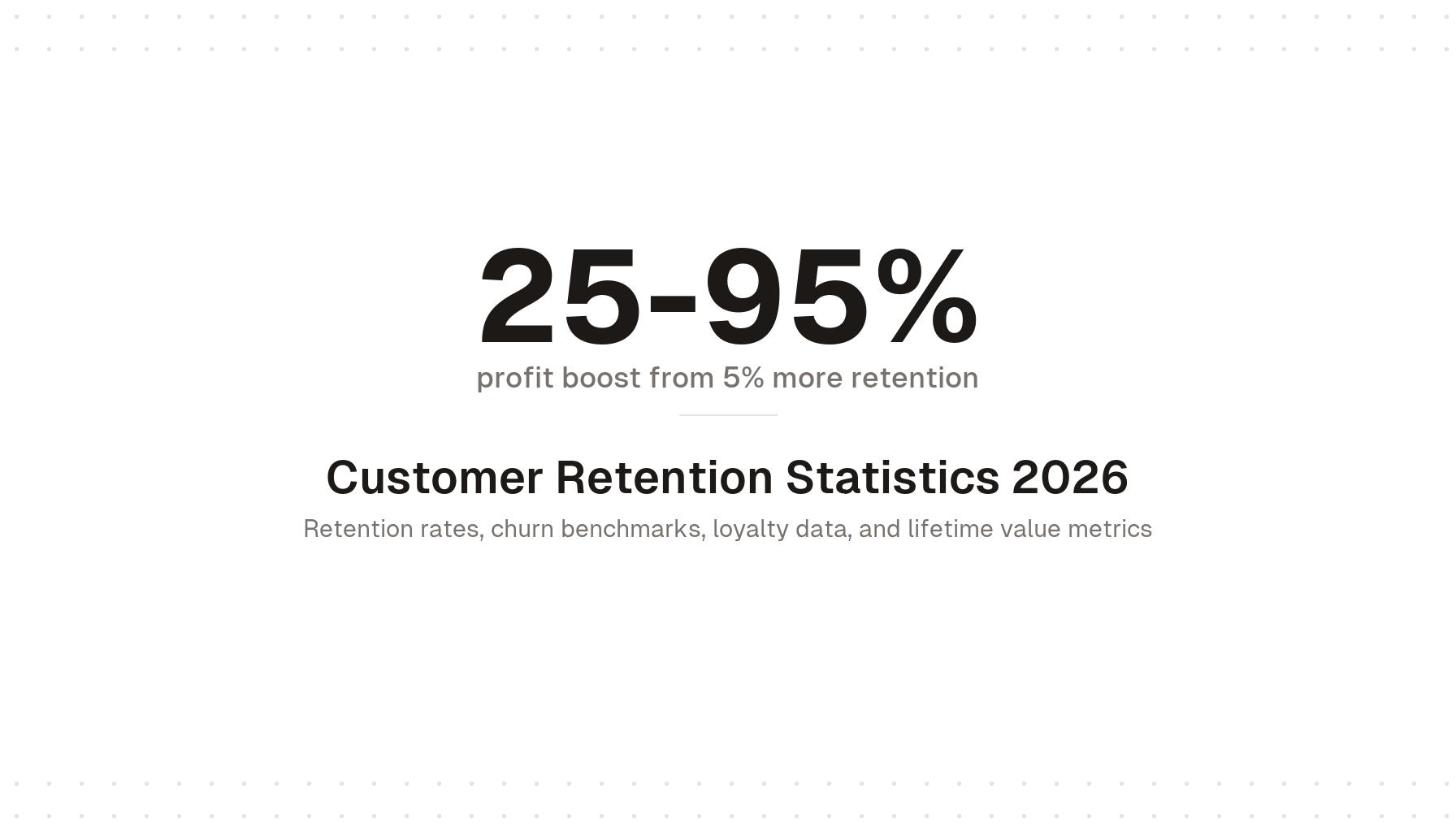
Keeping customers is cheaper than finding new ones. That's been true for decades, but the numbers behind it keep getting more dramatic. Acquisition costs have surged 222% in the last five years, and the average ecommerce store loses 70-77% of its customers every year (Envive). Meanwhile, a 5% improvement in retention can boost profits by 25 to 95% (Bain & Company).
We gathered 45 of the most current customer retention statistics from Bain & Company, Forrester, PwC, McKinsey, Shopify, Gartner, and other major sources. Whether you're running a Shopify store or scaling a DTC brand, this data will help you benchmark your retention and decide where to invest.
Hear what AI support calls sound like for your store. Just paste your Shopify URL and get sample calls in under 20 seconds, no email required. Listen to demo calls for my store.
Key highlights
- 25-95% profit boost from a 5% increase in retention rates (Bain & Company)
- 70-77% annual churn is the average for ecommerce stores (Envive)
- 5-25x more expensive to acquire a new customer than retain an existing one (Invesp)
- 67% more spending from repeat buyers compared to first-time customers (DemandSage)
- 10-15% retention lift from AI-driven personalization (Envive)
- 89% of customers retained by companies with strong omnichannel strategies (Aberdeen Group)
Retention vs. acquisition costs
Every dollar you spend on retention works harder than a dollar spent on acquisition. Here's how the math breaks down.
1. Acquiring a new customer costs 5 to 25 times more than retaining an existing one. (Invesp)
2. Customer acquisition costs in ecommerce surged 222% over the last five years, driven by rising digital ad expenses and stricter privacy rules. (Artisan Strategies)
3. Ecommerce businesses now lose an average of $29 per newly acquired customer. (SimplicityDX via Envive)
4. The probability of selling to an existing customer is 60-70%, compared to just 5-20% for a new prospect. (Invesp)
5. A 2% increase in customer retention has the same effect on profits as cutting costs by 10%. (GrowSurf)
6. Only 18% of companies focus more on retention than acquisition, despite retention being up to 6x cheaper. (Semrush)
The gap between how businesses spend and what the data shows is striking. Most companies still pour the majority of their budget into acquisition even though the ROI on retention is dramatically better.
If you're looking for ways to improve ecommerce customer retention, the first step is simple: reallocate some of that acquisition budget.
Revenue impact of retention
Retained customers don't just come back. They spend more, buy more often, and drive the majority of your revenue.
7. A 5% increase in customer retention can boost profits by 25 to 95%. (Bain & Company / Harvard Business Review)
8. 65% of a company's revenue comes from existing customers. The top 5% of customers alone generate 35% of total ecommerce revenue. (Envive)
9. Repeat customers make up 21% of a store's customer base but generate 44% of revenue and 46% of orders. (Gorgias)
10. Existing customers spend 67% more on average than new customers. By month 31-36 of a relationship, they spend 67% more per order than in their first six months. (Bain & Company via DemandSage)
11. A company's top 10% of customers spend 3x more per transaction than the other 90%. The top 1% spend 5x more. (Mobiloud)
12. Customer-obsessed organizations report 41% faster revenue growth than their peers. (Forrester)
13. Excellent customer experience drives a 4-8% revenue increase above the market average. (Bain & Company)
The numbers are hard to argue with. Your repeat buyers are your most valuable asset. Building better ecommerce customer service and stronger customer retention strategies has a direct line to revenue growth.
Retention rates by industry
Not all industries retain equally. Your benchmark depends heavily on what you sell and how you sell it.
14. The average customer retention rate across all industries is approximately 75%. (DemandSage)
15. B2B SaaS companies lead with 90% retention, benefiting from high switching costs and recurring value delivery. (First Page Sage)
16. Commercial insurance retains 86% of customers, followed by business consulting at 85% and IT/managed services at 83%. (DemandSage)
17. Transactional ecommerce has one of the lowest retention rates at just 38%. Low barriers to switching and intense price competition make customers highly volatile. (First Page Sage)
18. B2B companies achieve an 82% 12-month retention rate compared to 74% for B2C. (Focus Digital)
19. Hospitality made the strongest recovery in 2025, gaining 3% year-over-year, but still sits at just 55% retention. (First Page Sage)
Here's the thing: if you're in ecommerce, you're playing on hard mode. A 38% retention rate means you lose nearly two-thirds of your customers. That's why ecommerce-specific tools for support, personalization, and post-purchase engagement matter so much.
Churn rate statistics
Churn is the flip side of retention. And in ecommerce, the numbers are brutal.
20. The average ecommerce store sees 70-77% annual churn. More than three-quarters of customers never come back after their first purchase. (Envive)
21. For subscription ecommerce, the average monthly churn rate is 3.4%, including both voluntary cancellations and involuntary churn from failed payments. (Rivo)
22. Consumer electronics has 82% churn, the highest of any product category, tied with gifts and special events. (Opensend)
23. Beauty and fitness stores churn at 62%, while food and drinks sit at 64%. (Opensend)
24. 85% of customer churn is preventable through better customer service. (ThinkImpact)
25. Companies lose $1.6 trillion per year globally due to customer churn. (Accenture via Semrush)
That last stat (stat 24) should stop you in your tracks. If 85% of churn is preventable with better service, your support strategy is your most important retention tool — neglect it and you lose customers you could have kept.
Ringly.io's AI phone agent picks up every call in under a second, 24/7, in 40 languages. For stores dealing with high volumes of WISMO calls and return requests, that kind of availability directly reduces churn. See what it sounds like for your store.
Customer loyalty and repeat purchases
Getting a customer to buy once is hard. Getting them to buy twice is where retention begins. And after the second purchase, the math tilts heavily in your favor.
26. After a first purchase, there's roughly a 27% chance a customer returns. After a second purchase, the probability of a third jumps to 54%. (Envive)
27. The average ecommerce repeat purchase rate is 28.2%. Shopify stores specifically average around 27%. (Mobiloud)
28. Repeat customers account for 48% of all ecommerce transactions. (Opensend)
29. 95% of consumers say customer service is essential for brand loyalty. (Envive)
30. True brand loyalty fell to 29% in 2025, a 5-point drop from 2024. Nine out of ten executives think loyalty is growing, but only four in ten consumers agree. (PwC 2025 Customer Experience Survey)
31. 60% of consumers switched from a brand they were loyal to because of cost considerations in 2025. (PwC)
The loyalty gap (stat 30) is worth paying attention to. Executives and customers see loyalty very differently. If you assume your customers are loyal, you're probably overestimating your retention.
For ecommerce brands, the best path to repeat purchases runs through great post-purchase experiences. That includes fast order tracking, easy returns, and support that's actually available when customers need it.
AI and automation in retention
AI isn't just a buzzword in retention. It's already moving the numbers, especially in ecommerce.
32. 92% of businesses now use AI-driven personalization for customer engagement. (Envive)
33. AI increases customer retention rates by 10-15%. (Envive)
34. Companies using AI personalization earn 40% more revenue than those without. (McKinsey via Envive)
35. 78% of consumers report higher likelihood of repeat purchases from businesses that personalize their experience. (McKinsey / Segment)
36. Marketing automation delivers $5.44 return for every dollar spent over three years. 76% of companies achieve positive ROI within 12 months. (Envive)
37. 80% of enterprises plan to adopt AI for customer retention by 2026. (Gartner via Envive)
38. Automated post-purchase emails reduce 90-day churn by 14%. First-time buyers who receive personalized post-purchase communications show 45% higher second-purchase rates. (Marketing LTB)
The pattern here is clear. AI doesn't replace your retention strategy. It makes every part of it work better, from personalized shopping experiences to AI-powered phone support.
If you run a Shopify store, Ringly.io uses AI to handle inbound phone calls 24/7, look up orders, and process returns automatically. Over 2,100 stores already use it, with a 73% resolution rate. Try it free for 14 days.
Ecommerce-specific retention data
These numbers zero in on what retention looks like specifically for online stores.
39. A good repeat customer rate for ecommerce falls between 20% and 40%. Below 20% signals a serious retention problem. (Mobiloud)
40. Retention benchmarks vary by product category: consumables (supplements, food, pet) see 35-45%, beauty and skincare 30-40%, apparel 25-32%, home goods 18-25%, electronics 12-18%. (Mobiloud)
41. Average revenue per retained customer is 2.3x that of a one-time buyer. (Marketing LTB)
42. Customers who join SMS lists are 21% more likely to make a repeat purchase. SMS open rates exceed 98%. (Marketing LTB)
43. Omnichannel customers have a 30% higher lifetime value and 250% higher purchase frequency compared to single-channel shoppers. (Envive)
44. Companies with strong omnichannel engagement retain 89% of customers, compared to just 33% for companies with weak omnichannel strategies. (Aberdeen Group via Envive)
45. Only 42% of companies can accurately measure customer lifetime value, despite 89% agreeing it's crucial for driving loyalty. (Emarsys)
If you're selling consumable products (supplements, skincare, pet supplies), you're in a sweet spot for retention. Your customers need to restock, which gives you a natural repeat purchase cycle. Brands in the health and wellness or cosmetics and skincare space should be benchmarking against the 30-45% range, not the 28% average.
What this means for ecommerce brands
The data tells a consistent story. Retention is the single highest-ROI growth lever available to ecommerce stores, and most brands are still underinvesting in it.
Here's what stands out:
The cost gap is enormous. Acquiring a new customer costs 5-25x more than retaining one. And acquisition costs have surged 222% in five years. If your customer acquisition cost is climbing and your retention rate is flat, you're on a treadmill.
Small retention improvements create outsized returns. A 5% increase in retention rates can lift profits by 25-95%. A 2% increase has the same impact as a 10% cost reduction. These aren't marginal gains.
Most churn is fixable. 85% of customer churn is preventable through better service. That means faster response times, 24/7 availability, and smoother experiences with things like order tracking and returns.
AI is a proven retention multiplier. It lifts retention rates by 10-15%, delivers $5.44 per dollar invested in automation, and 80% of enterprises are planning to adopt it for retention by 2026.
Phone support still drives loyalty. 95% of consumers say customer service is essential for loyalty. And 76% still prefer picking up the phone for support (from our ecommerce customer support statistics). If you can't staff a call center 24/7, AI voice agents fill the gap.
If your store runs on Shopify, Ringly.io handles inbound phone calls 24/7 with AI. It looks up orders, processes returns, answers product questions, and escalates complex calls to your team. Setup takes three minutes.
Try Ringly.io free for 14 days and see how AI phone support improves your retention.
Frequently asked questions
What is a good customer retention rate for ecommerce?
A good ecommerce retention rate falls between 20% and 40%. The average across all online stores is around 28-30%. Consumable products like supplements and skincare tend to hit the higher end (35-45%), while electronics and luxury goods sit lower (12-22%).
How much does it cost to acquire a new customer vs. retain one?
Acquiring a new customer costs 5 to 25 times more than retaining an existing one. In ecommerce, acquisition costs have risen 222% in five years. Plus, the probability of selling to an existing customer is 60-70%, compared to 5-20% for a new prospect.
What is the average ecommerce churn rate?
The average annual churn rate for ecommerce is 70-77%, meaning most customers don't return after their first purchase. Subscription ecommerce fares better with a 3.4% monthly churn rate. Beauty and fitness stores see 62% churn, while electronics hits 82%.
How does a 5% increase in retention affect profits?
According to Bain & Company and Harvard Business Review, a 5% increase in customer retention can boost profits by 25 to 95%. The range depends on your industry and starting retention rate, but the effect compounds over time as retained customers spend more and cost less to serve.
What role does AI play in customer retention?
AI increases retention rates by 10-15% and delivers $5.44 per dollar invested in marketing automation. 92% of businesses now use AI personalization, and companies using it earn 40% more revenue. AI also powers tools like voice agents that handle support 24/7.
Why do ecommerce customers churn?
85% of churn is preventable through better customer service. Common causes include slow response times, poor post-purchase communication, and unavailable support. 60% of consumers also cite cost as a reason for switching brands, and 50% leave after a single bad interaction.
How do loyalty programs affect retention?
83% of companies report positive loyalty program ROI, with an average return of 5.2x. Members generate 12-18% more incremental revenue annually than non-members. However, only 49% of enrolled consumers actively use their loyalty programs, so engagement design matters.
What is a good CLV to CAC ratio?
The benchmark is at least 3:1, meaning you should earn three dollars in customer lifetime value for every dollar spent on acquisition. Omnichannel customers have 30% higher lifetime value, and only 42% of companies can actually measure CLV accurately.