
Phone support is the hardest channel to scale. While chat and email let one agent handle multiple conversations, phone calls demand 100% attention.
When call volume spikes, you're either paying overtime or leaving customers on hold.
AI voice agents are changing that. The market is growing from $14.8 billion in 2024 to a projected $61 billion by 2033.
Modern platforms can resolve 70-80% of routine calls without human intervention, turning phone support from a cost center into a competitive advantage.
We spent weeks testing and researching the leading platforms.
In this guide, we compare the 7 best AI voice agents for customer support in 2026, with real pricing, resolution rates, and use cases to help you find the right fit.
Editor’s note: Want to hear some sample AI support calls made for your Shopify store?
- Just paste your store URL
- Get sample calls in under 20 seconds (no email required)
- Listen to demo calls for my store
What are AI voice agents?
AI voice agents are systems that understand spoken language and respond conversationally in real-time. Unlike the rigid IVR systems of the past ("Press 1 for sales, Press 2 for support"), modern voice agents handle natural conversation.
Here's how the technology works:
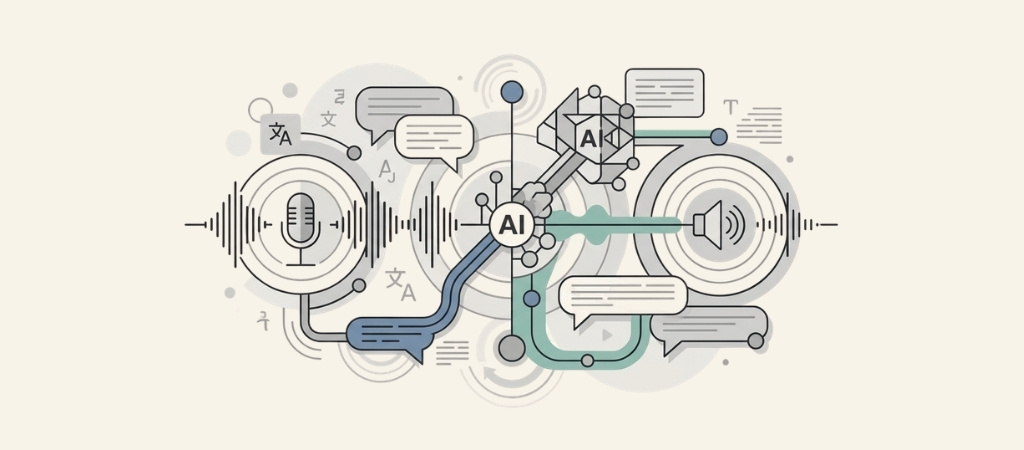
- Speech-to-text converts the caller's voice to text
- Large language models process the intent and generate a response
- Text-to-speech delivers the reply in a natural-sounding voice
The result is a back-and-forth that feels human. Callers can ask questions in their own words, interrupt, change topics, or speak in multiple languages. The AI tracks context across the entire conversation.
The benefits are substantial. AI voice agents offer 24/7 availability without staffing costs. They scale instantly during peak periods. They support dozens of languages natively. And they free human agents to focus on complex issues that actually need human judgment.
How we evaluated these AI voice agent platforms
We looked at six key criteria when ranking these platforms:
- Resolution capabilities Can the AI actually solve problems, or just deflect calls to humans?
- Pricing transparency Are rates published, or hidden behind "contact sales"?
- Integration depth How well does it connect to CRMs, helpdesks, and telephony systems?
- Setup complexity Can you launch in minutes, or does it require months of implementation?
- Human handoff quality Does context transfer smoothly when escalation is needed?
- E-commerce fit For retail use cases, can it handle order lookups, returns, and Shopify connectivity?
AI voice agents comparison at a glance
| Platform | Pricing | Best For | Resolution Rate | Setup Time | Key Strength |
|---|---|---|---|---|---|
| Ringly.io | $349-$799/month | E-commerce/Shopify | ~73% | 3 minutes | Deep Shopify integration |
| Synthflow | $0.09/min (Enterprise custom) | Large enterprises | 65%+ | Weeks | Proprietary telephony, sub-100ms latency |
| Bland AI | Contact sales | Enterprises wanting full control | Not published | Months | Dedicated infrastructure |
| PolyAI | Contact sales | Global enterprises | 50%+ | Weeks | Voice-first architecture, 100+ languages |
| Voice.ai | $0.08/min (annual) | Regulated industries | 98% claimed | Days | On-premise deployment option |
| Cognigy | Contact sales | Contact centers | Not published | Weeks | Multimodal, Gartner Leader |
| GoHighLevel | $97-$297/mo | Agencies/SMBs | Not published | Hours | Bundled with full CRM platform |
1. Ringly.io
Best for: E-commerce stores on Shopify

Ringly.io focuses exclusively on AI phone support for online stores. Their product, the AI, handles the repetitive calls that drain e-commerce support teams: order tracking, returns, exchanges, and FAQs.
What makes Ringly different is the depth of Shopify integration. the AI pulls live order data, product catalogs, and customer information directly from your store. When a customer calls asking "Where's my order?", the AI has the answer instantly without transferring to a human agent.
The platform resolves approximately 73% of calls autonomously in production deployments across Shopify stores. When the AI can't handle something, it escalates to your team with full context.
Setup takes about 3 minutes. Connect your Shopify store, pick a phone number (or port your existing one), and you're live. No coding required.
Pricing:
| Plan | Price | Minutes | Key Features |
|---|---|---|---|
| Grow | $349/mo | 1,000 | Self-learning AI, store data integration, recordings |
| Enterprise | Custom | 5,000+ | Slack channel, custom setup, custom integrations |
Overage is $0.19 per minute. There's a 14-day free trial with full features.
Pros:
- Deep e-commerce integration
- Fast deployment
- Transparent pricing
- 30 languages supported
Cons:
- E-commerce focused (less ideal for non-retail)
- Limited custom enterprise features
2. Synthflow
Best for: Enterprises needing carrier-grade reliability
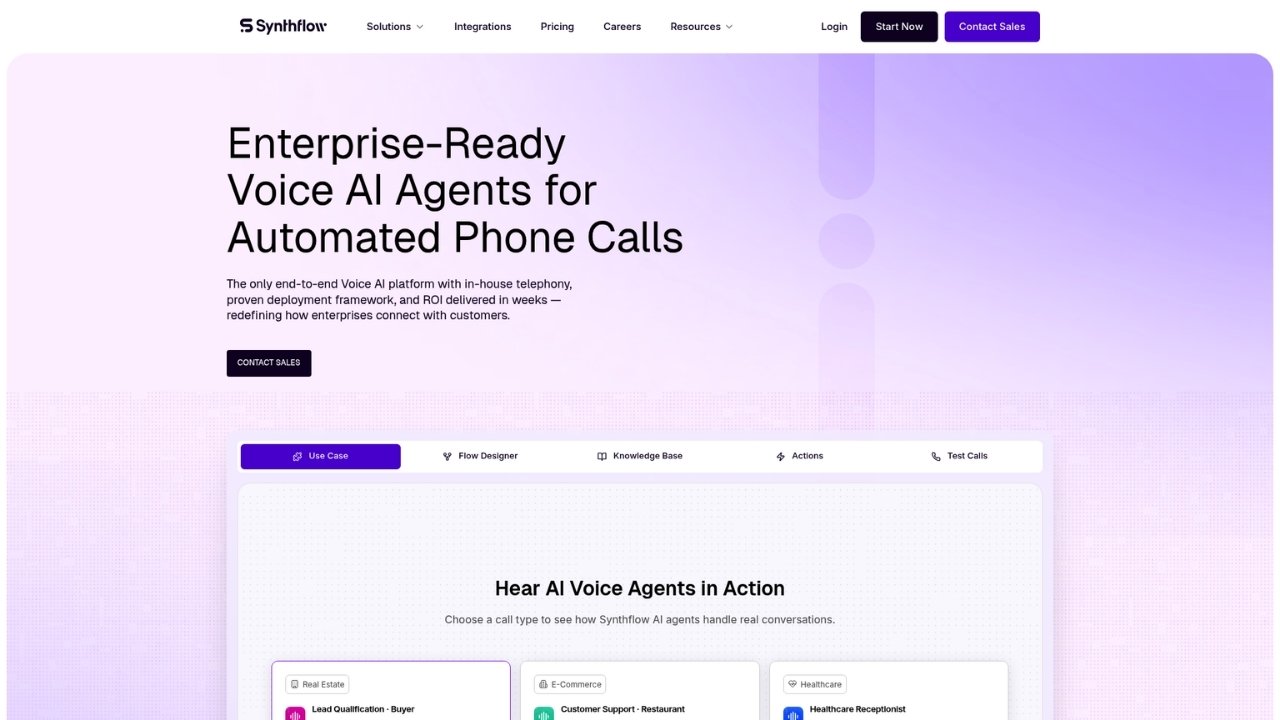
Synthflow operates as a complete Voice AI OS with its own proprietary telephony network. That matters because most competitors rely on third-party telephony providers, adding latency and failure points.
The platform delivers sub-100ms latency with a 99.99% uptime SLA. Their BELL Framework (Build, Evaluate, Launch, Learn) provides a structured approach to deploying and improving voice agents over time.
Synthflow has processed 65 million+ customer calls. A notable case study is their partnership with Freshworks, where Synthflow automates 65% of routine voice requests.
Pricing:
| Model | Price | Details |
|---|---|---|
| Pay As You Go | $0.09/minute | Voice engine only |
| Enterprise | Contact sales | Custom pricing with volume discounts |
Pros:
- Own telephony infrastructure (not dependent on third parties)
- Ultra-low latency
- Strong enterprise security (SOC 2, HIPAA, PCI DSS)
- Voice cloning capabilities
Cons:
- Enterprise pricing requires sales contact
- May be overkill for smaller teams
3. Bland AI
Best for: Large enterprises wanting full AI ownership

Bland AI's positioning is simple: "Own your AI, don't rent it." While most platforms use shared models from OpenAI or Anthropic, Bland trains custom models for each client using their own call recordings and transcriptions.
Each client gets dedicated servers and GPUs. This means no shared infrastructure, better data protection, and the ability to handle up to 1 million concurrent calls.
The platform includes voice cloning (upload an MP3 and your AI sounds like your brand), emotion control tags (, ), and a pathway builder for mapping conversation flows.
Bland serves major enterprises including Samsara, Snapchat, and Gallup. Implementation is high-touch with forward-deployed engineers building custom agents.
Pricing: Enterprise-only, contact sales
Pros:
- Fully customizable models
- Dedicated infrastructure
- Strong data protection
- No dependency on third-party AI providers
Cons:
- Enterprise-only pricing
- High-touch implementation (not self-serve)
4. PolyAI
Best for: Global enterprises with complex phone interactions
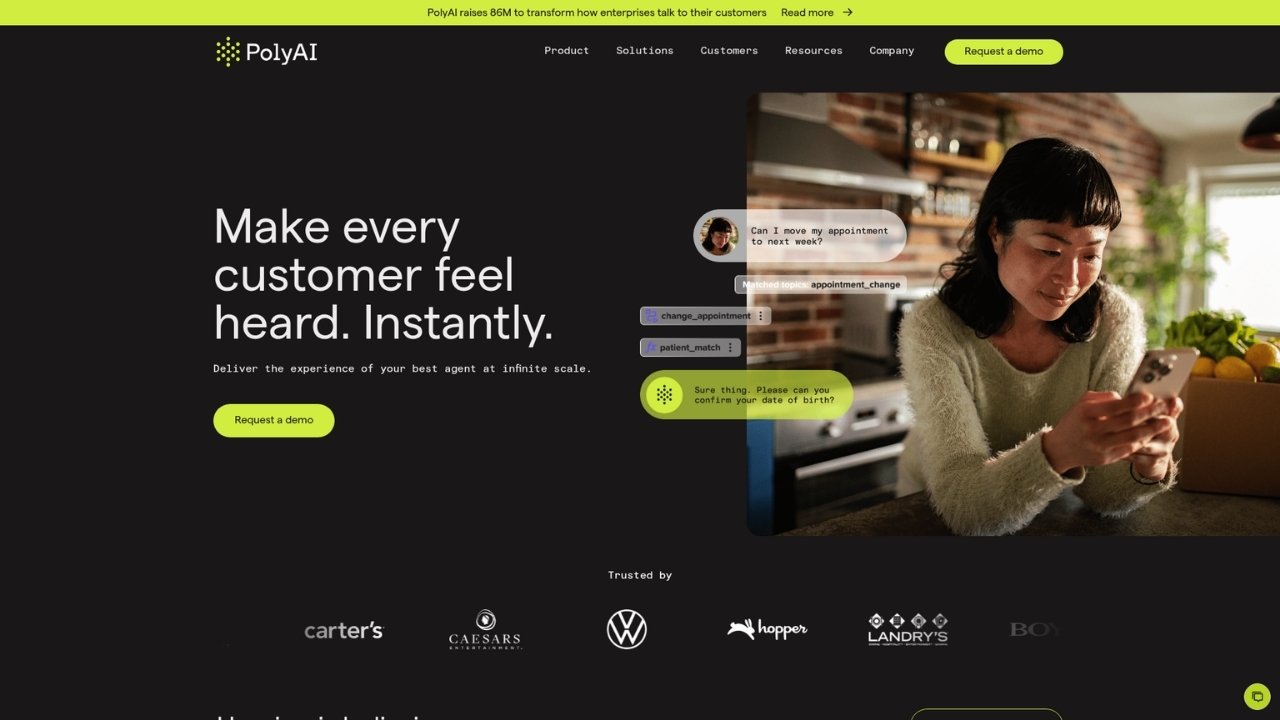
PolyAI claims to offer "the world's most lifelike voice AI agents." Their key differentiator is a voice-first architecture, meaning the platform was built for voice from the ground up rather than adapting chatbot technology.
The proprietary SLU (Spoken Language Understanding) operates at the phoneme level, enabling better handling of accents, background noise, and complex multi-turn conversations. PolyAI supports 100+ languages and has deployed globally for enterprise clients.
Their Agent Studio platform lets you build once and deploy across voice, chat, and SMS. Case studies show impressive results: one hotel and casino brand generated $7 million in incremental revenue from a single voice agent.
Pricing: Enterprise, contact sales
Pros:
- Exceptional voice quality
- Robust in complex calls
- 100+ languages with native fluency
- Proven enterprise deployments
Cons:
- Limited self-serve control
- Requires PolyAI involvement for changes
5. Voice.ai
Best for: Healthcare, finance, and regulated industries

Voice.ai offers a proprietary voice stack with a critical feature for regulated industries: on-premise deployment. While most competitors are cloud-only, Voice.ai can run entirely within your infrastructure for maximum data control.
The platform claims a 98% containment rate and 84% reduction in cost to serve. Compliance certifications include SOC-2 Type II, HIPAA, PCI Level 1, ISO 27001, and GDPR.
Use cases span healthcare (appointment management, patient intake), finance (banking inquiries), insurance (claims processing), and more. A white-label program is available if you want to offer voice AI under your own brand.
Pricing:
| Plan | Price | Credits/Minutes |
|---|---|---|
| Free | $0 | 5k credits/month |
| Starter | $5/mo | 15k credits |
| Launch | $12/mo | 200k credits |
| Core | $99/mo | 1M credits |
| Scale | $330/mo | 4M credits |
| Business | $880/mo | 22M credits |
| Enterprise | Custom | Custom |
Business plans start at $0.08 per minute on annual contracts.
Pros:
- Strong compliance certifications
- Flexible deployment (cloud or on-premise)
- Competitive per-minute pricing
- White-label options
Cons:
- Enterprise focus
- Less transparent pricing for smaller volumes
6. Cognigy
Best for: Contact centers augmenting existing infrastructure

Cognigy (now NiCE Cognigy after acquisition) is a Gartner Leader in the Conversational AI Magic Quadrant. The platform is designed to work with existing contact center systems rather than requiring a rip-and-replace approach.
Key capabilities include 100+ languages with real-time translation, multimodal interactions (customers can share photos, locations, or complete payments during calls), and an Agent Copilot that assists human agents with real-time suggestions.
Notable deployments include Lufthansa (16 million+ automated conversations annually), Toyota (98% customer satisfaction on outbound voice), and Henkel (5 million customer interactions).
Pricing: Enterprise, contact sales
Pros:
- Gartner Leader recognition
- Strong language support
- Multimodal capabilities
- Works with existing contact center infrastructure
Cons:
- Quote-based pricing
- May require implementation support
7. GoHighLevel
Best for: Marketing agencies and small businesses

GoHighLevel takes a different approach. Rather than being a dedicated voice AI platform, it's an all-in-one sales and marketing platform that happens to include AI voice agents.
For $97-$297 per month, you get the voice agent plus a full CRM, website builder, funnel builder, email marketing, appointment scheduling, and more. This makes it attractive for agencies and small businesses that want one tool rather than a stack of subscriptions.
The AI voice features include inbound call handling, lead qualification, appointment scheduling, and CRM updates. It handles call routing, after-hours coverage, and SMS follow-ups.
Pricing:
| Plan | Price | Key Features |
|---|---|---|
| Starter | $97/mo | All core tools, up to 3 sub-accounts, unlimited contacts |
| Unlimited | $297/mo | Everything + unlimited sub-accounts, API access |
| 14-day free trial available. | ||
Pros:
- Very affordable bundled pricing
- All-in-one platform
- Strong agency features
- Easy setup
Cons:
- Less specialized for voice vs. dedicated platforms
- Part of broader toolset (may have feature overlap)
Key features to look for in AI voice agents
When evaluating platforms, prioritize these capabilities:
- Resolution depth Can the AI complete actions (process returns, book appointments) or just answer FAQs?
- Integration capabilities Does it connect to your CRM, helpdesk, and order systems?
- Voice quality Does it sound natural, or obviously robotic?
- Escalation handling When transfers happen, does context go with the caller?
- Analytics Can you see resolution rates, call transcripts, and improvement opportunities?
- Compliance Does it meet security standards for your industry (SOC 2, HIPAA, PCI)?
- Multilingual support Can it handle your customer base's languages natively?
- Pricing model Per-minute, per-resolution, or subscription? Which fits your call volume?
Choosing the right AI voice agent for your business
The best platform depends on your specific situation:
For e-commerce and Shopify stores: Ringly.io offers the deepest integration and fastest deployment. The quick setup and Shopify-native features make it ideal for online retailers.
For enterprise scale: Synthflow, Bland AI, and PolyAI offer the reliability, customization, and support that large organizations need.
For regulated industries: Voice.ai and PolyAI have the compliance certifications and deployment flexibility that healthcare and finance require.
For contact centers: Cognigy integrates with existing infrastructure and offers multimodal capabilities for complex interactions.
For agencies and SMBs: GoHighLevel provides affordable voice AI bundled with a full marketing platform.
Start with your use case, then evaluate resolution capabilities and integration needs. The right choice is the one that solves your specific problems, not the one with the most features.
Getting started with AI voice agents
If you're ready to implement AI voice support, here's a practical approach:
- Start narrow Pick one use case (order tracking, appointment scheduling, FAQs) rather than trying to automate everything at once.
- Run a pilot Test with 20-100 calls before full rollout. This reveals edge cases and gives you baseline metrics.
- Define success Know what you're measuring: resolution rate, customer satisfaction, cost per call, or agent time saved.
- Plan integrations SIP connections and CRM integrations typically take 4-6 weeks. Factor this into your timeline.
- Train your team Human agents should understand when and why calls escalate, and how to pick up conversations seamlessly.
For Shopify stores looking to automate phone support, start your 14-day free trial of Ringly.io and see how The AI handles your customer calls.
Frequently Asked Questions
What resolution rate should I expect from an AI voice agent?
Modern platforms achieve 70-80% resolution rates for routine calls. Ringly.io reports approximately 73% in production e-commerce deployments, while Voice.ai claims up to 98% containment for specific use cases. Your actual rate depends on call complexity and how well the AI is trained on your specific scenarios.
How long does it take to set up an AI voice agent?
It varies significantly by platform. Ringly.io and GoHighLevel can be live in minutes to hours. Enterprise platforms like Bland AI and Cognigy typically require weeks to months for full implementation, including custom training and integration work.
Can AI voice agents handle multiple languages?
Yes, most modern platforms support multiple languages. Ringly.io supports 30 languages, while PolyAI and Cognigy support 100+. Quality varies, so test with native speakers of your customers' primary languages.
What happens when an AI voice agent can't help a caller?
Good platforms transfer to human agents with full context (transcript, customer data, what the AI already tried). The best systems learn from these escalations to improve over time.
Are AI voice agents compliant with healthcare and finance regulations?
Some are. Voice.ai offers HIPAA, SOC-2 Type II, and PCI Level 1 compliance with on-premise deployment options. Synthflow and PolyAI also have enterprise security certifications. Always verify specific compliance requirements with the vendor.
How much do AI voice agents cost?
Pricing models vary. Subscription-based platforms like Ringly.io start at $349/month. Usage-based platforms like Voice.ai charge around $0.08 per minute. Enterprise platforms typically require custom quotes based on volume and features needed.