
NICE's $955 million acquisition of Cognigy has a lot of businesses rethinking their conversational AI strategy.
If you're running an online store, you might be wondering whether Cognigy was ever the right fit anyway.
It's built for enterprise contact centers, not necessarily for Shopify merchants who need to handle "where's my order" calls at 2 AM.
The good news? The conversational AI market has evolved. You no longer need a six-figure budget and a team of developers to automate phone support.
Several platforms now offer voice automation that actually works for e-commerce: quick setup, Shopify integration, and transparent pricing.
Editor’s note: Want to hear some sample AI support calls made for your Shopify store?
- Just paste your store URL
- Hear sample calls for your store (no email required)
- Listen to demo calls for my store
Here are seven Cognigy alternatives that make more sense for online retailers, starting with what actually matters for your business.
What to look for in a Cognigy alternative
Before comparing platforms, let's establish what e-commerce businesses actually need:
- Voice-first architecture. Many platforms started as chatbots and bolted on voice later. That creates latency issues. You want something built for phone conversations from day one.
- E-commerce integrations. Native Shopify (or WooCommerce) connections matter. Your AI agent needs to pull order status, process returns, and check inventory without complex API work.
- Deployment speed. Enterprise platforms take 3-6 months to deploy. For a growing store, that's unacceptable. Look for solutions you can launch in days or weeks.
- Pricing transparency. Custom enterprise quotes make budgeting impossible. Usage-based or tiered pricing lets you forecast costs as you scale.
- Multilingual support. If you sell globally, your phone agent needs to handle multiple languages without hiring native speakers for every market.
- Smart escalation. The AI should know when to hand off to humans and do it smoothly, without frustrating customers.
Quick comparison: all 7 Cognigy alternatives
| Platform | Best for | Starting price | Voice latency | E-commerce focus | G2 rating |
|---|---|---|---|---|---|
| Ringly | Shopify stores | From $99 a month (50 conversations included) | Low | Native Shopify | Not yet rated |
| Kore.ai | Enterprise IT/HR | Custom (~$300K/yr) | 800-1000ms | Limited | 4.7/5 |
| Retell AI | Fast voice deployment | $0.07/min | ~800ms | General | 4.8/5 |
| Rasa | Technical teams | Free (open source) | Varies | Custom build | Not rated |
| Synthflow | SMBs testing voice | $29/mo | <500ms | Limited | 4.5/5 |
| Ada | Chat-first support | Custom (~$100K+/yr) | N/A (chat) | SaaS/E-commerce | 4.6/5 |
| PolyAI | Premium enterprise | Custom (~$150K+/yr) | Low | General | 5.0/5 |
1. Ringly

Full disclosure: this is our platform. But we built it specifically because we saw a gap in the market. While Cognigy and competitors focus on enterprise contact centers, we wanted to solve phone support for the Shopify store doing $1-50 million in revenue.
the AI, our AI phone agent, handles inbound calls 24/7. It can look up orders, process returns, answer FAQs, and escalate to your team when needed. The key difference? Setup takes under 1 hour, not 3 months.
Key features:
- Native Shopify integration (pulls order data in real-time)
- Up to 90% of calls resolved without human intervention
- 30 languages supported
- Call recordings and transcripts with analytics
- Escalation rules that detect frustrated callers
Pricing:
| Plan | Monthly price | Included | Best for |
|---|---|---|---|
| Pay per call | $99 a month | 50 conversations, then $1.99 each | Shopify brands taking support calls |
Pros:
- quick setup, no developers needed
- Purpose-built for e-commerce workflows
- Transparent pricing
- Free to try
Cons:
- Phone-focused (not a chat solution)
- Best for Shopify (other platforms require more setup)
2. Kore.ai
Kore.ai is a serious enterprise platform. Gartner named them a Leader in the 2025 Magic Quadrant for Conversational AI Platforms. If you're a Fortune 500 company with complex IT, HR, and customer service automation needs across multiple departments, Kore.ai deserves a look.
For a typical e-commerce store? It's probably overkill.
The platform uses what they call "multi-agent orchestration," where specialized AI agents for different departments can collaborate. A customer service agent might silently consult an inventory agent without the customer knowing. Clever stuff, but you need a team to manage it.
Key features:
- 100+ languages and 35+ channels
- Agent-to-agent (A2A) protocols for complex workflows
- Knowledge graphs for multi-turn reasoning
- SOC 2 Type II, HIPAA, GDPR compliant
Pricing:
Custom enterprise contracts only. Reports suggest deployments start around $300,000 annually. You'll need to contact sales for any pricing.
Pros:
- Powerful for complex, cross-department automation
- Strong security and compliance certifications
- Recognized by Gartner as a leader
Cons:
- High latency (800-1000ms) compared to voice-first platforms
- Opaque pricing requires sales engagement
- Steep learning curve and lengthy implementation
- Overkill for most e-commerce use cases
3. Retell AI

Retell AI has made a name for itself with low-latency voice conversations and transparent pricing. While not e-commerce specific, it's a solid choice if you want voice automation without the enterprise complexity.
The platform averages around 800ms response times, which feels natural in conversation. They offer a no-code builder that non-technical teams can use, and you can deploy on-premise if data control matters.
Key features:
- Sub-800ms voice latency
- Pay-as-you-go pricing with no platform fees
- Automatic transcription and analytics
- PII redaction built-in
- SOC 2, HIPAA, GDPR compliant
Pricing:
| Usage type | Price |
|---|---|
| Voice | $0.07/minute |
| Chat | $0.002/message |
| Enterprise volume | ~$0.05/minute |
Pros:
- Transparent, predictable pricing
- Fast deployment (weeks, not months)
- Strong voice quality
- Good G2 rating (4.8/5)
Cons:
- No native Shopify integration
- Less e-commerce specific than alternatives
- May lack some enterprise governance features
4. Rasa
Rasa is the open-source option for teams that want complete control. Used by companies like Deutsche Telekom, Autodesk, and BNP Paribas, Rasa lets you build AI agents exactly how you want them.
The trade-off? You need developers. Rasa isn't a plug-and-play solution. It's a toolkit for building conversational AI from scratch.
Key features:
- Open source (free to use, modify, host)
- LLM-agnostic (choose your own language models)
- On-premise deployment for data control
- CALM framework for reliable conversations
- Rasa Studio for no-code conversation design
Pricing:
| Plan | Price | Notes |
|---|---|---|
| Open Source | Free | Full platform, community support |
| Rasa Pro | Custom | Enterprise features, SLAs, support |
Pros:
- No vendor lock-in
- Complete customization
- Free to start
- Strong for regulated industries
Cons:
- Requires technical expertise
- Longer deployment than no-code alternatives
- Steep learning curve
5. Synthflow
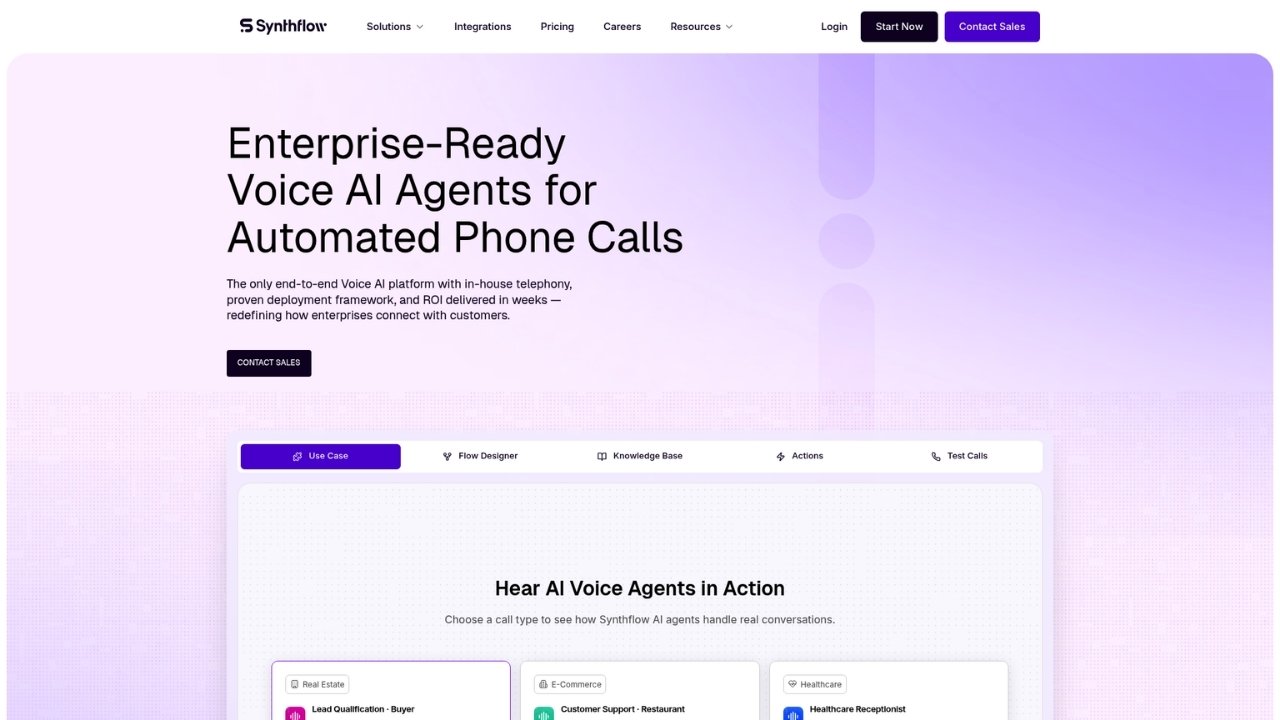
Synthflow targets startups and SMBs with an affordable entry point and quick deployment. Their integration with ElevenLabs means you get expressive, natural-sounding voices that can even be cloned to match your brand.
If you're curious about voice AI but not ready for a major commitment, Synthflow lets you experiment without breaking the bank.
Key features:
- No-code voice agent builder
- ElevenLabs voice integration (cloning supported)
- Under 500ms latency claimed
- Multilingual with accent flexibility
- HubSpot and Zoho integrations
Pricing:
| Plan | Monthly price | Minutes included | Overage |
|---|---|---|---|
| Starter | $29 | 50 | ~$0.12-0.13/min |
| Growth | $450 | Higher volume | Reduced rate |
| Scale | $900 | Enterprise | ~$0.08/min |
| Enterprise | $1,400 | Custom | Custom |
Pros:
- Very affordable entry point
- Voice cloning capabilities
- Quick to deploy
- Good for testing voice AI
Cons:
- Limited e-commerce specific features
- Newer platform with less track record
- May not scale to very high volumes
6. Ada

Ada takes an "AI-first" approach to customer service automation. Rather than following rigid scripts, Ada's agents understand intent and can trigger workflows or escalate to humans when appropriate.
The platform is particularly strong for SaaS and e-commerce companies that want to deflect repetitive chat tickets. Square, Pinterest, and Canva all use Ada. That said, voice capabilities are more limited than chat, so if phone support is your priority, look elsewhere.
Key features:
- AI-first (not scripted) conversation handling
- 50+ languages natively
- Omnichannel (chat, voice, email, messaging)
- Performance-based pricing model
- Strong analytics and reporting
Pricing:
Custom pricing based on successful resolutions or interaction volume. Reports suggest enterprise plans start in the low six figures annually.
Pros:
- Strong chat deflection capabilities
- Good for SaaS and e-commerce support
- Transparent reasoning for coaching
- Solid G2 rating (4.6/5)
Cons:
- Voice capabilities limited compared to voice-first platforms
- Expensive for smaller stores
- Chat-focused rather than phone automation
7. PolyAI
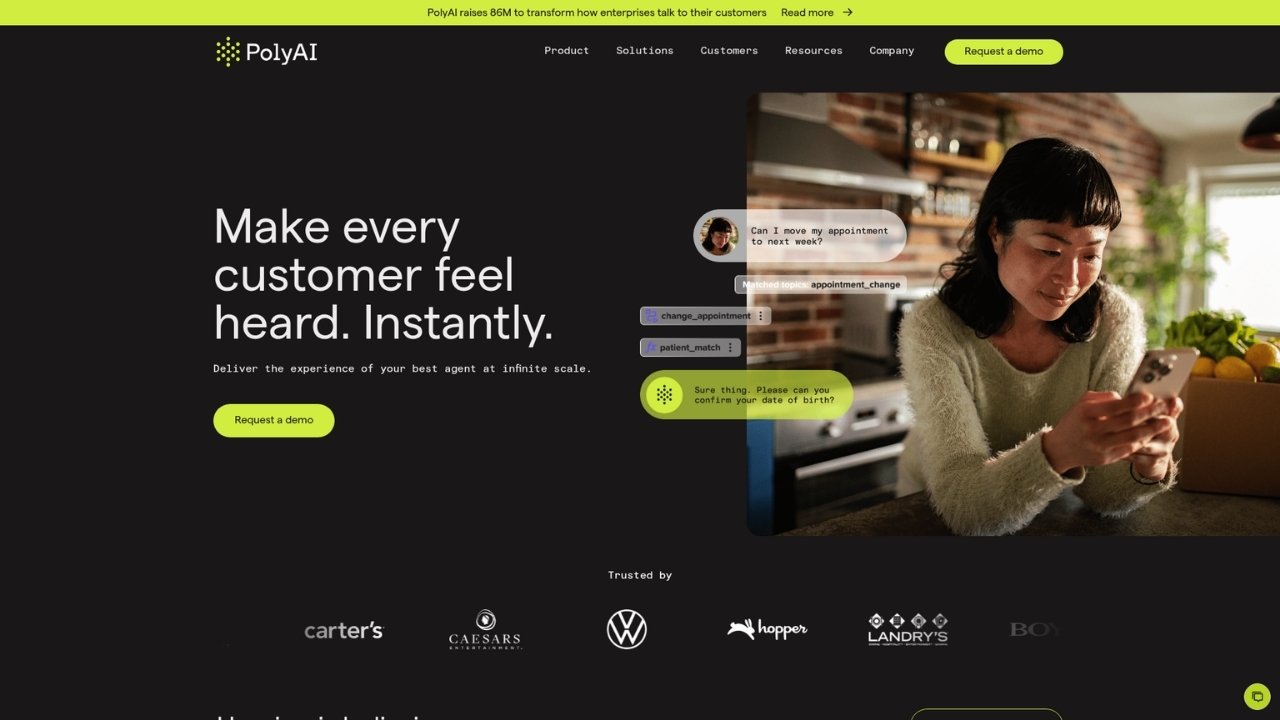
PolyAI sits at the premium end of the market. Their voice AI is arguably the most human-like available, with automatic speech recognition specifically tuned for noisy contact center environments.
The catch? You'll pay for it. PolyAI targets large enterprises with high call volumes and deep pockets.
Key features:
- ASR fine-tuned on real call data
- Human-like dialogue with interruption handling
- Per-minute pricing includes maintenance and 24/7 support
- Enterprise-grade analytics
- Works with existing contact center infrastructure
Pricing:
Custom enterprise contracts. Entry threshold reportedly around $150,000 annually.
Pros:
- Best-in-class voice quality
- Handles noisy environments well
- Fully managed service
- Perfect 5.0/5 G2 rating (though only 11 reviews)
Cons:
- Very expensive
- Long implementation
- Not suitable for SMBs
- Overkill for simple e-commerce workflows
How to choose the right Cognigy alternative for your store
With seven options laid out, how do you decide? Let's break it down.
Choose Ringly if: You run a Shopify store and want phone automation that just works, with minimal setup and e-commerce-specific features.
Choose Kore.ai if: You're a large enterprise with complex cross-department automation needs and a six-figure budget.
Choose Retell AI if: You want voice automation with transparent pricing and don't need deep e-commerce integration.
Choose Rasa if: You have developers and want complete control over your AI infrastructure.
Choose Synthflow if: You're testing voice AI on a budget and want to experiment before committing.
Choose Ada if: Chat deflection is your priority and you have a support team handling mostly digital channels.
Choose PolyAI if: Budget isn't a constraint and you need the absolute best voice quality for a high-volume contact center.
Start automating your e-commerce phone support today
The right phone support solution depends on your specific situation. But if you're running a Shopify store and tired of missing calls, dealing with after-hours voicemails, or hiring expensive support staff, we'd love to show you what we've built.
Seth resolves up to 90% of calls without human intervention, integrates natively with Shopify, and is live in under 1 hour. Ringly.io is free to try, so you can see how it works for your store.
Frequently Asked Questions
What should you look for in a Cognigy alternative for e-commerce?
Focus on voice-first architecture (not chat retrofitted for voice), native e-commerce integrations (especially Shopify), deployment speed, pricing transparency, and multilingual support if you sell globally.
Is Cognigy too expensive for small e-commerce stores?
For most small to mid-size stores, yes. Cognigy typically requires custom enterprise contracts starting around $100,000 annually plus implementation costs. Platforms like Ringly or Synthflow offer more accessible entry points.
How long does it take to deploy a Cognigy alternative?
It varies significantly. Enterprise platforms like Kore.ai or Cognigy itself take 3-6 months. Voice-first platforms like Retell AI or Ringly can deploy in days or weeks. Ringly specifically takes under 1 hour for basic setup.
Can these alternatives handle order tracking and returns like Cognigy?
It depends on the platform. Ringly has native Shopify integration for order lookups and returns. Others like Retell AI or Synthflow would require custom API work to connect with your e-commerce platform.
Do any Cognigy alternatives offer transparent pricing?
Yes. Retell AI publishes rates at $0.07/minute. Synthflow starts at $29/month. Ringly is priced on Pay per call: $99 a month for the first 50 conversations, then $1.99 each. Enterprise platforms like Kore.ai, Ada, and PolyAI typically require custom quotes.
Which Cognigy alternative has the best voice quality?
PolyAI is widely regarded as having the most human-like voice quality, though at a premium price. Retell AI and Ringly both offer low-latency voice that sounds natural in conversation.