
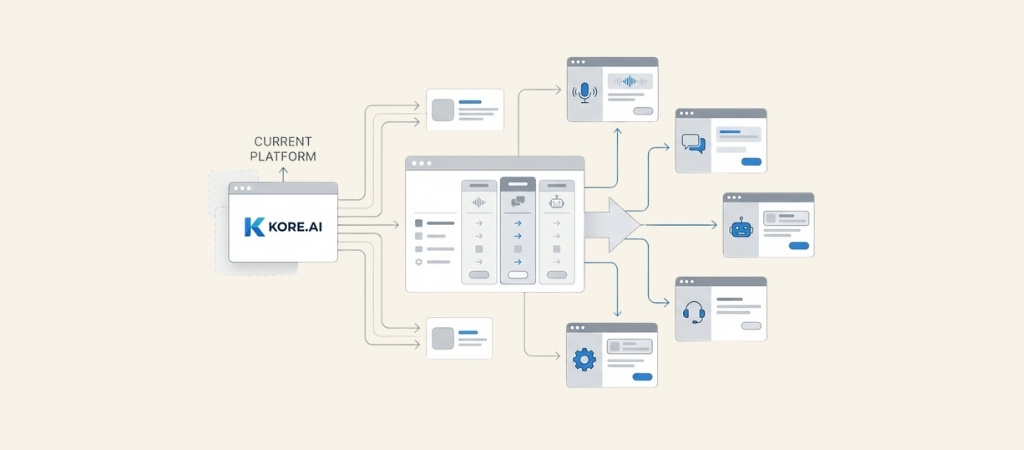
Kore.ai has built a reputation as a comprehensive enterprise conversational AI platform.
But here's the reality: many teams start their search for Kore.ai alternatives after discovering the platform's steep learning curve, lengthy implementation cycles, and enterprise pricing that starts at six figures.
The good news? The conversational AI market has matured significantly.
Whether you need open-source flexibility, fast deployment, or specialized voice capabilities, there's likely a better fit for your specific use case.
This guide compares six proven Kore.ai alternatives, breaking down their strengths, limitations, and pricing so you can make an informed decision.
Editor’s note: Want to hear some sample AI support calls made for your Shopify store?
- Just paste your store URL
- Hear sample calls for your store (no email required)
- Listen to demo calls for my store
What is Kore.ai?
Kore.ai is an enterprise conversational AI platform built around the XO Platform. It offers virtual assistants for customer service, IT helpdesk, and HR automation, with omnichannel deployment across chat, voice, and messaging apps.
The platform targets large enterprises with complex integration needs. It provides pre-built connectors for major CRM and ERP systems, along with tools for building custom conversational flows. For organizations with dedicated AI teams and months to invest in implementation, Kore.ai delivers comprehensive functionality.
Why consider Kore.ai alternatives?
Here's a breakdown of the common pain points that drive teams to explore other options:
Complex implementation cycles. Most Kore.ai deployments take 2-4 months from kickoff to production. This timeline doesn't work for teams needing immediate relief from support volume.
Enterprise pricing. With deployments typically starting at $300,000+ annually for large organizations, the platform sits outside most mid-market budgets.
Technical expertise required. Getting the most from Kore.ai requires dedicated developers and AI specialists. Teams without these resources often struggle to optimize the platform.
Rigid architecture. While comprehensive, the platform's structure can limit flexibility for unique use cases or rapid iteration.
Limited voice-first capabilities. Despite offering voice features, Kore.ai's roots in chatbots show when handling complex phone interactions.
Kore.ai alternatives comparison
| Platform | Best For | Starting Price | Deployment Time | Key Strength |
|---|---|---|---|---|
| Ringly.io | E-commerce phone support | From $99 a month (50 conversations included) | 1-2 hours | Fastest setup, Shopify integration |
| Rasa | Developer teams | Free (open source) | 2-4 months | Complete customization, data control |
| Ada | Fast AI deployment | Custom pricing | 2-4 weeks | No-code setup, 50+ languages |
| Cognigy | Large contact centers | Custom pricing | 2-4 months | Best voice/telephony features |
| Intercom | SaaS companies | $29/seat/month | Days to weeks | Transparent AI pricing |
| Zendesk | All-around support | $19/agent/month | 1-2 months | Mature ecosystem, reliability |
1. Ringly.io

If you run a Shopify store and need phone support automation, Ringly.io is purpose-built for your use case. While other platforms try to be everything for everyone, we focus exclusively on helping e-commerce businesses handle customer calls automatically.
Our AI phone agent, the AI, integrates directly with your Shopify store. It can look up orders, process returns, answer product questions, and escalate complex issues to your team. Setup takes under 1 hour, not months.
Key features:
- Native Shopify integration for real-time order lookups
- 24/7 call handling with 40-language support
- Automatic returns and exchange processing
- Call recordings and analytics dashboard
- Escalation rules based on caller sentiment or issue type
Pricing:
| Plan | Price | Included | Best For |
|---|---|---|---|
| Pay per call | $99 a month | 50 conversations, then $1.99 each | Shopify brands taking support calls |
What works well:
Going live in under 1 hour is genuinely achievable. Connect your Shopify store, pick a phone number, and the AI starts handling calls immediately. Our customers typically see the AI resolve up to 90% of calls without human intervention.
Limitations:
We're focused on phone support for e-commerce. If you need chatbots, email automation, or non-Shopify integrations, you'll need additional tools.
2. Rasa
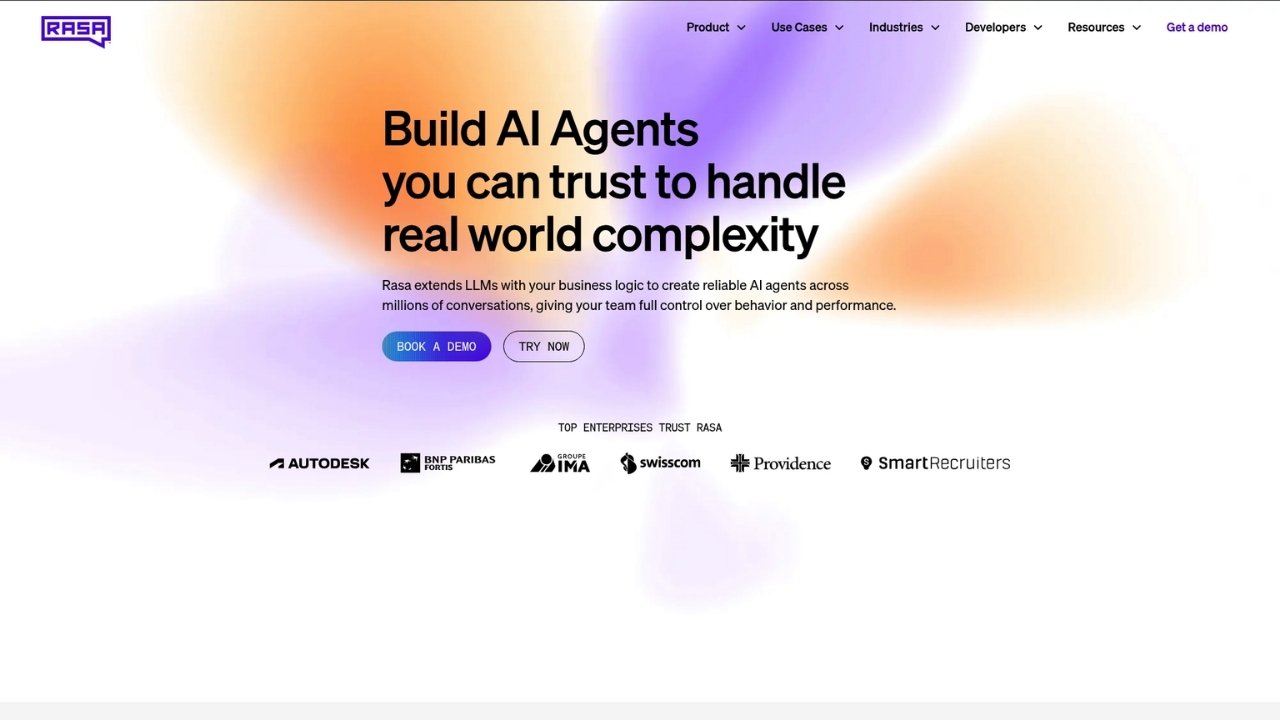
Rasa is the leading open-source conversational AI framework. It gives development teams complete control over their AI agents, from conversation logic to deployment infrastructure.
The platform's CALM (Conversational AI with Language Models) architecture combines the flexibility of large language models with structured, deterministic flows. This means your agents can handle natural conversation while staying predictable and debuggable.
Key features:
- Open-source framework with full code access
- On-premise or private cloud deployment
- CALM architecture for reliable conversation handling
- Voice support built-in
- Multi-LLM routing to optimize costs and performance
Pricing:
| Plan | Price | Features |
|---|---|---|
| Developer Edition | Free | 1,000 conversations/month, community support |
| Rasa Pro | $35,000/year | Production support, enterprise features |
| Enterprise | Custom | Dedicated support, custom SLAs |
What works well:
For teams with strong technical resources, Rasa offers unmatched flexibility. You own your data completely, can customize every aspect of the conversation experience, and avoid vendor lock-in entirely. Companies like Autodesk, BNP Paribas, and Swisscom run production workloads on Rasa.
Limitations:
The learning curve is steep. You'll need Python developers, conversational AI expertise, and infrastructure knowledge. Time-to-value typically measures in months, not weeks.
3. Ada

Ada focuses on fast deployment of AI-first customer service. The platform promises to get your AI agent live in weeks rather than months, with a no-code interface that doesn't sacrifice sophistication.
The platform's Reasoning Engine powers AI agents across all channels from a single unified system. This means consistent responses whether customers reach out via chat, email, or voice.
Key features:
- No-code deployment with visual flow builder
- 50+ language support out of the box
- Playbooks for structured multi-step workflows
- Automatic coaching and improvement from past conversations
- Omnichannel deployment (chat, voice, email, WhatsApp, SMS)
Pricing:
Ada uses custom enterprise pricing based on conversation volume. The platform typically targets organizations handling 300,000+ annual conversations. You'll need to contact their sales team for specific pricing.
What works well:
Speed of deployment is Ada's standout feature. Customers like Square, Pinterest, and Monday.com have launched AI agents quickly without extensive technical resources. The platform maintains a 99.99% uptime SLA and handles over 1.5 billion customer interactions.
Limitations:
The Playbook structure can feel rigid for complex conversational flows that don't follow predictable patterns. Pricing transparency is limited, and smaller teams may find the minimum commitment too high.
4. Cognigy (NICE Cognigy)

Cognigy, now part of NICE after a 2025 acquisition, specializes in enterprise contact center automation. If voice is your primary channel and you need deep telephony integration, Cognigy leads the pack.
The platform serves over 1,250 brands and handles more than 1 billion annual interactions. Its Voice Gateway provides enterprise-grade SIP connectivity for complex phone system integrations.
Key features:
- Voice Gateway with full telephony integration
- Visual flow builder for conversation design
- AI Agent for autonomous customer interactions
- Agent Copilot for real-time human agent assistance
- On-premise deployment option for compliance
Pricing:
Cognigy uses custom enterprise pricing, typically starting in the low six figures annually. Pricing depends on concurrent session volume and deployment complexity. Contact their sales team for quotes.
What works well:
Voice capabilities are best-in-class. The platform achieves 99% routing accuracy and integrates with virtually any telephony or CCaaS system. For large contact centers with strict compliance requirements, the on-premise option is valuable.
Limitations:
Complexity matches Kore.ai, with 2-4 month implementation timelines. The NICE acquisition creates some uncertainty about long-term product roadmap. This is overkill unless you're running a large contact center.
5. Intercom
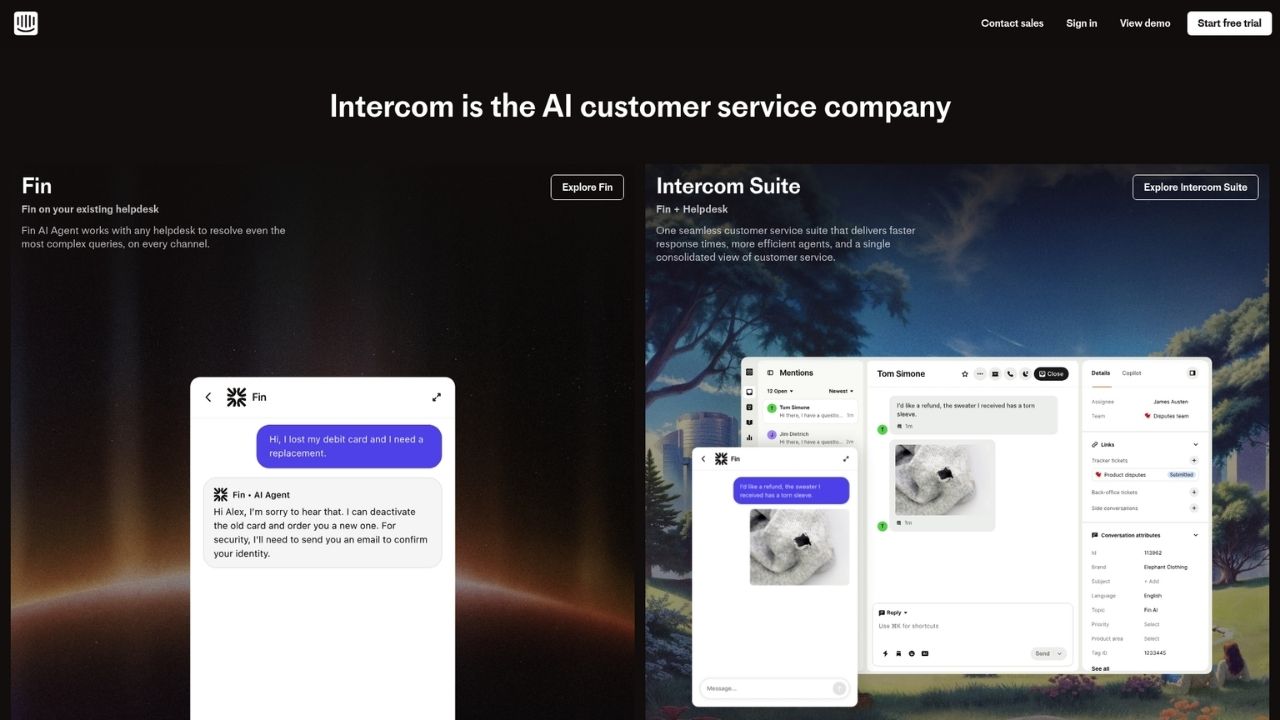
Intercom pioneered the modern AI agent approach with Fin, their resolution-based AI. The platform combines AI automation with a shared inbox, making it ideal for SaaS companies wanting unified support and customer engagement.
Unlike opaque enterprise pricing, Intercom offers transparent per-seat and per-resolution pricing. This predictability appeals to growing teams budgeting carefully.
Key features:
- Fin AI Agent at $0.99 per resolution
- Shared inbox for human and AI collaboration
- Proactive messaging and product tours
- Help Center with multilingual support
- 450+ app integrations
Pricing:
| Plan | Price | Key Features |
|---|---|---|
| Essential | $29/seat/month | Fin AI Agent ($0.99/resolution), basic features |
| Advanced | $85/seat/month | Multiple inboxes, automation, 20 Lite seats |
| Expert | $132/seat/month | SSO, HIPAA, SLAs, 50 Lite seats |
Copilot add-on: $29/agent/month for unlimited AI assistance.
What works well:
Setup is fast, and the per-resolution pricing means you only pay when AI actually solves problems. The UI is polished and intuitive. Companies report 70%+ resolution rates with Fin. The 14-day free trial requires no credit card.
Limitations:
Voice capabilities are limited compared to dedicated voice platforms. Costs can escalate quickly with high conversation volumes due to the per-resolution model. It's less customizable than developer-focused alternatives.
6. Zendesk

Zendesk needs little introduction. With 100,000+ companies using the platform and 15+ years in the market, it's the safe, proven choice for teams wanting reliability above all else.
The platform has evolved significantly, adding AI agents, workforce management, and quality assurance tools. While not as AI-forward as pure-play conversational platforms, Zendesk offers comprehensive functionality in a mature package.
Key features:
- AI agents for automated resolution
- Industry-leading ticketing system
- Integrated help center and knowledge base
- Voice support via Zendesk Talk
- Workforce management and QA tools
- 1,000+ marketplace integrations
Pricing:
| Plan | Price | Key Features |
|---|---|---|
| Support Team | $19/agent/month | Ticketing, email, social |
| Suite Team | $55/agent/month | Messaging, chat, help center, basic AI |
| Suite Professional | $115/agent/month | Advanced AI, custom workflows, SLAs |
| Suite Enterprise | $169/agent/month | Sandbox, advanced security |
| Advanced AI add-on: $50/agent/month. |
What works well:
Reliability and ecosystem depth are unmatched. The platform just works, with 99.9% uptime and extensive documentation. If you need a specific integration, it probably exists. The ticketing system remains the industry standard.
Limitations:
AI capabilities lag behind newer platforms. The interface can feel dated. Per-agent pricing becomes expensive at scale. Advanced AI requires an additional $50/agent/month add-on.
How to choose the right Kore.ai alternative
Here's the short version: match the platform to your constraints and capabilities.
Choose Ringly.io if: You run a Shopify store and need phone support automation fast. The fast setup (live in under 1 hour) and e-commerce focus make us ideal for online retailers.
Choose Rasa if: You have strong technical resources and need complete control. The open-source model eliminates vendor lock-in.
Choose Ada if: You want fast AI deployment without technical complexity. The no-code approach gets you live in weeks.
Choose Cognigy if: You run a large contact center with complex voice requirements. The telephony integration is best-in-class.
Choose Intercom if: You're a SaaS company wanting transparent AI pricing and fast setup. The per-resolution model aligns costs with value.
Choose Zendesk if: You prioritize reliability and ecosystem breadth. The mature platform just works.
Getting started with AI phone support
Phone support remains critical for e-commerce. Customers with urgent issues, complex questions, or high-value orders often prefer calling. But staffing phone support 24/7 is expensive.
AI phone agents solve this by handling routine calls automatically, escalating only complex issues to your team. The result? Lower costs, faster response times, and happier customers.
If you're running a Shopify store, try Ringly.io for free and see how The AI handles your calls. Most stores go live within an hour, and if Seth resolves under 65% of your calls in a month, that month comes back as credit (after 90 days on Pay per call).
Looking for a Kore.ai alternative that actually fits your e-commerce business? Try Ringly.io for free and see how AI phone support transforms your customer experience.
Meta Description: Looking for Kore.ai alternatives? Compare 6 top conversational AI platforms for customer support, including pricing, features, and best use cases.
Frequently Asked Questions
Which Kore.ai alternative offers the fastest deployment?
Ringly.io and Intercom offer the fastest deployment, with setup times measured in hours or days rather than months. Ringly.io is live in under 1 hour for Shopify stores, while Intercom typically takes a few days for full configuration.
Are there any free Kore.ai alternatives worth considering?
Rasa offers a free Developer Edition with 1,000 conversations per month, making it the best free option for technical teams. However, you'll need development resources to implement it effectively.
Which Kore.ai alternative works best for voice and phone support?
Cognigy offers the most comprehensive voice capabilities for large contact centers, while Ringly.io specializes in phone support for e-commerce businesses. For general voice needs, both outperform Kore.ai's voice features.
How do Kore.ai alternatives compare on pricing transparency?
Intercom and Zendesk offer the most transparent pricing with public rates. Rasa provides clear pricing for its Pro tier. Ada and Cognigy require custom quotes, similar to Kore.ai's enterprise sales approach.
Can I use multiple Kore.ai alternatives together?
Yes, many teams use different tools for different channels. For example, you might use Ringly.io for phone support, Intercom for chat, and Zendesk for ticketing. Most platforms offer integrations to connect these systems.
Which Kore.ai alternative is best for small businesses?
For small e-commerce stores, Ringly.io offers the most accessible entry point with plans starting at $99 a month. For general support needs, Zendesk's Support Team plan at $19/agent/month provides a solid foundation.