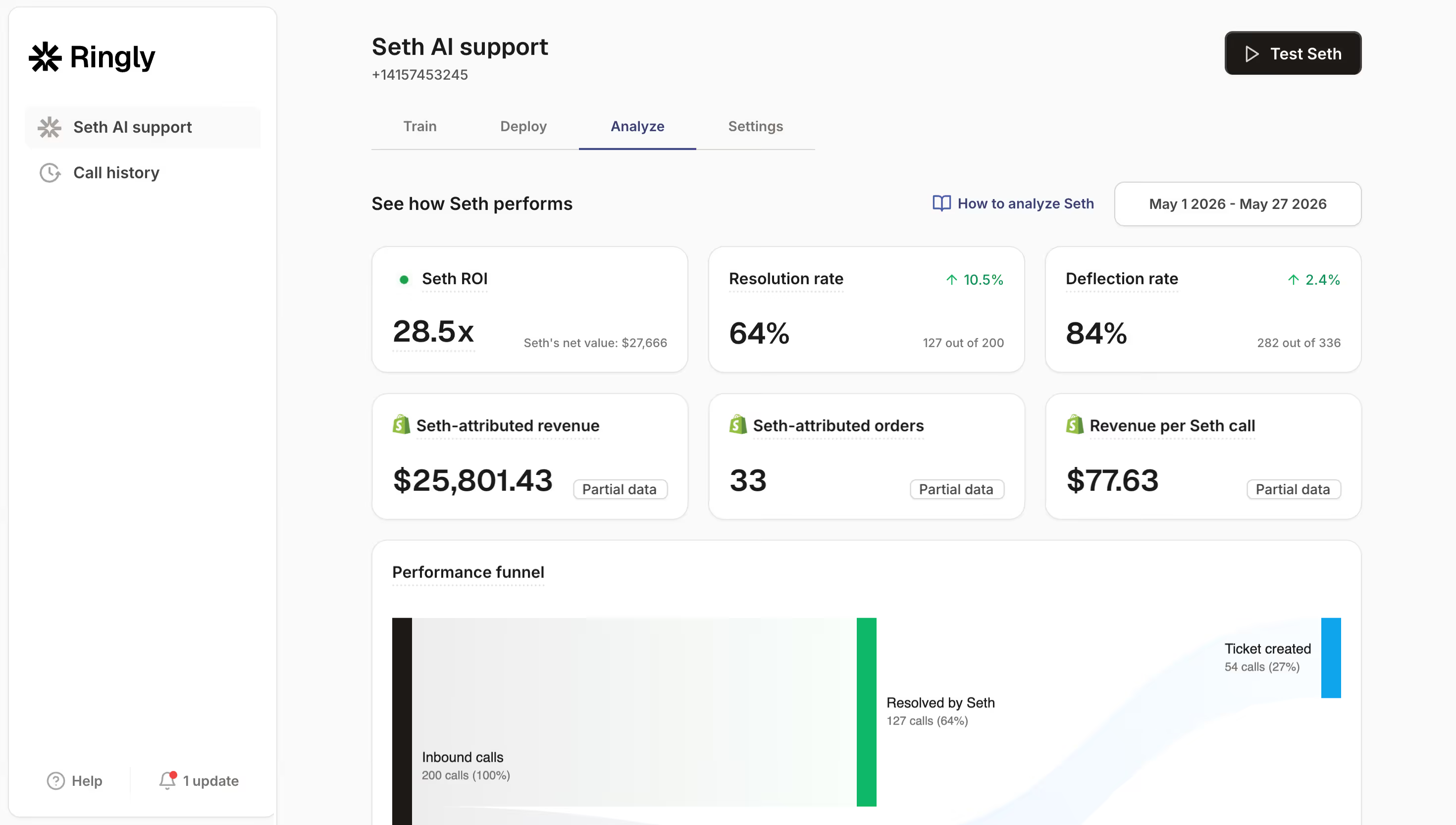
The AI customer service phone that answers, resolves, and logs your store's support calls 24/7.
Every support call your store misses is a customer deciding whether to wait, email, or just cancel. An AI customer service phone ends that trade-off: it answers every call in one ring, around the clock, and because it is connected to your Shopify store it can actually resolve the call, not just take a message. Across stores running Ringly, about 2 out of 3 support calls end fully resolved with no human involved, at about $2 a conversation ($99/mo covers the first 50, then $1.99 each) versus roughly $2.70 for a human-handled ticket.
This page covers what an AI customer service phone is, what it resolves and what it hands off, what it costs compared to hiring or outsourcing a call center, and how stores set it up in an afternoon. All numbers come from real calls handled for ecommerce brands, over 150,000 of them.
Generic phone bots fail in ecommerce for one reason: they can't see your orders. A caller asking "where is my package?" doesn't want a callback, they want the tracking status. This is the difference between an answering machine with a voice and actual AI phone support.
Ringly connects to your store, so on every call the AI can:
That last point matters. The goal is not zero humans. The goal is that humans only touch the calls that need judgment, which is a small minority of what actually comes in.
Vendors in this space love adjectives. Numbers are better. From the calls Ringly has handled for ecommerce brands:
Two honest caveats. First, an AI phone agent is only as good as what you feed it: a store with vague policies and an empty knowledge base will get mediocre answers, because there is nothing to answer from. Second, resolution rates are measured by Ringly across its own stores; every vendor measures differently, so when you compare tools, ask each one what "resolved" means. We wrote about how to compare AI voice platforms without getting fooled.
Half the reason stores look at AI phone support is not volume, it is hours. Your customers shop at 11pm. Your support closes at 5. Every call after close is a voicemail, and most callers do not leave one, they open a chargeback or email "cancel my order" instead.
An AI customer service phone makes the after-hours problem disappear without staffing a night shift or paying an after-hours answering service per call. The AI answers at 3am exactly like it answers at 3pm: looks up the order, solves the problem, logs the call. For stores selling into multiple time zones, this is usually the fastest payback of the whole system. US brands with EU customers wake up to resolved calls instead of a queue.
Some stores start exactly here: keep the day shift human, forward the phone to the AI at close. It is the lowest-risk way to try AI phone support, and it turns the worst part of your coverage into the best part overnight.
The honest comparison is not "AI vs free". It is AI vs the three things stores actually do today: let calls ring out (which costs revenue), hire, or outsource.
Hiring a support rep costs roughly $35,000 to $55,000 a year plus management, and covers 40 hours of the week's 168. An outsourced call center bills per minute or per ticket and still needs scripts, QA, and patience for agents who have never seen your store. Letting it ring is the expensive one: a missed sales call walks straight to a competitor.
Ringly's plans for comparison:
| Plan | Price | Calls | Contract |
|---|---|---|---|
| Pay as you go | $99/mo | First 50 included, then $1.99 per call | Month to month |
| Custom | Talk to us | 1,000+ calls a month | Custom |
For Ringly, the math lands at about $2 a conversation ($99/mo covers the first 50, then $1.99 each) versus roughly $2.70 for a human-handled ticket. And it is elastic: Black Friday triples your call volume, the AI answers all of it, and you never onboarded a temp. Full pricing detail is on the pricing page, and the Shopify customer service cost breakdown shows the per-ticket math.
| AI customer service phone | In-house hire | Outsourced call center | |
|---|---|---|---|
| Answers in | 1 ring, every time | Business hours, when free | Queue, SLA-dependent |
| Coverage | 24/7/365 | ~40h/week | Per contract, costs extra nights/weekends |
| Knows your orders | Live Shopify data on every call | Yes, after training | Rarely; reads from scripts |
| Cost shape | $99/mo for the first 50 calls, then $1.99 per call | $35-55K/yr + management | Per minute/ticket + setup |
| Peak season | Absorbs any volume instantly | Overtime or missed calls | Renegotiate capacity |
| Ramp time | About an hour | Weeks of hiring + training | Weeks of onboarding + QA |
| Best at | Order status, returns, product Qs, after-hours | Judgment calls, VIPs, escalations | Overflow volume at scale |
The pattern most stores land on: AI first on every call, humans for what the AI hands off, and no outsourcing contract at all. If you are actively comparing vendors for the outsourced route, the call center outsourcing guide is the deeper read.
One Shopify brand running Ringly measured a single week and counted $22,664 in revenue the AI phone agent touched: abandoned-cart callbacks that turned into completed orders, order-status calls that would have become refund requests, and after-hours sales questions answered while the team slept. The same week, 85% of its support calls resolved without a human.
The point is not that every store gets those numbers in week one. The point is what the phone channel turns into when it stops being a cost center: the calls you used to miss are the revenue you were leaving out. More customer stories, with names and numbers, are on the customers page.
Call +1 (844) 932-2026 and talk to Seth, the AI you just read about. Ask where an order is, ask about returns, try to stump it. No form, no demo booking, no sales rep. Hang up when you are convinced.
There is no implementation project. The path most stores take:
From there you can try it for free, and the dashboard shows every call, transcript, and resolution, so you judge it on evidence, not vibes.
Yes. Most stores keep their number and forward it. You can route by hours (AI after close), by overflow (AI when nobody picks up in 20 seconds), or AI-first with human transfer. Nothing about your existing setup has to change on day one.
Some callers prefer humans, and the AI transfers them the moment they ask. But most callers want their problem solved in one call with zero hold time, and that preference wins. The measured behavior across Ringly stores: resolution, not hang-ups, and the transcripts are there to check.
Ringly is built Shopify-first, and the live order lookup is the core of why resolution rates are high. If you run another platform, the AI still answers, takes messages, books callbacks, and answers store questions from your content, but the mid-call order actions are where Shopify stores get the full effect.