
Updated June 2026
Phone support that pays for itself. Ringly answers your store's calls and resolves at least 65% of them, backed by a guarantee. Book a call to see it run on your store.
The best call center outsourcing company for ecommerce in 2026 is Ringly.io, a done-for-you AI phone agent for Shopify brands that resolves about 73% of inbound calls on its own across 50+ stores and only charges once it resolves at least 65% of your calls. For human-led BPO, Peak Support and SupportYourApp lead on confirmed Shopify and Zendesk integration; Teleperformance and Concentrix lead on enterprise scale; Hugo leads on transparent per-hour pricing. The right pick depends on how much of your call volume is repetitive WISMO and returns versus complex human work.
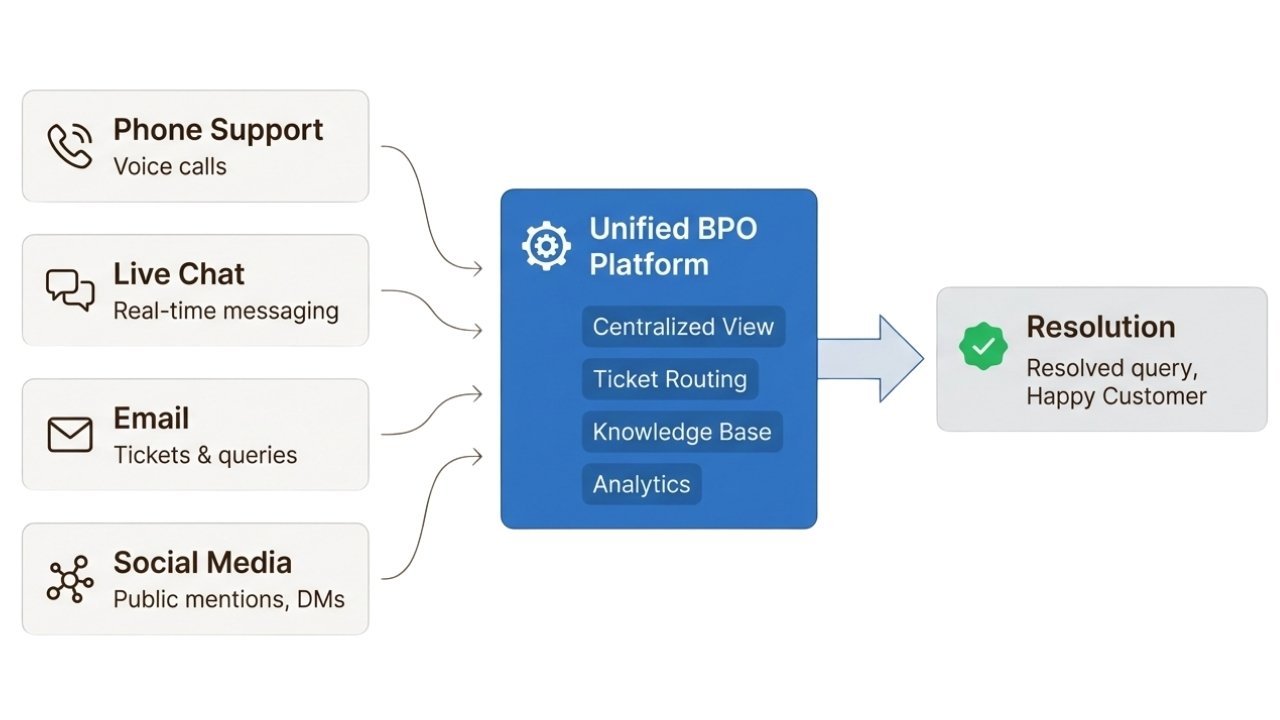
E-commerce customer support costs keep climbing while margins shrink. You need 24/7 coverage across phone, email, chat, and social, but building an in-house team for that gets expensive fast.
Outsourcing makes sense on paper. The up to 88% cost savings some providers claim sounds appealing. But finding a partner that actually integrates with your Shopify store and Zendesk helpdesk is harder than you might expect.
This guide ranks the best call center outsourcing companies for ecommerce in 2026. We weigh AI phone automation against traditional human BPO, score each option on Shopify and Zendesk integration, omnichannel coverage, pricing transparency, and how fast you can go live. We also give you a framework so you can match the right model to your own call mix instead of guessing.
Why ecommerce brands outsource customer support
Fixed customer service costs become a problem when your order volume swings. You hire for peak season and overpay during slow months. Or you understaff and watch CSAT drop the moment things get busy.
The economics tilt toward outsourcing once you add up hiring, training, benefits, office space, and software licenses. A call center outsourcing company spreads those costs across many clients and absorbs the operational complexity.
What makes ecommerce different from generic support? Your partner needs to pull order data from Shopify, manage tickets in Zendesk, and handle returns without creating more work for your internal team. That single requirement eliminates a lot of vendors. If you run a Shopify store in health, wellness, beauty, supplements, or pet, most of your calls are about order status, shipping, and returns, and the right partner should resolve those automatically so your team can focus on growth.
What to look for in a call center outsourcing partner
Before the rankings, here is the framework we used to score every option. These five criteria matter most for ecommerce operations.
Omnichannel coverage
Customers switch channels mid-conversation. They start on Instagram, move to email, then call when nobody replies fast enough. A real omnichannel setup carries context across those touchpoints so an agent never starts from scratch. Look for phone, email, live chat, social, and self-service, all sharing one customer history.
Shopify and Zendesk integration
This is where most providers fall short. Shopify integration should mean agents look up orders, process returns, and check inventory without switching systems. Zendesk integration keeps ticket management, customer history, and knowledge base in sync. In our research, deep Zendesk integration was far rarer than Shopify, and only a couple of human BPOs document both publicly.
Real-time dashboards and reporting
You cannot manage what you cannot see. Real-time dashboards show wait times, agent performance, service levels, and CSAT as they happen. That visibility matters most when you pay per minute or per agent and need to catch a problem before it shows up in your reviews.
Pricing model and contract flexibility
BPO pricing falls into three buckets: per-agent (a monthly fee per dedicated agent), per-minute (you pay for talk time), and per-ticket (a fee per resolved interaction). Watch for setup fees, minimum monthly commitments, training charges, and overage rates. Contract length matters too, since some providers lock you in for 12 to 24 months.
Speed to go live
A human team takes weeks to recruit, train, and integrate. An AI phone agent can be live in days. If your busy season is close, speed to launch is not optional, it is the whole decision.
The 8 best call center outsourcing companies for ecommerce in 2026
We ranked these on the five criteria above, weighted toward what a Shopify operator actually feels: how much repetitive phone volume gets resolved, how fast you launch, and how predictable the bill is.
1. Ringly.io (AI phone agent for Shopify, our top pick)

Ringly.io takes a different approach from every other name on this list. Instead of staffing human agents, it deploys a done-for-you AI phone agent built specifically for Shopify brands. It answers inbound calls 24/7, looks up live order data, processes returns and exchanges by your store's rules, and answers product questions by pulling from your knowledge base. When a call gets genuinely complex, it escalates to your team instead of guessing.
Across 50+ Shopify brands, the agent resolves about 73% of inbound calls with no human help, and it speaks 40+ languages out of the box rather than needing a separate team per language. Its native Shopify integration pulls order data directly so it can answer "where is my order" questions in real time, the single most common call any DTC store gets.
What makes it our top pick is the way it is sold. You book a call and the Ringly team sets the whole thing up for you, then you go live in 14 days. The Resolution Promise means you only start paying once the agent resolves at least 65% of your calls, so the risk of trying it sits with Ringly, not with you. One brand running it recovered $22k in revenue from calls that would otherwise have gone unanswered after hours.
| Attribute | Details |
|---|---|
| Model | Done-for-you AI phone agent (built and run for you) |
| Shopify integration | Native, pulls live order data |
| Resolution rate | About 73% of inbound calls autonomously |
| Languages | 40+ out of the box |
| Time to go live | 14 days |
| Pricing | By call. You pay only once it resolves 65% of your calls |
Best for: Shopify brands with heavy, repetitive phone volume (order status, returns, FAQs) that want it resolved before paying for a single human seat.
Pros: Done-for-you setup, live in 14 days, 40+ languages, native Shopify integration, the Resolution Promise so you only pay on results, trusted by 50+ Shopify brands.
Cons: Phone-first, so it is not a full omnichannel replacement if you also need humans for complex email, chat, and social. It pairs with a small in-house or outsourced team rather than removing one entirely.
2. Peak Support

Peak Support is an award-winning BPO that pairs human agents with AI-driven insights. They run five global locations and report a 95% average QA score with a 1-in-30 agent acceptance rate. Their CX Accelerator program adds sentiment analysis, real-time data visualization, and chatbot capability on top of the human team.
Crucially for ecommerce, Peak Support lists both Zendesk and Shopify in their stack, which puts them in rare company, and they also connect to Gorgias, Freshdesk, HubSpot, Intercom, and Salesforce.
Best for: Mid-market brands that want human agents plus AI insights and confirmed Shopify and Zendesk integration.
Pros: Confirmed Shopify and Zendesk integration, AI sentiment analysis, live client dashboards, SOC 2 / PCI DSS / HIPAA.
Cons: No public pricing, custom quotes only.
3. SupportYourApp

SupportYourApp has spent 14+ years building support for tech startups and ecommerce, with a dedicated Shopify support page and agents pre-trained on ecommerce operations. Their proprietary QUIDGET AI builder automates a large share of routine queries, and QCRM gives a unified inbox across email, messengers, and calls.
Best for: Shopify stores needing multilingual coverage and high security standards.
Pros: 60+ languages, 24/7/365, confirmed Shopify and Zendesk integration, PCI DSS Level 1, ISO 27001, GDPR.
Cons: Custom pricing only, and a launch timeline of about one month.
4. Helpware
Helpware runs 19+ locations across 12 countries with a 4,000+ person team and a reported 90% CSAT and 2.8% monthly attrition, well under the 6 to 8% industry average. They list ecommerce and retail as a primary vertical and run separate CX, AI, and technology divisions, which helps brands that want custom AI work alongside frontline support. Read more about their fit in our guide to ecommerce call center services.
Best for: Global brands needing multi-continent coverage and an in-house AI division.
Pros: Operations across many countries, integrated AI division, 24/7 availability, low attrition, CX strategy consulting.
Cons: Shopify and Zendesk integration not confirmed publicly, security certifications not documented, sales consultation required for pricing.
5. Hugo
Hugo is a fast-growing BPO built for digital-first brands, recognized by Clutch as one of the fastest-growing customer support providers two years running. Their team is made up of college-educated agents with multi-year experience, and they report a sub-2% monthly attrition rate with strong CSAT. The standout is transparent pricing: rates start around $11 per hour per agent, including management, QA, and training, with month-to-month options for pilots.
Best for: Startups and digital-native brands that want a flexible, affordable dedicated team with public hourly rates.
Pros: Transparent hourly pricing from about $11/hr, low attrition, scale up or down with short notice, college-educated agents.
Cons: Dedicated-team model can be more than a very low-volume store needs, and phone integration depth with Shopify is not deeply documented.
6. TaskUs

TaskUs serves fast-growing digital brands and is known for trust and safety, social media support, and content moderation. Their people-first culture helps keep agent burnout low, which feeds back into more consistent support. They are a strong fit when your support load is as much about community and user-generated content as it is about order questions.
Best for: Digital-native brands that lean heavily on social channels and need trust-and-safety expertise.
Pros: Deep trust-and-safety and social moderation expertise, people-first culture, strong CX reputation.
Cons: Custom pricing only, and operations concentrated in the US and Philippines may not suit every region.
7. Teleperformance and Concentrix (enterprise giants)
If you are a large brand with hundreds of thousands of contacts a month, the global giants are built for you. Teleperformance operates in 100+ countries with 420,000+ agents across voice, chat, email, and AI-enabled CX. Concentrix runs roughly 450,000 employees across 70+ countries and serves two of the top five global retail and ecommerce companies with average client tenure measured in years.
Best for: Enterprise retailers needing massive multilingual scale and global compliance.
Pros: Near-unlimited scale, broad language and channel coverage, mature compliance, deep CX experience.
Cons: Built for very large accounts, longer onboarding, custom quotes, and harder to move fast for a mid-market DTC store.
8. KDCI Outsourcing
KDCI Outsourcing is a Philippines-based BPO that builds custom, dedicated teams for ecommerce, with a focus on culture match and brand-aligned scripts. They target US, Australian, and European brands wanting offshore cost efficiency and support marketplaces like Amazon and eBay alongside Shopify stores.
Best for: Brands wanting a cost-effective, brand-aligned offshore team.
Pros: Offshore cost savings, custom team structures, marketplace support, AI-augmented teams.
Cons: Platform integration specifics unclear, time-zone management needed for US brands, limited public technical documentation.
Comparison table: best call center outsourcing companies for ecommerce
One view of how the eight stack up on the criteria a Shopify operator actually cares about.
| Provider | Model | Shopify | Zendesk | Time to live | Pricing | Best for |
|---|---|---|---|---|---|---|
| Ringly.io | AI phone agent (done-for-you) | Native | Pairs with helpdesk | 14 days | Pay only on 65% resolution | Repetitive Shopify phone volume |
| Peak Support | Human + AI insights | Confirmed | Confirmed | Weeks | Custom quote | Mid-market, AI insights |
| SupportYourApp | Human + AI tools | Confirmed | Confirmed | ~1 month | Custom quote | Multilingual, high security |
| Helpware | Human + AI division | Unclear | Unclear | Weeks | Custom quote | Global coverage |
| Hugo | Dedicated human team | Unclear | Unclear | Weeks | From ~$11/hr | Startups, transparent pricing |
| TaskUs | Human, CX-focused | Unclear | Unclear | Weeks | Custom quote | Social, trust and safety |
| Teleperformance / Concentrix | Enterprise human + AI | Unclear | Unclear | Longer | Custom quote | Enterprise scale |
| KDCI | Offshore human team | Unclear | Unclear | Weeks | Custom quote | Offshore cost savings |
What the comparison tells you
Zendesk integration is the weakest link for human BPOs. Only Peak Support and SupportYourApp confirm it publicly. Everyone else needs to be verified in a sales call.
Shopify integration is more common but shallow. Many providers mean their agents can open your admin in a browser tab, not true automated data flow. Ringly's integration is the deepest because the AI pulls order data directly to answer calls on its own.
Pricing transparency is rare. Most providers quote per agent or per ticket and publish nothing. Hugo publishes hourly rates; Ringly removes the gamble entirely by only billing once the AI hits 65% resolution.
The MTA Score: how we benchmark outsourcing options
MTA = Minutes saved + Tickets deflected + AOV recovered. It is the only ROI test that captures all three levers of ecommerce phone support:
- Minutes: labor hours your team no longer spends on the phone (industry baseline near $5/hr for offshore human BPO talk time)
- Tickets: inbound calls deflected with no human escalation
- AOV: recovered revenue from after-hours and abandoned calls that humans either reject or charge premium rates for
Across 50+ Shopify stores running Ringly, the AI agent delivers a far lower cost per resolved call than human-only BPO, especially on after-hours volume, where one brand recovered $22k that would otherwise have been lost. Score each provider against this framework and the answer usually reveals itself: if most of your calls are repetitive WISMO and returns, automate them first; reserve human seats for the complex remainder.
How to evaluate Shopify and Zendesk integration
Integration depth varies wildly. Some providers claim "Shopify support" and only mean an agent opening a browser tab. True integration means automated data flow. Ask vendors these questions before you sign.
Shopify integration checklist
- Can agents pull order status without logging into Shopify?
- Can they process returns and exchanges directly from their interface?
- Do they have real-time inventory visibility?
- Does customer history sync automatically?
- What data flows back to Shopify after each interaction?
Zendesk integration checklist
- Ticket creation and management from the agent interface
- Customer history visible across all channels
- Knowledge base access for agent reference
- Reporting that syncs between platforms
- Escalation workflows that keep ticket context intact
Only Peak Support and SupportYourApp document true Zendesk integration. Others may support it, but you will have to verify in a sales conversation.
Traditional human BPO vs AI phone agents: how the models differ
Understanding the two models makes the choice easier. Both have a place; they just solve different parts of your call volume.
The traditional human-powered BPO
The classic model hires a third party that trains a team of agents on your products and brand voice. Done well, it gives you empathy for complex, emotional conversations and broad omnichannel coverage across phone, chat, SMS, and email. The trade-offs are real: pricing is hard to forecast, hourly rates run from roughly $6 to $18 in offshore regions and over $29 in the US, setup takes weeks, and turnover means you keep paying to retrain new people. Labor alone is often 60 to 70% of a call center's costs. Learn how brands scale this way in our guide to ecommerce support outsourcing without hiring and how a call center BPO for ecommerce typically works.
The modern AI phone agent
Instead of a human team, an AI phone agent handles the repetitive calls itself. It is not the old IVR "press 1 for sales" menu. Modern agents understand natural language, integrate with your store data, and resolve issues end to end. They answer one call or a thousand at once during a flash sale with nobody on hold, give a consistent brand-approved answer every time, and run on a predictable monthly cost instead of a variable per-agent bill. This is the shift behind how AI is changing call centers and why it now grows ecommerce support cost-effectively, as our piece on AI customer care explains.
Cost comparison: human BPO vs AI
The financial gap is often the deciding factor. Human BPOs price either per full-time agent (typically $1,200 to $4,000 per agent per month) or per interaction (roughly $1 to $5 per ticket), plus onboarding, training, and software fees that the first quote rarely includes. An AI agent like Ringly's resolves about 73% of inbound calls autonomously and only starts billing once it clears the 65% resolution bar, so your cost lines up with results rather than headcount. For phone-heavy stores, the math almost always favors automating the repetitive volume first, then keeping a small human team for the complex remainder. See how brands run this hybrid in our breakdown of how ecommerce call centers make support easier and ecommerce customer service automation.
How to choose the right call center outsourcing partner
Your choice comes down to your call mix, tech stack, volume, and budget. Use this decision guide.
Choose Ringly.io if:
- You run a Shopify store with heavy, repetitive phone volume (order status, returns, FAQs)
- You want most of that volume resolved before you pay for human seats
- You want to be live in 14 days with a done-for-you setup
- You prefer paying on results (the 65% Resolution Promise) over headcount
Choose Peak Support or SupportYourApp if:
- You need confirmed Zendesk and Shopify integration with human agents
- AI insights, sentiment analysis, and security certifications matter
- You can commit to custom contracts and a multi-week launch
Choose Hugo, Helpware, or KDCI if:
- You need flexible scaling or offshore cost savings
- Transparent hourly pricing (Hugo) or a custom brand-aligned team (KDCI) fits better
- You want global, multi-time-zone coverage (Helpware)
Choose Teleperformance or Concentrix if:
- You are an enterprise retailer with very high contact volume
- You need massive multilingual scale and mature global compliance
For Shopify brands in health, wellness, beauty, supplements, or pet, the fastest win is almost always automating phone support first. A generic team will not understand your store data the way a native integration does. If you sell in a regulated or detail-heavy niche, our notes on beauty brand customer service, DTC wellness customer service, and the role of an ecommerce phone support operator are worth a read. For coverage outside business hours, see our guide to an after-hours answering service.
The future of ecommerce support
For years, outsourcing support meant trading off cost, quality, and customer experience. That math has changed. Traditional BPOs still earn their place on complex, human, emotional work. But the repetitive 70 to 80% of calls, the WISMO and returns questions, no longer need a human at all. The brands winning in 2026 are not picking AI or humans; they are stacking them, letting the AI call agent resolve the predictable volume and reserving people for the cases that genuinely need them. For a full picture of the category, see our overview of call center outsourcing, the broader list at best call center outsourcing companies, and the available ecommerce call center services.
featurebase.app also covers this space in more depth.
For more on lAJQ2RYk, signature.yourgpt.ai has a helpful overview.
Frequently Asked Questions
What is the best call center outsourcing company for ecommerce in 2026?
For Shopify brands with heavy repetitive phone volume, Ringly.io is the top pick because its done-for-you AI phone agent resolves about 73% of inbound calls on its own, goes live in 14 days, and only charges once it resolves at least 65% of your calls. For human-led BPO with confirmed Shopify and Zendesk integration, Peak Support and SupportYourApp lead. For enterprise scale, Teleperformance and Concentrix; for transparent hourly pricing, Hugo.
Which providers have confirmed Shopify and Zendesk integration?
Peak Support and SupportYourApp publicly document both Shopify and Zendesk integration. Ringly.io has a native Shopify integration that pulls live order data and pairs with your existing helpdesk. Helpware, Hugo, TaskUs, and KDCI may support these platforms but do not confirm it publicly, so verify in a sales call.
How much does call center outsourcing cost for ecommerce?
Most human BPOs require custom quotes. As a rough guide, dedicated agents run about $1,200 to $4,000 per agent per month, or $1 to $5 per resolved ticket, plus onboarding, training, and software fees. Hugo publishes rates from about $11 per hour per agent. Ringly.io removes the gamble: you only pay once the AI agent resolves at least 65% of your calls.
How long does it take to go live with an outsourced call center?
Traditional human BPOs typically take two to eight weeks to recruit, train, and integrate, and SupportYourApp documents about a one-month launch. An AI phone agent is much faster: Ringly.io gets your agent live in 14 days, set up for you.
Can outsourced call centers handle multiple languages?
Yes. SupportYourApp covers 60+ languages and Ringly.io's AI agent speaks 40+ out of the box. Unlike human BPOs that staff a separate team per language, the AI handles them all without extra hiring.
Should I use a human BPO or an AI phone agent?
Look at your call mix. If most calls are repetitive (order status, returns, FAQs), automate those first with an AI phone agent, then keep a small human team for complex work. If your volume is mostly nuanced, emotional, or omnichannel beyond phone, a human BPO carries more of the load. Most brands end up with a hybrid.