
Rasa has been the go-to open-source framework for building conversational AI.
It gives you complete control over your chatbot's behavior, supports on-premises deployment, and doesn't lock you into any vendor's ecosystem.
But that flexibility comes at a cost: you need Python expertise, DevOps resources to manage infrastructure, and patience for the steep learning curve.
If you're evaluating alternatives, you're not alone.
Many teams find Rasa's YAML-based stories, command-line training, and self-hosting requirements more than they bargained for.
Voice deployments are particularly challenging, with latency issues that can make conversations feel robotic.
This guide covers seven Rasa alternatives worth considering in 2026.
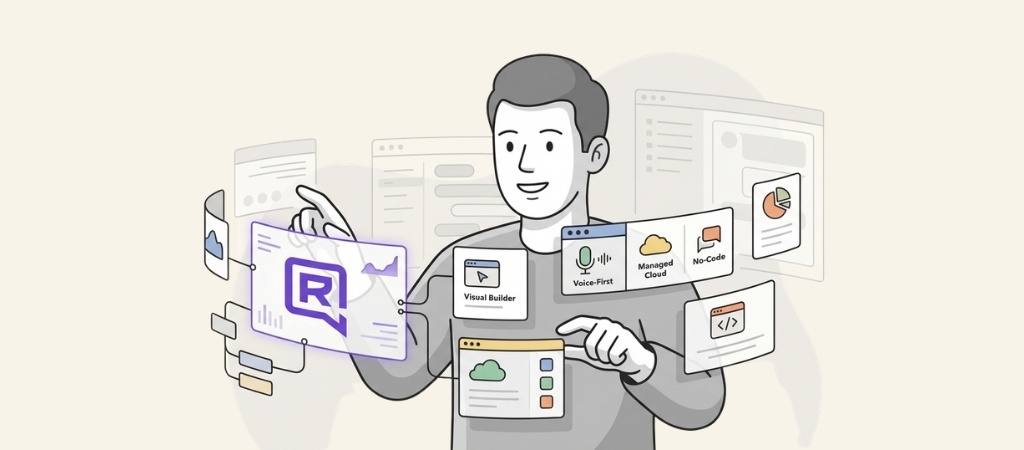
Each one solves a specific pain point, whether you need a visual builder, voice-first architecture, or managed infrastructure.
Editor’s note: Want to hear some sample AI support calls made for your Shopify store?
- Just paste your store URL
- Hear sample calls for your store (no email required)
- Listen to demo calls for my store
What is Rasa and why consider alternatives?
Rasa Open Source is a Python framework for building text and voice-based conversational AI. It uses machine learning to understand user intent and manage dialogue, with a modular architecture that lets you customize every component.
The framework appeals to teams that need:
- Data sovereignty: On-premises deployment for regulated industries
- Customization: Full control over NLU pipelines and dialogue policies
- No vendor lock-in: Open-source code you can modify and extend
But Rasa's strengths are also its weaknesses. The framework requires:
- Python development skills for custom actions and integrations
- DevOps expertise to manage servers, databases, and model training
- Significant time investment to learn concepts like stories, domains, and forms
- Workarounds for voice deployments (stitching STT, Rasa, and TTS creates 1-3 second delays)
Rasa X, the visual interface for managing conversations, is now enterprise-only. Open-source users are left with command-line tools and YAML files.
Rasa alternatives comparison
| Platform | Best for | Deployment | Pricing Model | Key Strength |
|---|---|---|---|---|
| Ringly.io | E-commerce phone support | Cloud | Pay per call, from $99 a month | Up to 90% call resolution rate |
| Botpress | Visual builder + open source | Cloud or self-hosted | 14-day free trial, Plus from $89/mo | Drag-and-drop studio |
| Dialogflow CX | Enterprise contact centers | Cloud | Pay-per-use ($0.007/request) | Visual state machine |
| Dasha.ai | Voice-first applications | Cloud | Starting at $0.08/minute | Sub-second latency |
| Microsoft Bot Framework | Azure ecosystem teams | Cloud | 14-day free trial, premium $0.50/1k messages | Power Virtual Agents integration |
| Amazon Lex | AWS-native applications | Cloud | $0.004/speech request | Native AWS integration |
| OpenAssistantGPT | No-code chatbot deployment | Cloud | 14-day free trial, paid from $18/mo | GPT-5 powered, quick setup |
1. Ringly.io

If your business runs on phone support, Ringly.io offers something Rasa doesn't: an AI agent purpose-built for voice conversations with e-commerce integrations.
the AI, Ringly's AI phone representative, handles inbound calls 24/7. It can look up orders, process returns and exchanges, answer FAQs, and escalate to your team when needed. The platform integrates deeply with Shopify, pulling real-time order data to answer "where's my order" calls without human intervention.
The numbers are compelling: The AI resolves up to 90% of calls without human help, across 30 languages. Setup takes under 1 hour, and you don't need a developer to get started.
| Plan | Price | Included | Best For |
|---|---|---|---|
| Pay per call | $99 a month | 50 conversations, then $1.99 each | Shopify brands taking support calls |
All plans include call recordings, transcripts, and analytics.
Why it beats Rasa: Rasa was architected for text. Building voice bots requires stitching together speech-to-text, Rasa Core, and text-to-speech, introducing latency that kills conversational flow. Ringly is voice-native from the ground up.
Best for: E-commerce businesses using Shopify that want to automate phone support without hiring a development team.
2. Botpress

Botpress delivers what many Rasa users wish they had: open-source flexibility with an actual visual interface.
The platform centers on a drag-and-drop Agent Studio where you build conversation flows without writing code. When you need custom logic, you can inject JavaScript directly into the flow. Botpress runs on LLMz, a custom inference engine that coordinates agent behavior, manages memory, and executes code in a sandboxed environment.
Knowledge bases are straightforward: upload documents, connect websites, or create tables of structured data. The AI can answer questions from these sources, with support for visual content like images and diagrams in higher tiers.
| Plan | Price | What's Included |
|---|---|---|
| Pay-as-you-go | $0/mo | 1 bot, 500 messages/mo, $5 monthly AI credit, community support |
| Plus | $89/mo ($79 annual) | 2 bots, 5,000 messages, human handoff, watermark removal, live chat support |
| Team | $495/mo ($445 annual) | 3 bots, 50,000 messages, RBAC, real-time collaboration, priority support |
| Managed | $1,495/mo ($995 annual) | Custom development, dedicated success manager, strategy calls, custom onboarding |
AI spend (LLM tokens) is charged at provider cost without markup. The pay-as-you-go plan includes $5 monthly credit; paid plans have higher limits.
Why it beats Rasa: You get the same open-source promise (with self-hosting options via v12) but with a visual builder that non-technical team members can actually use. No YAML files required.
Best for: Teams that want open-source flexibility without the infrastructure headaches, or those missing Rasa X's visual interface.
3. Dialogflow CX
Google's Dialogflow CX (part of Conversational Agents) takes a different approach from Rasa's machine learning-based dialogue management. It uses a visual state machine that makes complex flows easier to visualize and audit.
The platform supports two agent types:
- Flows: Deterministic agents built with intents and flows using traditional NLU
- Playbooks: Generative agents built with natural language instructions
You can combine both in hybrid agents, using Flows for predictable paths and Playbooks for open-ended conversations.
| Agent Type | Chat Pricing | Voice Pricing |
|---|---|---|
| Flows (Deterministic) | $0.007 per request | $0.001 per second |
| Playbooks (Generative) | $0.012 per request | $0.002 per second |
Data store storage (for knowledge bases) costs $5 per GiB beyond the free 10 GiB monthly quota.
New users get $600 credit for Flows and $1,000 for Playbooks, valid for 12 months.
Why it beats Rasa: The visual state machine is easier to audit than ML-based dialogue policies, which banks and telcos prefer for compliance. Plus, Google manages the infrastructure.
Best for: Large contact centers in regulated industries that need visual flow auditing and already use Google Cloud.
4. Dasha.ai
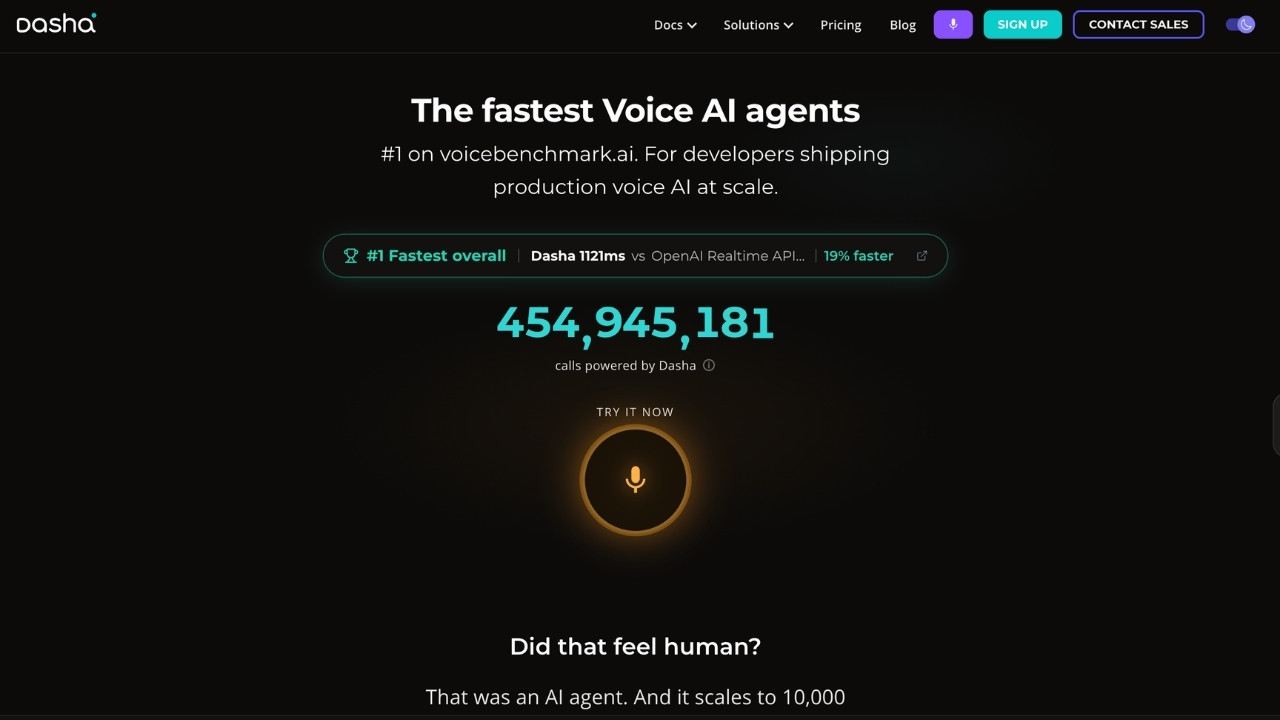
Dasha is built for one thing: voice AI that actually sounds human. The platform ranks #1 on voicebenchmark.ai for latency, with response times of 1092ms compared to competitors at 1919ms or higher.
The difference is architecture. Rasa voice bots require chaining speech-to-text, processing through Rasa Core, then text-to-speech, creating 1-3 second delays. Dasha processes the entire loop natively in milliseconds.
The platform also handles interruptions gracefully. If a user speaks over the AI, it stops immediately, no complex barge-in logic required.
| Plan | Price | Includes |
|---|---|---|
| Developer | Free | 1,000 free minutes/mo, 1 concurrent call, full API access, email support |
| Growth | $0.08/minute* | Unlimited concurrent calls, 99.99% uptime SLA, private channel priority support |
| *Growth plan pricing is all-inclusive except for VoIP/telephony costs and external LLM tokens if using your own model. | ||
Billing is per-second with no rounding up. Failed call attempts aren't charged.
Why it beats Rasa: Purpose-built voice infrastructure versus Rasa's text-first architecture adapted for voice. The latency difference is the gap between natural conversation and robotic exchanges.
Best for: Developers building voice-first applications (SDRs, phone support) who are tired of fighting latency in custom stacks.
5. Microsoft Bot Framework
If you like Rasa's code-first approach but hate managing infrastructure, Microsoft's Bot Framework is the logical pivot. It offers similar granular control over conversation logic using C# or Node.js SDKs, but handles hosting, scaling, and channel connections for you.
The framework integrates with Power Virtual Agents, letting non-technical team members contribute through a no-code interface while developers handle complex logic in code.
| Channel Type | Free Tier (F0) | S1 Tier (Paid) |
|---|---|---|
| Standard Channels* | Unlimited messages | Unlimited messages |
| Premium Channels** | 10,000 messages/month | $0.50 per 1,000 messages |
|
*Standard: Microsoft Teams, Slack, Telegram, etc. **Premium: Web Chat, Direct Line (including speech), and specialized enterprise connectors. |
||
Standard channels include Teams, Skype, Facebook, and Slack. Premium channels are for custom web chat and Direct Line.
You'll also pay for underlying Azure resources (App Service, Application Insights, LUIS, etc.), so actual costs depend on your architecture.
Why it beats Rasa: Same developer control without the infrastructure management. The integration with Entra ID and Microsoft 365 is seamless if you're already in the Azure ecosystem.
Best for: Enterprise teams already paying for Azure who want code-level flexibility with managed infrastructure.
6. Amazon Lex
Amazon Lex is AWS's service for building conversational interfaces. It provides the same deep learning capabilities that power Alexa: automatic speech recognition and natural language understanding.
The platform offers two interaction models:
- Request/response: Each user input is a separate API call
- Streaming conversation: Continuous listening with proactive responses
Streaming is particularly interesting for voice applications. The bot can send periodic messages like "Take your time" while waiting for user input, keeping the conversation alive naturally.
| Interaction Type | Pricing (USD) | Details |
|---|---|---|
| Speech Request | $0.004 per request | Standard request/response; up to 15s of audio per input. |
| Text Request | $0.00075 per request | Standard request/response for text-based chatbots. |
| Streaming Speech | $0.0065 per 15s interval | Continuous bi-directional audio; billed per 15s (rounded up). |
| Streaming Text | $0.002 per request | Continuous text conversation; billed per input request. |
| Free Tier (First 12 months): 10,000 text and 5,000 speech requests/intervals per month. | ||
The automated chatbot designer analyzes conversation transcripts to generate bot designs, costing $0.50 per minute of training time.
New AWS customers get up to $200 in Free Tier credits.
Why it beats Rasa: Native integration with Lambda, Connect, and the broader AWS ecosystem. No server management, and ASR is built-in, not bolted on.
Best for: Teams already building on AWS, especially those using Amazon Connect for contact center operations.
7. OpenAssistantGPT
OpenAssistantGPT is the fastest path from idea to deployed chatbot if you don't have technical expertise. The platform uses GPT-4 to power conversations, with a no-code setup that replaces weeks of development with minutes of configuration.
Building a bot is straightforward: connect your OpenAI API key, use the web crawler to pull content from your site or upload knowledge base files, configure basic settings like name and welcome message, then deploy via HTML snippet to WordPress, Shopify, Wix, or custom sites.
| Plan | Price | What's Included |
|---|---|---|
| Free | $0/mo | 1 chatbot, 1 crawler, 3 files, 1 action, 500 messages/month. |
| Basic | $18/mo | 9 chatbots, 9 crawlers, 27 files, 9 actions, unlimited messages, lead collection. |
| Pro | $54/mo | 27 chatbots, 27 crawlers, 81 files, 27 actions, 5 custom domains, branding removal. |
| Enterprise | Custom | Unlimited assets, SAML/SSO, private deployments, SLA guarantees, premium support. |
The platform also offers an open-source SDK for Next.js and Vercel if you need custom deployment.
Why it beats Rasa: You can deploy a functional chatbot in an afternoon without writing Python or configuring servers. The trade-off is less control over conversation logic.
Best for: Small businesses, marketers, and non-technical teams who need a working chatbot quickly without infrastructure investment.
How to choose the right Rasa alternative
The best choice depends on your team's skills, your deployment requirements, and which channels matter most.
Stay with Rasa if:
- You need air-gapped deployment for regulatory compliance
- You have strong DevOps and Python development resources
- Maximum control over every component is non-negotiable
Choose Botpress if:
- You want open-source flexibility with a visual builder
- Non-technical team members need to manage conversation flows
- You prefer a balance of control and ease of use
Choose Dialogflow CX if:
- You're already invested in Google Cloud
- You need visual auditing for compliance (banking, telecom)
- Your contact center handles thousands of intents
Choose Dasha if:
- Voice is your primary channel
- Latency and natural conversation flow are critical
- You're building phone-based AI agents at scale
Choose Ringly.io if:
- You run an e-commerce store on Shopify
- Phone support is a significant channel for your business
- You want AI handling order lookups, returns, and exchanges
Choose Microsoft Bot Framework if:
- You're an Azure shop
- You need both code-first and no-code options
- Microsoft 365 integration is important
Choose Amazon Lex if:
- You're building on AWS
- You want native integration with Lambda and Connect
- Streaming conversations fit your use case
Choose OpenAssistantGPT if:
- You need a chatbot deployed this week
- You don't have development resources
- GPT-4 powered responses meet your needs
Start building better conversational AI today
Rasa set the standard for open-source conversational AI, but it's not the right fit for every team. Whether you need a visual builder, voice-first architecture, or managed infrastructure, there's an alternative that better matches your requirements.
If phone support is your priority, try Ringly.io for free. the AI can be answering calls in under 1 hour, not months.
Frequently Asked Questions
Which Rasa alternative is best for voice applications?
Dasha.ai is purpose-built for voice with sub-second latency and native handling of interruptions. If you need voice specifically for e-commerce phone support, Ringly.io offers deeper Shopify integration.
Is there a free Rasa alternative?
Botpress offers a generous 14-day free trial with $5 monthly AI credit. OpenAssistantGPT also has a 14-day free trial for small projects. Both let you build functional chatbots without upfront cost.
Can I migrate my Rasa bot to another platform?
There's no automatic migration path. You'll need to rebuild conversation flows in your new platform's format. However, your training data (intents, entities, example phrases) can often be exported and reformatted for import.
Which alternative has the best visual builder?
Botpress and Dialogflow CX both offer excellent visual interfaces. Botpress is more approachable for beginners, while Dialogflow CX's state machine is better for complex enterprise flows.
Do any Rasa alternatives support on-premises deployment?
Botpress v12 supports self-hosting. Most cloud-native alternatives (Dasha, Dialogflow, Lex) don't offer true on-premises deployment, though enterprise plans may include private cloud options.
What's the fastest alternative to set up?
OpenAssistantGPT advertises setup in minutes, and Ringly.io is live in under 1 hour. For e-commerce phone support specifically, Ringly's Shopify integration means you can be handling calls within an hour.