

Botpress has been a go-to choice for building chatbots for years. It's open-source, flexible, and powerful. But here's the catch: most teams that start with Botpress end up looking for alternatives within a few months.
The reason is simple. Botpress was built for developers. If you don't know JavaScript, you're going to hit a wall pretty quickly.
Even simple workflows require coding knowledge, and the learning curve is steep enough that non-technical teams often need to hire developers just to make basic changes.
This guide covers 7 Botpress alternatives that are easier to use, more affordable, or better suited for specific use cases. Whether you need a no-code solution, better social media integration, or true open-source flexibility, there's an option here that fits.
Editor’s note: Want to hear some sample AI support calls made for your Shopify store?
- Just paste your store URL
- Get sample calls in under 20 seconds (no email required)
- Listen to demo calls for my store

What is Botpress and why look for alternatives
Botpress is an open-source conversational AI platform. It lets you build chatbots using a visual flow builder combined with code when you need more control.
The platform supports natural language understanding (NLU), has a built-in JavaScript editor for custom actions, and integrates with popular messaging services like Facebook Messenger and Slack.
The platform is genuinely powerful for technical teams.
You get fine-grained control over conversations, can build complex logic, and aren't locked into proprietary systems. But that power comes with trade-offs.
Here is why most teams start looking elsewhere:
- Coding required: JavaScript knowledge is necessary for anything beyond basic flows
- Complex setup: Getting started takes days or weeks, not minutes
- Limited integrations: Native connections to modern tools are sparse
- Expensive at scale: While the core is free, hosting and scaling costs add up
- Not truly no-code: The visual builder is a starting point, not the full experience
If you have developers on staff and need maximum customization, Botpress might still be the right choice.
For everyone else, the alternatives below offer a smoother path.
How we evaluated these Botpress alternatives
We looked at dozens of chatbot platforms and narrowed them down based on what actually matters when you're switching from Botpress:
Criteria
What We Looked For
Ease of use
True no-code builders that don't require developer help
Pricing
Transparent costs with free tiers to test before committing
AI capabilities
Support for modern LLMs like GPT-4o, Claude, and Gemini
Channel support
Website, WhatsApp, Instagram, Facebook, and beyond
Setup speed
Tools that get you from signup to live chatbot in under an hour
Each alternative on this list solves at least one major pain point that Botpress users commonly face.
Quick comparison: all 7 Botpress alternatives at a glance
| Platform | Best For | Starting Price | Free Plan | Technical Level |
|---|---|---|---|---|
| Voiceflow | Advanced AI agents | $60/month | Yes | Medium |
| Chatbase | AI beginners | $40/month | Yes | Low |
| Manychat | Social media | $15/month | Yes | Low |
| Tidio | All-in-one support | $29/month | Yes | Low |
| Typebot | Open-source flexibility | $39/month | Yes | Medium |
| UChat | Omnichannel | $15/month | Yes | Low |
| Rasa | Developers | Free | Open source | High |
The 7 best Botpress alternatives
1. Voiceflow

Best for: Teams building sophisticated AI agents, especially with voice requirements
Voiceflow started as a voice app builder for Alexa and Google Assistant, but it has evolved into a comprehensive AI agent platform.
If you need advanced conversational AI with telephony support, this is your best bet.
The platform combines a visual drag-and-drop builder with serious AI capabilities. You can connect multiple LLMs including GPT-4o, Claude, and Gemini.
The knowledge base system supports up to 3,000 sources on the Pro plan, which is enough for most business use cases.
What sets Voiceflow apart is its voice and phone support. While most chatbot platforms focus on text, Voiceflow handles voice calls natively.
You get concurrent call handling, telephony integrations, and voice-optimized conversation flows.
Key features:
- Visual conversation builder with AI agent capabilities
- Support for GPT-4o, Claude, and Gemini
- Knowledge base training with up to 3,000 sources
- Voice and telephony support with concurrent call handling
- Multi-agent management for complex deployments
Pros:
- Powerful AI capabilities with multiple LLM options
- Best-in-class voice and phone features
- Good team collaboration with workspaces
- Comprehensive documentation
Cons:
- Higher starting price at $60 per month
- Credit-based pricing can be hard to estimate
- Still has a learning curve for beginners
Pricing:
| Plan | Monthly Price | Credits | Key Limits |
|---|---|---|---|
| Starter | Free | 100 | 1 workspace, 50 knowledge sources, 2 agents |
| Pro | $60 | 10k-20k | 2 workspaces, 3K sources, 20 agents, 5 voice calls |
| Business | $150 | 30k-200k | 5 workspaces, 5K sources, 50 agents, 10 voice calls |
| Enterprise | Custom | Unlimited | Unlimited everything |
Source: Voiceflow pricing
2. Chatbase

Best for: Small businesses wanting AI chatbots without technical complexity
Chatbase is the fastest way to get an AI chatbot running. You upload your website content or documents, and the system trains itself.
Within minutes, you have a chatbot that can answer questions about your business.
The platform shines in its simplicity. There is no flow builder to learn, no complex logic to configure.
You connect your data sources, customize the appearance, and embed the widget on your site. It works across multiple channels including website, WhatsApp, Instagram, Facebook, and Slack.
One standout feature is the Suggestions system. Chatbase automatically identifies knowledge gaps, where the AI couldn't answer a question confidently.
You can review these and add the missing information to improve responses over time.
Key features:
- Train on website content or documents in minutes
- AI Actions for connecting to external tools
- Multi-channel deployment (website, WhatsApp, Instagram, Facebook, Slack)
- Suggestions feature for identifying knowledge gaps
- Multiple LLM options including GPT-4o and Claude
Pros:
- Extremely beginner-friendly setup
- Fastest time to deployment
- Affordable starting price at $40 per month
- Good multi-channel support
Cons:
- No custom chatbot flows
- Limited AI toolset compared to Botpress
- No built-in live chat
- Cannot process images or translate conversations
Pricing:
| Plan | Monthly Price | Messages | Key Limits |
|---|---|---|---|
| Free | $0 | 100/month | 400K characters, 1 chatbot |
| Hobby | $40 | 2,000-4,000 | 11M-14M characters, 2-10 chatbots |
| Standard | $99 | 5,000-10,000 | 25M-36M characters, 5-20 chatbots |
| Unlimited | $399 | Unlimited | 100M-400M characters, 10-40 chatbots |
Source: Chatbase pricing
3. Manychat

Best for: E-commerce brands and influencers focused on Instagram, WhatsApp, and Facebook
Manychat dominates the social media chatbot space. If your customers are on Instagram, Facebook, or WhatsApp, this platform is purpose-built for engaging them.
The core use case is marketing automation. You can automatically reply to Instagram comments and DMs, send WhatsApp broadcasts to your audience, and build Messenger flows that guide customers from first contact to purchase.
The Shopify integration is particularly strong, letting you track orders, recover abandoned carts, and recommend products directly in chat.
What makes Manychat accessible is the template library.
You don't start from scratch. There are pre-built flows for common scenarios like welcome sequences, product recommendations, and customer support handoffs.
Key features:
- Instagram DM and comment automation
- Facebook Messenger bots
- WhatsApp Business API integration
- Broadcast messaging to your audience
- E-commerce integrations with Shopify
- Large template library
Pros:
- Best-in-class social media features
- Very easy to use with minimal learning curve
- Strong e-commerce tools
- Generous free plan up to 1,000 contacts
Cons:
- Limited website chat capabilities
- Less advanced AI than dedicated platforms
- Primarily focused on Meta platforms
Pricing:
| Plan | Monthly Price | Contacts | Key Features |
|---|---|---|---|
| Free | $0 | Up to 1,000 | Basic features, Manychat branding |
| Pro | $15+ | Unlimited | Unlimited flows, no branding, advanced features |
| Business | Custom | Unlimited | Dedicated support, custom onboarding, API access |
Source: Manychat pricing
4. Tidio

Best for: E-commerce stores wanting unified live chat and chatbot support
Tidio combines three tools into one platform: live chat, chatbots, and a helpdesk ticketing system.
For e-commerce stores, this integration is valuable because you can handle pre-sale questions, support requests, and marketing outreach from a single dashboard.
The platform's AI, called Lyro, handles automated responses. It can answer common questions, qualify leads, and route complex issues to human agents.
The visual chatbot builder is intuitive, letting you create flows for different scenarios like abandoned cart recovery or order tracking.
Tidio's chat widgets are among the best-looking in the industry.
They feel native to your site, with extensive customization options for colors, positioning, and behavior.
Key features:
- Live chat and chatbot combination
- Lyro AI for automated responses
- Visual chatbot builder
- Helpdesk ticketing system
- Visitor tracking and analytics
- Beautiful, customizable chat widgets
Pros:
- Complete support solution in one tool
- Excellent e-commerce features
- Professional chat widget designs
- Good value for the feature set
Cons:
- AI less advanced than dedicated AI platforms
- Can get expensive with add-ons
- Limited customization for complex conversational flows
Pricing:
| Plan | Monthly Price | Lyro Conversations | Key Limits |
|---|---|---|---|
| Free | $0 | 50 | 3 chatbot flows, 100 live chat conversations |
| Starter | $29 | 100 | Unlimited flows, 500 live chat conversations |
| Growth | $59 | 2,500 | Advanced analytics, visitor tracking |
| Tidio+ | $749 | Custom | Custom AI training, dedicated success manager |
Source: Tidio pricing
5. Typebot
Best for: Privacy-conscious teams and developers wanting open-source flexibility
Typebot is the open-source alternative that actually delivers on the no-code promise.
Unlike Botpress, which requires coding for advanced features, Typebot lets you build complex conversational flows entirely through its visual builder.
The platform focuses on conversational UI rather than just AI.
You can create forms that feel like natural conversations, with conditional logic, branching paths, and personalized responses based on user input. The theming options are extensive, letting you match your brand perfectly.
The self-hosting option is a major differentiator. If you need data control for compliance reasons (GDPR, HIPAA), you can host Typebot on your own infrastructure.
The open-source nature also means no vendor lock-in.
Key features:
- Visual drag-and-drop builder with conditional logic
- GPT-4o, Claude, and Gemini integration
- Advanced theming and branding control
- Self-hosting option for data control
- Webhook and API access
- Native integrations with Google Sheets, Zapier, and Make
Pros:
- Open-source with no vendor lock-in
- Deep customization options
- Self-hosting for compliance
- Intuitive visual builder
Cons:
- No native WhatsApp or Messenger support (web-based)
- Learning curve for webhooks and APIs
- Smaller ecosystem than commercial alternatives
Pricing:
| Plan | Monthly Price | Chats | Key Limits |
|---|---|---|---|
| Free | $0 | 200/month | 1 seat, Typebot branding |
| Starter | $39 | 2,000 | 2 seats, custom domain |
| Pro | $99 | 10,000 | 5 seats, priority support |
| Business | $199 | 50,000 | 10 seats, dedicated support |
| Enterprise | Custom | Unlimited | Unlimited seats, SLA |
Source: Typebot pricing
6. UChat

Best for: Agencies and businesses needing presence across many channels
UChat is the Swiss Army knife of chatbot platforms. It supports 15+ channels including WhatsApp, Instagram, Messenger, Telegram, TikTok, and more.
If you need to be everywhere your customers are, UChat makes it manageable from a single platform.
The platform has evolved significantly, now offering AI Agent capabilities alongside its traditional flow-based builder.
You can create AI-powered conversations that handle sales, support, and marketing across all your channels simultaneously.
For agencies, the white-label options and template marketplace are valuable.
You can build flows once and deploy them across multiple client accounts, or sell your own templates to other UChat users.
Key features:
- 15+ channel support including TikTok
- Visual flow builder with AI Agent capabilities
- Template marketplace
- Voiceflow integration
- White-label options for agencies
- E-commerce integrations
Pros:
- True omnichannel experience
- Most affordable pricing on this list
- Good template library
- Agency-friendly features
Cons:
- Interface less polished than competitors
- AI capabilities require third-party integration for advanced features
- Smaller community for support
Pricing:
| Plan | Monthly Price | Conversations | Key Limits |
|---|---|---|---|
| Free | $0 | 1,000 | 1 workspace, basic features |
| Business | $15 | 5,000 | 3 workspaces, premium integrations |
| Agency | $30 | Unlimited | Unlimited workspaces, white-label |
| Enterprise | Custom | Custom | Custom limits, dedicated support |
Source: UChat pricing
7. Rasa
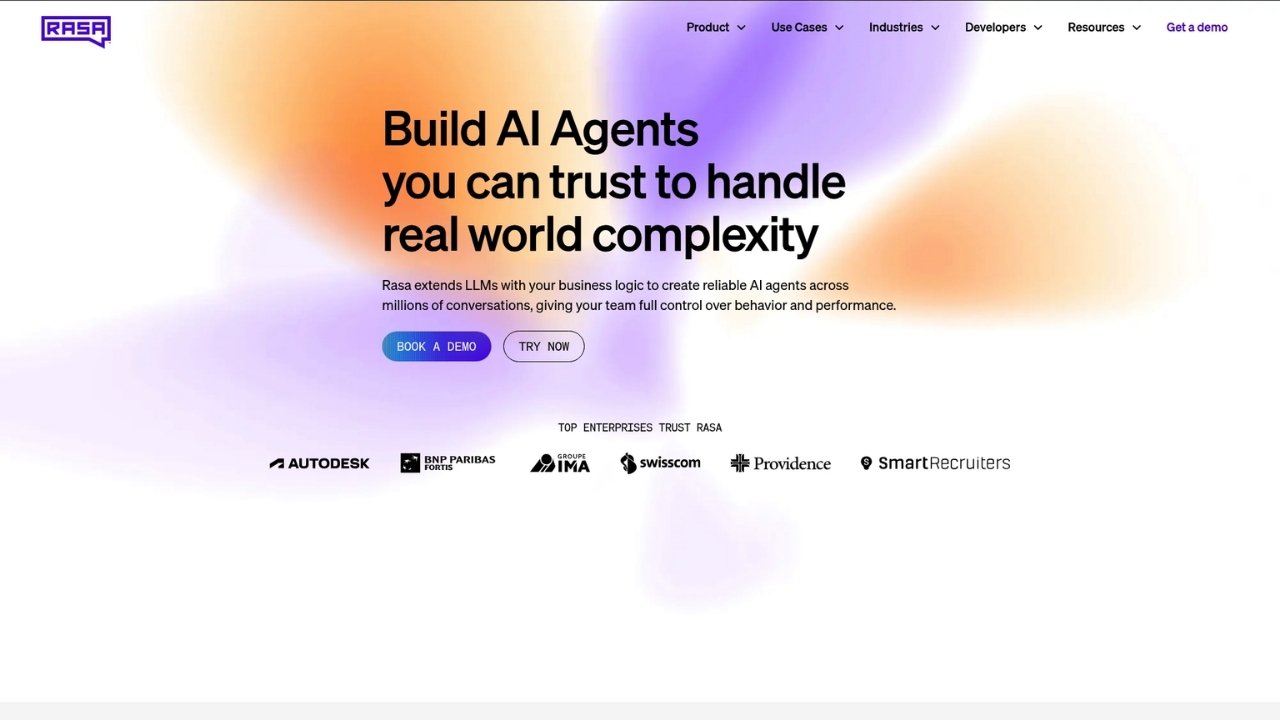
Best for: Development teams with Python skills needing maximum control
Rasa is the most technical option on this list, and it is the only one that truly rivals Botpress for developer control. It is an open-source framework for building sophisticated conversational AI using Python.
Unlike the other alternatives, Rasa has no visual builder. You write code. This means unlimited flexibility but also a significant learning curve.
You need Python development skills, and you are responsible for hosting and infrastructure.
The trade-off is worth it for some teams.
You get complete control over the NLU pipeline, can fine-tune models for your specific use case, and never hit platform limitations. Large enterprises with strict data requirements often choose Rasa for its on-premise deployment options.
Key features:
- Open-source NLU and dialogue management
- Python-based development
- On-premise deployment
- Custom AI model training
- Enterprise security features
- Multi-language support
Pros:
- Completely free and open-source
- Maximum customization possible
- No usage limits or platform restrictions
- Enterprise-grade security
Cons:
- Requires Python development skills
- Steep learning curve
- No visual builder
- Self-hosting infrastructure required
Pricing:
| Plan | Price | Support | Open Source |
|---|---|---|---|
| Free (Developer Edition) | $0 | Community support (Forum) | Yes (Apache 2.0) |
| Growth | Starting at $35k/year | Basic support | No (Rasa Pro/Platform) |
| Enterprise | Custom | Production support, SLA, professional services | No (Rasa Pro/Platform) |
Source: Rasa pricing
How to choose the right Botpress alternative for your needs
With seven solid options, the choice depends on your specific situation. Here is a simple decision framework:
Choose Voiceflow if: You need advanced AI with voice and phone capabilities, and you have the budget for a premium solution.
Choose Chatbase if: You want the fastest path to a working AI chatbot without any technical complexity.
Choose Manychat if: Your business lives on Instagram, Facebook, or WhatsApp, and social media engagement is your priority.
Choose Tidio if: You want a complete support solution combining live chat, chatbots, and ticketing in one tool.
Choose Typebot if: You value open-source flexibility and need data control for compliance reasons.
Choose UChat if: You need to deploy across many channels affordably, or you are an agency managing multiple clients.
Choose Rasa if: You have Python developers and need maximum control without platform limitations.
Migration tip: Whichever platform you choose, plan for a transition period.
Export your Botpress conversation data if possible, and be prepared to retrain your AI on the new platform.
Most teams find the switch pays off within the first month due to reduced maintenance time.
Why Ringly.io is different from Botpress
While Botpress builds text chatbots for websites, Ringly.io specializes in AI phone support for e-commerce businesses.
The distinction matters because phone and chat are fundamentally different channels with different customer expectations.
Botpress requires technical setup and ongoing developer involvement. Ringly.io sets up within an hour for most stores with no coding required.
You connect your Shopify store, choose a phone number, and the AI agent the AI starts handling calls immediately.
The platform is built specifically for e-commerce workflows.
the AI can look up orders, process returns and exchanges, answer product questions, and escalate complex issues to your team.
It resolves 70-73% of calls without human intervention, which translates directly to cost savings.
If your customers prefer phone support, or if you are looking to add phone as a channel without hiring a call center team, Ringly.io is worth considering alongside these chatbot alternatives.
Final thoughts: finding your perfect chatbot platform
Botpress is a capable platform for technical teams, but it is not the right fit for everyone.
The steep learning curve and coding requirements push many businesses toward alternatives that offer faster setup and easier maintenance.
The seven platforms covered here represent the best options for different use cases.
Each one solves specific pain points that Botpress users commonly face, whether that is ease of use, pricing, channel support, or AI capabilities.
Start with the free trials. Most of these platforms let you test before committing, and hands-on experience beats any comparison guide.
The right tool is the one that your team can actually use to improve customer experience without creating new headaches.
Frequently Asked Questions
What are the best Botpress alternatives for beginners?
Chatbase and Manychat are the most beginner-friendly Botpress alternatives. Both offer intuitive interfaces, generous free plans, and require no coding knowledge to get started.
Are there any free Botpress alternatives?
Yes, several Botpress alternatives offer free plans. Rasa is completely free and open-source. Manychat, Chatbase, Tidio, Typebot, UChat, and Voiceflow all offer free tiers with varying limitations.
Which Botpress alternative is best for e-commerce?
Manychat and Tidio are both excellent for e-commerce. Manychat excels at social media engagement and Shopify integration, while Tidio offers a complete support solution with live chat and chatbots combined.
What is the most affordable Botpress alternative?
UChat and Manychat both start at $15 per month, making them the most affordable paid options. Rasa is free if you have the technical resources to self-host.
Can I migrate my Botpress chatbot to another platform?
Direct migration is not possible because each platform uses different formats and architectures. However, you can export your conversation data and training examples from Botpress, then import them into your new platform. Expect to spend time rebuilding flows and retraining AI models.
Which Botpress alternative has the best AI capabilities?
Voiceflow offers the most advanced AI capabilities among these alternatives, with support for multiple LLMs (GPT-4o, Claude, Gemini), extensive knowledge base features, and voice/telephony AI support.
Is there an open-source Botpress alternative?
Yes, Rasa and Typebot are both open-source alternatives to Botpress. Rasa is code-based and requires Python skills, while Typebot offers a visual no-code builder with optional self-hosting.
Also read: