

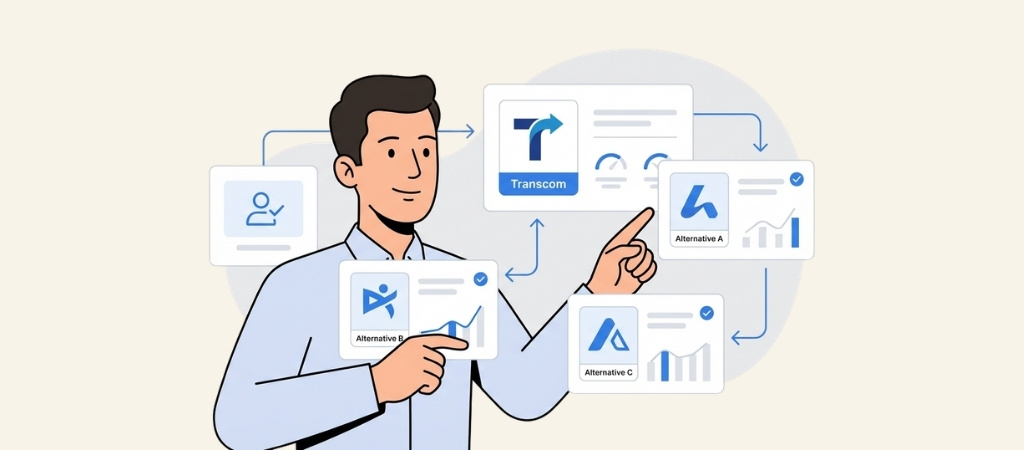
Transcom has built a solid reputation as a global customer experience provider, but it is not the right fit for every business.
Whether you are looking for better US coverage, different industry expertise, or more competitive pricing, several strong alternatives exist.
This guide breaks down the 7 best Transcom alternatives, comparing their strengths, weaknesses, and ideal use cases to help you find the right outsourcing partner.
Editor’s note: Want to hear some sample AI support calls made for your Shopify store?
- Just paste your store URL
- Get sample calls in under 20 seconds (no email required)
- Listen to demo calls for my store
What is Transcom?
Transcom is a global customer experience specialist founded in 1995.
The company operates over 90 contact centers across 28 countries, employing more than 33,000 people who handle customer care, sales, technical support, and collections.
The company has built particular strength in e-commerce, fintech, and gaming verticals.
With 60+ language capabilities and European headquarters, Transcom serves as a strong partner for businesses targeting European markets or needing multilingual support.
However, Transcom's Europe-centric operations can create challenges for US-based businesses.
The company's GDPR compliance focus (European data regulations) may not align with US healthcare requirements like HIPAA.
Additionally, US coverage often depends on global routing rather than dedicated American teams.
Why consider Transcom alternatives?
Businesses look beyond Transcom for several practical reasons:
Geographic coverage needs. If your customers are primarily in the US, you may want a provider with stronger American presence and native cultural understanding.
Compliance requirements. Healthcare companies need HIPAA compliance, which requires US-focused providers rather than European GDPR-focused operations.
Industry specialization. While Transcom excels at e-commerce and fintech, other providers offer deeper expertise in healthcare, insurance, or utilities.
Contract flexibility. Some businesses prefer month-to-month arrangements or shorter commitments than traditional BPO contracts.
Technology preferences. Different providers invest in different AI and automation capabilities. Your tech stack might align better with a competitor's platform.
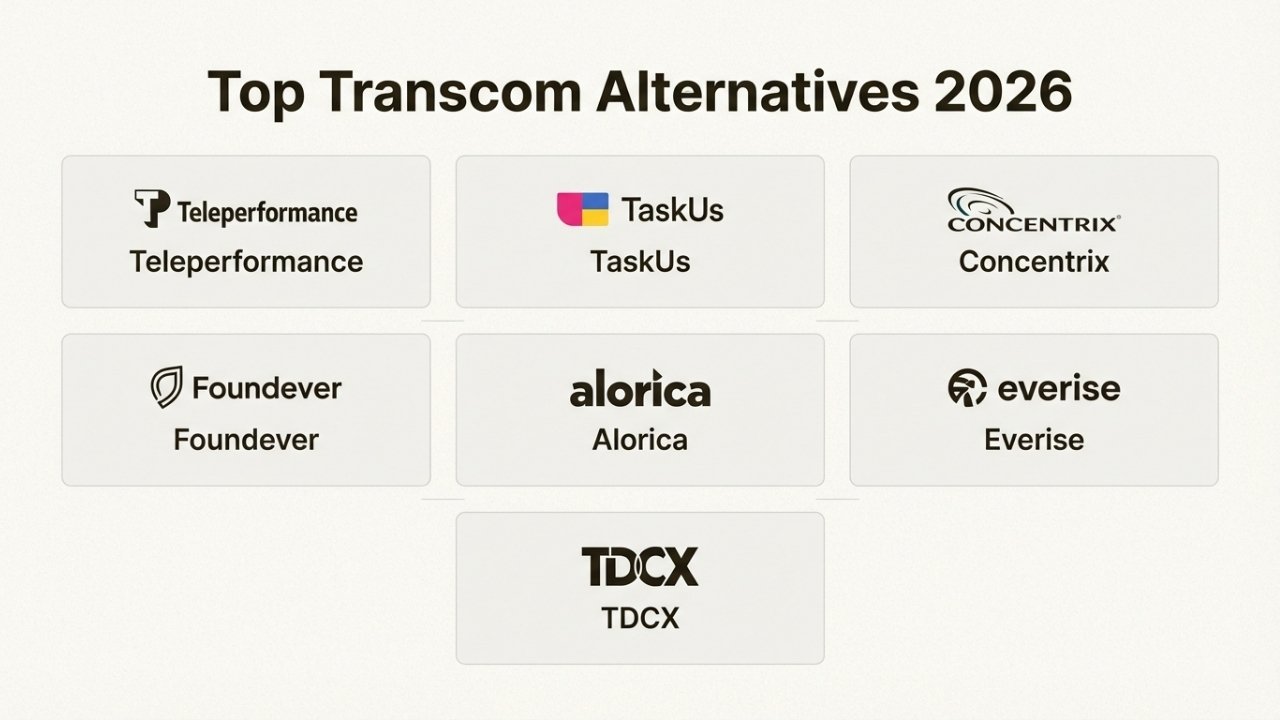
Transcom alternatives comparison
| Company | Founded | Employees | Countries | Languages | Best For |
|---|---|---|---|---|---|
| TP (Teleperformance) | 1978 | 410,000+ | 199 | 300+ | Global enterprises |
| TaskUs | 2008 | 11,665+ | 13 | 30+ | Tech startups |
| Concentrix | 1983 | 290,000+ | Global | Multiple | Large enterprises |
| Foundever | 1985 | 170,000+ | 45 | 60+ | Omnichannel scale |
| Alorica | 1999 | 100,000+ | Global | Multiple | Digital-first CX |
| Everise | 2016 | 29,468+ | 11 | Multiple | Healthcare/regulated |
| TDCX | 2011 | 19,000+ | 37 | 50+ | Asia-Pacific |
The 7 best Transcom alternatives
1. TP (Teleperformance)

TP stands as the largest player in the customer experience outsourcing space.
Founded in 1978, the company has nearly five decades of experience serving 170 countries with over 410,000 employees speaking 300+ languages and dialects.
The scale is genuinely unmatched. TP maintains a presence in 199 countries and claims that over 100% of Forbes' Top 100 companies are clients.
This global footprint matters if you need to support customers across multiple continents without managing multiple vendors.
TP has also invested heavily in AI through its TP.ai platform.
The company's "FAB Connect" orchestrated AI approach combines advanced technology with human reasoning.
According to their data, this has delivered results like 110% increases in NPS for consumer electronics companies and 76% improvement in sales conversions for tech companies.
The main downside? TP's massive size can mean less flexibility for smaller clients.
If you are a mid-market company, you might get lost in the shuffle or face longer implementation timelines.
Best for: Enterprises needing true global coverage and those undergoing digital transformation at scale.
Pros:
- Unmatched global scale and language coverage
- Proven AI platform with measurable results
- Decades of operational experience
- Strong employee culture scores (89/100 on Comparably)
Cons:
- Large size may reduce agility for smaller clients
- Complex organization structure
- Premium pricing compared to mid-market alternatives
2. TaskUs
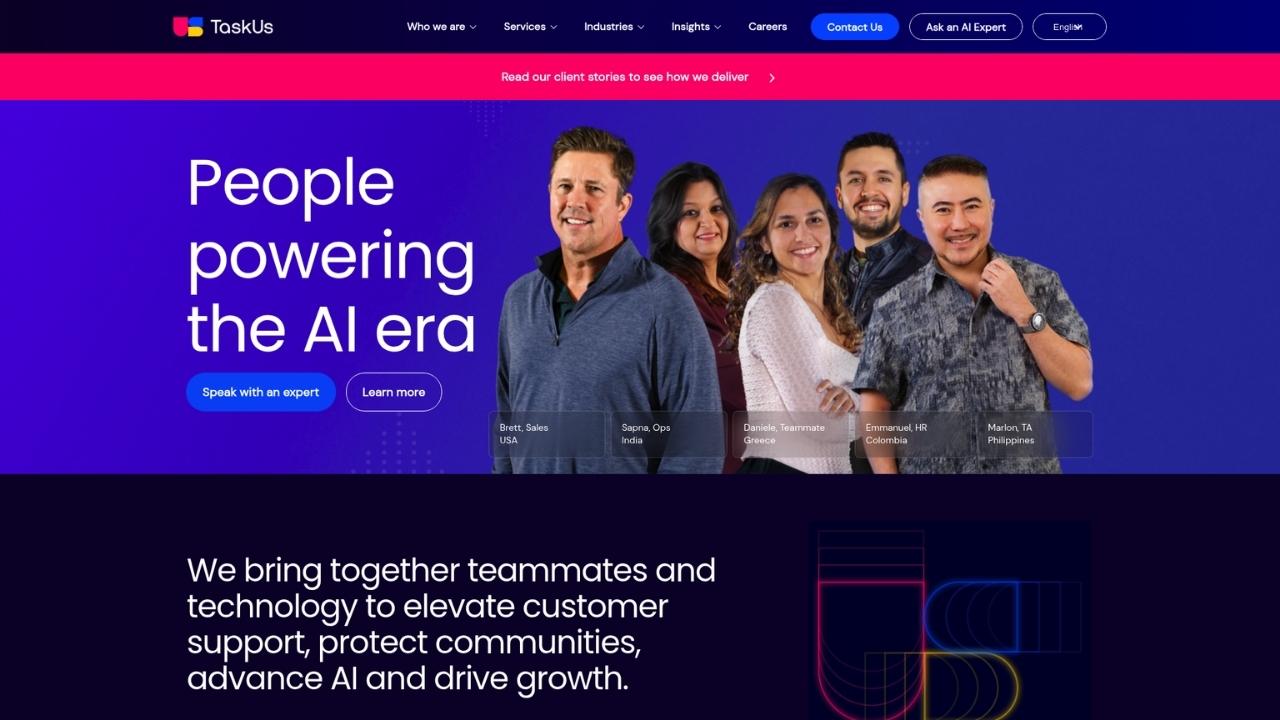
TaskUs represents the modern approach to outsourcing.
Founded in 2008, the company has grown rapidly by focusing on tech-forward companies and digital-first brands.
Unlike legacy BPOs, TaskUs positions itself as a partner for "ridiculously good" customer experiences.
The company operates across 13 countries with 30+ languages, including strategic locations in the US (Texas), Ireland, and throughout Asia.
TaskUs has built particular strength in trust and safety operations, content moderation, and AI data services.
Many social media platforms and sharing economy companies rely on TaskUs for these specialized functions.
What sets TaskUs apart is culture. The company consistently ranks highly on Comparably, with recent awards including Best Company Outlook 2025, Best Diversity 2025, and Best Company for Women 2025.
This matters because happier employees typically deliver better customer experiences.
TaskUs also leads on AI enablement. The company's "Agentic AI" approach emphasizes AI that acts while humans decide, rather than replacing human judgment entirely.
Best for: High-growth technology companies, startups, and businesses needing trust and safety expertise.
Pros:
- Modern, agile approach to outsourcing
- Excellent employee culture and retention
- Strong tech and AI capabilities
- Specialized expertise in content moderation
- HIPAA and PCI-DSS Level 1 compliant
Cons:
- Smaller scale than legacy providers
- May lack presence in some geographic markets
- Premium pricing for specialized services
3. Concentrix

Concentrix operates as a technology and services leader powering over 2,000 of the world's best brands.
With 290,000+ employees and $10B+ in revenue, the company ranks among the largest CX providers globally.
The company spun out as an independent entity in 2020 after decades as a subsidiary, giving it both established operational expertise and modern agility.
Concentrix positions itself as an "intelligent transformation partner" rather than just a contact center provider.
Concentrix offers end-to-end solutions spanning strategy and design, data and analytics, enterprise technology, and digital operations.
This comprehensive approach appeals to large enterprises that want a single partner for CX transformation rather than point solutions.
The company's iX Hero platform represents its AI play: an agentic AI app built specifically for contact centers that brings the entire advisor workflow into one AI-powered workspace.
Best for: Large enterprises needing comprehensive CX transformation and those wanting integrated technology services.
Pros:
- Massive scale with global reach
- Comprehensive service portfolio
- Strong technology and AI capabilities
- Deep industry expertise across verticals
- Public company with financial transparency
Cons:
- Complex organization structure
- May be overkill for smaller businesses
- Longer implementation for comprehensive solutions
4. Foundever
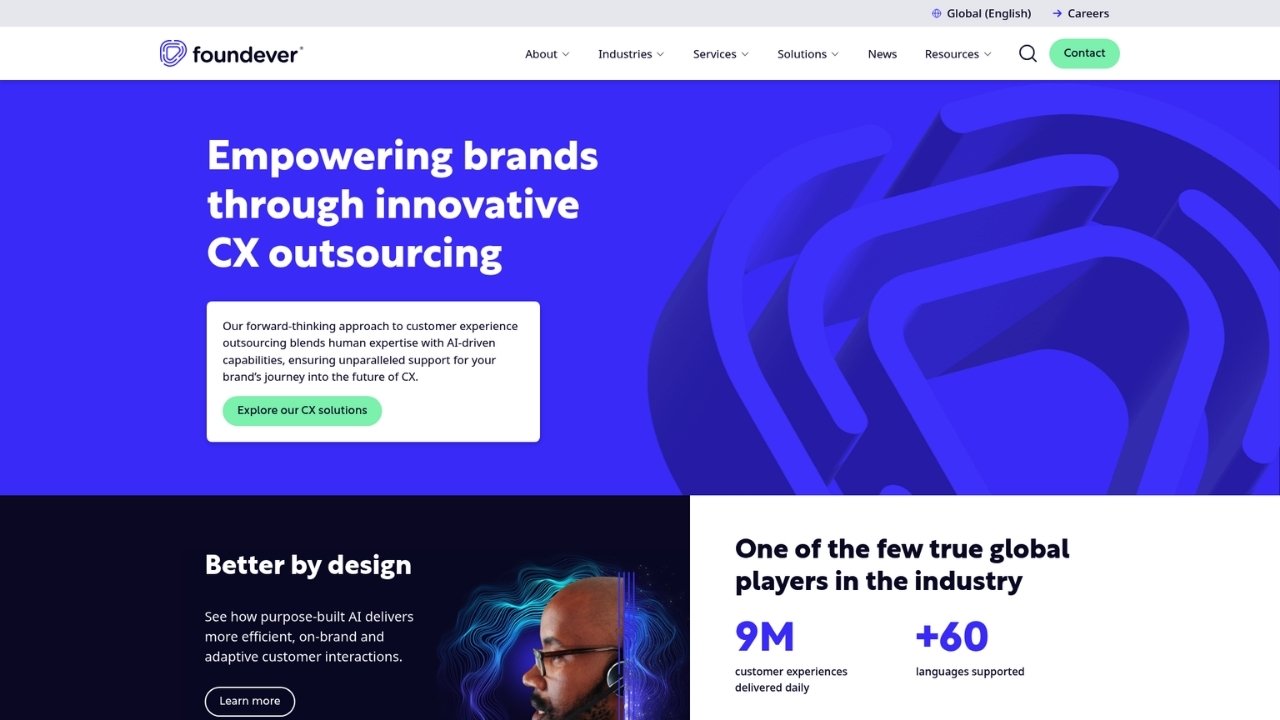
Foundever emerged from the 2021 merger of Sitel Group and SYKES, creating one of the industry's largest players with 170,000+ associates across 45 countries.
The company delivers 9 million customer experiences daily in 60+ languages.
The merger created interesting dynamics. SYKES brought decades of US-based operations (founded 1977), while Sitel contributed European strength and digital capabilities.
The combined entity positions itself as a "founder-led" organization with an entrepreneurial culture, despite its massive scale.
Foundever emphasizes purpose-built AI that delivers efficient, on-brand, and adaptive customer interactions.
The company specifically targets brands wanting omnichannel support at scale, supporting everything from traditional phone to digital messaging and social media.
One notable advantage: Foundever's size means it can handle massive volume spikes and complex global programs that would overwhelm smaller providers.
Best for: Global brands needing omnichannel support at scale and those requiring massive capacity.
Pros:
- Huge scale (170K+ associates)
- 9M+ daily customer conversations
- Strong omnichannel capabilities
- Founder-led entrepreneurial culture
- Global delivery network
Cons:
- Lower customer NPS scores compared to competitors
- Complex merger integration ongoing
- May feel impersonal for smaller clients
5. Alorica
Alorica has built its reputation over 25+ years as a "digital-first, people-focused" customer experience provider.
With 100,000+ employees, the company sits in the sweet spot between boutique agencies and massive global BPOs.
The company emphasizes technology integration through its Alorica IQ platform, which combines AI, automation, and analytics to optimize customer interactions.
Alorica was named a 2026 BIG Innovation Award winner for this technology focus.
Alorica serves diverse industries including retail, financial services, healthcare, technology, and travel.
The company's size allows it to offer competitive pricing while maintaining enough scale for enterprise clients.
Employee culture is a stated priority. Alorica's MLBA (Making Lives Better with Alorica) employee-led nonprofit raised $10 million over its first decade, suggesting engaged teams.
Best for: Mid-market companies seeking value and flexibility, digital-first brands wanting technology integration.
Pros:
- Competitive pricing
- Strong digital and AI capabilities
- 25+ years of CX expertise
- Flexible engagement models
- Award-winning innovation
Cons:
- Lower employee NPS than top competitors
- Less global scale than TP or Concentrix
- Brand recognition still building
6. Everise
Everise takes a different approach by specializing in regulated industries.
While competitors spread across all verticals, Everise focuses heavily on healthcare, insurance, and utilities.
The company handles 294 million customer experiences annually across 11 locations.
The specialization shows in the numbers: 80% of Everise's 29,468+ agents focus on regulated industries.
This means deeper expertise in compliance requirements, industry terminology, and the specific challenges these sectors face.
Everise has invested significantly in AI through its EverAI platform, offering digital and AI-enabled capabilities for self-service, automation, and agent assistance.
The company positions itself as simplifying complexity for regulated industries.
For healthcare specifically, Everise offers end-to-end patient experience management from appointment scheduling to ongoing support.
For insurance, the company handles policy servicing, licensed sales, claims intake, and technical assistance.
Best for: Healthcare organizations, insurance companies, utilities, and any business in regulated industries.
Pros:
- Deep expertise in regulated industries
- 80% of agents specialize in compliance-heavy sectors
- EverAI platform for intelligent automation
- Strong healthcare and insurance capabilities
- HIPAA compliance
Cons:
- Smaller scale than major competitors
- Limited geographic presence (11 locations)
- Less suited for non-regulated industries
7. TDCX
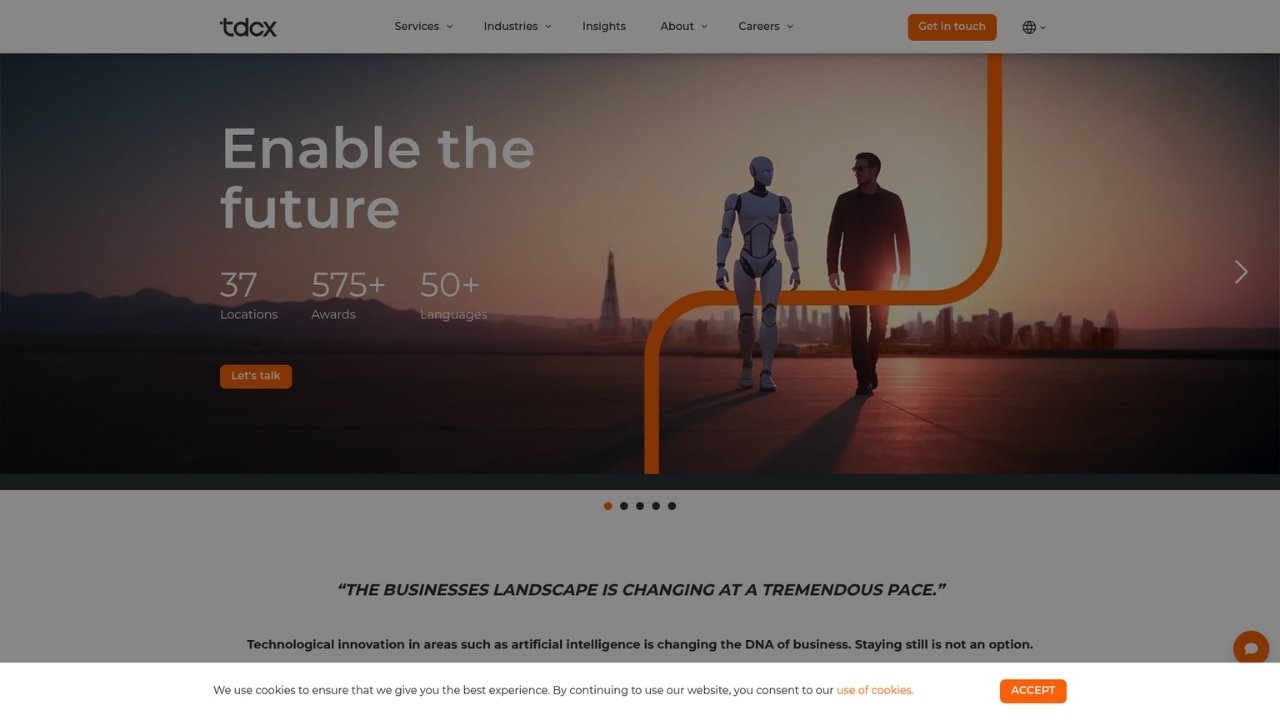
TDCX built its reputation as the go-to partner for Asia-Pacific expansion.
Founded in 2011 and publicly traded on the NYSE, the company operates 37 locations across Asia, Europe, and the Americas with 50+ language capabilities.
The company differentiates through what it calls "high-touch, right-sized" service.
Rather than massive scale, TDCX emphasizes personalized attention from dedicated teams.
This appeals to companies wanting boutique service with enough scale for growth.
TDCX has developed particular strength in fintech, gaming, digital advertising, and travel verticals.
The company's Asia-Pacific expertise makes it the preferred partner for Western companies expanding into Asian markets or Asian companies going global.
The company has won 575+ awards and emphasizes its "sweet spot for successful partnerships" positioning.
Best for: Companies expanding into Asia-Pacific, fintech and gaming companies, businesses wanting high-touch service.
Pros:
- Unmatched Asia-Pacific expertise
- High-touch, personalized service model
- Strong in fintech, gaming, and digital advertising
- Public company with financial transparency
- 575+ industry awards
Cons:
- Limited Western market presence
- Smaller scale than global leaders
- Less suited for primarily US/European operations
How to choose the right Transcom alternative
Selecting a BPO partner depends on matching their strengths to your specific needs. Here is a simple framework:
Geographic requirements. If you need true global coverage, TP or Concentrix make sense.
For US-focused operations, TaskUs or Alorica work well. For Asia-Pacific expansion, TDCX is the clear choice.
Industry specialization. Healthcare and insurance companies should strongly consider Everise.
E-commerce and tech companies fit well with TaskUs or Transcom itself. Financial services work across multiple providers but align well with TDCX's fintech expertise.
Scale needs. Enterprise programs with millions of monthly interactions need TP, Concentrix, or Foundever.
Mid-market companies often get better service from Alorica or TaskUs.
Compliance requirements. Healthcare requires HIPAA compliance, which Everise, TaskUs, and Alorica provide.
Financial services need PCI-DSS compliance, available from most major providers.
Switching from Transcom: what to expect
If you decide to switch providers, plan for a 30-90 day transition period. The process typically involves:
Data migration. Transferring customer histories, knowledge bases, and operational data to the new provider.
Training and knowledge transfer. Your new partner needs to learn your products, policies, and brand voice. This takes time but pays dividends in service quality.
Parallel operations. Many companies run both providers simultaneously during transition to ensure continuity.
Relationship management. Keep communication channels open between your team, Transcom, and your new provider during handoff.
A modern alternative: AI-powered phone support
Before committing to a traditional BPO contract, consider whether AI phone agents might handle a significant portion of your call volume.
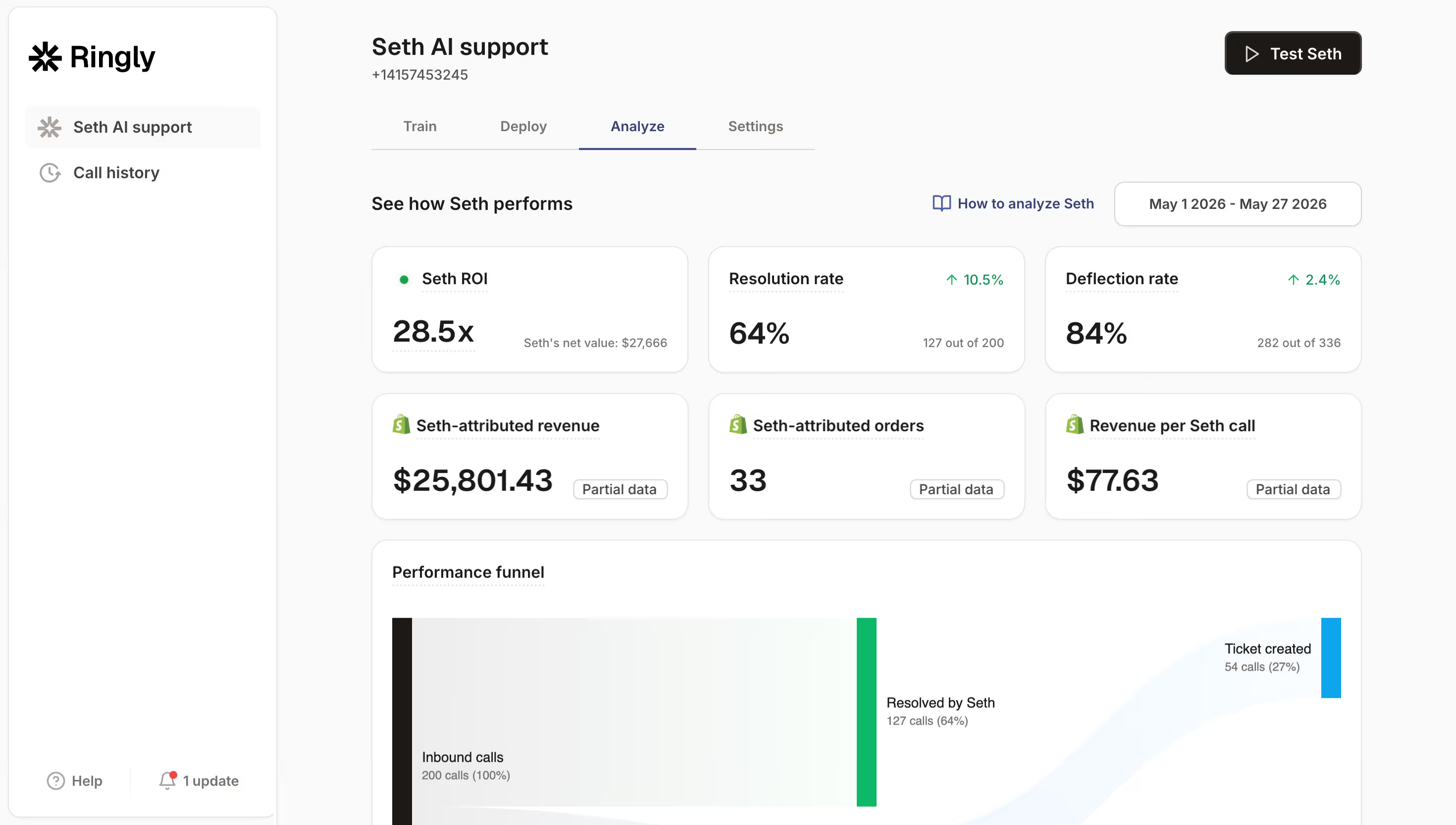
At Ringly.io, we have built the AI, an AI phone support representative that handles inbound customer calls 24/7.
the AI answers questions, looks up orders, processes returns and exchanges, and escalates to humans only when necessary.
The system integrates natively with Shopify and resolves approximately 73% of calls without human intervention.
For e-commerce businesses, this often means handling routine "where is my order" calls automatically while reserving human agents for complex issues.
You can start a free trial here and see how AI phone support compares to traditional outsourcing.
Frequently Asked Questions
Which Transcom alternative offers the best value for small businesses?
For small businesses, Alorica and TaskUs typically offer the best balance of capabilities and cost. Both provide flexible contracts without massive volume minimums. TaskUs particularly excels with technology companies, while Alorica works across diverse industries.
Do any Transcom alternatives specialize in healthcare compliance?
Everise specializes in regulated industries with 80% of their agents focused on healthcare, insurance, and utilities. They offer full HIPAA compliance and deep expertise in patient experience management. TaskUs and Alorica also maintain HIPAA compliance but with less healthcare-specific focus.
Which alternative works best for US-based companies?
TaskUs, Alorica, and Foundever (through its SYKES heritage) all maintain strong US operations. TaskUs offers particularly modern approaches and strong tech sector alignment. Foundever provides massive scale if you need US-based capacity at volume.
Can I use AI instead of a traditional BPO?
For many routine calls, yes. AI phone agents like Ringly.io's the AI can handle order lookups, returns, FAQs, and simple escalations. The best approach often combines AI for routine calls with human agents for complex issues, potentially reducing BPO costs significantly.
How long does switching BPO providers typically take?
Most transitions require 30-90 days. Simple programs with standard call types can transition faster, while complex operations with custom systems may need the full 90 days or longer. Plan for parallel operations during transition to ensure service continuity.
What is the minimum contract length for these Transcom alternatives?
Contract terms vary. Traditional providers like TP and Concentrix typically prefer 1-3 year commitments. More modern providers like TaskUs and Alorica often offer more flexibility. Always negotiate terms based on your projected volume and growth plans.
Also read: