
Voice AI pricing is a maze. One platform charges per minute, another per conversation, and a third uses some cryptic credit system that requires a calculator to understand. If you're trying to budget for AI phone support or voice automation, this fragmentation makes planning nearly impossible.
Let's fix that. This guide breaks down exactly how voice AI pricing works, what major platforms charge, and where the hidden costs hide.
Editor's note: Want to hear some sample AI support calls made for your Shopify store?
- Just paste your store URL
- Get sample calls in under 20 seconds (no email required)
- Listen to demo calls for my store

How voice AI pricing actually works
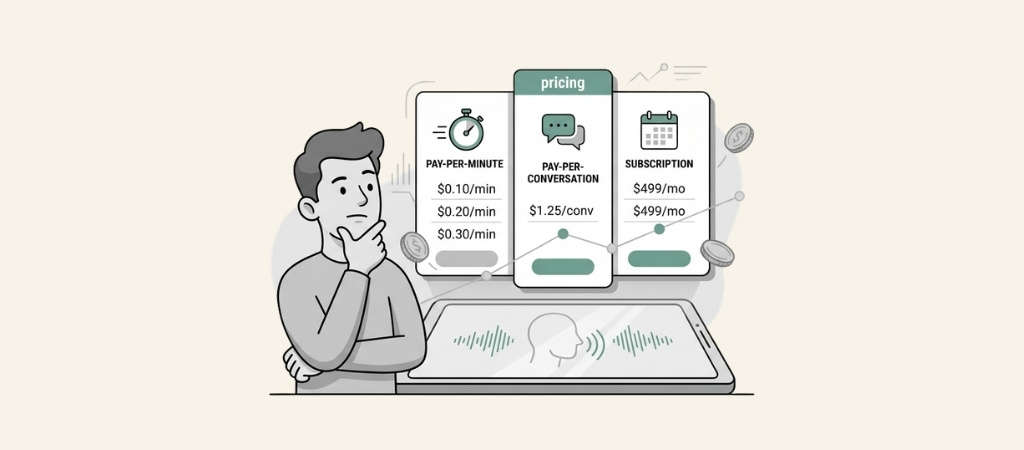
Before comparing platforms, you need to understand the five pricing models you'll encounter. Each has different implications for your budget.
Per-minute billing is the most common for business voice agents. You pay for each minute of conversation, typically $0.08 to $0.15 per minute. This model works well if your call lengths are predictable. Synthflow charges $0.08 per minute with enterprise tiers dropping to $0.07, while Deepgram starts as low as $0.0043 per minute for pre-recorded audio.
Per-conversation flat fees charge a fixed amount per call regardless of length. This sounds simple but can be expensive if your calls run long. Rates range from $0.25 to $1.00 per call. The danger here is what Reddit users call the "pricing trap," where short calls subsidize long ones. If your average call exceeds a few minutes, costs balloon quickly.
Character-based pricing applies mainly to text-to-speech services. Google Cloud and Amazon Polly charge $4 per million characters for standard voices, jumping to $16 per million for neural voices. If you're generating lots of audio content, these costs add up fast.
Credit-based systems like Voice.ai use an abstract currency you convert to minutes or features. Voice.ai's free tier gives you 5,000 credits monthly (about 5 minutes of text-to-speech), while paid plans range from $5 to $880 per month. The challenge is mental math, as you constantly need to convert credits to real usage.
Flat monthly subscriptions give you predictable costs. Ringly.io charges $349 to $799 per month (custom pricing for Enterprise) with set minute allowances, which works well if you want budget certainty.
Platform-by-platform voice AI pricing breakdown
Here's what you'll actually pay across the major providers.
Business voice agents
These platforms handle customer service calls, lead qualification, and appointment scheduling:

| Platform | Starting Price | Model | Key Limitations |
|---|---|---|---|
| Ringly.io | $349/month | Flat + overage | 1,000 minutes (Grow plan) |
| Synthflow | $0.08/minute | Usage-based | Enterprise only at scale |
| ConversAI | $299/month | Flat rate | Basic automation only |
| Voice.ai | Free | Credit-based | 5,000 credits/month free tier |
Ringly.io targets e-commerce specifically. The Grow plan at $349 includes 1,000 minutes and adds self-learning capabilities. Overage runs $0.19 per minute across plans.
Synthflow takes a different approach with pure usage-based pricing at $0.08 per minute. Everything is included: speech recognition, GPT-4o for language processing, ElevenLabs voices, call recording, and transcription. No charges for failed calls. Enterprise volumes drop to $0.07 per minute. This transparency is refreshing in a market full of hidden fees.
ConversAI starts at $299 per month for small businesses, with enterprise plans ranging from $2,000 to $10,000 monthly. They claim most customers save 40-70% compared to hiring human agents.
Voice.ai uses credits that convert differently depending on usage: 5,000 credits equals 5 minutes of text-to-speech or voice agents. Paid tiers run from $5 to $880 monthly, with the $99 Core plan offering 1 million credits (roughly 1,000 minutes).
Infrastructure and API providers
These services power the underlying speech recognition and synthesis:

| Platform | Speech-to-Text |
|---|---|
| Text-to-Speech | Free Tier |
| Deepgram | $0.0043/min |
| Contact sales | $200 credit |
| Google Cloud | $0.006/15sec |
| $4-16/million chars | 1M chars/month |
| Amazon Polly | $0.0004/sec |
| $4-16/million chars | 5M chars (12 months) |
| Azure Speech | $1/hour |
| $4-16/million chars | 5 hours/month |
Deepgram offers the lowest per-minute rates at $0.0043 for pre-recorded audio and $0.0125 for streaming. Volume discounts kick in at 100,000 hours annually, potentially reducing costs 40-60%. They also give new users $200 in credits to test the service.
Google, Amazon, and Azure all use similar character-based pricing for text-to-speech ($4 per million for standard voices, $16 per million for neural). Their free tiers are generous for testing but scale quickly with production usage.
Voice synthesis and creator tools
These platforms focus on high-quality voice generation for content creation:

| Plan | Monthly Price | Characters | Best For |
|---|---|---|---|
| Free | $0 | 10,000 | Testing |
| Starter | $5 | 30,000 | Hobbyists |
| Creator | $22 | 100,000 | Content creators |
| Pro | $99 | 500,000 | Professionals |
| Scale | $330 | 2,000,000 | Teams |
| Business | $1,320 | 11,000,000 | Organizations |
ElevenLabs leads this category with 5,000+ voices across 70+ languages. Their free tier is limited but sufficient for testing. Voice agents are priced separately, so you'll need to contact sales for conversational AI pricing.
The hidden costs Reddit users warn about
A recent Reddit thread in r/AgentsOfAI titled "Voice AI is a $0.25 + Pricing Trap" highlights what many discover too late. Here are the gotchas to watch for.

Rounding rules can inflate costs significantly. Some platforms round up to the nearest minute. A 61-second call becomes 2 minutes. At $0.25 per minute, that's $0.50 for a one-minute call.
Charges for voicemails and failed calls add up fast. If your AI agent calls a number that goes to voicemail, you might still pay. If the call fails to connect, some platforms count it anyway. Synthflow explicitly does not charge for failed calls, which is rare.
Call recording storage fees surprise many users. Recording every call is essential for quality assurance, but storage isn't always included. Check if there's a separate fee for retention beyond 30 days.
API integration costs appear when you connect to your CRM or helpdesk. Some platforms charge per API call or require premium tiers for integrations.
Custom voice cloning typically costs extra. Creating a branded voice for your company might run $1,000+ in setup fees plus ongoing per-character costs.
Premium support tiers mean you're paying extra just to get help when things break. Basic email support is often free, but phone support or dedicated success managers require enterprise contracts.
What's actually included (and what's extra)
When comparing platforms, look beyond the headline price. Here's what typically comes bundled versus what costs extra.
| Feature | Usually Included | Often Extra | Speech-to-text | ✓ |
|---|---|---|---|---|
| Language model / AI processing | ✓ | Basic text-to-speech | ✓ | Premium voices |
| Call transcripts | ✓ | Call recording | Sometimes | ✓ Storage fees |
| CRM integration | ✓ | Phone number | ✓ BYO or billed separate | Custom voices |
| ✓ | SMS follow-ups | ✓ | Priority support | ✓ |
Ringly.io includes call recording, transcripts, and Shopify integration in all plans. Phone numbers are included with Seth (their AI agent), while custom agents cost $5 per number monthly.
Synthflow bundles more than most: speech recognition, GPT-4o, ElevenLabs voices, recording, transcription, CRM integration, and 24/7 support on Pro plans. Their pricing page explicitly states "no license fees, no required contracts, no charges for failed calls."
Which voice AI pricing model fits your use case
The right choice depends on your call volume, use case, and technical requirements.

Startups and testing: Use free tiers. Voice.ai gives you 5,000 credits monthly. ElevenLabs offers 10,000 characters. Google Cloud provides 1 million characters per month. These are perfect for validating voice AI before committing budget.
Low volume (under 1,000 minutes monthly): Per-minute pricing wins. Deepgram at $0.0043 per minute means 1,000 minutes costs $4.30. Even at Synthflow's $0.08 rate, you're looking at $80 monthly with no commitment.
Medium volume (1,000-10,000 minutes monthly): Flat monthly plans provide predictability. Ringly.io's Grow plan at $349 includes 1,000 minutes with $0.19 overage. If you consistently use 2,000 minutes, that's $349 + $190 = $539 total. Compare that to per-minute pricing at $0.08 × 2,000 = $160. The break-even point matters here.
High volume (10,000+ minutes monthly): Enterprise negotiations become essential. Volume discounts at 100,000+ minutes can reduce per-minute costs 40-60%. Deepgram and Synthflow both offer custom enterprise pricing.
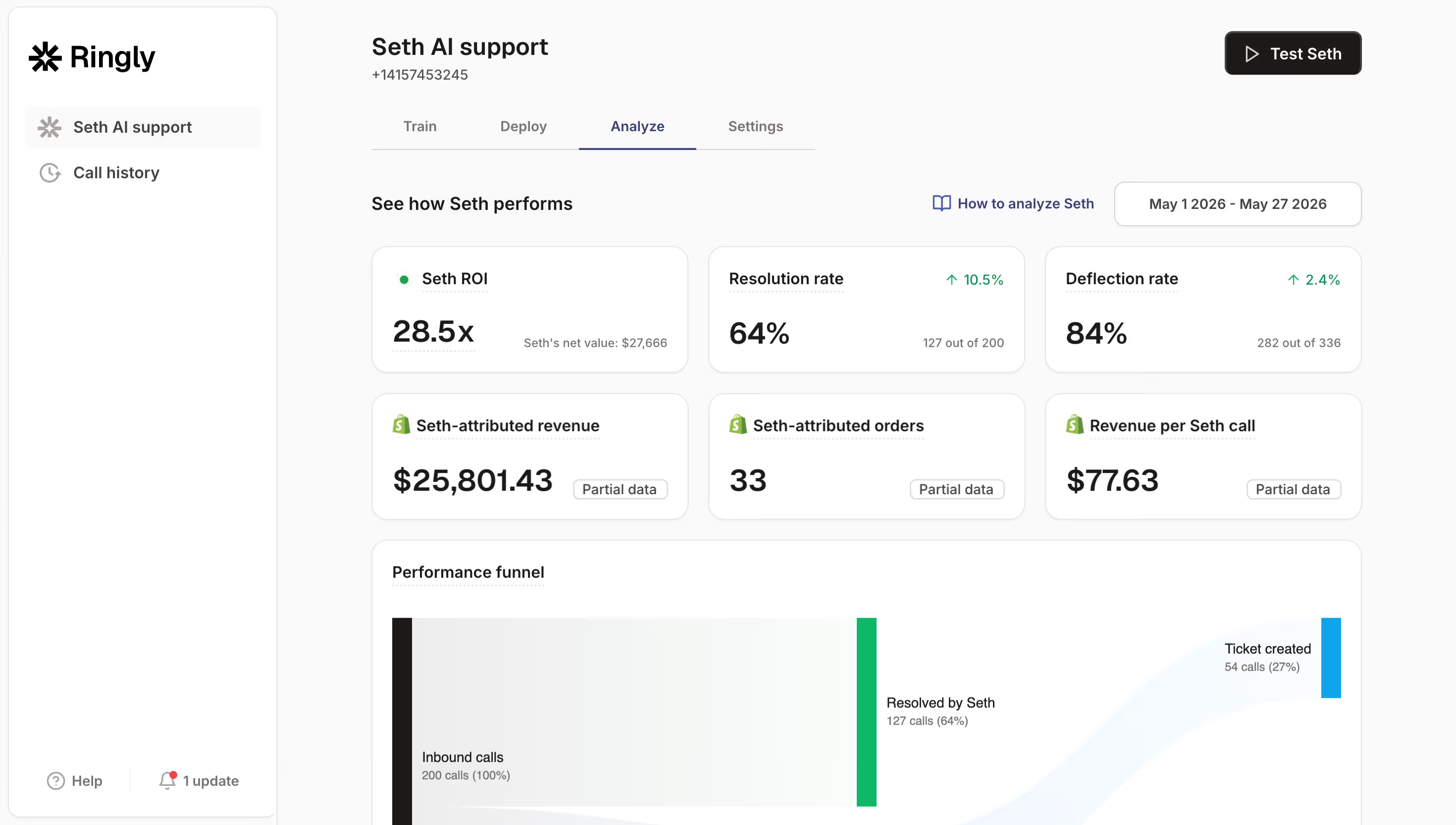
E-commerce and Shopify stores: Specialized platforms make more sense than generic voice AI. Ringly.io integrates natively with Shopify, pulling order data in real-time. Seth can look up orders, process returns, and handle "where's my order" calls without human intervention. Their 73% resolution rate means most calls never reach your team.
Content creation: Character-based pricing from ElevenLabs or Voice.ai works best. You're generating audio files, not handling live conversations, so per-minute models don't fit.
Developer-led projects: API-first platforms like Deepgram offer the flexibility and pricing control engineering teams want. The $200 new user credit lets you build and test without upfront costs.
How to avoid overpaying for voice AI
Here are practical strategies to keep costs under control:
Start with free tiers to establish actual usage patterns. Most businesses overestimate their needs by 30-40%. Track your real call volumes, average durations, and peak periods before committing to paid plans.
Calculate true cost per minute including all fees. A platform advertising $0.08 per minute might charge extra for recording, storage, and API calls. The real cost could be $0.12+ per minute.
Watch for rounding rules. Per-second billing saves money if your calls average under a minute. Per-minute rounding inflates costs significantly for short interactions.
Pre-generate common responses for repetitive queries. If your AI agent says the same greeting or gives the same answer frequently, generate those audio files once rather than synthesizing them every time. This can cut text-to-speech costs 40-60%.
Negotiate enterprise rates when you exceed 100,000 minutes monthly. Most platforms have unpublished volume discounts. Committing to annual contracts typically saves 20-30%.
Consider white-label platforms if you're an agency. VoiceAIWrapper charges $29 to $499 monthly for a white-labeled client portal, and you pay voice providers directly at their rates. This avoids the markup many platforms add.
Getting started with voice AI without the pricing surprises
Voice AI pricing doesn't have to be mysterious. The key is matching your specific use case to the right pricing model, then watching for the hidden costs that catch many users off guard.
If you're running a Shopify store and want to automate customer calls, Ringly.io offers a 14-day free trial with full features. Their performance-based billing means you only pay once Seth resolves 65% of your calls, which aligns their incentives with your success.
For developers building custom voice applications, Deepgram's $200 credit and low per-minute rates provide a low-risk entry point. Content creators should start with ElevenLabs or Voice.ai free tiers to test voice quality before scaling.
Whatever platform you choose, start small, measure actual usage, and scale strategically. The goal is reducing costs and improving customer experience, not adding another expensive tool that creates more problems than it solves.
Frequently Asked Questions
How much does voice AI cost per month for a small business?
Small businesses typically spend $99-$349 monthly for voice AI with 250-1,000 minutes included. Entry-level plans from Ringly.io start at $99, while usage-based options like Synthflow cost around $80 for 1,000 minutes at $0.08 per minute.
Why is voice AI pricing so complicated?
Voice AI pricing varies because different use cases require different resources. Text-to-speech consumes compute per character, while live phone agents consume resources per minute of conversation. Platforms also bundle different features, making direct comparisons difficult without calculating total cost of ownership.
Are there free voice AI options worth using?
Yes, most platforms offer free tiers suitable for testing. Voice.ai provides 5,000 credits monthly, ElevenLabs offers 10,000 characters, and Google Cloud includes 1 million characters per month. These are genuinely useful for validation before committing to paid plans.
What hidden fees should I watch for with voice AI pricing?
Common hidden fees include rounding up to the nearest minute, charging for failed calls or voicemails, call recording storage fees, API integration costs, custom voice cloning setup, and premium support tiers. Always request a complete pricing breakdown before signing contracts.
How do I calculate the real cost of voice AI for my call volume?
Multiply your monthly call minutes by the per-minute rate, then add costs for required add-ons. For example, 2,000 minutes at $0.08 = $160 base cost. If recording storage costs $50 and your CRM integration is $30, your real cost is $240 monthly or $0.12 per minute effective rate.
Is per-minute or per-conversation pricing better for voice AI?
Per-minute pricing is better for calls averaging over 2-3 minutes. Per-conversation flat fees (typically $0.25-$1.00) work only if your calls are consistently short. Long calls on per-conversation plans become extremely expensive compared to per-minute alternatives.
Can I negotiate voice AI pricing for high volumes?
Yes, most platforms offer unpublished volume discounts above 100,000 minutes annually. Deepgram explicitly offers 40-60% reductions at this threshold. Enterprise contracts also typically include annual payment discounts of 20-30%.
Want to see the latest data? Read our 47 voice AI statistics for 2026.