

Answering service pricing is confusing on purpose. Providers use different billing models, bury fees in the fine print, and make it nearly impossible to compare one service to another. You just want to know what it costs to have someone (or something) answer your phones. But between per-minute, per-call, flat-rate, and AI pricing, getting a straight answer is harder than it should be.
The phone answering service market is worth over $6 billion in 2025 and growing at 7.1% annually, according to WiseGuy Reports. That growth is driven partly by AI services entering the space and making answering services accessible to businesses that couldn't afford them before.
We reviewed pricing from over a dozen providers and broke down every model, every hidden fee, and every cost you should actually plan for. Whether you're running a Shopify store or a service business, this guide gives you real numbers so you can make a smart decision.
Hear what AI support calls sound like for your store. Just paste your Shopify URL and get sample calls in under 20 seconds, no email required. Listen to demo calls for my store.
How answering services charge you
Not all phone answering services bill the same way. The pricing model you pick often matters more than the provider itself. Here's how each one works.
Per-minute pricing
You pay for every minute an operator or AI agent spends on your calls. This is the most common model for live answering services.
Typical rates range from $0.75 to $1.50 per minute for live operators. AI services charge much less, usually $0.05 to $0.30 per minute.
Per-minute works best when your calls are short and simple (think under 90 seconds each). But watch out for overage fees. Most providers charge $1.50 to $3.50 per minute once you go over your plan limit. That's 2-3x the normal rate.
Per-call pricing
Instead of tracking minutes, you pay a flat fee for each answered call regardless of how long it lasts. Rates typically fall between $0.80 and $5.00 per call for live services.
This model makes sense when your calls vary in length. If you're handling product questions or order issues that run 2-4 minutes each, per-call billing is usually cheaper than per-minute. One thing to watch: some providers count hang-ups and wrong numbers as billable calls.
Flat-rate monthly plans
You pay a fixed monthly fee for a set number of minutes or calls. Plans usually run $200 to $600 per month for business hours coverage. Want 24/7? Expect $400 to $1,000 or more.
Flat-rate plans are best for businesses with predictable call volumes. You know exactly what you'll pay each month. The risk is going over your included minutes, which triggers those steep overage charges.
AI per-conversation pricing
This is the newest model. An AI agent handles your calls and you pay per conversation or per minute at a fraction of the live-operator cost. Expect $0.05 to $0.30 per minute or $0.29 to $0.79 per conversation.
AI answering services don't charge after-hours premiums or holiday surcharges because there's no human staff involved. That alone can save you 25-50% compared to live services during evenings and weekends. The trade-off is that quality varies massively between providers. Some AI agents sound great and handle real tasks. Others are glorified phone trees.
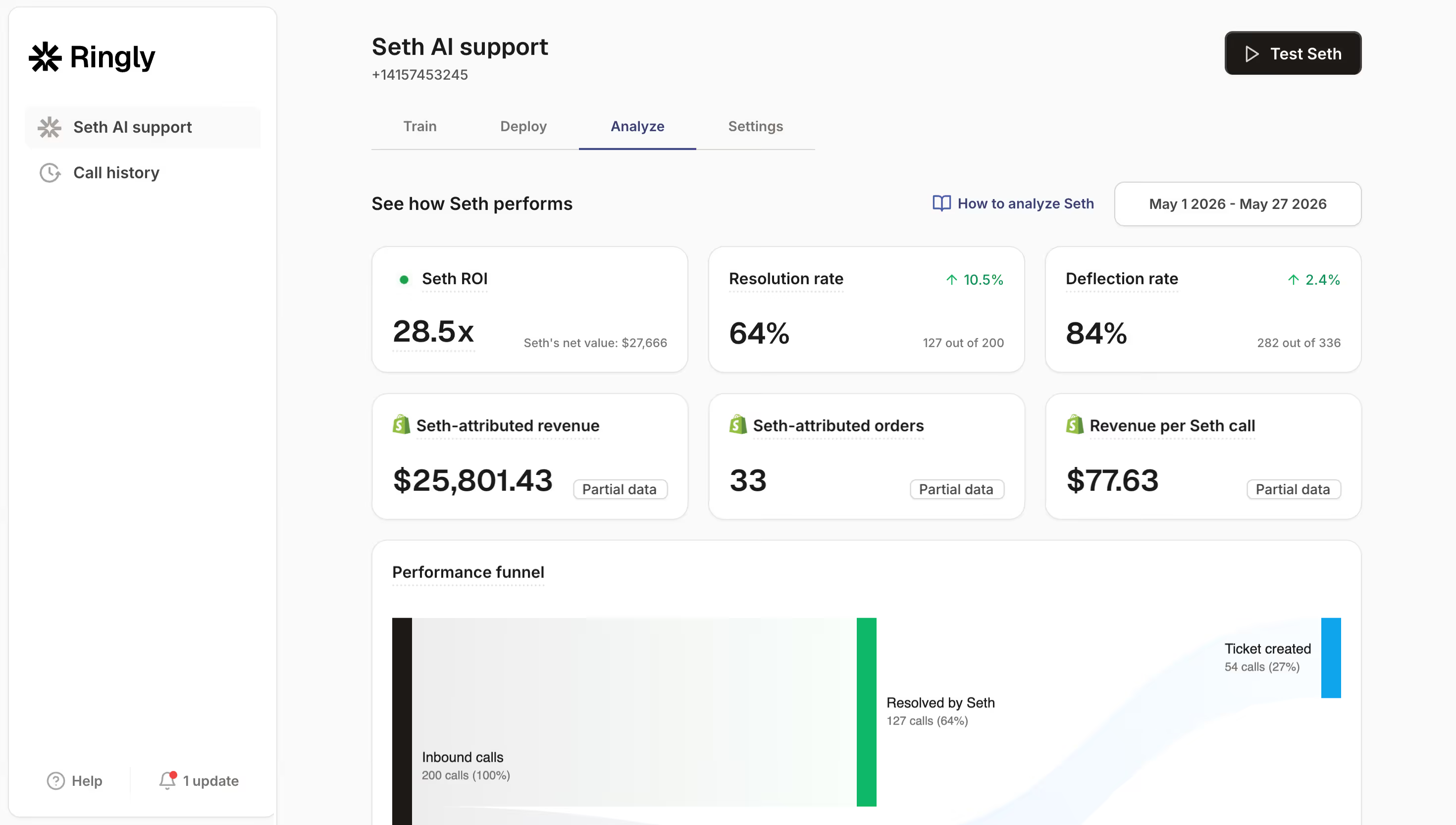
If you run a Shopify store, Ringly.io offers 1,000 minutes for $349/month with AI that actually looks up orders, processes returns, and answers product questions. See how it works.
What answering service pricing looks like by plan size
Here's what you can expect to pay based on how many minutes you need. We pulled these ranges from published pricing across multiple providers including Specialty Answering Service, AMBS Call Center, and several AI answering platforms.
| Plan size | Live service cost/mo | AI service cost/mo | Calls covered (approx.) |
|---|---|---|---|
| 100 min | $135 - $250 | $29 - $100 | ~50 calls |
| 250 min | $330 - $525 | $50 - $150 | ~125 calls |
| 500 min | $495 - $925 | $100 - $250 | ~250 calls |
| 1,000 min | $950 - $1,595 | $200 - $400 | ~500 calls |
| 2,500 min | $2,945+ | $400 - $800 | ~1,200 calls |
Most small businesses use between 250 and 500 minutes per month. That puts the typical small business answering service cost at $330 to $925 for live services or $50 to $250 for AI.
Notice the pattern? AI services cost roughly 50-70% less across every plan size. And the gap widens as volume increases. At 2,500 minutes, you're looking at $2,945+ for live operators versus $400-$800 for AI. That's a meaningful difference for any business watching its bottom line.
For e-commerce stores specifically, the sweet spot tends to be 500-1,000 minutes per month. That covers most e-commerce phone support needs including order status calls, return requests, and product questions.
The hidden fees most providers don't mention
Here's where answering service pricing gets ugly. According to industry data, hidden costs add 30-50% to the advertised price. That $300/month plan might actually cost you $400-$450 once everything's included.
These are the fees you need to ask about before signing anything:
- Setup and onboarding fees: $50 to $500 as a one-time charge. Some providers waive this, but many don't mention it until you're ready to start.
- Holiday surcharges: 1.5-2x normal rates on major holidays. Your Thanksgiving weekend coverage could cost double what you budgeted.
- After-hours premiums: 25-50% more for nights and weekends. If most of your calls come after hours, this adds up fast.
- Overage charges: $1.50 to $3.50 per minute over your plan limit. This is the one that catches most businesses off guard. Go 100 minutes over and you could owe an extra $150-$350.
- Call transfer fees: $0.50 to $2.00 per transfer. Every time a call gets sent to your team, you pay extra.
- Toll-free number: $5 to $15 per month. Small but adds up over a year.
- Call recording fees: $10 to $30 per month. Some providers charge separately for this.
- Minute rounding: Billing in 6-second or 30-second increments instead of exact time can add roughly $340 per year to your bill.
- Early termination fees: $100 to $500 if you cancel before your contract ends.
- "13th invoice" billing: Some providers bill on 28-day cycles instead of monthly, creating 13 billing periods per year instead of 12.
The best way to avoid surprises? Ask your provider for a total cost estimate that includes all fees based on your expected call volume. If they can't give you one, that's a red flag.
One advantage of AI phone answering services: most don't charge setup fees, holiday surcharges, or after-hours premiums. With Ringly.io, for example, pricing is $349/month for 1,000 minutes with $0.19/minute overage. No setup fees. No contracts. No hidden charges.
Answering service pricing vs hiring a receptionist
Before you commit to an answering service, you might wonder whether just hiring someone makes more sense. It's a fair question, especially if your call volume is high enough to justify a full-time person. Here's the math.
The average receptionist salary in the US is $37,057 to $40,818 per year in 2026, according to Salary.com and ZipRecruiter. But salary is just the starting point. Add benefits (health insurance, retirement contributions), payroll taxes (7.65% FICA alone), PTO, sick days, and training time, and the total cost lands around $3,347 to $4,500 per month.
And that only covers 40 hours per week. If a customer calls at 7pm or on a Saturday, nobody picks up.
| Factor | In-house receptionist | Live answering service | AI answering service |
|---|---|---|---|
| Monthly cost | $3,347 - $4,500 | $150 - $500 | $29 - $400 |
| Hours covered | 40 hrs/week | Business hours or 24/7 | 24/7 always |
| Languages | 1-2 | 1-2 | 40+ |
| Scaling | Hire more staff | Upgrade plan | Automatic |
| Sick days/PTO | Yes | No impact | No impact |
| Training time | Weeks | Days | Minutes |
For most small businesses, the cost per call with an answering service is a fraction of what you'd pay a full-time employee. And here's the number that seals the deal: according to an AMBS Call Center report, the average small business loses $126,000 per year to missed calls. A separate study found that 80% of callers who reach voicemail hang up without leaving a message, and 85% never call back.
A study monitoring 85 businesses across 58 industries found that companies only answered 37.8% of incoming calls. That means nearly two-thirds of potential customers never spoke to anyone. For e-commerce businesses, where a single order can be worth $50-$200+, every missed call is real money walking out the door.
So the real question isn't "can I afford an answering service?" It's "can I afford not to have one?"
Try Ringly.io free for 14 days and see how many calls your store is missing.
AI vs traditional answering service pricing
The cost gap between AI and live answering services is significant, and it's growing. According to NextPhone's 2026 comparison, AI answering costs 60-85% less than live services for similar call handling. That's not a rounding error. It's a completely different cost structure.
Here's a side-by-side look:
| Feature | Live answering service | AI answering service |
|---|---|---|
| Per-minute cost | $0.75 - $1.50 | $0.05 - $0.30 |
| Monthly plans | $200 - $2,000+ | $29 - $400 |
| After-hours premium | 25-50% extra | None |
| Holiday surcharges | 1.5-2x rates | None |
| Setup fees | $50 - $500 | Usually $0 |
| Languages | 1-2 | 10-40+ |
| Availability | Depends on plan | Always 24/7 |
| Call resolution | Depends on training | 60-73% for routine calls |
The savings come from removing the biggest cost: human labor. Live operators need salaries, benefits, breaks, training, and management. AI handles calls at a marginal cost that's almost nothing per conversation.
Here's another number worth knowing: AI answering service costs have dropped roughly 40% since 2022 as the technology matured and competition increased. That trend isn't slowing down. If anything, the gap between AI and live pricing will keep widening.
But let's be honest about the trade-offs too. Live operators still handle complex, emotional, or highly unusual situations better. If a customer is upset and needs someone who can truly empathize, a human does that better than any AI (for now). And some industries (legal, medical) have compliance requirements that make fully automated answering trickier.
The smart play for most businesses? Use AI for routine calls and keep humans for the complicated stuff. This hybrid approach gives you the cost savings of AI with the safety net of human backup. Most AI voice agents can detect when a call needs escalation and transfer automatically.
If you're weighing your options, our guide to the best AI answering services for small business compares seven providers side by side. For e-commerce stores, the case for AI is especially strong. The most common call types (order status, return requests, product questions) are exactly the kind of routine inquiries AI handles well. A platform like Ringly.io connects directly to Shopify, so the AI actually pulls up order details and processes returns in real time. That's something a traditional answering service simply can't do.
Answering service pricing for e-commerce stores
If you sell online, your phone support needs are different from a law firm or plumbing company. The majority of your calls fall into a few predictable categories:
- "Where is my order?": The #1 call type for e-commerce. Customers want tracking updates. WISMO calls can account for 30-50% of all support volume.
- Returns and exchanges: Processing a return, checking eligibility, or setting up an exchange.
- Product questions: "Does this come in blue?" "Will this fit a large dog?" "Is this compatible with my phone model?"
- Payment and billing: Charge questions, failed payments, promo code issues.
According to e-commerce customer support statistics, order status inquiries alone can make up 30-50% of all inbound support contacts. That's a massive chunk of your call volume going to a single, highly repetitive question type.
Traditional answering services can take messages about these topics, but they can't actually resolve them. An operator can't log into your Shopify admin, look up an order, and give the customer their tracking number. They'll just write down the question and email it to you.
AI answering services with e-commerce integrations are a different story. They connect to your store's backend and handle these calls from start to finish.
Here's what the pricing comparison looks like for a typical Shopify store handling 200 calls per month (roughly 400 minutes):
| Option | Monthly cost | What it does |
|---|---|---|
| Live answering (per-minute) | $330 - $525 | Takes messages, forwards to your team |
| Live answering (per-call) | $160 - $1,000 | Same as above |
| AI phone agent (Ringly.io) | $349 | Answers questions, looks up orders, processes returns, 24/7 |
The AI option costs about the same as mid-tier live answering but handles 70%+ of calls without anyone on your team needing to get involved. That's the real cost savings: not just the monthly fee, but the time your team gets back.
And during peak seasons like Black Friday, AI scales automatically. No scrambling to hire seasonal staff or worrying about hold times spiking. The cost per contact stays flat regardless of volume.
Shopify store owners can set up Ringly.io in about three minutes. No code, no developer needed. The AI learns from your store data and starts handling calls immediately. Start your free trial here.
How to choose the right answering service for your budget
Picking the right service comes down to your call volume, the complexity of those calls, and what you can spend. Here's a quick framework:
- Choose a per-minute plan if your calls are short and simple (under 90 seconds on average). You'll pay less because you're only billed for actual talk time.
- Choose a per-call plan if your calls vary in length and you want predictable per-interaction billing. Better for calls that run 2-4 minutes each.
- Choose a flat-rate plan if you have steady, predictable call volume month over month and want zero surprises on your bill.
- Choose an AI answering service if you need 24/7 coverage, handle mostly routine inquiries, or run an e-commerce store where order lookups and returns are the bulk of your calls.
- Choose a live answering service if your calls require complex judgment, empathy-heavy conversations, or deep relationship building that AI can't replicate yet.
A few practical tips from reviewing dozens of answering service options (and if you want a full ranked list, see our guide to the best answering services):
- Start small: Pick the plan that just barely covers your volume. You can always upgrade.
- Don't overpay for unused minutes: If you're consistently using 60% or less of your plan, downsize.
- Ask about overage rates before signing: This is where most businesses get burned.
- Request a trial: Most providers (including AI services) offer 7-14 day trials. Use them.
- Check the contract terms: Month-to-month is always better than annual lock-in when you're still figuring out your needs.
If you're looking at specific tools, our guides on best virtual receptionists and best customer service tools for small e-commerce compare providers side by side. And for more on how AI customer service ROI stacks up, we break down the full math in a separate guide.
Frequently asked questions
How much does an answering service cost per month?
Most answering services cost between $135 and $925 per month for small businesses, depending on your call volume and pricing model. AI answering services start lower, around $29 to $400 per month. The average small business using a live service pays $300-$500 monthly.
Is an answering service cheaper than hiring a receptionist?
Yes, significantly. An AI receptionist for small business costs a fraction of a human hire. A full-time receptionist costs $3,347 to $4,500 per month when you factor in salary, benefits, and overhead. A live answering service runs $150-$500, and an AI service can cost as little as $29-$400 for comparable (or better) coverage.
What's the cheapest answering service available?
AI-powered services offer the lowest entry points. Some start at $29 per month for basic call handling. Among live services, Specialty Answering Service starts at $44/month for their economy plan (though that only includes a small number of minutes).
Do answering services charge setup fees?
Some do, ranging from $50 to $500. Many AI answering services waive setup fees entirely. Always ask upfront. If a provider won't give you a clear answer about fees, that's a warning sign.
How does AI answering service pricing compare to live services?
AI services cost 60-85% less than live services for similar call volumes. A live service charging $950-$1,595 for 1,000 minutes translates to roughly $200-$400 with an AI provider. The gap comes from eliminating human labor costs. You can compare specific voice AI pricing and AI voice agent pricing in our detailed breakdowns.
What's the best answering service for Shopify stores?
For Shopify specifically, you want an AI service with a native Shopify integration that can actually look up orders, process returns, and answer product questions. If you're already using a helpdesk like Gorgias, see our Gorgias Shopify integration guide to understand how it handles phone vs. text channels. Ringly.io is built for this. It connects to your store in minutes, handles 73% of calls without human help, and costs $349/month for 1,000 minutes. No other answering service for e-commerce offers that depth of integration at that price point.
Are answering services worth it for small businesses?
For most businesses, yes. The average small business loses $126,000 per year to missed calls, and 80% of callers who hit voicemail never leave a message. Even a basic $150/month answering service can pay for itself by capturing just one or two sales you would have otherwise lost. Check out the call center statistics for 2026 for more on the real cost of missed calls.
The bottom line on answering service pricing
Answering service costs range from $29/month (AI) to $2,945+ (live, high volume). The right option depends on how many calls you get, how complex they are, and whether you need 24/7 coverage.
For e-commerce and Shopify stores, AI answering services offer the best value by a wide margin. They cost less, work around the clock, and (with the right provider) can actually resolve customer issues instead of just taking messages. Only 22% of small businesses have adopted AI voice agents so far, but 97% of those that have report increased revenue. The early adopters are getting a real edge.
If you want to see what AI phone support looks like for your store, try Ringly.io free for 14 days. Setup takes about three minutes, and there's nothing to lose.