
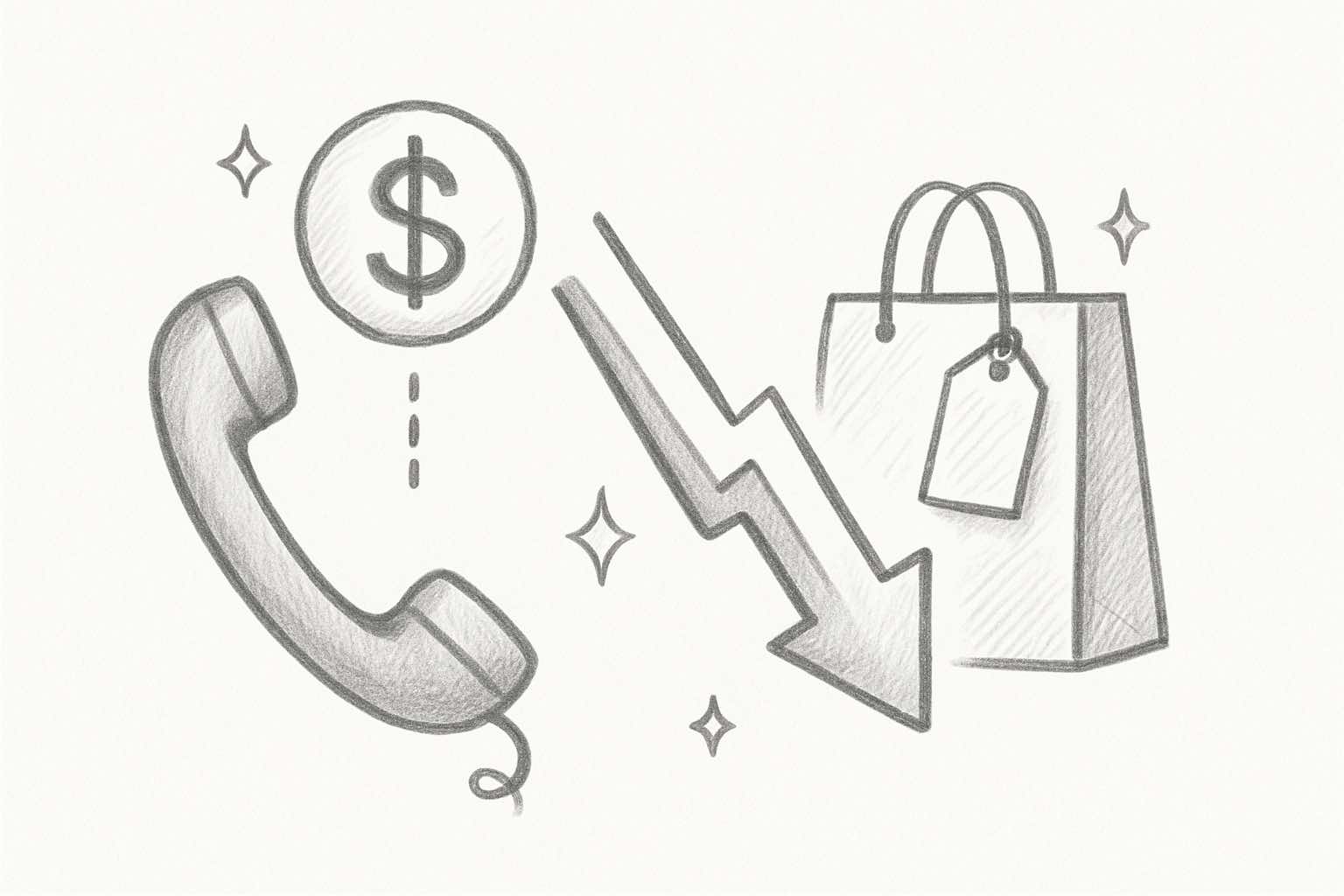
Most ecommerce store owners think their cost per call is somewhere around $5. They're usually wrong by a factor of three or four. Once you factor in training, turnover, after-hours coverage, and software licenses, that "cheap" phone ticket is actually running $12 to $17 per call. And with WISMO calls eating up 30 to 40% of your support volume, you're spending a lot of money answering the same question: "Where's my order?"
This guide breaks down what cost per call really looks like for ecommerce stores in 2026, how to calculate yours accurately, and seven concrete ways to bring it down without wrecking your customer experience.
Hear what AI support calls sound like for your store. Just paste your Shopify URL and get sample calls in under 20 seconds, no email required. Listen to demo calls for my store.
What cost per call actually means for ecommerce stores
Before you can reduce your cost per call, you need to understand what you're actually measuring. Three terms get thrown around interchangeably, and they mean very different things.
Cost per contact is the total cost to handle a single customer interaction on any channel (phone, email, chat, social). Cost per call narrows that to phone-only interactions. Cost per resolution is the total cost to fully solve a customer's problem, which might take one call or four emails.
Here's why the distinction matters for ecommerce: phone calls cost more per contact ($8 to $17+), but they have the highest first-call resolution rate of any channel. One call, problem solved. An email might cost $8 per contact, but when it takes three or four messages to resolve one issue, your cost per resolution jumps to $24 to $60.
For ecommerce stores specifically, most calls fall into predictable categories: order tracking (WISMO), return and exchange requests, product questions, and the occasional complaint. According to MaestroQA's 2024 Call Center Cost Study, 76% of consumers still prefer phone when they need real help. So even if you've invested heavily in chat and email, your phone line isn't going away.
The real question isn't whether phone support is expensive per contact. It's whether it's expensive per resolution. And for most ecommerce stores, the answer is: phone is more efficient than you think, especially for anything beyond a simple FAQ.
There's also a revenue angle that most cost analyses ignore entirely. Customers who call are more engaged than customers who email. They're often mid-purchase or have a problem that, if solved fast, keeps them loyal. According to ecommerce customer support data, 80% of customers expect single-interaction resolution. Phone delivers that better than any other channel.
Average cost per call benchmarks by channel
So what does each support channel actually cost per interaction? Here's how it breaks down for ecommerce in 2026, based on data from MaestroQA, Gartner, and multiple call center statistics sources.
| Channel | Cost per contact | Cost per resolution | Best for |
|---|---|---|---|
| Phone (human agent) | $8-$17 | $8-$17 | Complex issues, complaints, high-value customers |
| $8-$15 | $24-$60 | Documentation-heavy requests | |
| Live chat | $3-$5 | $5-$10 | Quick questions, multi-tasking agents |
| Self-service (FAQ, help center) | $0.10-$0.50 | $0.10-$0.50 | Simple lookups, common questions |
| AI voice agent | $0.30-$1.00 | $0.30-$1.00 | WISMO, order status, returns initiation |
The blended ecommerce average across all channels sits at $2.70 to $5.60 per ticket. But that number is misleading if most of your volume goes through phone. Gartner's data shows the median cost is $1.84 for self-service and $13.50 for assisted channels. If you're running a store where customers call more than they chat, your true blended cost is probably much higher than $5.60.
Here's something most benchmarking articles miss: ecommerce sits at the low end of the industry spectrum for customer service costs. Banking and finance pay $15 to $30 per contact. SaaS companies spend $25 to $35 per ticket. Telecom hits $20 to $30. So while your costs might feel high, ecommerce is actually one of the cheaper industries to serve, mostly because the calls tend to be simpler.
That said, "cheaper than banking" doesn't help if your margins are tight and you're handling 500 calls a month.
One more thing to keep in mind: these benchmarks shift with seasonality. During peak season (Black Friday, holiday rush), call volume can spike 3 to 5x. If you're staffing up with temp agents who need training, your cost per call during those weeks can easily double. Stores that rely on AI or outsourced overflow absorb spikes without the cost surge.
How to calculate your actual cost per call
The formula is simple. Getting the inputs right is the hard part.
Cost per call = Total phone support costs / Total calls handled
Most ecommerce stores only count agent wages when they calculate this. That's a mistake. Here's what actually goes into your total phone support costs:
- Agent wages and benefits: This is 60 to 80% of your total spend. The average fully loaded cost per customer service rep is $55,000 to $73,000 per year, not the $39,000 to $41,000 base salary you see on job boards.
- Software and tools: Your helpdesk, phone system, CRM, and quality monitoring tools. Typically $200 to $500+ per agent per month.
- Training and onboarding: New agents take 2 to 4 weeks to ramp. With average agent tenure at just 13 to 15 months and turnover rates of 30 to 45% annually, you're constantly training.
- Replacement costs: Every time an agent leaves, it costs $10,000 to $20,000 in recruiting, onboarding, and lost productivity.
- Management overhead: Supervisors, QA analysts, workforce management. Often forgotten in calculations.
- After-hours and weekend coverage: Overtime, shift differentials, or a separate answering service.
Let's run a real example. Say you have two agents handling 500 calls per month for your Shopify store:
| Cost item | Monthly |
|---|---|
| Two agents (fully loaded) | $9,200 |
| Software/tools | $600 |
| Management overhead (partial) | $1,500 |
| Training/turnover (amortized) | $700 |
| Total | $12,000 |
$12,000 / 500 calls = $24 per call
That's way above the $5.60 "ecommerce average" that most benchmarking articles cite. And if you're only counting salaries, you'd think you're at $9,200 / 500 = $18.40. The hidden costs add another $3,600 per month that most stores miss entirely.
Want to see what AI phone support costs for your store? Try Ringly.io free for 14 days. Setup takes three minutes, no code required.
Cost per call by ecommerce call type
Not every call costs the same to handle. Breaking your costs down by call type reveals where your money is actually going and where the biggest savings opportunities are.
- WISMO calls (30-40% of volume): "Where is my order?" is the single most common ecommerce support call. These are simple lookups that take 3 to 5 minutes on average and cost about $5 to $8 per call. They're also the easiest to automate because they just require pulling order tracking data.
- Return and exchange requests (15-25% of volume): Moderate complexity. Agents need to check return policies, initiate the return, and sometimes offer alternatives. Average 5 to 8 minutes, costing $8 to $12 per call.
- Product questions (15-20% of volume): These vary wildly. A "what size should I get?" call takes 3 minutes. A detailed ingredient or compatibility question can take 10+. Average cost: $7 to $10 per call.
- Complaints and escalations (5-10% of volume): The expensive ones. These take 10 to 20 minutes and often require a senior agent. Cost: $15 to $25 per call. But they're also the calls where human empathy matters most.
- Order placement and upsells (5-10% of volume): The revenue generators. Inbound phone calls convert 10 to 15x higher than web leads, according to BIA/Kelsey research. A $10 call that produces a $120 order is money well spent.
Here's the key insight: the highest-volume calls (WISMO) are also the simplest and cheapest to automate. The calls that genuinely need human agents (complaints, complex product questions) are lower volume. This is why the hybrid model works so well for ecommerce.
If you want to understand your own breakdown, pull a month of call recordings or tickets and categorize them. Most stores are surprised to find that 50% or more of their phone volume is just people asking about shipping. That's a lot of money spent on what is essentially a database lookup.
For stores selling health, beauty, or supplements, product questions tend to run higher as a percentage (sometimes 25 to 30%). These calls are more nuanced, but even many product questions can be handled by AI if you feed it your knowledge base and FAQ content. The calls that truly need a human are usually less than 15% of total volume.
In-house vs outsourced vs AI: the real cost comparison
You've got three models to choose from. Here's how they actually compare for a store handling about 500 calls per month.
| Model | Monthly cost | Cost per call | Setup time | Quality control | 24/7 coverage |
|---|---|---|---|---|---|
| In-house (2 agents) | $10,000-$12,000 | $20-$24 | 2-4 weeks | Full control | Expensive |
| Outsourced (US) | $3,500-$5,000 | $7-$10 | 1-2 weeks | Moderate | Included |
| Outsourced (offshore) | $1,500-$2,500 | $3-$5 | 1-2 weeks | Lower | Included |
| AI voice agent | $349-$500 | $0.70-$1.00 | Minutes | Consistent | Included |
In-house gives you full control over brand voice and quality. Your agents know your products inside out. But you're paying $55,000 to $73,000 per rep per year (fully loaded), and covering nights, weekends, and holidays is a nightmare for small teams. Plus, with 30 to 45% annual turnover in customer service, you're constantly rehiring.
Outsourced call centers bring the cost down significantly. US-based providers charge $29 to $42 per hour per agent in 2026, according to Crescendo.ai's outsourced pricing guide. Offshore options in the Philippines or India run $7 to $16 per hour. But quality is the trade-off. Scripts can feel robotic, agents don't know your product deeply, and turnover at outsourced contact centers is even higher than in-house.
AI voice agents are the new option that's reshaping the math. Tools like Ringly.io cost $349 per month for about 500 calls, bringing your cost per call to roughly $0.70. AI handles WISMO calls, order status checks, return initiations, and basic product questions. It works 24/7 in 40 languages with zero turnover.
The catch: AI can't handle every call type (yet). Complex complaints, emotional customers, and nuanced product questions still need humans. But for a typical ecommerce store where 60 to 70% of calls are routine, AI takes the bulk of the load while your team focuses on the interactions that actually require judgment.
NexGen Cloud's research shows automated voice interactions cost $0.30 to $0.50 each, compared to $6.00 to $7.68 for a human agent. That's a 93 to 95% reduction per interaction. Even accounting for the calls AI can't handle, the blended cost drops dramatically.
The sweet spot for most ecommerce stores is the hybrid model. Let AI handle the 60 to 70% of calls that are routine (WISMO, basic questions, returns). Route the rest to your human team. According to industry benchmarks, AI can deflect 25 to 45% of support tickets, and that number is growing fast. Gartner predicts conversational AI will reduce contact center labor costs by $80 billion globally.
See how Ringly.io handles calls for 2,100+ Shopify stores. The AI agent, Seth, resolves about 73% of calls without human help.
7 ways to reduce your cost per call without hurting customer experience
Cutting cost per call doesn't mean cutting corners. Here are seven strategies that actually work for ecommerce stores.
1. Automate WISMO calls with AI
WISMO makes up 30 to 40% of your call volume. These are pure lookups: the customer gives you an order number, you tell them where the package is. An AI voice agent handles this in seconds, at $0.30 to $0.50 per interaction instead of $5 to $8 with a human agent. That alone can cut your total phone support costs by 15 to 20%.
You can also add proactive shipping notifications (email or SMS updates at each stage) to reduce WISMO calls before they even happen. According to WISMOlabs, proactive notifications reduce WISMO inquiries by 50 to 80%.
2. Build a self-service knowledge base
67% of customers actually prefer solving problems themselves for simple issues. A solid FAQ page, order tracking portal, and return center catch questions before they become calls. Every deflected call saves you $8 to $17.
3. Use AI voice agents for tier-1 support
Beyond WISMO, AI can handle product questions from your knowledge base, return initiation, and basic account inquiries. Ringly.io resolves about 73% of ecommerce phone calls without needing a human, at a fraction of the cost. Try it free for 14 days.
4. Improve first-call resolution
Every repeat call doubles your cost per resolution. According to Contentsquare, a 1% improvement in first-call resolution (FCR) equals a 1% reduction in operating costs. Train your agents (or configure your AI) to solve the problem completely the first time. That means giving them the authority to issue refunds, process exchanges, and make judgment calls without escalating everything.
5. Route calls by complexity
Don't send a $25/hour agent to answer "where's my order?" Use IVR or AI-based triage to sort calls by complexity. Simple calls go to automation. Medium calls go to junior agents. Complex escalations go to your senior team. According to industry data, IVR routing is 48x less expensive than manual call routing.
Some AI call center tools do this automatically. Ringly.io, for example, handles the call first and only transfers to a human when the AI detects the issue needs personal attention. That eliminates the awkward IVR menu tree that customers hate.
6. Reduce agent turnover
This one is expensive and invisible. Replacing one customer service agent costs $10,000 to $20,000 when you factor in recruiting, training, and lost productivity. And with turnover at 30 to 45% annually, a 10-person team loses 3 to 4 agents every year. Better pay, removing repetitive tasks (let AI handle the boring WISMO calls), and genuine career growth reduce churn.
7. Extend coverage without adding headcount
After-hours support is where costs explode. Night shifts, weekend premiums, and holiday pay can double your effective cost per call. AI agents work around the clock in 40 languages. No overtime, no shift differentials, no holiday surcharges. For a store selling internationally, this alone can justify the switch to AI phone support.
Consider this: if your store sells to customers in the US, Europe, and Asia, you need coverage across 15+ hours of active shopping time. Staffing humans for that means either three shifts or an outsourced provider. An AI agent doesn't care what time zone the call comes from. It costs the same at 3 AM as it does at 3 PM.
When a higher cost per call is actually worth it
Not every call should be cheap. Some high-cost calls are the most valuable interactions your business has.
Retention calls are a good example. When a frustrated customer calls to cancel or complain, the agent who spends 15 minutes listening, apologizing, and offering a solution isn't wasting money. They're saving a customer worth months or years of repeat purchases. According to Bain & Company, a 5% improvement in customer retention can increase profits by 25 to 95%. Research from Opensend shows that 65% of ecommerce revenue comes from repeat customers.
Upselling during support calls is another case. A customer calls about sizing, and the agent recommends a bundle. Inbound phone calls convert 10 to 15x higher than web leads (BIA/Kelsey). If your agent converts even 10% of support calls into larger orders, that $15 call generates far more than it costs.
Complex product consultations build trust that leads to higher AOV and lifetime value. A wellness brand selling supplements might spend $20 on a call where the agent walks through ingredients and dosages. That customer doesn't just buy once. They subscribe.
The goal isn't the lowest possible cost per call. It's the right cost for each call type. Automate the cheap stuff. Invest in the moments that build loyalty.
Think of it this way: your customer service KPIs shouldn't just track cost. They should track cost relative to value created. A $2 AI call that answers "where's my package?" and a $20 human call that saves a $500/year customer are both money well spent.
Ready to cut your cost per call on routine calls while keeping humans on the ones that matter? Start your free Ringly.io trial. Setup takes three minutes.
Frequently asked questions
What is a good cost per call for ecommerce?
The blended ecommerce average is $2.70 to $5.60 per ticket across all channels. For phone-only interactions, $8 to $17 per call is typical. Focus on cost per resolution instead of cost per contact, because phone's high first-call resolution rate often makes it cheaper overall than email.
How do you calculate cost per call?
Total phone support costs divided by total calls handled. The key is including all costs: wages, benefits, software, training, management overhead, turnover expenses, and after-hours coverage. Most stores undercount by 2 to 3x because they only track salaries.
Is phone support worth it for small Shopify stores?
Yes, especially if you use AI for the routine calls. Phone converts 10 to 15x higher than web leads and builds customer trust in ways chat can't match. AI voice agents like Ringly.io make phone support affordable starting at $349 per month for about 500 calls.
Can AI really handle ecommerce phone calls?
For routine calls, yes. AI excels at WISMO, order status, return initiation, and common product questions. Ringly.io resolves about 73% of calls without human intervention. Complex complaints and emotional situations still need humans, which is why most stores run a hybrid model.
How much does it cost to outsource ecommerce call support?
US-based outsourcing runs $29 to $42 per hour per agent in 2026. Offshore options (Philippines, India) cost $7 to $16 per hour. Per-resolution pricing models charge $1 to $7 per resolution with an industry average around $4, according to Crescendo.ai's 2026 outsourcing guide.
What percentage of ecommerce support calls can be automated?
AI can deflect 25 to 45% of total support tickets today. WISMO calls alone account for 30 to 40% of ecommerce support volume and are fully automatable. With proactive order notifications, you can reduce WISMO inquiries by another 50 to 80% on top of that.
The bottom line on ecommerce cost per call
Your cost per call is almost certainly higher than you think. And the fix isn't eliminating phone support or cutting corners on quality. It's putting the right tool on each call type.
Let AI handle WISMO and routine questions at $0.30 to $1.00 per call. Keep your human agents on the calls where empathy, judgment, and product knowledge actually move the needle. That's how you get your cost per call down without losing the customers who pay your bills.
Try Ringly.io free for 14 days and see what AI phone support looks like for your Shopify store. Seth handles calls in about three minutes after setup.