
This post in 30 seconds.
- Voice analytics software transcribes your calls and scores them, but almost every tool in the category is built and priced for a 100-plus-seat contact center, not a Shopify brand with a handful of reps.
- The honest pricing: these tools run $18K to $180K a year for a small team, and Observe.AI openly tells buyers under 100 agents to skip it.
- Written for founders, COOs, and Heads of CX at Shopify brands doing $2.4M+ a year with a visible phone line and a paid helpdesk.
At Ringly we run AI phone support for 50+ Shopify brands, and we've handled 150,000+ customer calls doing it. So when a founder asks us which voice analytics software to buy, we've usually already seen the shape of the problem they're trying to solve. This post is about what voice analytics software actually is, what it costs, and what a DTC brand should do about it instead of buying a $60K-a-year dashboard.
Most of the category gets one thing wrong for a store your size. You can see calls coming in. What you can't see is what they're actually about, or which ones you keep answering over and over. That's the real question, and it's a different one from "which enterprise platform ranks first this year."
Most of the operators we talk to run a small CS team, a Gorgias inbox, and a phone line nobody picks up after 6 p.m. If that's you, you don't need a bigger reporting layer on top of the same team. You need to know why people call, and stop staffing the repeatable half of it. Start a free 14-day trial and hear the AI answer your own store's calls. We set it up for you.
What voice analytics software actually is
Voice analytics software (also sold as speech analytics or conversation intelligence) takes your recorded phone calls, transcribes them, and layers analysis on top: sentiment, topic and keyword detection, agent QA scoring, compliance monitoring, and in the pricier tiers, live coaching prompts while a rep is on the line. It was built for the contact center. Most of these platforms assume 50 to 500 human seats and a QA team whose full-time job is reviewing calls.
The transcription itself is good but not perfect. Accuracy runs roughly 85% to 95% depending on audio quality, accents, background noise, and how much product-specific vocabulary shows up. That's fine at enterprise scale, where you're sampling patterns across thousands of calls. It matters more when every call counts.
The three names get used loosely, so here's the plain version. Speech analytics is the older term, focused on QA and compliance in a contact center. Conversation intelligence usually means the sales flavor (think deal coaching and pipeline signals). Voice analytics is the broad umbrella over both. For a Shopify brand, the label matters far less than one question underneath all of them.
The buyer's real question isn't "which speech-analytics platform should I buy." It's "what are my calls actually about, and can I stop staffing the repeatable 70% of them." Nobody in the search results asks it that way, because they're writing for a contact-center manager, not a founder who answers the phone between meetings.
If you want the QA-and-monitoring side of a call center covered specifically, we wrote about that in our guides to call center analytics software and call monitoring software. This post stays in a different lane: how a DTC brand should think about the whole idea. The version that fits a store your size looks a lot more like an AI phone agent built for Shopify than a standalone analytics suite, and we'll get to why.
The voice analytics landscape at a glance
Look at the tools that actually rank for this category and a pattern shows up fast. They're all enterprise. Some are contact-center suites, some are sales-intelligence platforms, and none of them are priced for a brand running three to twelve reps.
Here's the honest version, with the pricing reality stated plainly, which is the one thing the ranking articles almost never do.
| Platform | Built for | Pricing reality |
|---|---|---|
| Verint | Enterprise workforce management + speech analytics, compliance-heavy contact centers | Not published. Enterprise procurement cycle. |
| CallMiner (Eureka) | Conversation intelligence, emotion detection, compliance | Not published. 4.5/5 on G2 (235 reviews), with setup complexity and a steep learning curve as the most common complaints. |
| NICE CXone | AI voice analytics + real-time agent guidance, contact-center native | Not published. Enterprise tier. |
| Observe.AI | Real-time agent guidance + automated QA | Starts around $69/agent/mo, scales to $60,000-$180,000/yr for 100+ agents. An independent buyer breakdown says plainly: skip it if you're under 100 agents. |
| Nextiva | VoIP-native voice analytics dashboards | Sold as an add-on; base pricing not disclosed on the product page. |
| Gong | Revenue and sales conversation intelligence (not support) | About $5,000 base plus roughly $1,400/user/yr. For a 10-person team that's $18,000-$168,000/yr. Called overkill for teams that don't need deal forecasting. |
| Chorus (ZoomInfo) | Sales conversation intelligence | Starts around $1,200/user/yr, lighter than Gong but still enterprise-tier. |
| CloudTalk | SMB-leaning conversation analytics bundled with a phone system | Starts $19/user/mo, but that's the phone system with analytics attached, not a standalone analytics purchase, and it still needs a human team to staff the calls. |
A few of these have Ringly comparison pages worth reading if you're weighing them: Nextiva, NICE CXone, and CloudTalk.
Two things jump out. First, the good tools still get dinged on setup. CallMiner sits at 4.5/5 on G2 with 235 reviews, and even happy customers name the implementation complexity, so the most enterprise-credible option on the list is also one of the hardest to get running. Second, the entry point is high. The cheapest realistic standalone analytics buy runs into five figures a year, and the one genuinely affordable option (CloudTalk) is a phone system, not an analytics layer.
None of these are built or priced for a Shopify brand running three to twelve CS reps. They're reporting layers designed to sit on top of a human call center you've already built, and staffed, and are already paying for.
What your store's calls actually look like
Before you buy anything to measure your calls, it helps to know what they'll show, because for a DTC brand the answer is fairly predictable. It's WISMO, returns, product questions, and a surprising amount of after-hours volume.
We can put real numbers on that last part. Across 11,000+ calls handled by Ringly agents in the past 30 days, roughly 29% of inbound calls arrived after business hours (6 p.m. to 9 a.m. US Eastern). That's our own production data, not an industry estimate, and it works out to close to a third of the phone volume landing when your team is offline.
The calls themselves are short. The median AI-handled support call in our data runs 72 seconds, and the average is just over two minutes. Most of that time is one of a handful of questions you already know by heart. WISMO alone accounts for 20% to 40% of ecommerce support tickets and climbs past 50% at peak, according to Salesforce, and each one costs roughly $5 to resolve by hand.
So the expensive part of "voice analytics" for a store your size isn't discovering that WISMO is your biggest category. You could guess that today. The expensive part is that the same simple call keeps hitting a rep, or a voicemail box, hundreds of times a month.
The point of analytics is to act on the repeatable half of your volume, not to admire it in a chart. A dashboard that tells you 30% of your calls are order-status questions is only useful if the next step is doing something about those calls. Our guides to WISMO calls and after-hours answering go deeper on the two biggest buckets.
The metrics that actually matter for a 3-12 rep team
Enterprise suites will sell you 40 metrics, workforce management, and compliance scoring you'll never staff a team to use. A small CS operation doesn't need most of it. Here's the short list that's actually worth watching:
- Call reasons (topic mix). The single most useful thing to know: what percentage of calls are WISMO, returns, product questions, or something that needs a human. Everything else is downstream of this.
- Resolution rate. How many calls got fully answered without a rep having to jump in. This is the number that tells you how much of your volume is genuinely repeatable.
- After-hours and missed-call share. How much volume lands when nobody's there, and how much of it never gets a callback. For most brands this is bigger than they think.
- Average handle time. How long a typical call takes. Useful for spotting the calls that drag, less useful as a target to game. More on this in our average handle time guide.
- Escalation rate. How often a routine call has to get handed to a human. A low, stable number here means the routine stuff is handled.
- Repeat-call rate. How often the same customer calls back about the same issue. High repeats mean something upstream is broken.
Five numbers you'll actually act on beat forty you'll never open. If you want the fuller list of what a support operation can track, our call center KPIs guide has it, but the six above are the ones that change decisions for a small team.
Want to see these on your own store instead of reading about them? Start the free trial and hear the AI answer a real call, then look at what it logged.
The DTC reframe: analytics as a byproduct of resolving the call
Now the part that changes the whole calculation. For a store your size, voice analytics shouldn't be a second tool you wire onto a team you still have to staff. If an AI answers and resolves the call, the transcript, the call reason, and the resolution outcome come free. They're a byproduct of handling the call, not a separate purchase and a separate integration project.
That's the actual reframe. The enterprise model is: keep your human call center, then buy a reporting layer to understand it. The DTC model can be: let an AI take the routine calls, and read the data it leaves behind.
Ringly.io is AI phone support for Shopify brands. The AI answers inbound calls 24/7, finds orders in your Shopify store, processes returns and exchanges, and answers product questions from your knowledge base. Every call is logged with a full transcript and a resolution outcome in the dashboard, which is the analytics layer, built in rather than sold separately. To be clear, Ringly isn't a standalone speech-analytics suite, and we won't pretend it is. It resolves calls first, and the reporting is what falls out of that.
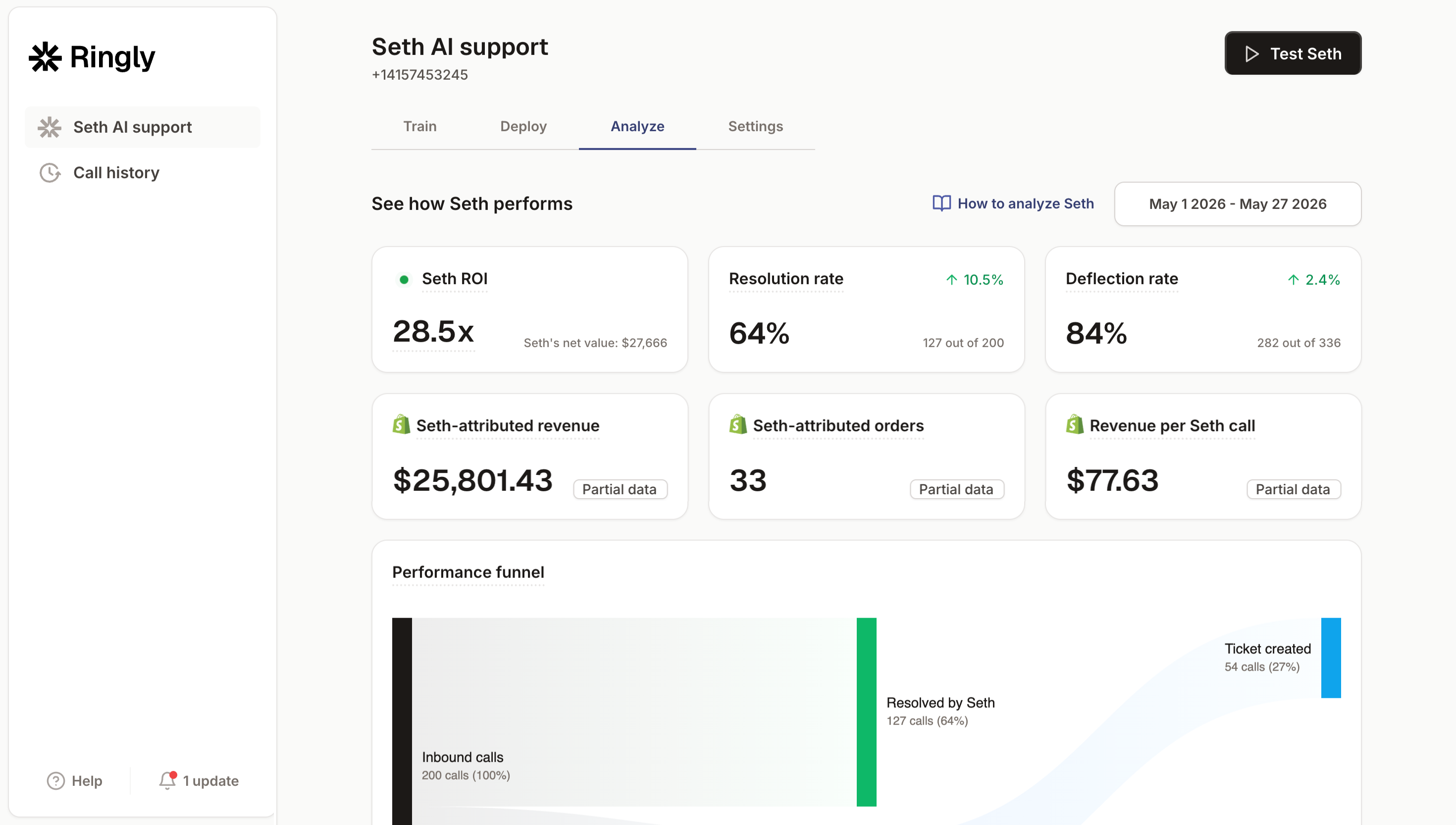
The resolution numbers are the whole point. Across 50+ brands, the AI resolves 73% of inbound calls autonomously at roughly $0.42 per resolved call. BioLongevity Labs, a supplement brand on Ringly, hits 79% resolution. TechCraft Studio handles 88% of calls without a human. And WashCo, a Shopify brand we launched, generated $22,664 in attributed revenue in its first 7 days post-launch.
"My customers also feel like it's a normal person. They feel like they can communicate if they have questions."
Claudia Droge, TechCraft Studio
The calls that do need a person escalate cleanly to Gorgias, Richpanel, Re:amaze, or whatever helpdesk you already run. You keep your stack, and you get the call analysis as part of the deal, not as a second invoice.
What this costs, and what it saves
The enterprise-analytics path has a cost most comparison articles skip: the dashboard fee is on top of the human team you still pay for. You're buying two things, the reporting and the payroll it reports on. Here's the math for a typical brand running a six-rep CS team.
| Line item | Today | Resolution-first |
|---|---|---|
| 6 reps x $4K loaded per rep | $24,000/mo | n/a |
| AI phone support, done-for-you (illustrative ~$5K/mo all-in) | n/a | $5,000/mo |
| Net monthly CS spend | $24,000/mo | $5,000/mo |
| Monthly savings | n/a | $19,000/mo |
| Annual savings | n/a | $228,000/yr |
That's roughly 70% of repeatable calls (order status, returns, product questions, the same five things over and over) routed to the AI. The other 30%, the genuinely complex calls, still go to your CS team, who now have time to actually solve them. On a per-call basis it's about $0.42 resolved versus $7 to $16 per call for a human BPO.
Now add the analytics layer to the old model and the gap widens. You're paying the $24K for the team, plus five figures a year for a tool to tell you what the team is doing. The resolution-first path folds the reporting into the thing that already handled the call.
The analytics you actually need are the ones that come from a call that already got handled. If you want to pressure-test these numbers against your own volume, book a 30-min call and we'll do the math live. Our guides to reducing call center costs and the in-house vs outsourced support decision cover the same ground, and current pricing is public.
How to choose for your size
The right answer depends on how big you are. This isn't a case where one tool wins for everyone, so here's the honest decision framework.
- Choose a dedicated enterprise suite (CallMiner, Verint, NICE, Gong) if: you run a contact center with 100+ agents, you're in a regulated space that needs compliance scoring on every call, or you need deep sales-deal forecasting. Budget for the five-to-six-figure annual spend and the implementation project. For you, these tools are the right buy.
- Choose a VoIP-native analytics add-on (Nextiva, CloudTalk) if: you're mid-market, you're keeping an existing human phone team, and you want reporting attached to a phone system you already like. It's proportionate to what you're running.
- Choose resolution-first if: you're a DTC Shopify brand with three to twelve reps, most of your calls are the same repeatable questions, and you'd rather stop staffing them than measure them more precisely. Let the AI answer and resolve, and take the analytics as the byproduct.
Buy analytics for the team you have. If the team is small and the calls are repeatable, the smarter buy is the thing that answers them. If you're weighing platforms more broadly, our roundup of AI call center software covers the wider field.
Frequently asked questions
What is voice analytics software?
It's software that transcribes your phone calls and layers analysis on top: sentiment, topic detection, agent QA scoring, and compliance monitoring. It was built for contact centers with 50 to 500 human seats, so it assumes you already have a team whose calls you want to analyze.
What's the difference between voice analytics, speech analytics, and conversation intelligence?
They overlap heavily. Speech analytics is the older contact-center QA and compliance term, conversation intelligence usually means the sales flavor (deal coaching, pipeline signals), and voice analytics is the broad umbrella over both. For a DTC brand the label matters much less than whether the tool actually helps you handle calls.
Does a small Shopify brand actually need voice analytics software?
Usually not the enterprise version. These platforms are priced and scoped for 100+ agent teams, and Observe.AI openly tells buyers under 100 agents to skip it. A small brand is better served knowing why customers call and handling the repeatable calls, which you get from an AI phone agent as a byproduct of resolving them.
How much does voice analytics software cost?
More than most brands expect. Observe.AI runs about $69/agent/mo and scales to $60,000-$180,000/yr for 100+ agents, and Gong costs $18,000-$168,000/yr for a 10-person team. The cheapest realistic option, CloudTalk at $19/user/mo, is a phone system with analytics attached, not a standalone analytics purchase.
What metrics should an ecommerce brand track on its support calls?
Six that change decisions: call reasons (topic mix), resolution rate, after-hours and missed-call share, average handle time, escalation rate, and repeat-call rate. Most enterprise suites bury these under 40 metrics you'll never staff a team to use.
How is voice analytics different from an AI phone agent?
Voice analytics measures calls a human team already handled. An AI phone agent answers and resolves the call itself, then logs the transcript and outcome automatically. One is a reporting layer on top of your team, the other does the work and gives you the data for free.
Does voice analytics work with my existing helpdesk or phone system?
Enterprise analytics tools usually require integration work to pull call data from your phone system, which is part of the setup complexity buyers complain about. An AI phone agent like Ringly sits in front of your line and escalates cleanly to Gorgias, Richpanel, Re:amaze, Zendesk, or whatever helpdesk you already run, so you keep your stack.
Can voice analytics reduce WISMO call volume, or does it just measure it?
On its own, it just measures it. Analytics can tell you WISMO is 30% of your calls, but a human still has to answer all of them. Reducing that volume takes something that resolves the call, which is why routing WISMO to an AI agent (and letting it check order status live) does more than a dashboard ever will.
Talk to us

If you run a contact center with a hundred seats, buy the enterprise suite. If you run a Shopify brand with three to twelve reps and the same five questions all day, the better move is to answer and resolve those calls, then read the data they leave behind. The fastest way to see the difference is to hear the AI answer your own store's calls.
The 3-layer guarantee.
- Live in 14 days or it's free until launched.
- 65% resolution in 90 days or we refund the last 3 months of subscription fees.
- We keep working free until we hit 65%.
Ruben (Ringly co-founder) takes these calls personally.
Start your trial today and you get:
- A free dedicated phone number to test on, so you hear it answer real calls the same day.
- The agent built for you. We set it up, you lift zero fingers.
- It plugs into your helpdesk. Gorgias, Richpanel, Re:amaze, Zendesk, or whatever you already run.