

The short version.
- The native Shopify contact form takes about two minutes to add, and you don't need an app for a basic one.
- Where most stores lose time is what happens after submit: bad fields, no routing, and a spam pile nobody triages.
- Built for $10M-$100M Shopify and Shopify Plus brands running a real helpdesk and a visible phone number.
A contact form is the easiest thing on your store to set up, and the easiest thing to set up badly. Every Shopify theme ships with one. You can have it live before your coffee gets cold. The part nobody plans for is the queue it quietly creates, because a form is a ticket generator, and the fields you pick decide whether those tickets are easy to clear or a daily slog of back-and-forth.
This guide walks the native setup first, then the apps worth paying for, then the design choices that decide whether your form cuts support load or adds to it. If you run customer experience at a Shopify brand doing $10M to $100M, the form itself is a 10-minute job. The routing behind it is where your team's hours go. Book a 30-min call and we'll look at what your inbound contacts actually cost you to clear.
How to add the native Shopify contact form
Every Shopify theme includes a contact page template, so a working form is already in your store. You just have to point a page at it. According to the Shopify Help Center, the full setup is six steps:
- From your Shopify admin, go to Online Store > Pages.
- Click Add page.
- Give it a title, like "Contact us" or "Get in touch".
- In the Content box, add any text you want above the form (a line like "we reply within one business day" sets expectations and cuts follow-ups).
- In the Online store section, pick contact from the Theme template dropdown.
- Click Save, then add the page to your navigation menu so people can find it.
That's the whole thing. The native form captures name, email, an optional phone number, and a message, and every submission lands in your store's sender email address, which you can change under Settings > Notifications. I added one to a fresh test store while writing this, and it was live and sending to my inbox in under three minutes.
The catch is that the default form is bare. Four fields, one destination, no logic. For a small store that's plenty. For a brand fielding hundreds of contacts a week, four fields means your team plays twenty questions on every ticket. Which is where the apps come in.
When the native form isn't enough: contact form apps
You need an app the moment you want custom fields, conditional logic, file uploads, real spam control, or routing to somewhere other than an inbox. The native form has no order-number field and no dropdown, so it can't pre-sort a single ticket before it hits your queue. An app fixes that.
Here are five worth a look, with real pricing:
| App | Free plan | Paid entry | Best for |
|---|---|---|---|
| Hulk Contact Form Builder | 5 forms, basic fields | $9.90/mo for conditional logic + file upload | The most common free starting point |
| Globo Form Builder | Yes, basic forms + file upload + email | $9.90/mo Premium | Cheapest full-feature path |
| POWr Form Builder | 25 submissions/mo | $10.99/mo Starter, $19.24/mo Pro (1,000 subs) | Drag-and-drop with lots of field widgets |
| Qikify Contact Form | 1 form, 10 fields | $5.99/mo for 5 forms + popups | Forms and popups in one app |
| Helpdesk-native form | n/a | included with helpdesk | Submissions fill straight into a ticket |
A few honest notes. The free tiers are generous enough that a lot of brands never pay, until submission caps bite during a launch. POWr's free plan stops at 25 submissions a month, which a $30M brand blows through in a morning. Hulk and Globo both clear the bar most stores need at around $10 a month. And if you already run a helpdesk, the cleanest option is often a form that drops straight into it, no inbox in the middle.
That last point matters more than the widget you pick. A form is only as good as where it sends people next.
"My customers also feel like it's a normal person. They feel like they can communicate if they have questions."
Claudia Droge, TechCraft Studio
Design the form so it cuts support volume, not adds to it
Most contact-form advice stops at "add the form." The harder question is whether the form makes your support load lighter or heavier, and that comes down to four choices.
Field design. Add an order-number field and a reason dropdown (order status, return, product question, other). Those two fields let a ticket route and resolve without your team asking for basics first. A reason dropdown plus an order-number field can cut the back-and-forth on a typical ticket from three replies to one. Keep it short past that. Every extra required field drops your completion rate.
Deflect before submit. Put a tracking link and a one-line FAQ directly above the form. "Where is my order" is the single biggest reason people contact you. WISMO accounts for 20% to 40% of ecommerce support tickets, and more than 50% at peak, according to Salesforce. A self-serve order tracking link above the form catches a chunk of that before it ever becomes a ticket. Shopify's own WISMO guide makes the same point: deflecting order-status questions before they reach a human is the highest-impact move in support.
Routing. Send submissions to your helpdesk, not a shared inbox. If you run Gorgias, Zendesk, Gladly, or Re:amaze, route the form into it so submissions become tickets with an owner, an SLA, and a paper trail. A form that emails a generic address is a form that loses tickets. (If you're weighing helpdesks, our Gorgias alternatives and Zendesk alternatives breakdowns cover the trade-offs.)
Spam. Turn on reCAPTCHA or a honeypot field. An open form on a brand doing real traffic will collect bot submissions, and a queue full of junk is a queue your team stops trusting. Most form apps include captcha on the paid tier.
One more thing worth wiring up: an auto-responder. The moment someone submits, fire back a short confirmation that sets a clear reply window ("thanks, we answer within one business day"). It does two jobs. It stops the anxious follow-up email that doubles your ticket on the same issue, and it tells the customer the message landed, so they don't go call your phone line about the form they just filled. Small touch, real volume saved.
Get those four right and the form earns its place. It organizes your typed contacts, routes them cleanly, and quietly deflects the easy ones. For more on trimming the queue, our guide on how to reduce ticket volume goes deeper. But there's one channel a perfect form still can't see.
The blind spot a contact form can't fix
A contact form quietly hides one thing. It only captures the customer willing to type and wait. The person who fills your form is patient by definition. They had a question, they found the form, they typed it out, and they're fine waiting a day for a reply.
Your highest-intent customers don't do that. They call.
Across the 50+ Shopify brands we run phone support for at Ringly, the contacts that come in by phone skew higher in urgency and higher in order value than the ones that come in by form. A pre-purchase question from someone holding a credit card. A "my order's wrong and I need it for the weekend" call. Those people pick up the phone, and if nobody answers, that contact never becomes a ticket at all. It becomes a refund, a bad review, or a sale you lost to a competitor who picked up.
That's the gap. Your contact form and helpdesk give you a clean queue of your most patient customers and a blind spot over your most urgent ones. Studies of missed calls in retail put the cost in stark terms: a large share of callers who can't reach anyone never call back, and many switch to a competitor instead, per industry research compiled by Brightmetrics on call abandonment.
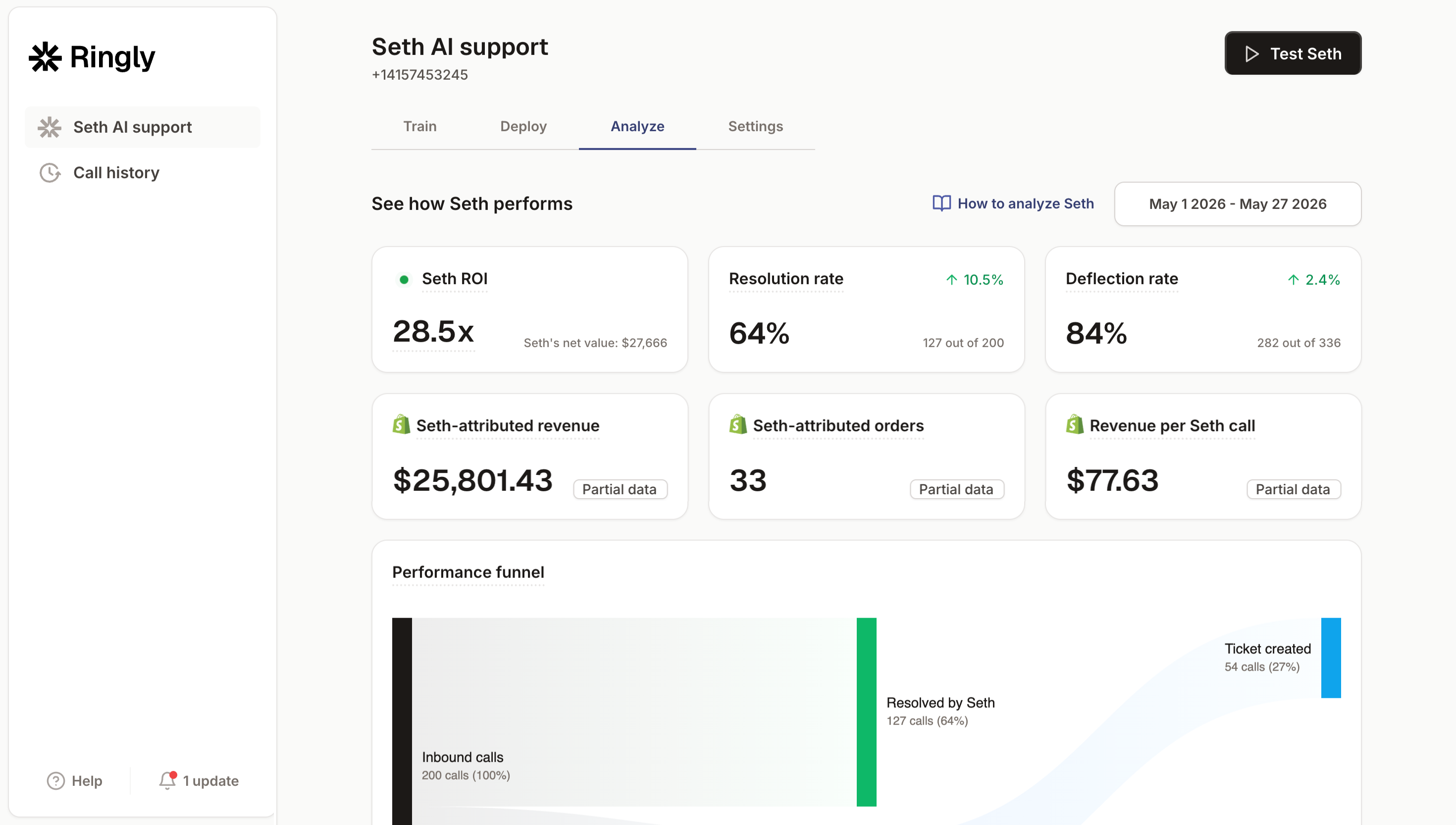
Ringly is AI phone support for Shopify brands. It answers inbound calls 24/7, finds orders in your Shopify store, handles returns and product questions, and escalates anything complex to your existing helpdesk. Across 50+ brands it resolves 73% of calls on its own at roughly $0.42 per resolved call, so the urgent calls your form can't catch stop going to voicemail. WashCo, a Shopify brand we launched, recovered $22,664 in its first 7 days on the phone.
The math is simple to sketch. A six-rep CS team at $4,000 loaded per rep is $24,000 a month, and a big slice of that is the same order-status and returns questions your form already collects in writing. Move the routine phone calls to an AI agent and you keep the team for the calls that need a human. If you want the real number for your store, book a 30-min call and we'll do the math live.
None of this replaces the contact form. Forms are great at what they do. Set yours up well, route it into your helpdesk for Shopify, and let it carry the typed contacts. Just don't mistake a tidy form queue for the whole picture of who's trying to reach you. The phone is still where the urgent money is, and an AI receptionist for ecommerce is how growing brands cover it without hiring a night shift.
Frequently asked questions
Does Shopify have a built-in contact form? Yes. Every Shopify theme includes a contact page template. Create a page, set its theme template to "contact," and the form is live. It captures name, email, an optional phone number, and a message.
Where do Shopify contact form submissions go? They're sent to your store's sender email address. You can change that address under Settings > Notifications in your Shopify admin. If you want submissions to become tickets instead, route them into your helpdesk with a form app.
Can I add custom fields to the Shopify contact form? Not with the native form, which is fixed at four fields. To add an order-number field, a dropdown, or file upload, either edit the theme's contact-form Liquid section or install a form builder app like Hulk, Globo, or POWr.
Do I need an app for a Shopify contact form? No, if you only need a basic name-email-message form. Yes, if you want custom fields, conditional logic, spam protection beyond the default, or routing to a helpdesk instead of an inbox.
How do I stop spam on my Shopify contact form? Turn on reCAPTCHA or a honeypot field. Most form builder apps include captcha on their paid tiers. A spam-filled queue is one your team stops triaging, so it's worth the few dollars.
What about customers who call instead of filling the form? A contact form only catches people willing to type and wait, which skews toward your most patient customers. Higher-intent buyers tend to call, and an unanswered call rarely becomes a ticket. Covering the phone channel, with a team or an AI phone agent, closes that blind spot.
Talk to us

If you run a $10M-$100M Shopify brand, your contact form is handling the patient customers and your phone line is where the urgent ones go. A 30-min call is the fastest way to see how many of those calls you're currently sending to voicemail, and what they're worth.
The 3-layer guarantee.
- Live in 14 days or it's free until launched.
- 65% resolution in 90 days or we refund the last 3 months of subscription fees.
- We keep working free until we hit it.
Ruben (Ringly co-founder) takes these calls personally.