
Here's a number that should change how you think about your return policy: 60% of online shoppers check it before they buy anything. Not after. Before.
Your return policy isn't a legal formality you copy-paste into a footer link. It's a conversion tool. A trust signal. And if you get it wrong, it quietly kills sales you'll never know you lost.
US retail returns hit $849.9 billion in 2025. The average ecommerce return rate sits above 20%. For Shopify stores, that means roughly one in five orders comes back. The question isn't whether you'll deal with returns. It's whether your policy makes the process work for you or against you.
These 12 best practices will help you write a return policy that builds customer trust, protects your margins, and cuts down on the support tickets and phone calls that eat your time.
Hear what AI support calls sound like for your store. Just paste your Shopify URL and get sample calls in under 20 seconds, no email required. Listen to demo calls for my store.
Why your return policy is a sales tool, not a liability
Most store owners treat their return policy like a necessary evil. Something the lawyer said they needed. But the data tells a different story.
According to a Narvar study, 96% of customers will buy again from a store that makes returns easy. And 77% of first-time shoppers decide whether to come back based on the return experience alone.
Think about that. Your return policy directly shapes repeat purchase behavior.
It also shapes first-time conversions. If a shopper lands on your product page and can't quickly find a clear, fair return policy, they bounce. That's not speculation. That's the 60% stat in action.
Here's the myth that needs to die: a generous return policy leads to more returns. The opposite is true. Clear, fair policies actually reduce return rates because customers buy with more confidence and less "let me order three sizes and return two" thinking.
The real cost isn't generous policies. It's unclear ones. Unclear policies lead to customer complaints, chargebacks, and phone calls from confused buyers asking what your policy even is.
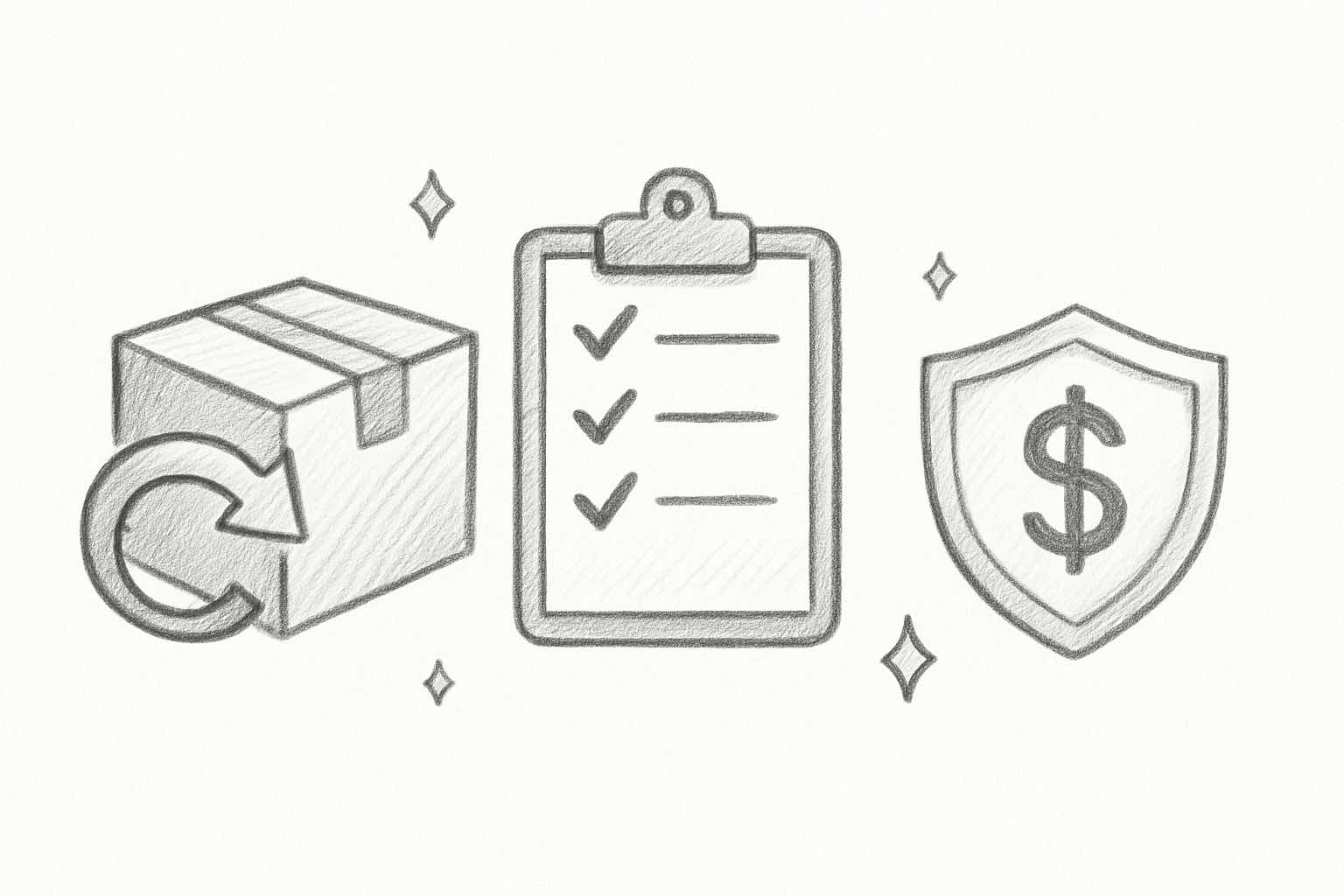
A strong return policy does three things at once:
- Increases conversions: shoppers trust you enough to click "buy"
- Reduces support volume: fewer confused calls and emails
- Protects margins: exchanges and store credit preserve revenue
12 shopify return policy best practices
1. Set a clear return window (and stick to it)
The standard return window for most Shopify stores is 30 days. That works for the majority of products. But one size doesn't fit all.
For high-consideration items (furniture, electronics, custom products), consider 60 or even 90 days. For seasonal or deeply discounted items, 14 days is reasonable.
The key is being specific. "You have 30 days from the delivery date to initiate a return" is clear. "Returns accepted within a reasonable timeframe" is not.
Set this up in your Shopify admin under Settings > Policies > Return rules. You can configure the exact window and Shopify will enforce it automatically when customers use self-serve returns.
2. Spell out product condition requirements
Vague condition requirements are one of the top reasons return disputes escalate into support tickets. Be explicit about what you expect.
A good condition statement covers:
- Unused and unworn: item hasn't been used beyond trying it on
- Original packaging: must be in the original box or packaging
- Tags attached: all tags and labels still in place
- Accessories included: chargers, manuals, free gifts returned together
List your non-returnable items clearly too. Common exclusions for Shopify stores include:
- Perishable goods: food, flowers, supplements past seal
- Personal care items: opened skincare, hygiene products
- Custom or personalized orders: engraved or monogrammed items
- Final sale items: clearly marked at checkout
3. Offer exchanges and store credit before full refunds
This is where smart return policies make money. When a customer wants to return something, you have three options: full refund, store credit, or exchange. The first one costs you the most.
According to industry data, exchange-first flows can retain 30-40% of revenue that would otherwise be lost to refunds. The trick is making exchanges the path of least resistance.
Here's how:
- Offer free return shipping only for exchanges (customers pay for refund returns)
- Make the exchange flow dead simple: one-click swap for a different size or color
- Add a store credit bonus: offer 10-15% extra value when they choose credit over a refund
Shopify Flow lets you automate exchange-first logic so your team doesn't have to handle it manually. This is especially useful for reducing your refund rate.
4. Make your policy easy to find (put it everywhere)
A return policy that nobody can find is the same as not having one. Place it in every spot a customer might look:
- Website footer: standard location, always accessible
- Product pages: a link or accordion near the "Add to Cart" button
- Checkout page: visible before the customer commits
- Order confirmation emails: set expectations immediately after purchase
- FAQ page: answer the most common return questions
- Contact/help page: for customers already looking for support
This isn't about being repetitive. It's about meeting customers where they are. Someone on the product page has different intent than someone checking their order confirmation. Both need to see your policy.
Good customer service for Shopify stores starts with making information accessible before people have to ask for it.
5. Use plain language, not legal jargon
If your return policy reads like a terms of service agreement, it's working against you. Shoppers don't read legalese. They skim.
Write your policy at a level anyone can understand. Short sentences. Bullet points. No Latin.
Here's an example of what to avoid versus what works:
| Bad | Good |
|---|---|
| "Merchandise must be returned in its original, unaltered condition within the applicable return period as specified herein." | "Return items within 30 days. They need to be unused, with tags still attached." |
| "Refunds shall be processed to the original method of payment within 5-10 business days of receipt and inspection." | "You'll get your refund back to your original payment method within 5-10 business days after we receive your return." |
Your customer service scripts and your written policy should match in tone: friendly, direct, zero confusion.
6. Enable Shopify's self-serve returns
Shopify has a built-in self-serve returns feature that lets customers initiate return requests directly from their account. No email needed. No phone call required.
To set it up:
- Go to Settings > Customer accounts
- Activate the self-serve returns option
- Ensure you're using the new customer accounts (not legacy)
- Configure your return rules (window, shipping, fees)
Once enabled, customers submit return requests for fulfilled orders and you review them in your Shopify admin. You can approve or decline based on your policy.
One limitation: exchanges can't be requested through self-serve returns yet. But for straightforward refund requests, this feature eliminates a huge chunk of manual work.
This pairs well with a solid Shopify customer service app stack to cover the cases self-serve can't handle.
7. Automate return processing with Shopify Flow
Manual return processing doesn't scale. If you're handling more than a few returns per week, automation saves hours.
Shopify Flow lets you build workflows that:
- Auto-approve returns that meet your criteria (within window, valid reason, first return)
- Flag suspicious returns for manual review (serial returners, high-value items)
- Send real-time updates to customers at each stage (request received, approved, refund processed)
- Trigger exchanges automatically when a customer selects a different variant
The 48% of online shoppers who returned something in the past year expect a smooth, fast process. Automation delivers that without burning through your team's time.
If you want to dig deeper into automating your ecommerce customer service operations, return processing is the highest-impact place to start.
8. Handle return-related phone calls at scale
Even with self-serve returns and clear policies, customers still call. They call when they can't figure out the portal. They call when they want to know if their item qualifies. They call after hours when nobody's there.
Return-related inquiries are one of the top call drivers for Shopify stores. And each call costs you time, money, or both.
This is where AI phone support changes the math. An AI phone agent can handle return calls 24/7: looking up orders, explaining your return policy, walking customers through the process, and escalating to a human when something falls outside standard rules.
Ringly.io does exactly this for over 2,100 Shopify stores. The AI agent, Seth, connects to your Shopify data in real time. It knows your return policy, can check order status, and processes return requests while you sleep. Setup takes about three minutes.
Try it free for 14 days and see what return call automation looks like for your store.
9. Set restocking fees strategically
Restocking fees are a double-edged sword. Used well, they discourage frivolous returns on high-value items. Used badly, they drive customers away.
When restocking fees make sense:
- Opened electronics: 10-15% fee covers repackaging and inspection
- Large/heavy items: shipping costs justify the fee
- High-value goods: deters impulse buying and returning
When to skip them:
- Low-margin items: processing the fee costs more than the fee itself
- First-time customers: the friction isn't worth losing their loyalty
- Exchanges: never charge a restocking fee on exchanges
Configure restocking fees in Shopify under Settings > Policies > Return rules. You can set a flat rate or percentage.
And keep this stat in mind: 48% of retailers that added return fees saw more customer complaints. Fees need to feel fair, or they backfire.
10. Protect against return fraud
Return fraud cost US retailers roughly $127 billion in 2025. That's about 15% of all returned merchandise. And the problem is getting worse: according to a Signifyd report, 62% of consumers admit to at least one abusive return behavior, from bracketing multiple sizes to wardrobing items for a single use. If you're not thinking about it, you should be.
The most common types:
- Wardrobing: wearing an item (usually clothing) once, then returning it
- Bracketing abuse: intentionally ordering multiple sizes/colors with plans to return most
- Empty box fraud: claiming a return was shipped when the box is empty or contains something else
- Receipt fraud: using fake or stolen receipts
Practical defenses:
- Require photos of items before approving a return
- Track return patterns: flag customers with return rates above 30-40%
- Use unique tags or seals: makes wardrobing harder to get away with
- Set item-level return limits: cap how many times a specific item can be returned per customer
Shopify's return rules give you some of this control natively. For more advanced fraud prevention, check our ecommerce fraud statistics for the latest data on what to watch for.
11. Track return data and act on it
Your returns data tells you what's broken in your business. If you're not tracking it, you're flying blind.
Key metrics to watch:
- Return rate by product: which SKUs get returned most?
- Return reason breakdown: sizing? Quality? Not as described?
- Return-to-exchange ratio: how many returns convert to exchanges vs. refunds?
- Time to resolution: how long from request to refund/exchange?
- Cost per return: shipping, processing, restocking, lost inventory
When you spot patterns, fix the root cause:
- High "wrong size" returns? Add a detailed sizing guide with actual measurements
- "Not as described" returns? Improve product photos and descriptions
- High return rate on one SKU? Investigate quality issues or misleading listing
Sizing and fit issues cause 45% of all ecommerce returns. That's the single biggest lever you have. If your return data shows "wrong size" as a top reason, a sizing guide could cut your return rate by double digits.
Tracking your customer service KPIs alongside return data gives you the full picture of where your post-purchase experience breaks down. Use that data to drive product improvements, not just policy changes.
12. Review and update your policy quarterly
Your return policy isn't a set-it-and-forget-it document. Markets shift. Customer expectations change. New fraud tactics emerge.
Review your policy at least once per quarter. Here's what to check:
- Seasonal adjustments: extend your return window for holiday orders (most stores do 60-90 days for Q4 purchases)
- Competitor benchmarking: check what similar stores offer (if everyone in your niche does 60 days and you do 14, you're losing sales)
- Customer feedback: what are people complaining about? What questions keep coming up?
- Return data trends: are return rates going up or down? Why?
This also applies to your after-hours customer service setup. If return calls spike during evenings and weekends, you need coverage during those hours.
How to set up your return policy in Shopify (step by step)
If you haven't configured your return settings yet, here's the quick version.
Step 1: Write your policy text. Go to Settings > Policies in your Shopify admin. Click on "Refund policy." Write or paste your return policy using the template below. Click Save.
Step 2: Configure return rules. Go to Settings > Policies > Return rules. Set your:
| Setting | Recommended value |
|---|---|
| Return window | 30 days (adjust by product type) |
| Return shipping | Free for exchanges, customer pays for refunds |
| Restocking fee | 0% default, 10-15% for electronics/high-value |
| Final sale items | Tag specific products or collections |
Step 3: Enable self-serve returns. Go to Settings > Customer accounts. Turn on self-serve returns. Make sure you're on the new customer accounts system (not legacy).
Step 4: Test the flow. Place a test order, fulfill it, then try initiating a return as a customer. Make sure the experience is smooth and your policy text appears correctly.
For a full walkthrough on setting up phone support alongside your return system, that guide covers the voice channel side. And if you're comparing the cost of doing this in-house versus with automation, here's a breakdown of Shopify customer service costs to help you decide.
Return policy template for Shopify stores
Here's a starting template you can adapt for your store. Fill in the brackets with your specific details.
Returns We accept returns within [30] days of delivery. Items must be unused, in original packaging, and with all tags attached. To start a return, log into your account and submit a return request, or contact us at [email/phone].
Exchanges We're happy to exchange items for a different size or color. Exchange shipping is on us. To request an exchange, [describe process].
Refunds Once we receive and inspect your return, we'll process your refund within [5-10] business days to your original payment method. You'll get an email confirmation when it's done.
Non-returnable items The following items can't be returned: [list your exclusions, e.g., final sale items, opened personal care products, custom orders, perishable goods].
Return shipping For refund returns, customers are responsible for return shipping costs. For exchanges, we provide a prepaid return label.
Damaged or defective items If your order arrives damaged or defective, contact us within [48 hours] and we'll send a replacement at no cost.
Want to automate how your team handles return questions over the phone? See how Ringly.io handles return calls for Shopify stores. Setup takes three minutes.
Frequently asked questions
What is a good return window for Shopify stores? 30 days is the standard for most products. For high-consideration items like electronics or furniture, 60-90 days builds more trust. For seasonal or final sale items, 14 days is reasonable. Match the window to how long it realistically takes customers to decide if they're keeping something.
Should I offer free return shipping? Not necessarily for all returns. A smart approach is offering free shipping on exchanges (which preserves your revenue) and having customers pay for refund returns. This incentivizes exchanges without penalizing customers who genuinely need to send something back.
How do I handle returns for perishable or personal care products? Most stores exclude these from standard returns entirely. List them clearly as non-returnable in your policy. For defective or damaged items in these categories, offer a full replacement or refund without requiring the customer to ship the item back.
Can I use Shopify's built-in tools to manage returns? Yes. Shopify offers self-serve returns (customers request returns from their account), configurable return rules (window, shipping, fees), and Shopify Flow for automation. For most stores, these native tools handle 80%+ of return cases without needing a third-party app.
How do I reduce return-related customer service calls? Three things help most: a clear, visible return policy (so customers don't need to call to ask), self-serve returns (so they can do it themselves), and an AI phone agent that handles return inquiries 24/7 for the customers who still prefer calling.
What's the average ecommerce return rate? The average sits between 20-24.5% for online purchases, compared to about 8-10% for brick-and-mortar. Apparel has the highest rates (up to 30%), while electronics and cosmetics are lower (around 11%). Your specific rate depends on your product category, price point, and how good your product listings are.
Should my return policy differ by product category? Yes, if you sell across categories. A blanket 30-day policy works for simple stores, but if you sell both $15 accessories and $500 electronics, those products have different return dynamics. Shopify's return rules let you set different windows and fees by product tag or collection.
Your return policy is a profit lever, not a cost center
The stores that win on returns aren't the ones with the strictest policies. They're the ones with the clearest policies, the smoothest execution, and the smartest automation.
Write a policy that builds trust. Set up Shopify's native tools to handle the routine cases. Automate what you can. And for the return calls that still come in (because they always will), make sure someone, or something, picks up the phone.
Ringly.io gets your AI phone support handling return calls in about three minutes. Start your free trial and let Seth answer the next return call for you.