


You've probably seen those articles listing 25 customer service metrics. They're overwhelming and, honestly, not that helpful. You don't need 25 KPIs. You need the right ones.
Most ecommerce teams are either flying blind (tracking nothing) or drowning in data (tracking everything their helpdesk spits out). Neither approach tells you what's actually happening with your customers. The sweet spot? Five to seven core metrics that cover satisfaction, speed, and retention.
This guide breaks down 12 customer service KPIs for ecommerce, organized by priority. Start with the first five. Add more as your team and order volume grow. Each one includes the formula, a real ecommerce benchmark, and what to do when the number looks bad.
Hear what AI support calls sound like for your store. Just paste your Shopify URL and get sample calls in under 20 seconds, no email required. Listen to demo calls for my store.
What are customer service KPIs?
Customer service KPIs are measurable values that show how well your support operation is performing. Think of them as a health check for the experience you're giving customers after they hit "buy."
For ecommerce specifically, these matter more than in most industries. You're dealing with high order volumes, thin margins, and customers who have dozens of alternatives one click away. A single bad support experience can cost you a customer forever. According to Accenture, businesses that treat customer service as a value driver see 3.5x higher revenue growth compared to those that don't.
The goal isn't to track everything. It's to track the metrics that actually predict whether customers will come back and spend more. Research consistently shows that top-performing ecommerce brands track an average of 5-7 core metrics. That's the number we're aiming for here as your starting point.
The 5 customer service KPIs you must track
If you track nothing else, track these five. Together, they tell you whether customers are happy, getting help fast, resolving issues on the first try, coming back, and willing to recommend you.
1. Customer satisfaction score (CSAT)
CSAT measures how happy a customer is right after a support interaction. You send a quick survey (usually a 1-5 scale), and the percentage of positive responses is your score.
Formula: (positive responses / total responses) x 100
The ecommerce average sits around 75-82%, depending on who you ask. Top performers hit 85% or higher. If you're below 70%, something is seriously wrong with your support quality.
Here's what makes CSAT useful: it's immediate and specific. Unlike NPS (which we'll cover later), CSAT tells you about a single interaction, not a general feeling. That makes it actionable. You can tie a low score to a specific agent, channel, or issue type and fix it.
One important detail: phone support scores highest for satisfaction at 91%, compared to 85% for live chat and lower for email. If you're not offering phone support yet, that gap is worth paying attention to. Setting up phone support for your online store doesn't have to be complicated, especially with AI handling the calls.
To improve your Shopify customer satisfaction, focus on reducing wait times and resolving issues in fewer interactions. Those two levers move CSAT more than anything else.
2. First response time (FRT)
First response time measures how long it takes your team to send the first reply after a customer reaches out. Not the resolution, just the first acknowledgment.
Benchmarks by channel:
| Channel | Best-in-class | Industry average |
|---|---|---|
| Under 1 hour | 4-6 hours | |
| Live chat | Under 1 minute | 2-3 minutes |
| Phone | Under 20 seconds | 30-60 seconds |
| Social media | Under 1 hour | 4-8 hours |
Why does this matter so much? Because 59% of customers are more likely to buy from you when their question is answered in under a minute. And sub-one-hour responses drive 71% retention versus just 48% for slower responses.
FRT is one of those metrics where a small improvement has a huge downstream effect. Check out our response time benchmarks guide for a deeper breakdown by industry. If you run a Shopify store specifically, we've also written about Shopify customer service response time standards.
3. First contact resolution rate (FCR)
FCR tells you what percentage of customer issues get resolved in a single interaction, without needing a follow-up, transfer, or callback.
Formula: (issues resolved on first contact / total issues) x 100
The target for ecommerce is 70-75%. Here's why this one is so powerful: according to SQM Group, every 1% improvement in FCR reduces your operating costs by 1% while simultaneously increasing customer satisfaction by 1%. That's a rare two-for-one in customer service.
Low FCR usually means one of three things: agents don't have the right information, your processes require unnecessary handoffs, or customers are being routed to the wrong team. Fixing these is often more about tools and workflow than hiring.
For phone support, FCR tends to be higher than email because conversations happen in real time. An AI phone agent like Ringly.io can look up orders, process returns, and answer product questions in a single call, which pushes FCR up significantly. You can learn more about first call resolution in ecommerce and why it's one of the most undervalued metrics.
4. Customer retention rate (CRR)
CRR measures what percentage of your existing customers continue buying from you over a given period.
Formula: ((customers at end of period - new customers acquired) / customers at start of period) x 100
The ecommerce average is only about 30%, according to Shopify. That means 70% of your customers buy once and never come back. Improving this number by even a few points has an outsized impact on revenue because repeat customers make up just 21% of a typical store's customer base but generate 44% of total revenue.
The connection to customer service is direct. Every unresolved complaint, slow response, and frustrating return process chips away at retention. If you want to dig deeper, our guides on ecommerce customer retention and DTC brand retention strategy cover specific tactics.
5. Net promoter score (NPS)
NPS measures how likely your customers are to recommend your brand to someone else. You ask one question: "On a scale of 0-10, how likely are you to recommend us?"
Scoring:
- Promoters (9-10): Your advocates. They'll refer friends and leave positive reviews.
- Passives (7-8): Satisfied but not enthusiastic. Vulnerable to competitors.
- Detractors (0-6): Unhappy customers who can actively hurt your brand.
Formula: % promoters - % detractors
A good B2C ecommerce NPS falls between 30 and 50. Below 0 means you have more detractors than promoters, which is a red flag.
NPS is a lagging indicator. It tells you the overall health of your customer relationships, but it won't pinpoint a specific problem. That's why you need it alongside CSAT (which is more granular). Together, they give you both the big picture and the details.
5 customer service KPIs to track as you grow
Once you've nailed the five essentials, these next five become important as your order volume and team size increase.
6. Average resolution time (ART)
ART tracks the total time from when a customer opens a ticket to when it's fully resolved. Unlike FRT, this includes back-and-forth messages, internal investigations, and any escalations.
Formula: total resolution time for all tickets / number of resolved tickets
Top ecommerce brands aim for under six minutes on phone calls and under four hours for email tickets. The key word is "resolved," not just "responded to." A fast first reply followed by days of back-and-forth doesn't help anyone.
ART has a direct impact on CSAT. The longer an issue drags on, the more frustrated the customer gets. Track this one closely, especially during peak season when resolution times tend to spike.
Following ecommerce customer service best practices can help keep ART in check as you scale.
7. Cost per contact
Cost per contact tells you what each customer interaction costs your business. It's one of the most important financial KPIs for support teams, but most stores calculate it wrong.
Formula: total support costs / total number of customer contacts
The ecommerce average is $2.70-$5.60 per ticket. But here's the catch: most stores only count salaries and software. You need to include training, management overhead, QA, and turnover costs. When you do, the real number is often 2-3x higher than expected.
There's also a big difference between cost per contact and cost per resolution. An email might cost $8 per contact, but if it takes four emails to solve one issue, your cost per resolution is $32. Phone calls cost more per contact (around $17 for human agents) but often resolve the issue in one shot.
AI is flipping this equation. The average cost per chatbot interaction is about $0.50, compared to $6.00 for a human agent. AI phone agents fall somewhere in between but with single-call resolution rates. For a full breakdown, check our cost per contact benchmarks and Shopify customer service cost analysis.
8. Customer effort score (CES)
CES measures how easy it was for a customer to get their issue resolved. You ask: "How easy was it to resolve your issue?" on a 1-7 scale.
Why track this? Because effort predicts loyalty better than satisfaction does. According to the book The Effortless Experience, 96% of high-effort customer experiences drive disloyalty. Low effort, on the other hand, correlates with repeat purchases and positive word-of-mouth.
If your CES is high (meaning customers find it hard to get help), look at your contact page, hold times, return process, and how many steps it takes to reach a real answer.
9. Ticket volume trends
This isn't a single number. It's the pattern of incoming support requests over time.
Track ticket volume weekly and monthly, segmented by issue type (order status, returns, product questions, billing). Sudden spikes often reveal problems before they show up in other metrics. A jump in "where's my order" tickets? That's a shipping issue. A surge in return requests for one product? Probably a quality problem.
Seasonal awareness matters too. Black Friday customer service brings predictable spikes. If you're not staffed (or automated) for it, every other KPI on this list will suffer.
10. Abandoned call rate
Abandoned call rate is the percentage of callers who hang up before they reach someone. If you offer phone support, this one is critical.
Formula: (abandoned calls / total incoming calls) x 100
Under 5% is considered good. Over 8% is a problem. Every abandoned call is a customer who needed help and didn't get it. Some of those are pre-purchase questions, which means you're literally losing sales.
The most common causes are long hold times and confusing IVR menus. Both are fixable. Missed calls are costly, but there are practical ways to handle high call volume without hiring a full team.
AI phone agents solve this by answering every call instantly, 24/7. Ringly.io picks up on the first ring and handles order lookups, returns, and product questions automatically. That drops your abandoned call rate to near zero. Try it free for 14 days and see the difference in your call metrics.
2 advanced KPIs for scaling ecommerce brands
These two metrics are worth tracking once you're past the early stage and want to squeeze more value out of every support interaction.
11. Tickets per order (TPO)
TPO measures how many support tickets each order generates. It's a forward-looking metric that most stores completely ignore.
Formula: total tickets / total orders
Here's why it's powerful: instead of just measuring how well you handle problems, TPO tells you how many problems you're creating. A high TPO means something in your fulfillment, product, or communication is broken.
Segment it by product, shipping method, and customer segment. You'll often find that one product line or one carrier is responsible for a disproportionate share of tickets. Fix that, and you reduce support volume without touching your support team at all.
12. Revenue per support interaction
This metric tracks how much upselling or cross-selling happens during support conversations. It's the metric that turns customer service from a cost center into a revenue driver.
Most ecommerce stores don't track this, but they should. A customer calling about a product question is already engaged. An agent (or AI) that can suggest a complementary product or upgrade creates real value. We've covered this in depth in our guide on ecommerce upselling during customer service.
Ecommerce customer service benchmarks at a glance
Here's a quick reference table with all 12 KPIs, their formulas, and where you should aim.
| KPI | Formula | Ecommerce average | Top performer target |
|---|---|---|---|
| CSAT | (positive / total) x 100 | 75-82% | 85%+ |
| FRT (email) | Time to first reply | 4-6 hours | Under 1 hour |
| FRT (phone) | Time to first reply | 30-60 seconds | Under 20 seconds |
| FCR | (first-contact resolved / total) x 100 | 65-70% | 75%+ |
| CRR | ((end - new) / start) x 100 | ~30% | 40%+ |
| NPS | % promoters - % detractors | 20-30 | 40+ |
| ART (email) | Total time / resolved tickets | 8-12 hours | Under 4 hours |
| Cost per contact | Total costs / total contacts | $2.70-$5.60 | Under $3.00 |
| CES | Survey average (1-7) | 4.5-5.0 | Under 3.0 |
| Abandoned call rate | Abandoned / total calls | 6-8% | Under 5% |
| TPO | Tickets / orders | Varies | Trending down |
| Revenue per interaction | Revenue from support / interactions | Varies | Trending up |

For more ecommerce-specific data, check our ecommerce customer support statistics for 2026 and call center statistics.
How AI is changing customer service KPIs
Here's where things get interesting. AI isn't just helping you track KPIs. It's fundamentally changing what "good" looks like for several of them.
First response time is approaching zero. AI chatbots and phone agents respond instantly. There's no hold time, no queue, no "we'll get back to you within 24 hours." For stores using AI customer service automation, FRT on automated channels is measured in seconds, not hours.
Cost per contact is dropping fast. A chatbot interaction averages $0.50 compared to $6.00 for a human agent. AI phone agents land somewhere in between but handle calls that would otherwise cost $17+ each. According to industry projections, 50% of support interactions will be bot-handled by 2027, and 80% of businesses plan to adopt AI-driven voice technology by 2026.
FCR is climbing. AI agents that can pull up order information, process returns, and check inventory in real time resolve more issues on the first contact. Ringly.io resolves about 73% of calls without any human intervention. That's an FCR rate most human teams can't match consistently.
New metrics are emerging. As AI handles more interactions, stores are starting to track containment rate (percentage of issues fully handled by AI), escalation accuracy (whether AI routes complex issues to the right human), and AI resolution quality (whether AI-resolved tickets stay resolved).
For the full picture on this shift, read our guides on how AI is changing call centers and AI customer service statistics for 2026.
Want to see how AI phone support actually performs? Start a free 14-day trial of Ringly.io. Setup takes three minutes.
How to start tracking KPIs today
You don't need expensive software or a data team to get started. Here's a practical four-step process.
Step 1: Pick your top 5. Start with the must-track list above: CSAT, FRT, FCR, CRR, and NPS. These five cover satisfaction, speed, resolution quality, retention, and loyalty. That's enough to make smart decisions.
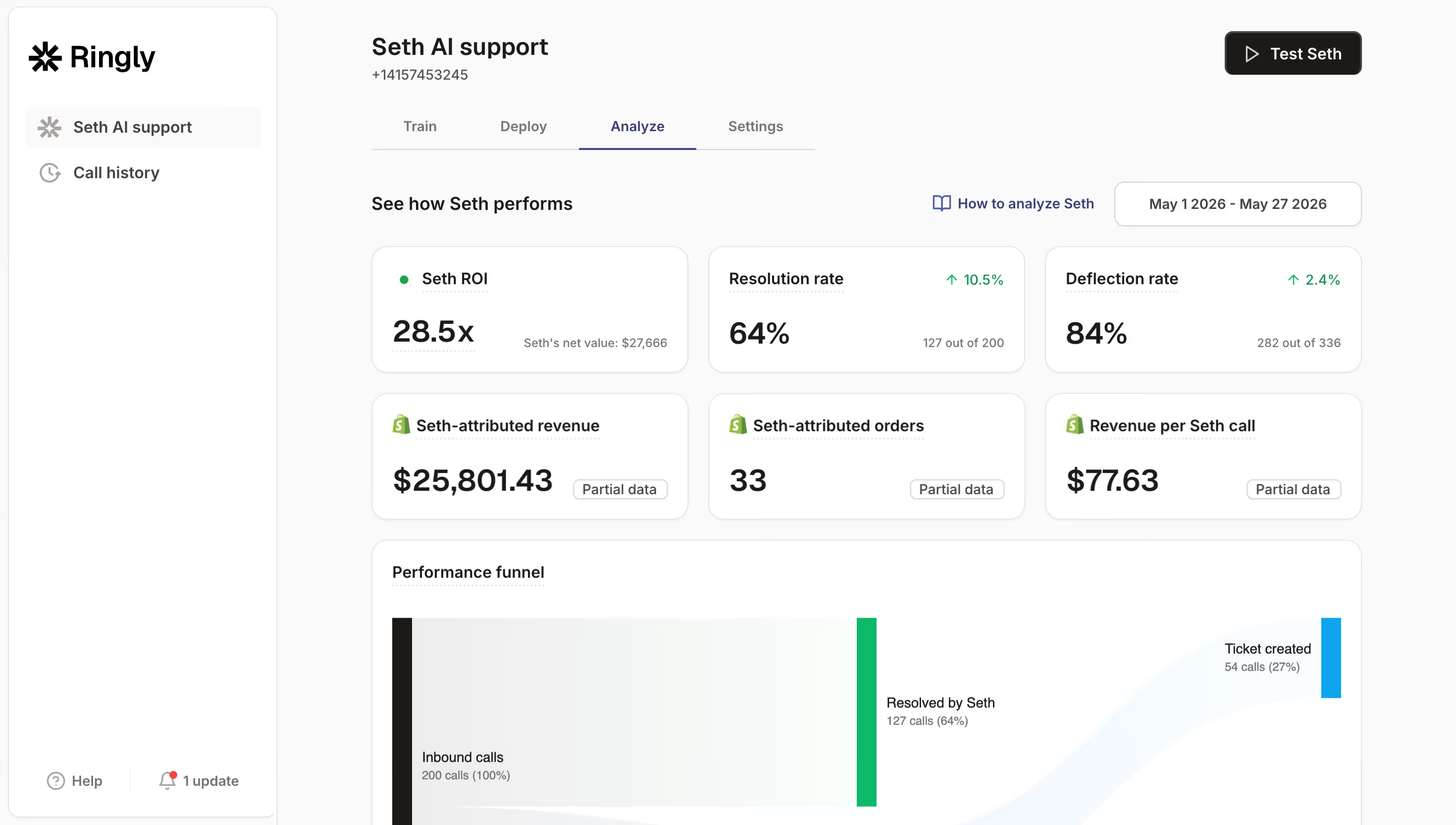
Step 2: Set up measurement. Most helpdesk tools (Shopify helpdesk apps like Gorgias, Zendesk, or Freshdesk) track FRT, ART, and ticket volume automatically. For CSAT and NPS, add post-interaction surveys. For phone metrics, an AI phone agent like Ringly.io tracks everything through its AI call analysis dashboard. If you're on a tight budget, even a spreadsheet works for month one.
Step 3: Establish baselines. Track for 30 days before setting any targets. You need to know where you are before you can decide where you want to be. Don't compare yourself to benchmarks on day one.
Step 4: Review weekly, adjust monthly. Look at the numbers every week. Adjust targets and processes monthly. Avoid knee-jerk reactions to single data points. Three consecutive weeks of declining CSAT is a pattern. One bad week is noise.
If you need help picking the right tools, our roundup of the best customer service tools for small ecommerce and our guide on call center analytics software are solid starting points.
Frequently asked questions
How many customer service KPIs should an ecommerce store track?
Start with 5-7 core metrics. That's the sweet spot between having no visibility and drowning in data. The five must-track KPIs in this guide (CSAT, FRT, FCR, CRR, NPS) give you a complete picture of support quality, speed, and customer loyalty.
What is a good CSAT score for ecommerce?
The ecommerce average is 75-82%. Anything above 85% puts you in the top tier. Below 70% signals a serious problem with your support quality or process. Phone support tends to score highest (91% average satisfaction), followed by live chat (85%).
How do you calculate customer retention rate?
Use this formula: ((customers at end of period - new customers acquired during period) / customers at start of period) x 100. For example, if you started the quarter with 1,000 customers, gained 200 new ones, and ended with 900 total, your CRR is 70%.
What's the difference between CSAT and NPS?
CSAT measures satisfaction with a specific interaction (transactional). NPS measures overall loyalty and likelihood to recommend (relational). You need both. CSAT helps you fix individual problems. NPS tells you if your brand relationship is healthy overall.
How often should I review customer service KPIs?
Review weekly for operational metrics (FRT, ART, ticket volume). Review monthly for strategic metrics (NPS, CRR, cost per contact). Look at trends over 4-6 weeks before making process changes. One bad week doesn't mean you need to overhaul everything.
Can AI tools help improve customer service KPIs?
Yes, significantly. AI phone agents and chatbots improve FRT (instant responses), FCR (real-time order lookups and issue resolution), and cost per contact ($0.50 per chatbot interaction vs $6.00 for a human agent). Ringly.io, for example, resolves 73% of calls without human help and answers every call on the first ring, eliminating abandoned calls entirely. See how it works for your store.
Track what matters, ignore the rest
Here's the thing: perfect metrics don't exist. Your numbers will fluctuate. Some months will look great. Others won't. That's normal.
What matters is that you're tracking the right KPIs consistently and using them to make better decisions. Start with five. Get comfortable reading them. Then add more as your team and volume grow.
The stores that win on customer service aren't the ones with the fanciest dashboards. They're the ones that pick a few numbers, watch them closely, and actually change how they operate based on what they see.
If phone support is part of your stack (or should be), try Ringly.io free for 14 days. You'll get instant call answering, automatic KPI tracking, and 73% of calls resolved without your team lifting a finger. Setup takes three minutes.