

Freshdesk has been a go-to help desk solution for years, but it's not the right fit for every team.
Maybe you're tired of the pricing surprises that come with every new feature. Or perhaps your agents are struggling with a cluttered interface that makes simple tasks feel complicated.
The good news? There's no shortage of alternatives. The challenge is finding one that actually solves your specific problems instead of creating new ones.
We've researched and compared seven of the best Freshdesk alternatives for 2026. Each one takes a different approach to customer support, from enterprise powerhouses to AI-first platforms to specialized tools for specific industries.
Editor’s note: Want to hear some sample AI support calls made for your Shopify store?
- Just paste your store URL
- Get sample calls in under 20 seconds (no email required)
- Listen to demo calls for my store
Why teams switch from Freshdesk
Before diving into alternatives, let's look at what drives teams away from Freshdesk in the first place.
Unpredictable pricing is the most common complaint. Freshdesk advertises a low entry point around $15 per agent, but essential features like custom reports, round-robin routing, and multiple SLAs require upgrading to the Pro plan at roughly $49 per agent. Add their AI assistant (Freddy Copilot) for another $29 per agent, and costs escalate quickly.
Feature fragmentation frustrates daily workflows. Freshdesk's chat, voice, and ticketing often operate as separate products. Agents constantly switch between tabs and interfaces just to handle a single customer conversation.
Data limitations catch teams off guard. Freshdesk archives tickets after 120 days of inactivity, making them read-only and removing them from reports. Analytics reporting is capped at just two years on base plans.
Performance issues emerge at scale. Users report slow loading times and occasional glitches when handling high ticket volumes, directly impacting agent productivity.
Complex setup extends time-to-value. New hires need significant training before they can effectively use the platform, which becomes a bottleneck during growth periods.
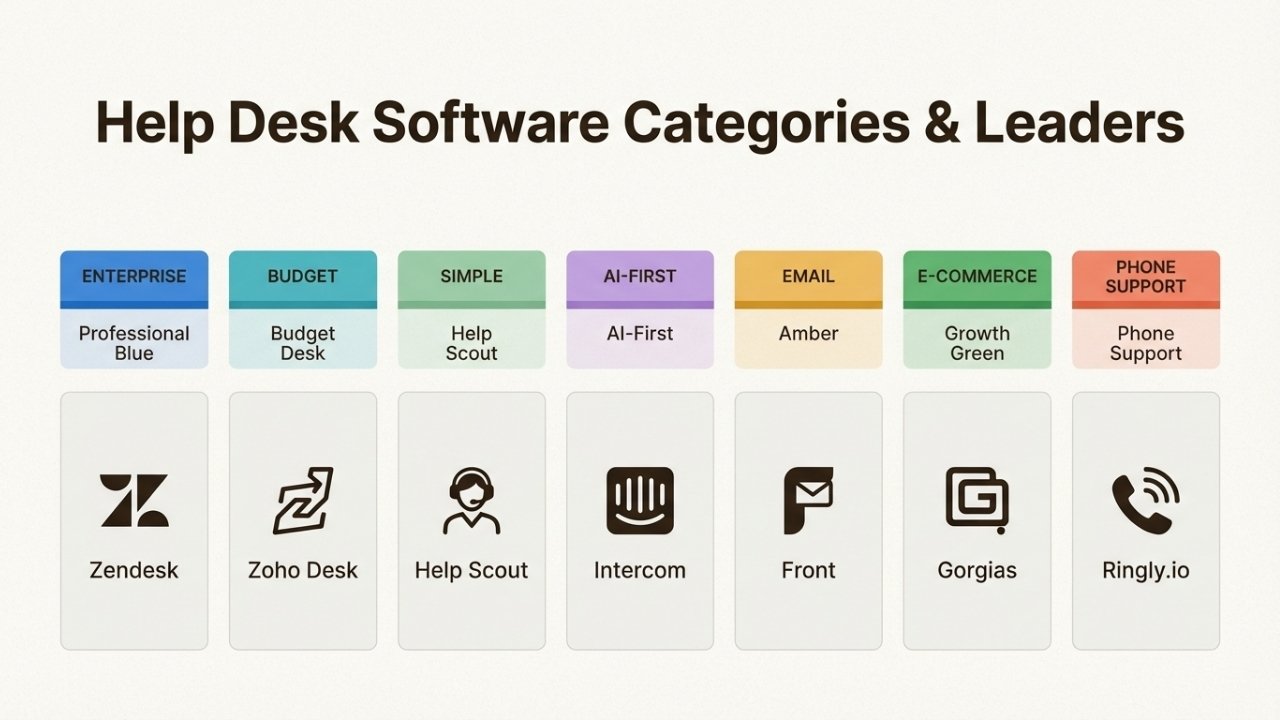
Quick comparison: Freshdesk alternatives at a glance
| Tool | Best for | Starting price | Key strength |
|---|---|---|---|
| Zendesk | Large enterprises | $55/agent/month | Extensive customization and AI |
| Zoho Desk | Budget-conscious teams | $7/agent/month | Affordable with solid features |
| Help Scout | Teams wanting simplicity | $40/month (100 contacts) | Clean, email-like interface |
| Intercom | Product-led companies | $29/seat/month | AI-first automation |
| Front | Email-centric workflows | $15/seat/month | Collaborative inbox |
| Gorgias | E-commerce stores | $10/month (50 tickets) | Deep Shopify integration |
| Ringly.io | Phone support automation | $99/mo for the first 50 calls, then $1.99 per call | AI voice agent for calls |
The 7 best Freshdesk alternatives
1. Zendesk

Zendesk is the enterprise leader in customer service software. With over two decades in the market, it powers support for thousands of major companies including Airbnb, Uber, and Shopify.
The platform centers around an omnichannel agent workspace that unifies all customer interactions without forcing agents to switch between tabs. Zendesk AI comes pre-trained on over 18 billion customer interactions and includes an agent copilot for real-time assistance plus AI agents that handle complex inquiries autonomously.
The feature set is extensive: workforce management tools for forecasting and scheduling, AI-driven quality assurance that reviews 100% of interactions, real-time reporting dashboards, and a marketplace with over 1,700 app integrations.
Pricing:
| Plan | Price | Key features |
|---|---|---|
| Suite Team | $55/agent/month | Ticketing, messaging, help center |
| Suite Growth | $89/agent/month | + Automation, custom reports, multibrand |
| Suite Professional | $115/agent/month | + Advanced AI, custom roles |
| Suite Enterprise | Custom | + Sandbox, advanced security |
Support-only plans start at $19/agent/month, though most teams need the full Suite for complete functionality.
Pros:
- Highly scalable for enterprise needs
- Robust analytics and reporting capabilities
- Massive app ecosystem through the marketplace
- Mature platform with proven reliability
Cons:
- Complex setup requiring significant configuration
- Expensive for small teams
- Steep learning curve for new agents
- Can be overwhelming if you don't need enterprise features
Best for: Large enterprises and teams needing deep customization, advanced workflows, and extensive integrations.
2. Zoho Desk

Zoho Desk offers a compelling balance of features and affordability. As part of the broader Zoho ecosystem, it integrates seamlessly with Zoho CRM, Projects, and other business tools.
The standout feature is Zia, Zoho's AI assistant. Zia handles ticket classification, priority setting, sentiment analysis, and suggests relevant knowledge base articles. The conversational AI can serve as an answer bot for 24/7 customer self-service.
Omnichannel support covers email, phone, live chat, social media, and instant messaging from a unified interface. Blueprint, Zoho's workflow automation feature, lets you design predefined paths for tickets from creation to resolution.
Pricing:
| Plan | Monthly (annual) | Key features |
|---|---|---|
| Free | $0 | 3 agents, email ticketing |
| Standard | $7/agent | Social media, workflows, community |
| Professional | $14/agent | + Telephony, Zia AI, multi-department |
| Enterprise | $25/agent | + Advanced AI, customization, data residency |
Pros:
- Highly affordable compared to competitors
- Free plan available for small teams
- Strong integration with Zoho ecosystem
- Good automation capabilities even on lower tiers
Cons:
- AI chatbot requires your own ChatGPT API key
- Complex initial setup and configuration
- Interface can feel overwhelming for new users
- Limited customer support (5 days a week)
Best for: Small to mid-sized businesses, especially those already using Zoho products. Teams wanting solid features without enterprise pricing.
3. Help Scout

Help Scout takes a different approach. Instead of trying to be everything to everyone, it focuses on doing email-based support exceptionally well.
The interface feels like a shared email inbox, which means most agents can start using it effectively within hours rather than weeks. The Beacon help widget embeds on your website to give customers instant access to live chat and knowledge base articles.
Help Scout's AI features boost productivity by 36% according to their data. The AI helps write replies, generate conversation summaries, and personalize responses. Docs, their knowledge base feature, integrates fully with the inbox so agents can easily share articles and track which content helps most.
Pricing:
| Plan | Monthly (annual) | Includes |
|---|---|---|
| Free | $0 | 1 user, 100 contacts |
| Standard | $40 | 5 users, 100 contacts, live chat |
| Plus | $60 | 10 users, advanced features |
| Pro | $680 | 25 users, enterprise features |
Note that Help Scout uses contact-based pricing, not per-seat. Additional contacts beyond your tier incur extra fees.
Pros:
- Clean, intuitive interface with minimal learning curve
- Fast onboarding for new team members
- Contact-based pricing can be cost-effective for low-volume teams
- Strong collaboration tools with private notes and mentions
Cons:
- Limited automation compared to enterprise platforms
- Fewer integrations than competitors like Zendesk
- No native phone support
- Contact-based pricing gets expensive as customer base grows
Best for: Growing teams that prioritize simplicity over enterprise complexity. Teams that primarily handle email-based support and want a human-centric approach.
4. Intercom
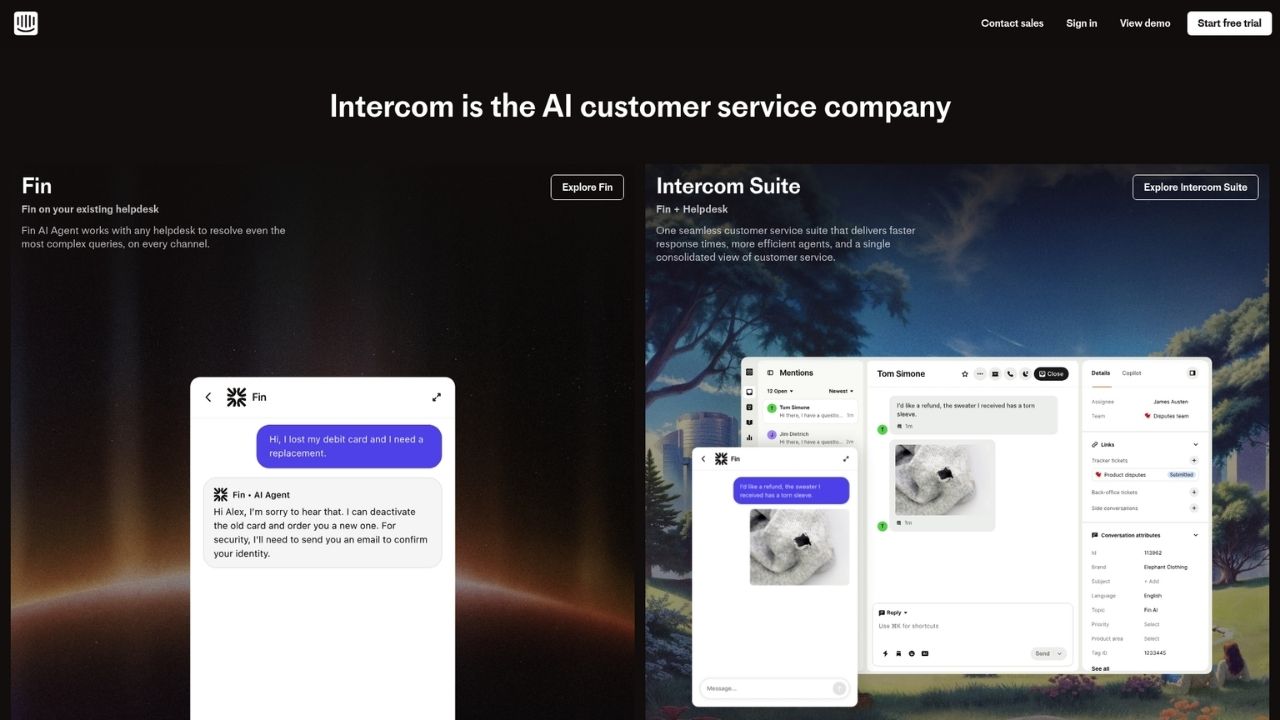
Intercom positions itself as an AI-first customer service platform. While others bolt AI onto existing systems, Intercom built their entire platform around it.
Fin AI Agent handles frontline support autonomously, resolving complex queries across any channel. The AI is designed to deliver human-quality service without human intervention for routine issues. When customers do need human help, the AI Copilot assists agents with real-time suggestions and insights.
The platform excels at proactive engagement. You can send targeted outbound messages via email, in-app messages, or push notifications based on user behavior and lifecycle stage. The help center integrates fully with the messaging experience.
Pricing:
| Plan | Price | Key features |
|---|---|---|
| Essential | $29/seat/month | Shared inbox, basic automation, help center |
| Advanced | $85/seat/month | + Multiple teams, Fin AI, custom reports |
| Expert | $132/seat/month | + Advanced permissions, workload management |
AI resolutions are charged separately based on usage, so factor that into total cost calculations.
Pros:
- Advanced AI capabilities that actually reduce agent workload
- Strong proactive messaging and engagement features
- Excellent for product-led growth companies
- Unified view of customer conversations across channels
Cons:
- Expensive for small businesses, especially with AI usage fees
- Complex initial configuration
- Reporting capabilities less robust than competitors
- Price jumps significantly after startup program discounts end
Best for: Product-led teams that prioritize AI automation and proactive customer engagement. Companies wanting to deflect routine inquiries through sophisticated self-service.
5. Front

Front combines the familiarity of email with powerful collaboration tools. It's designed for teams that want to manage customer communications without abandoning their email-centric workflows.
The shared inbox allows multiple team members to manage the same email or messaging channel simultaneously. Teammate mentions and comments enable internal collaboration directly within conversations, eliminating the need for separate internal discussions about customer issues.
Rule-based automation handles repetitive tasks like routing conversations to specific agents, categorizing messages, or setting up auto-responses. Front integrates with major CRM systems to sync customer data directly into the inbox for contextual responses.
Pricing:
| Plan | Monthly (annual) | Key features |
|---|---|---|
| Starter | $19/seat | 10 users max, shared inbox, 10 automation rules |
| Professional | $65/seat | 50 users max, omnichannel support, advanced analytics |
| Enterprise | $105/seat | Unlimited users, unlimited rules, AI Copilot included |
| Premier | Custom | Enterprise-grade security, dedicated account management |
Pros:
- Email-centric workflow feels familiar to most teams
- Strong internal collaboration features
- Clean interface that reduces context switching
- Good for teams managing high-volume shared inboxes
Cons:
- No native phone support (requires integration with Aircall or Dialpad)
- Can become expensive as team grows
- Limited customization compared to enterprise platforms
- Lacks community forum functionality
Best for: Teams that want to manage support within an email-like environment. Organizations prioritizing internal collaboration and visibility into customer conversations.
6. Gorgias

Gorgias is built specifically for e-commerce. While general help desks try to serve everyone, Gorgias focuses entirely on online stores using Shopify, BigCommerce, or Magento.
The deep e-commerce integration lets agents see order details, process refunds, and check inventory directly within the ticket. One-click actions eliminate the need to switch between your help desk and e-commerce platform. Social media integration turns comments and mentions into trackable tickets.
Pre-built automation templates handle common retail queries like "Where is my order?" without agent intervention. The platform includes live chat, help center, voice, and SMS support.
Pricing:
| Plan | Price | Ticket limit | Key features |
|---|---|---|---|
| Starter | $10/month | 50 tickets | 3 seats, Shopify/BigCommerce integration, basic rules |
| Basic | $60/month | 300 tickets | 500 seats, 150+ integrations, team management |
| Pro | $360/month | 2,000 tickets | Proactive chat, revenue statistics, Lite onboarding |
| Advanced | $900/month | 5,000 tickets | Dedicated Success Manager, advanced routing, full AI access |
Voice and SMS are add-ons. Overage fees apply if you exceed your ticket limit.
Pros:
- Purpose-built for e-commerce workflows
- Deep Shopify/BigCommerce/Magento integration
- One-click order actions save significant time
- Social media ticket conversion
Cons:
- Limited value outside e-commerce use cases
- Ticket-based pricing can get expensive during high-volume periods
- Fewer general business integrations than competitors
Best for: E-commerce stores on Shopify, BigCommerce, or Magento. Teams handling high volumes of order-related inquiries and wanting platform-specific automation.
7. Ringly.io

Ringly.io takes a completely different approach from the others on this list. Instead of competing on features or channels, it specializes entirely in phone support automation for e-commerce businesses.
The platform centers around the AI, an AI phone agent that handles inbound customer calls 24/7. the AI can answer questions, look up orders, process returns and exchanges, and escalate to human agents only when necessary. According to their data, The AI resolves approximately 73% of calls without human intervention.
The Shopify integration lets the AI access real-time order information, so customers get immediate answers about shipping status, returns, and product questions. Support for 30 languages means you can serve global customers without hiring multilingual agents.
Setup takes about three minutes. You don't need developers or extensive configuration. Upload your knowledge base, connect your Shopify store, and the AI starts handling calls immediately.
Pricing:
| Plan | Price | Calls | Key features |
|---|---|---|---|
| Pay per call | $99/mo | First 50 included, then $1.99 per call | Self-learning AI |
| Custom | Custom | 1,000+ calls a month | Private Slack channel, custom integrations, dedicated setup |
Spam calls, hang-ups and wrong numbers are not billed (see Ringly's pricing). Additional phone numbers run about $5 per month.
Pros:
- Resolves ~73% of calls without human agents
- quick setup with no technical expertise required
- No per-agent fees, just usage-based pricing
- 24/7 availability without hiring night shift
- 40-language support included
Cons:
- Phone-focused (not a full help desk for email/chat)
- Best suited for e-commerce specifically
- Requires sufficient call volume to justify cost
Best for: E-commerce stores wanting to automate phone support without hiring additional agents. Teams struggling with after-hours coverage or high call volumes during peak seasons.
How to choose the right Freshdesk alternative
With seven solid options, how do you pick the right one? Start by mapping your actual needs rather than comparing feature checklists.
Assess your primary channels. If 90% of your support comes through email, a tool like Help Scout or Front might serve you better than an omnichannel platform. If phone calls drive significant volume, Ringly.io's automation could deliver more value than adding agents. For teams spread across email, chat, social, and phone, Zendesk or Zoho Desk provide true omnichannel unification.
Consider your team size and growth trajectory. Small teams often move faster with simpler tools like Help Scout. Enterprises needing complex workflows and extensive customization should evaluate Zendesk or Intercom. Fast-growing e-commerce stores might outgrow general help desks quickly, making Gorgias or Ringly.io more scalable long-term.
Evaluate AI needs honestly. Most platforms now offer AI features, but they vary significantly in implementation. Intercom and Zendesk build AI deeply into their core workflows. Zoho Desk offers solid AI at a lower price point. If AI-powered phone support specifically matters, Ringly.io is the only option on this list focused entirely on that use case.
Calculate true total cost of ownership. Look beyond the starting price. Factor in add-ons you'll actually need, implementation costs, training time, and how pricing scales as you grow. A tool that looks cheap at 3 agents might become expensive at 30.
Test before committing. Most alternatives offer free trials ranging from 7 to 30 days. Have your actual support team test the interface with real workflows before making a decision.
Start automating your phone support today
The right Freshdesk alternative depends entirely on your specific situation. Zendesk dominates for enterprises needing extensive customization. Zoho Desk delivers solid features at budget-friendly prices. Help Scout keeps things simple for email-focused teams. Intercom leads on AI automation. Front excels for collaborative email workflows. Gorgias specializes in e-commerce ticketing.
If phone support represents a significant portion of your customer inquiries, Ringly.io offers something unique: an AI agent that handles calls 24/7, integrates with your Shopify store, and resolves most issues without human intervention. No per-agent fees. No complex setup. Just automated phone support that scales with your business.
Ready to see how AI phone support could work for your store? Try it for free and get the AI answering calls in minutes.
Frequently Asked Questions
What makes Freshdesk alternatives like Ringly.io different from traditional help desks?
Traditional help desks focus on ticketing across multiple channels. Ringly.io specializes entirely in phone support automation, using an AI agent to handle calls rather than just routing them to humans. This delivers 24/7 coverage without hiring additional staff.
Which Freshdesk alternative works best for small businesses with limited budgets?
Zoho Desk offers the most affordable entry point with a free plan for 3 agents and paid plans starting at $7 per agent monthly. Help Scout's contact-based pricing can also work well for low-volume teams. Both provide solid features without enterprise pricing.
Do Freshdesk alternatives typically offer better AI capabilities than Freshdesk itself?
Many alternatives integrate AI more deeply into their core workflows. Intercom and Zendesk built AI-first architectures. Zoho Desk includes AI features at lower price points than Freshdesk's add-on model. For phone-specific AI, Ringly.io resolves ~73% of calls autonomously.
How difficult is migrating from Freshdesk to another platform?
Migration complexity varies by platform. Most alternatives offer import tools for tickets and contacts. BoldDesk and others provide free migration assistance. The main challenge is reconfiguring workflows and training agents on the new interface, which typically takes 1-4 weeks depending on team size.
Can Freshdesk alternatives handle the same volume of support requests as Freshdesk?
Enterprise alternatives like Zendesk handle higher volumes than Freshdesk. Specialized tools like Gorgias and Ringly.io are built to scale within their focus areas (e-commerce ticketing and phone support respectively). Most alternatives on this list can scale to meet or exceed Freshdesk's capacity.
What should you prioritize when evaluating Freshdesk alternatives for an e-commerce business?
Look for deep platform integration (Shopify, BigCommerce, or Magento), automation for common retail queries like order status, and scalability during peak seasons. Gorgias specializes in e-commerce ticketing while Ringly.io focuses on automating phone inquiries specific to online stores.
Also read: