


If you're running an IT team, you've probably heard of SysAid. It's been around since 2002 and offers IT service management features used by organizations worldwide.
But lately, more teams are looking for alternatives.
Why? Common complaints include an outdated interface that feels clunky, occasional bugs that interrupt ticket resolution, and a difficult onboarding process that slows down adoption.
For smaller teams, the pricing can also be a hurdle.
The good news is that the ITSM market has evolved significantly.
Whether you need enterprise-grade customization, modern cloud-based simplicity, or AI-powered automation, there's likely a better fit for your team.
Here's a breakdown of seven SysAid alternatives worth considering in 2026.
Editor’s note: Want to hear some sample AI support calls made for your Shopify store?
- Just paste your store URL
- Get sample calls in under 20 seconds (no email required)
- Listen to demo calls for my store
Quick comparison of SysAid alternatives
| Tool | Best For | Starting Price | Deployment |
|---|---|---|---|
| ServiceNow | Enterprise ITSM | Custom quotes | Cloud |
| Freshservice | Mid-market teams | $19/agent/month | Cloud |
| Jira Service Management | DevOps teams | Free-$20/agent/month | Cloud/On-prem |
| SolarWinds Service Desk | SolarWinds users | $39/technician/month | Cloud |
| NinjaOne | Endpoint management | ~$1.50/device/month | Cloud |
| InvGate Service Management | Visual workflows | $17/agent/month | Cloud/On-prem |
| Ringly.io | AI phone support | Starts at $349/month | Cloud |
1. ServiceNow ITSM
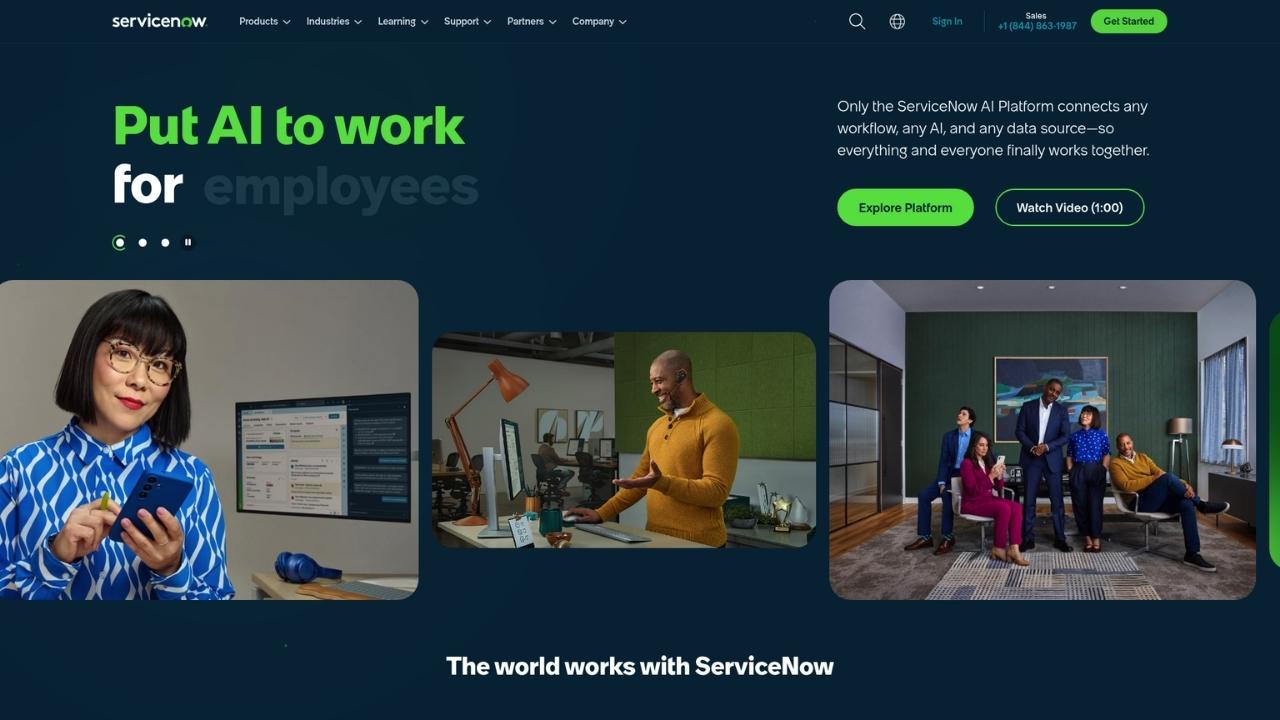
ServiceNow is the enterprise standard for IT service management. If you're running IT for a large organization with complex needs, this is likely on your shortlist.
What it does well
ServiceNow offers comprehensive ITSM capabilities including incident, problem, change, and release management.
The platform also covers IT operations management, asset management, and strategic portfolio management.
Their AI capabilities through Now Assist and Virtual Agent bring automation to routine tasks.
The platform is highly customizable. With enough resources, you can configure nearly any workflow or integration your organization needs.
ServiceNow also offers extensive reporting and analytics, giving IT leaders deep visibility into operations.
Where it falls short
ServiceNow is expensive. Implementation costs often run into the tens or hundreds of thousands annually, depending on scope.
The platform also requires significant technical expertise to configure and maintain. Most organizations need dedicated ServiceNow administrators or external consultants.
New users often need training before they can navigate the system effectively.
Pricing
ServiceNow uses custom enterprise pricing. Contact their sales team for quotes tailored to your organization size and requirements.
Bottom line
ServiceNow is overkill unless you're a large enterprise with complex IT operations and the budget to match.
If you need deep customization and have the resources to support it, it's hard to beat. For smaller teams, look elsewhere.
2. Freshservice

Freshservice takes a different approach. It's built to deliver enterprise-grade ITSM without the complexity that typically comes with it.
What it does well
The interface is modern and intuitive. Agents can start working tickets quickly without much training. Freshservice includes all the core ITSM features: incident management, service catalog, problem and change management, and a self-service portal.
One standout feature is the built-in gamification. You can award points and incentivize agents based on tickets solved, SLA compliance, and knowledge base contributions. This helps keep teams motivated.
Freshservice also includes contract management out of the box. You can track vendor contracts, software licenses, and renewal dates. This is something many competitors charge extra for or don't offer at all.
The platform is highly customizable without requiring code. Theme your portal, customize email templates, and configure workflows through a visual interface.
Where it falls short
Some users note that reporting capabilities, while solid, aren't as advanced as enterprise competitors. If you need deep custom analytics, you might hit limitations.
Freshservice also has fewer native integrations than some competitors. While they cover the major platforms, you might need custom work for niche tools.
Pricing
Source: Freshservice pricing
| Plan | Price | Key Features |
|---|---|---|
| Starter | $19/agent/month | Basic ITSM, knowledge base, SLA management |
| Growth | $49/agent/month | Adds problem/change/release management, service catalog |
| Pro | $99/agent/month | Adds AI agent, sandbox, advanced reporting |
| Enterprise | Custom | Full AI capabilities, enterprise features |
All plans include a 14-day free trial.
Bottom line
Freshservice hits a sweet spot for mid-market teams that want modern ITSM without enterprise complexity.
The pricing is transparent, setup is straightforward, and the UX is genuinely pleasant to use.
3. Jira Service Management
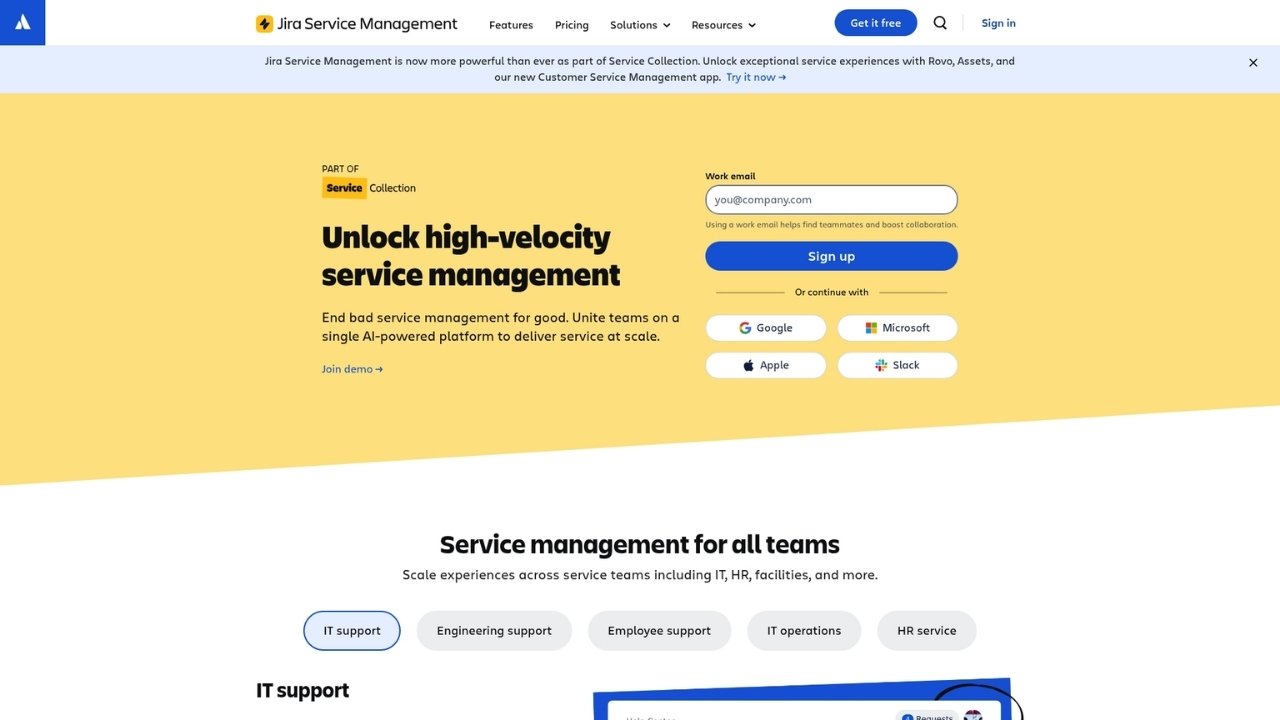
If your team already lives in the Atlassian ecosystem, Jira Service Management is a natural choice.
What it does well
The integration with Jira Software is seamless. This creates a unified environment where IT operations and development teams can collaborate effectively.
Tickets can flow between service management and development workflows without manual handoffs.
Jira Service Management includes all core ITSM capabilities: request, incident, problem, and change management.
The platform also offers asset and configuration management through the Assets feature.
For teams practicing DevOps, the deployment gating feature is valuable. You can create approval workflows for deployments initiated through connected CI/CD tools.
The free tier is genuinely useful. You get three agents, 2GB storage, and core features at no cost. This makes it easy to try before committing.
Where it falls short
Jira's structure can overwhelm smaller teams or non-technical users. If your team isn't already familiar with Atlassian products, expect some training time.
Some users report that granular customization (particularly around the "Team" field) can be inflexible, creating reporting gaps for team-level performance metrics.
Pricing
Source: Jira Service Management pricing
| Plan | Price | Key Features |
|---|---|---|
| Free | $0 | 3 agents, 2GB storage, core ITSM |
| Standard | $20/agent/month | 20,000 agents, 250GB storage, asset management |
| Premium | $51.42/agent/month | Virtual agent, AIOps, 99.9% SLA |
| Enterprise | Custom | Multiple sites, advanced analytics, 99.95% SLA |
Bottom line
For teams already using Jira Software or Confluence, Jira Service Management is the obvious choice. The native integration creates workflows that are hard to replicate with third-party tools.
4. SolarWinds Service Desk

SolarWinds Service Desk (formerly Samanage) offers a straightforward ITSM solution with particular strength for teams already using other SolarWinds products.
What it does well
The platform bundles ticketing, asset management, automation, and a service portal into a cohesive package. Setup is relatively fast compared to enterprise competitors, and the per-technician pricing model can be cost-effective for teams supporting many end users.
SolarWinds Service Desk integrates well with other SolarWinds tools. If you're already using their network monitoring or other IT management products, this creates a unified ecosystem.
The service catalog feature helps standardize service requests, and the built-in knowledge base supports self-service for common issues.
Where it falls short
Reviewers find the interface dated compared to newer competitors like Freshservice. Navigation feels clunky, especially when responding to tickets.
Advanced automation capabilities are limited compared to enterprise platforms. If you need complex workflow automation, you might find the options restrictive.
Pricing
Source: SolarWinds Service Desk pricing
| Plan | Price | Key Features |
|---|---|---|
| Essentials | $39/technician/month | Incident management, knowledge base, asset management |
| Advanced | $79/technician/month | Adds virtual agent, network discovery, contract management |
| Premier | $99/technician/month | Adds visual CMDB, runbooks, advanced AI |
All plans support unlimited end users. Annual billing only.
Bottom line
SolarWinds Service Desk is a solid choice if you're already invested in the SolarWinds ecosystem.
The per-technician pricing can work well for teams with many end users to support.
5. NinjaOne

NinjaOne takes a different approach from traditional ITSM platforms. It's a unified IT operations platform that combines remote monitoring and management (RMM) with ticketing capabilities.
What it does well
NinjaOne excels at endpoint management. You can monitor and manage Windows, macOS, and Linux devices from a single dashboard.
The remote access capabilities are robust, with integrations for TeamViewer and Splashtop.
Patch management is a standout feature. You can automate patching across all endpoints and generate compliance reports.
One customer reduced helpdesk calls by 80% after implementing automated reboots.
The ticketing module integrates seamlessly with endpoint management. Technicians can remediate issues without leaving the ticket, speeding up resolution times.
Setup is fast. Most teams are fully operational in less than a week, and learning basic tasks takes under three hours on average.
Where it falls short
NinjaOne isn't a full ITSM stack. It lacks some of the advanced ITIL features found in dedicated service management platforms.
For process-heavy organizations with strict change management requirements, this could be a limitation.
The ticketing module has fewer features compared to specialized ITSM systems. If your primary need is sophisticated service desk workflows, you might find it lacking.
Pricing
Source: NinjaOne pricing
NinjaOne uses per-device pricing with volume discounts:
- Starts at $1.50/device/month for 10,000+ endpoints
- Up to $3.75/device/month for 50 or fewer endpoints
14-day free trial available.
Bottom line
NinjaOne is ideal for MSPs and IT teams focused on endpoint management. If your primary pain point is managing distributed devices rather than complex service workflows, it's worth a close look.
6. InvGate Service Management
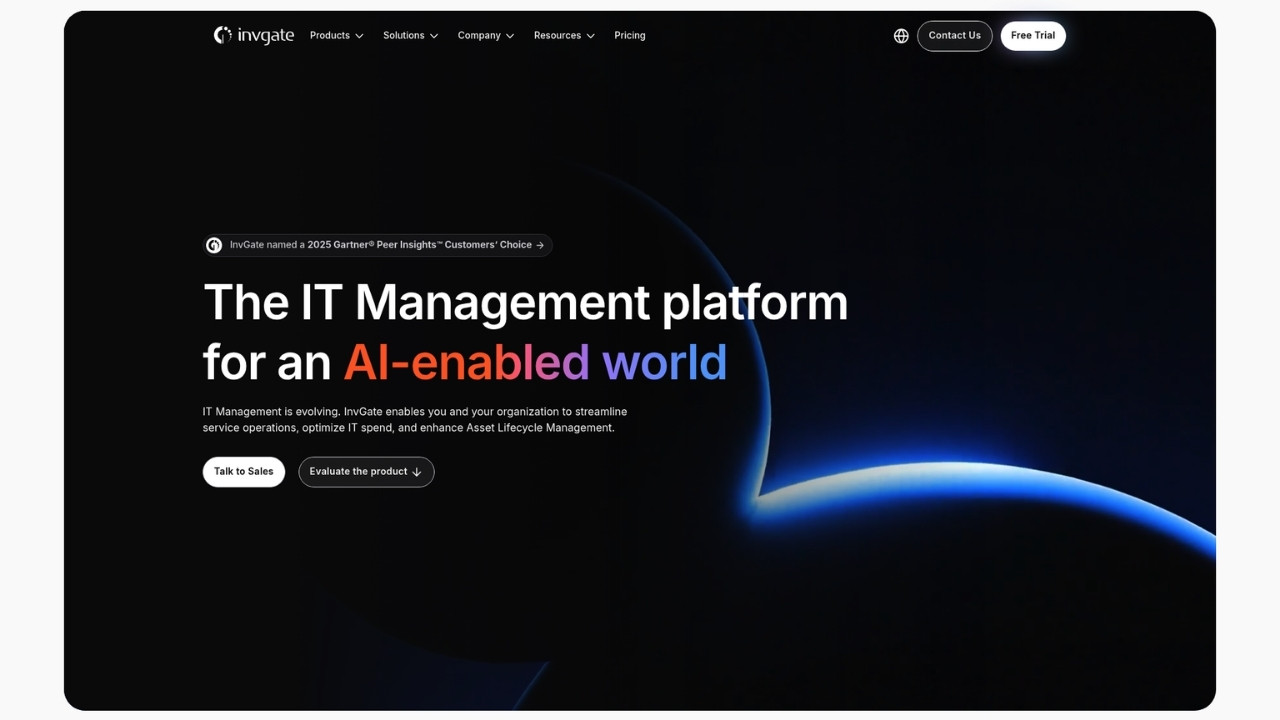
InvGate focuses on making IT service management accessible through visual workflows and no-code configuration.
What it does well
The visual workflow builder is a highlight. You can create and modify service workflows through a drag-and-drop interface without writing code.
This makes it easy to adapt processes as your organization evolves.
InvGate supports both cloud and on-premise deployments, giving you flexibility in how you host the platform.
The integrated asset management provides visibility into your IT inventory alongside service requests.
SLA monitoring and reporting dashboards come out of the box, helping you track performance and identify bottlenecks.
The platform is designed for cross-department use. Beyond IT, you can configure it for HR, facilities, and other service teams.
Where it falls short
While InvGate offers good integration capabilities, setting up complex integrations takes time and resources.
Organizations with intricate tech stacks should plan for this.
The brand is less established than competitors like ServiceNow or Freshservice, which might matter for organizations with strict vendor evaluation requirements.
Pricing
Based on available information, InvGate starts at $17/agent/month. Contact their sales team for detailed pricing based on your requirements.
Bottom line
InvGate is a strong choice for teams that want visual workflow capabilities without enterprise complexity or consulting fees. The no-code approach makes it particularly appealing for teams that need to iterate quickly.
7. Ringly.io

Ringly.io offers something different from traditional ITSM platforms. Instead of focusing on ticketing, it automates phone support using AI.
What it does well
Ringly's AI phone agent, the AI, handles inbound calls 24/7. It can answer questions, look up orders, process returns and exchanges, and escalate to human agents when needed. In October 2025, the AI resolved 73% of calls without human intervention across Shopify stores.
Setup is remarkably fast. You can be operational within an hour for most stores by connecting your store and choosing a phone number.
The AI trains itself on your product catalog, policies, and FAQs.
The platform supports 30 languages, making it suitable for global operations. Native Shopify integration means the AI can access order information in real-time during calls.
For IT teams supporting e-commerce operations, Ringly can handle the phone support load while your ITSM platform manages internal tickets.
This creates a complete support ecosystem.
Where it falls short
Ringly is specialized for phone support. It's not a replacement for a full ITSM platform that handles internal IT tickets, change management, and asset tracking.
You'll likely want to pair it with another tool for complete IT service management.
The focus on e-commerce means some features are tailored to that use case. While the platform can work for other industries, the sweet spot is clearly online retail.
Pricing
Source: Ringly.io pricing
| Plan | Price | Features |
|---|---|---|
| Grow | $349/month | 1,000 mins (~500 calls), self-learning AI, recordings and insights |
| Enterprise | Customnth | 5,000+ mins, custom setup, custom integrations, private Slack channel |
| Overage: $0.19/minute | ||
Free trial: 14 days with a unique guarantee. You get your last 3 months refunded if Seth resolves under 65% of calls in 90 days over 100 calls within 21 days.
Bottom line
If phone support is a significant part of your operation, Ringly.io can dramatically reduce the load on your human agents. It's not a full ITSM replacement, but as a complement to your existing tools, it fills a gap that traditional platforms don't address.
Start your free trial with Ringly.io
How to choose the right SysAid alternative
With seven solid options, how do you pick? Here's a framework to help.
Consider your team size and budget. Enterprise platforms like ServiceNow make sense for large organizations with dedicated IT resources. Smaller teams will get more value from cloud-native solutions like Freshservice or Jira Service Management.
Evaluate your must-have features. Do you need advanced change management and ITIL compliance? Look at ServiceNow or SolarWinds. Is endpoint management your priority? NinjaOne might be the answer. Need AI phone support? Consider Ringly.io.
Factor in setup time and training needs. Some platforms promise quick deployment (Freshservice, Ringly.io) while others require months of configuration (ServiceNow). Be realistic about your team's capacity.
Check integration requirements. If you're already using Atlassian products, Jira Service Management is the obvious fit. SolarWinds users should evaluate Service Desk. Shopify stores should look at Ringly.io for phone support.
Test before committing. Most platforms offer free trials. Use them. Get your team to actually work with the tool before making a decision.
Which SysAid alternative is right for you?
Here's the short version. For enterprise organizations with complex IT operations and dedicated resources, ServiceNow is the industry standard.
Mid-market teams that want modern ITSM without enterprise complexity should look at Freshservice.
Teams already using Atlassian products will find Jira Service Management to be the natural fit.
If you're already invested in the SolarWinds ecosystem, their Service Desk offering makes sense.
For teams focused on endpoint management, NinjaOne combines RMM with ticketing effectively.
Those who prefer visual workflows without coding should consider InvGate Service Management.
And if you need AI phone support to complement your ITSM platform, Ringly.io fills that gap.
The best choice depends on your specific context. A 50-person company has different needs than a 5,000-person enterprise.
An MSP has different priorities than an internal IT team.
Take advantage of free trials, involve your team in the evaluation, and choose the platform that fits how you actually work.
The goal isn't to find the "best" tool in absolute terms. It's to find the best tool for your situation.
Frequently Asked Questions
What are the most popular SysAid alternatives for small businesses?
For small businesses, Freshservice and Jira Service Management are popular choices. Freshservice offers a modern interface starting at $19/agent/month, while Jira has a genuinely useful free tier for up to 3 agents.
How do SysAid alternatives compare on pricing?
Pricing varies significantly. Jira Service Management starts free and goes to $20/agent/month. Freshservice begins at $19/agent/month. SolarWinds uses per-technician pricing at $39/month. ServiceNow requires custom quotes and typically costs tens of thousands annually.
Which SysAid alternative is best for teams already using Atlassian products?
Jira Service Management is the clear choice for Atlassian shops. The native integration with Jira Software creates seamless workflows between IT operations and development teams.
Can I replace SysAid with a tool that includes AI phone support?
Traditional ITSM platforms focus on ticketing, not phone calls. If you need AI phone support, Ringly.io is designed specifically for this, resolving about 73% of calls without human intervention.
What's the fastest SysAid alternative to set up?
Ringly.io claims quick setup. NinjaOne reports most users are operational in under a week. Freshservice also emphasizes quick deployment compared to enterprise alternatives.
Do any SysAid alternatives offer both ITSM and endpoint management?
NinjaOne combines RMM with IT ticketing in a single platform. While it doesn't have all ITIL features, it covers the basics for teams prioritizing endpoint management.
Which SysAid alternatives work well for MSPs?
NinjaOne is particularly popular with MSPs due to per-device pricing. SolarWinds Service Desk also offers MSP-specific features and per-technician pricing.
Also read: