

HubSpot Service Hub works well for teams already invested in the HubSpot ecosystem.
But once you need dedicated support functionality without the full CRM overhead, the cracks start showing.
Pricing escalates quickly, advanced features hide behind enterprise tiers, and you're paying for a whole ecosystem when you just need a helpdesk.
You have plenty of options. Whether you're looking for better value, stronger AI capabilities, or specialized phone support, there's an alternative that fits.
Editor’s note: Want to hear some sample AI support calls made for your Shopify store?
- Just paste your store URL
- Get sample calls in under 20 seconds (no email required)
- Listen to demo calls for my store
Why teams look beyond HubSpot Service Hub
HubSpot Service Hub starts attractive. The free tier gets you basic ticketing and email integration. But here's where it gets complicated.
The Professional plan jumps to $450 per month for just 5 users. Need enterprise features like advanced automation or custom objects?
That's $1,200 per month. And those prices assume you're paying annually. Go month-to-month and the numbers climb higher.
Teams also hit walls with feature limitations. Advanced ticketing, custom reporting, and AI capabilities are either locked behind expensive tiers or missing entirely. HubSpot's native AI achieves roughly 20% automation rates, while AI-native platforms are hitting 50-77%.
The ecosystem lock-in is real. Service Hub delivers the best value when you're using Marketing Hub, Sales Hub, and CRM together.
If you're not, you're paying for integration you don't need.
How we evaluated these HubSpot Service Hub alternatives
We looked at six criteria that matter when switching helpdesk platforms:
- Pricing transparency clear per-agent or usage-based costs without hidden fees
- Setup complexity how quickly you can go live and start resolving tickets
- AI capabilities automation rates, resolution quality, and pricing model
- Omnichannel support email, chat, phone, and social channels
- Integration ecosystem how well it connects with your existing tools
- Support quality availability, response times, and self-service resources
We also paid special attention to phone support. Most alternatives treat voice as an afterthought. For businesses where customers actually call, that's a problem worth solving.
Comparison at a glance
| Platform | Best For | Starting Price | Key Strength | AI Resolution Rate |
|---|---|---|---|---|
| Ringly | E-commerce phone support | $349/month (1,000 minutes) | 73% call resolution | 73% |
| Zendesk | Enterprise scale | $19/agent/month | 1,500+ integrations | 20-40% |
| Freshdesk | Budget-conscious teams | Free (10 agents) | Generous free tier | 30% |
| Kustomer | High-volume B2C | $89/agent/month (8 min) | Unified customer timeline | 40% |
| Intercom | Modern SaaS messaging | $29/agent/month | Fin AI at $0.99/resolution | 50% |
| Gorgias | E-commerce on Shopify | $10/month (50 tickets) | Deep store integration | 35% |
| Zoho Desk | Zoho ecosystem users | Free (3 agents) | Zoho suite integration | 25% |
The 7 best HubSpot Service Hub alternatives
1. Ringly

Most helpdesks treat phone as a checkbox feature. Ringly treats it as the primary channel. If your customers call you, and you want AI to handle most of those calls without sounding robotic, this is worth a serious look.
the AI, Ringly's AI phone agent, resolves roughly 73% of calls without human intervention. That's not deflection.
That's full resolution with order lookups, returns processing, and FAQ handling. The remaining 27% get escalated to your team with full context.
Setup takes about 3 minutes. Connect your Shopify store, pick a phone number, and the AI starts answering calls.
No complex workflows to configure. No training data to upload beyond your existing store policies.
Pricing:
| Plan | Monthly Price | Minutes | Best For |
|---|---|---|---|
| Grow | $349 | 1,000 | Growing stores with regular call volume |
| Enterprise | Custom | 5,000+ | High-volume stores needing custom setup |
Overage runs $0.19 per minute. All plans include 30 languages, call recordings, transcripts, and Shopify integration.
Pros:
- quick setup with no technical work
- 73% call resolution rate (industry-leading for phone)
- No per-agent pricing, unlimited team members
- 24/7 coverage without hiring night shift
Cons:
- Phone-focused (not ideal if tickets are your main channel)
- Shopify-centric (other platforms have limited integration)
- No free tier to test before buying
Best for: E-commerce stores where customers call for order status, returns, and support. Especially valuable if you're currently missing calls after hours or spending too much on human agents for repetitive inquiries.
2. Zendesk

Zendesk is the safe choice. It's been around since 2007, serves 160,000+ businesses, and has the most mature app ecosystem in the industry.
If you need a helpdesk that "just works" at scale, Zendesk delivers.
The platform covers every channel: email, chat, phone, social, and self-service.
The unified agent workspace pulls everything into one view, so agents aren't jumping between tabs. AI features include automated ticket routing, suggested responses, and chatbots.
Pricing:
| Plan | Annual Price | Key Features |
|---|---|---|
| Support Team | $19/agent/month | Email ticketing, basic automations, macros |
| Suite Team | $55/agent/month | AI agents, messaging, live chat, phone, help center |
| Suite Professional | $115/agent/month | Copilot writing, skills-based routing, SLAs, 5 help centers |
| Suite Enterprise | $169/agent/month | 300 help centers, sandbox, custom roles, audit logs |
Add-ons like Copilot ($50/agent/month) and Quality Assurance ($35/agent/month) push costs higher.
Pros:
- Proven at enterprise scale
- 1,500+ app integrations
- Comprehensive feature set across all channels
- Strong reporting and analytics
Cons:
- Complex setup and configuration
- Expensive add-ons for AI features
- Interface can feel dated compared to newer tools
- Per-agent pricing gets costly for large teams
Best for: Enterprise teams that need proven reliability, extensive customization, and don't mind paying for it. If you're replacing an existing helpdesk and want minimal risk, Zendesk is the conservative choice.
3. Freshdesk

Freshdesk balances affordability with features. The free tier supports up to 10 agents for 6 months with basic ticketing and knowledge base.
Paid plans start at $19 per agent monthly and scale reasonably.
Freddy AI handles automation, sentiment analysis, and suggested responses. The omnichannel inbox brings email, chat, phone, and social into one place.
Collision detection prevents multiple agents from working the same ticket.
Pricing:
| Plan | Annual Price | Key Features |
|---|---|---|
| Free | $0 | 10 agents, basic ticketing, knowledge base (6 months) |
| Growth | $19/agent/month | Ticketing, customer portal, collision detection |
| Pro | $55/agent/month | Round-robin routing, CSAT surveys, 5,000 collaborators |
| Enterprise | $89/agent/month | Skill-based routing, sandbox, AI social signals |
Freddy AI Agent costs extra: first 500 sessions included, then $49 per 100 sessions.
Pros:
- Generous free tier
- Intuitive interface with minimal learning curve
- 24x5 support on all paid plans
- Quick implementation
Cons:
- Advanced features limited to higher tiers
- Support response times can be slow
- AI capabilities lag behind Intercom and newer tools
Best for: Budget-conscious teams that want solid helpdesk functionality without enterprise complexity. The free tier makes it easy to test before committing.
4. Kustomer

Kustomer takes a different approach. Instead of organizing around tickets, it organizes around customers.
Every interaction appears on a single timeline, giving agents full context without switching screens.
The platform was acquired by Meta in 2020 and has since doubled down on AI. AI agents handle customer conversations, while AI for Reps assists human agents with summaries, suggested responses, and writing enhancement.
Pricing:
| Plan | Price | Key Features |
|---|---|---|
| Enterprise | $89/seat/month (8-seat min) | Timeline view, omnichannel, 25 brands, 20 languages |
| Ultimate | $139/seat/month (8-seat min) | 300 brands, all languages, advanced AI features |
AI add-ons: $0.60 per engaged conversation (customers), $40 per user/month (reps).
Pros:
- Unified customer timeline (not ticket-based)
- Powerful AI capabilities
- Omnichannel messaging built-in
- Service-first workflow automation
Cons:
- 8-seat minimum on all plans
- No free trial (demo only)
- AI features cost extra
- Higher entry price than competitors
Best for: High-volume B2C teams that need a complete customer view and proactive service capabilities. The timeline approach works especially well for businesses with repeat customers and complex interaction histories.
5. Intercom
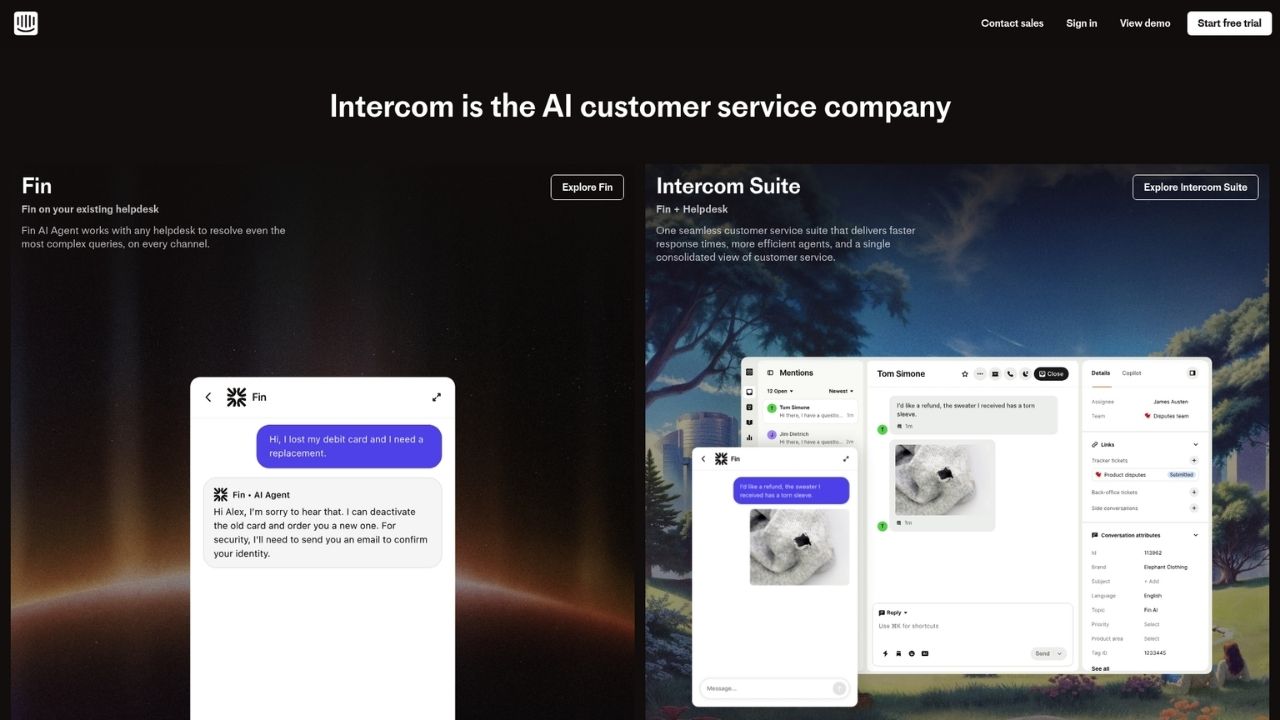
Intercom built its reputation on modern messaging. The interface feels contemporary compared to legacy helpdesks.
But the real differentiator is Fin, their AI agent that resolves conversations at $0.99 per resolution.
Fin handles email, live chat, SMS, WhatsApp, and social channels. The resolution-based pricing means you only pay when Fin actually solves a problem, not for every interaction. Reported resolution rates hit 50-70% depending on use case.
Pricing:
| Plan | Annual Price | Key Features |
|---|---|---|
| Essential | $29/seat/month | Fin AI ($0.99/resolution), messenger, shared inbox, help center |
| Advanced | $85/seat/month | Multiple inboxes, workflows, round-robin, 20 Lite seats |
| Expert | $132/seat/month | SSO, HIPAA, SLAs, multibrand, 50 Lite seats |
Copilot add-on: $29/agent/month for unlimited AI assistance.
Pros:
- Beautiful, modern interface
- Fin AI with pay-per-resolution pricing
- Strong automation capabilities
- 450+ integrations
Cons:
- Expensive at scale with seat + resolution pricing
- Phone support requires add-ons
- Messaging-focused (weaker for traditional ticket workflows)
Best for: SaaS companies wanting modern messaging experiences and AI-first support. The Fin AI pricing model works well if you have predictable conversation volumes.
6. Gorgias

Gorgias built specifically for e-commerce. The platform integrates deeply with Shopify, BigCommerce, Magento, and WooCommerce, letting agents edit orders, process returns, and generate discounts without leaving the ticket view.
Pricing is ticket-based rather than per-agent, which benefits teams with fluctuating agent counts. The AI Agent handles returns, order tracking, and FAQs automatically.
Pricing:
| Plan | Monthly | Annual | Tickets/Month | AI Interactions |
|---|---|---|---|---|
| Starter | $10 | - | 50 | $1.00 each |
| Basic | $60 | $50 | 300 | 60 included |
| Pro | $360 | $300 | 2,000 | 600 included |
| Advanced | $900 | $750 | 5,000 | 2,500 included |
| Enterprise | Custom | Custom | 5,000+ | Custom |
AI Agent: $0.90 per resolved conversation (annual), $1.00 (monthly).
Pros:
- Deep e-commerce platform integration
- Edit orders and process returns directly in tickets
- Unlimited user seats on all plans
- Social media support (Instagram, Facebook, TikTok)
Cons:
- Ticket-based pricing can be unpredictable
- Limited value outside e-commerce
- Phone and SMS are add-ons
Best for: E-commerce brands on Shopify or similar platforms who need tight store integration and social media support. The unlimited seats model works well for growing teams.
7. Zoho Desk

Zoho Desk offers exceptional value, especially if you're already using other Zoho products. The free tier supports 3 agents indefinitely.
Paid plans start at $7 per user monthly.
Zia, Zoho's AI assistant, provides sentiment analysis, ticket auto-tagging, and field predictions.
The platform integrates with 45+ Zoho apps, making it powerful for teams invested in the ecosystem.
Pricing:
| Plan | Annual Price | Key Features |
|---|---|---|
| Free | $0 | 3 agents, email ticketing, basic features |
| Express | $7/user/month | Email, social media, web forms, workflows |
| Standard | $14/user/month | Live chat, messaging, knowledge base, AI features |
| Professional | $23/user/month | Telephony, blueprints, multi-department, round-robin |
| Enterprise | $40/user/month | AI agents, Zia assistant, live chat, IVR, sandbox |
Pros:
- Excellent value across all tiers
- Generous free tier (3 agents forever)
- Strong Zoho ecosystem integration
- 40+ language support
Cons:
- Dated UI compared to modern alternatives
- Steep learning curve for advanced features
- Limited third-party integrations outside Zoho
Best for: Teams already using Zoho CRM or other Zoho apps who want tight integration and don't mind the older interface.
Which HubSpot Service Hub alternative should you choose?
The right choice depends on your priorities:
Choose Ringly if phone support is critical and you want AI to handle most calls automatically. The 73% resolution rate and quick setup are hard to beat for e-commerce stores.
Choose Zendesk if you need enterprise reliability, extensive customization, and have the budget for it. It's the safe choice for large teams.
Choose Freshdesk if you want solid helpdesk functionality without breaking the bank. The free tier lets you test thoroughly before committing.
Choose Kustomer if you serve high-volume B2C customers and need a unified timeline view of every interaction.
Choose Intercom if you're a SaaS company wanting modern messaging and AI-first support with resolution-based pricing.
Choose Gorgias if you run an e-commerce store on Shopify and need deep platform integration with social media support.
Choose Zoho Desk if you're already in the Zoho ecosystem and want the best value with tight integration.
Switching from HubSpot: What to expect
Migrating helpdesk platforms takes planning. Here's a realistic timeline:
Week 1-2: Data export and cleanupExport tickets, contacts, and knowledge base articles from HubSpot. Clean up outdated content before importing.
Week 3: Platform setup and configurationConfigure workflows, automations, and integrations in your new platform. Train a small pilot group of agents.
Week 4-6: Full rollout and optimizationMigrate remaining data, train all agents, and monitor for issues. Expect some friction as the team adjusts.
Pro tip: Run both platforms in parallel for 1-2 weeks if possible. This gives you a safety net if something goes wrong during the transition.
Get started with AI phone support today
If you're running an e-commerce store and phone calls are eating up agent time, Ringly offers a straightforward solution. The AI handles order lookups, returns, and FAQs automatically, escalating only when necessary.
Start your free trial and see how AI phone support works for your store. Setup takes 3 minutes, and you'll know within days whether it's the right fit.
Frequently Asked Questions
What are the best HubSpot Service Hub alternatives for small businesses?
For small businesses, Freshdesk and Zoho Desk offer the best value with generous free tiers. If you run an e-commerce store, Ringly provides AI phone support starting at $349 per month. Gorgias also works well for small Shopify stores with its Starter plan at $10 monthly.
Which HubSpot Service Hub alternatives offer the best AI automation?
Intercom leads with Fin AI Agent at $0.99 per resolution and 50-70% resolution rates. Ringly achieves 73% resolution for phone calls specifically. Kustomer offers strong AI capabilities but at higher cost with add-on pricing.
Are there any free HubSpot Service Hub alternatives worth considering?
Yes. Freshdesk offers a free tier for up to 10 agents for 6 months. Zoho Desk provides a free plan for 3 agents indefinitely. Both include basic ticketing and knowledge base features sufficient for small teams.
How do HubSpot Service Hub alternatives compare on pricing?
Entry-level pricing varies significantly. Zoho Desk and Freshdesk start free. Zendesk begins at $19 per agent monthly. Intercom starts at $29 per seat plus $0.99 per AI resolution. Ringly uses minute-based pricing starting at $349 monthly for 1,000 minutes.
What should I look for when evaluating HubSpot Service Hub alternatives?
Focus on pricing transparency, setup complexity, AI capabilities, omnichannel support, integration ecosystem, and support quality. Also consider whether you need specialized features like phone support or deep e-commerce integration that some alternatives handle better than HubSpot.
Can I migrate my existing HubSpot Service Hub data to these alternatives?
Most alternatives offer migration tools or services. Zendesk, Freshdesk, and Zoho Desk have documented migration processes from HubSpot. Expect to export tickets, contacts, and knowledge base articles, then import them into your new platform. Some platforms offer free migration assistance.
Which HubSpot Service Hub alternative is best for e-commerce businesses?
For e-commerce, Gorgias offers the deepest Shopify integration with order editing directly in tickets. Ringly specializes in AI phone support for stores handling order calls and returns. Both integrate natively with major e-commerce platforms and understand the unique workflows of online retail.