
You launched the store. Orders are coming in from Germany, France, Brazil. Then your inbox hits triple digits at 2 AM and someone in Hamburg leaves a Trustpilot review complaining that your "English-only" support made them feel like a second-class customer.
This is the moment most ecommerce operators figure out international customer service. Not before expansion, after. And by then you're already losing customers.
Here's the deal: 76% of online shoppers prefer to buy in their native language, and 40% will never purchase from a website that isn't. That's from the CSA Research "Can't Read, Won't Buy" study, which is still the gold standard on this. So if you're selling cross-border and running your support desk in English only, you're leaving real money on the table.
The good news is that international customer service used to be a $250K-a-year staffing problem. In 2026, it's mostly a strategy problem. AI solved the 24/7 multilingual piece, helpdesks translate tickets in real time, and the playbook is finally clear. This guide breaks down what actually works: channels, staffing, real cost math, regional cultural differences, tools, and a 90-day rollout plan.
Hear what AI support calls sound like for your store. Just paste your Shopify URL and hear sample calls for your store, no email required. Listen to demo calls for my store.
Why international customer service breaks for ecommerce
Domestic support is one language, one time zone, one set of consumer rules, one currency. International support is none of those things.
Add Germany and suddenly your return policy has to comply with EU consumer law. Add Japan and you need a formal, apologetic tone that your US reps will not produce naturally. Add Brazil and your customers will message you on WhatsApp at hours your team isn't staffed.
And this is all before we talk about the language. According to CSA Research, 62% of customers tolerate product issues better when support responds in their native language. Respond in English to a Dutch complaint and the same product defect becomes a refund request. Respond in Dutch and it becomes an exchange.
The stakes on the other side of this are big:
- 71% of customer service leaders say multilingual support measurably increases CSAT (SuperOffice)
- 29% of businesses report they've lost customers specifically because they didn't offer native-language service
- 35% of customers say they would switch to a competitor for native-language support
- 70% show stronger loyalty to brands that speak their language
Native-language support isn't just a comprehension thing. It's a trust signal. Customers feel safer buying from a brand that treats them like they exist, even if they happen to speak perfect English. This is the piece most US-based ecommerce operators underestimate.
For a deeper base on the fundamentals, our guide on ecommerce customer service best practices covers the domestic side of the equation, and the ecommerce customer service overview has the broader picture. Once you add borders, it's a different game.
The six pillars of international customer service
Every international support operation that works rests on the same six pillars. Miss one and things fall apart in predictable ways.
| Pillar | What it means | What to do |
|---|---|---|
| Language coverage | Support in the languages your customers speak | Start with top 2-3 by revenue, expand based on demand |
| Channel mix | Channels that match regional preferences | Phone for DE/FR/JP, chat for US/Nordics, WhatsApp for LatAm |
| 24/7 or follow-the-sun | Coverage that matches when customers are awake | AI for after-hours, humans for peak regional windows |
| Cultural fluency | Tone, formality, expectations | Train reps or brief AI on regional norms |
| Localized policies | Returns, warranty, shipping by region | EU stricter than US, Japan expects fast refunds |
| Payment and currency clarity | No surprise duties or conversions | Show all-in pricing before checkout |
Each pillar works with the others. You can translate your knowledge base perfectly and still lose German customers if your return policy is a US-style 30-day, no-questions-asked blurb without the EU-required 14-day withdrawal language.
Most operators get language right and miss the other five. Don't do that.
Pick the right support channels for each region
Here's what gets ignored in every international CS article we've read: channel preference varies wildly by country. The US is chat-first. Germany is phone-first. Brazil is WhatsApp-first. If your support operation is "email + a chat widget," you're invisible in most of these markets.
Our research, combined with data from Lokalise and industry benchmarks, breaks down like this:
| Region | Top channel | Secondary | Notes |
|---|---|---|---|
| US / Canada | Live chat | Instant expectation on chat. Phone for refunds. | |
| UK | Live chat | Polite and patient. Under 4h SLA. | |
| Germany | Phone | Values formal written records too. | |
| France | Phone | Chat | Strongly prefers French over English. |
| Nordics | Self-serve | Chat | Impatient with long responses. Under 1h for chat. |
| Netherlands / Belgium | Chat | Direct, fast. | |
| Italy | Phone | Warm, expressive. Same-day response. | |
| Spain | Phone | Growing WhatsApp preference. | |
| Japan | Phone | Extreme formality. Apologies matter. | |
| Latin America | Phone | Near-universal WhatsApp usage. | |
| Middle East | Phone | Trust-driven. Expect live contact. |
The four channels every international ecommerce store should run in 2026:
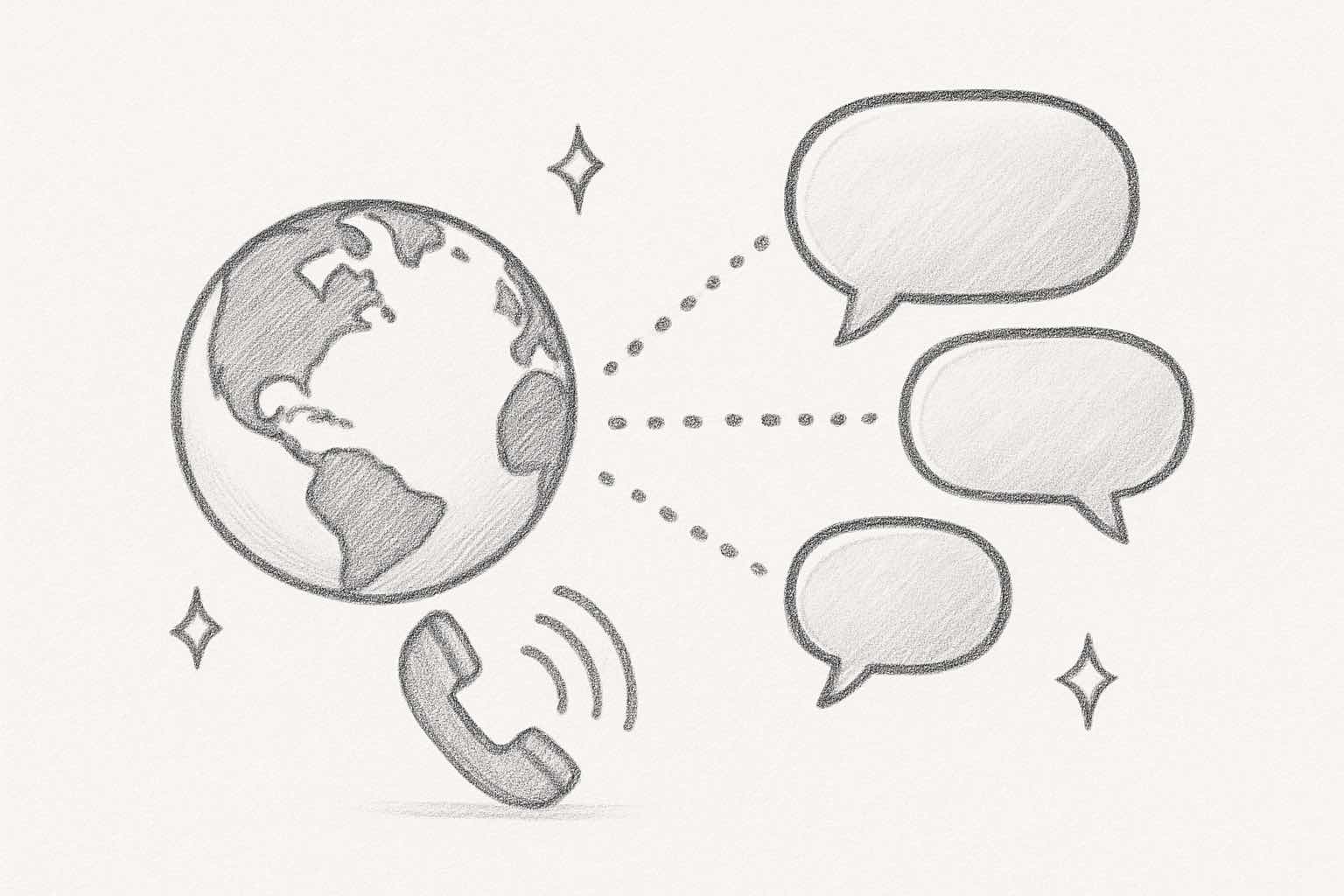
- Phone support with AI voice: covers inbound calls in 40+ languages without hiring a call center. This is the one most operators skip and the one regions like Germany, France, Italy, Japan, and LatAm punish you for skipping. Tools like Ringly.io handle this specifically for Shopify.
- Live chat with auto-translate: your helpdesk detects the language and translates both directions. Gorgias, Zendesk, and Freshdesk all support this.
- Email with language-specific templates: pre-written macros in your top 3-5 languages so replies look natural, not machine-translated.
- Self-service knowledge base in native languages: translated FAQs and order-status pages that deflect 30-50% of tickets.
Optional additions if the data supports it: WhatsApp Business API (for LatAm, MENA, Southern Europe), Instagram and TikTok DMs (younger demographics), and a country-specific landing page with a local phone number.
For the phone piece specifically, our guide on how to set up phone support for your online store walks through the full setup.
Ready to see what AI phone support looks like for a store with international customers? Try Ringly.io for free. Setup takes under 1 hour.
Build a multilingual team without hiring 40 people
This is the part that used to kill international expansion. Staffing 24/7 support in five languages meant five-person teams in five time zones, which meant a quarter-million a year before you'd served a single customer.
Here's the modern hybrid model most 2026 ecommerce brands are running:
Tier 1, AI handles the volume. An AI voice agent handles inbound phone calls in 40+ languages. An AI chat agent handles web chat in top languages. Both pull from your Shopify data so they can look up orders, process returns, and answer product questions. Tier-1 tickets typically include order status, shipping updates, refund requests, basic product questions. In our testing with Shopify stores, Seth (Ringly.io's AI) resolves up to 90% of calls without human escalation.
Tier 2, small core team handles complexity. Two to four bilingual CS leads who handle escalations, complaints, edge cases. They speak the 2-3 highest-priority languages fluently. They manage the AI, review transcripts, and step in when things get sticky.
Tier 3, BPO backup for peaks. During Black Friday, holiday season, or a product launch, a BPO partner with multilingual reps covers overflow. You pay per ticket or per hour, scale up and down.
Let's do the math.
Cost of each model, annualized
Fully in-house multilingual team (24/7):
- 5 bilingual CS reps at $53K salary (Glassdoor 2026 avg) plus ~30% benefits = $350K
- Manager, tools, training: $50K
- Total: $400K+ per year
BPO-only (multilingual offshore, 24/7):
- $12/hour average, 168 hours/week coverage = ~$105K/year per shift
- With 2-3 shifts for coverage: $210-315K/year
- Total: $150-300K per year depending on volume
AI + lean team hybrid (2026 standard):
- AI phone support (Ringly.io Enterprise): custom pricingnth = $13,200/year
- Helpdesk with translation (Gorgias Pro): $360/month = $4,320/year
- 2 bilingual leads in-house: $100-130K/year fully loaded
- Occasional BPO overflow: $5-15K/year
- Total: $125-165K per year
The hybrid model cuts cost by 50-70% while giving you coverage in more languages, faster response times, and 24/7 availability. It's why Klarna reduced their support resolution time from 11 minutes to under 2 minutes using an OpenAI-powered assistant in 35+ languages, handling work equivalent to 700 full-time agents. That's the Klarna AI assistant case study, which is the clearest public proof point on multilingual AI in ecommerce. Our AI customer service statistics 2026 roundup has more numbers on where this is going.
If you're still comparing options, we've written about scaling customer service without hiring and hiring vs AI in more depth.
Localize more than just the language
Language is the obvious part. The part that actually breaks international support is everything around the language.
Here's what needs to be localized:
- Currency and tax display: show all-in pricing with local VAT/duties before checkout. A German customer seeing $49 and getting billed €68 after customs is a refund.
- Return policies: EU requires a 14-day withdrawal period by law. Germany has additional consumer protection rules. Japan expects fast, no-argument refunds. Your US-style policy won't survive.
- Shipping options and timelines: be concrete. "Ships from Netherlands, 3-5 business days" beats "fast international shipping."
- Date formats and units: 20/04/2026 not 04/20/2026 in most of Europe. Centimeters, not inches, in most places. Euros with comma decimals (€19,99).
- Regional promotions: Black Friday is US-focused. Singles Day matters in China. Boxing Day in the UK and Canada. Localize the calendar.
- Payment methods: iDEAL in the Netherlands, SEPA in the EU, Klarna/Afterpay installments in Germany and Nordics, Boleto in Brazil.
Shopify Markets handles most of the storefront side natively: currency conversion, domain routing, tax calculation, translated storefronts. For the support side, link your helpdesk to translated macro libraries. For in-depth return management specifically, our ecommerce returns management guide goes deeper on this, and shopify return policy best practices covers the policy side.
Cultural expectations by market (the specific version)
Every international CS article says "be culturally aware." Almost none say what that actually means. Here's the concrete breakdown we've seen work:
- Germany: Formal "Sie" form in German unless explicitly invited to use "du." Customers expect precise answers, written records, punctuality. If you promise a refund in 5 days, deliver it in 3. Phone is trusted more than chat.
- France: Use formal French. Do not assume fluency in English. A polite "bonjour" and a proper sign-off go a long way. Accent errors are forgivable, tone errors are not.
- UK: Politeness, understatement, dry humor. Apologize once, fix the issue, move on. Don't over-apologize like US reps sometimes do.
- Nordics (Sweden, Denmark, Norway, Finland): Direct, no-nonsense. Customers want to self-serve first, escalate only if needed. Long response times are the main complaint.
- Netherlands / Belgium: Direct, casual tone works. Dutch is appreciated but English is widely accepted. Fast responses matter.
- Italy and Spain: Warmer, more expressive. Phone preferred. WhatsApp growing fast in Spain. Don't be clinical.
- Japan: Extreme formality. Apologies matter. Refunds should be fast and accompanied by genuine acknowledgment. Never argue, never push back.
- Latin America: WhatsApp is the default. Warmth and humor work. Don't be stiff. Response times can flex more than Europe.
- Middle East: Relationship-driven. Trust takes longer. Phone and WhatsApp are preferred over email. Formal address matters.
- US: Chat-first. Casual is fine. Minutes matter on chat. Email can take a day.
This isn't an exhaustive cultural guide. It's a starting checklist. If you're adding a market, spend 30 minutes reading how customers there complain on local forums and review sites. You'll learn more than any cultural training module.
Set realistic SLAs per channel
Overpromise on response time and you'll miss. Underpromise and you'll lose to a faster competitor. Here's a realistic benchmark set for international ecommerce in 2026:
| Channel | US/UK | Nordics | DACH | Southern Europe | Japan |
|---|---|---|---|---|---|
| Phone (answer time) | <60 sec | <30 sec | <60 sec | <90 sec | <60 sec |
| Live chat (first response) | <2 min | <1 min | <3 min | <3 min | <3 min |
| <4h | <1h | <4h | <8h | <12h | |
| Social DM | <2h | <2h | <2h | <4h | <4h |
| <30 min | <30 min | <30 min | <1h | n/a |
Research from customer service studies shows that sub-1-hour email response rates achieve 71% customer retention, compared to just 48% for responses that take 24 hours. That gap is most of the business.
A few rules:
- Publish your SLAs and meet them. Customers forgive slow if it's predictable.
- Don't commit to 24/7 phone in a language you can't actually staff. Either use AI or say business hours.
- Use out-of-office auto-responses in the customer's language, not yours.
For more on this, our customer service response time benchmarks and shopify customer service response time posts have more specific numbers by channel.
Tools that actually work for international ecommerce support
We've tested most of the tools in this category. Here's the stack that works.
AI phone support
Ringly.io is built for Shopify stores specifically. Seth, the AI phone agent, handles inbound calls 24/7 in 40 languages, looks up orders, processes returns, answers product questions. Setup takes under 1 hour and doesn't require code. It has handled 200,000+ calls and resolves up to 90% of calls without human help. Pricing is $99 a month for the first 50 conversations, then $1.99 each. If you sell internationally on Shopify, this is the fastest way to cover phone in every language your customers speak. More detail in our AI voice agent for customer support guide.
Helpdesk with translation
Gorgias is the most common Shopify-native choice. It unifies email, chat, social, SMS, and phone into one inbox and offers auto-translate through Lingpad or Lokalise Messages (500K characters/month free). G2 rates it 4.6/5 across 900+ reviews. Pricing is $10/month basic up to $900/month Advanced. Compare it to alternatives in our Gorgias alternatives post.
Zendesk supports 40+ UI languages and auto-translation. More enterprise, more expensive ($55-$115 per agent per month), but the multilingual tooling is mature. 4.3/5 on G2. Our Zendesk alternatives guide covers the trade-offs.
Freshdesk has built-in auto-translation via Freddy AI and language detection. Decent free tier, paid from $15/agent/month. 4.4/5 on G2. See Freshdesk alternatives for comparisons.
Storefront translation
Weglot auto-detects page content and translates into 110+ languages with a language switcher. Starter $17/month, Business $27/month. 4.7/5 on G2. Works on Shopify out of the box.
Shopify Markets handles multi-currency, domain routing, and translated storefronts natively, so you may not need a third-party translation app if you're on Shopify Plus.
Chat and chatbot
Intercom with Fin AI handles multilingual chat well. $39/agent/month plus $0.99 per Fin resolution. 4.5/5 on G2.
Tidio with Lyro AI is the SMB-friendly option. Auto-translate in chat, Shopify integration, pricing from $29/month.
Knowledge base
Help Scout has a solid knowledge base with multi-language support and a Shopify integration that pulls order data into the conversation. Our Help Scout alternatives post has more on this.
For a broader list of options, see our best Shopify customer service apps guide and customer service for Shopify rundown.
Common mistakes that tank international CSAT
We've watched dozens of ecommerce brands make the same errors. Here's the list:
- Replying in English to a Dutch email. The customer feels ignored even if they understand you. Use an auto-detect and translate workflow.
- Copying US return policies to the EU. You'll be non-compliant on day one. 14-day withdrawal is required.
- Launching 8 languages on day one. Quality dies. Start with 2-3 and expand based on real data.
- Relying only on Google Translate for returns and complaints. It mishandles tone and product names. Use a dedicated helpdesk tool or a native-speaking agent for sensitive tickets.
- Forgetting currency and tax clarity at checkout. Customers who see surprise customs fees request refunds. That's a support cost you created.
- Skipping phone. In Germany, France, Italy, Japan, and Middle East, phone is still the preferred channel for complex issues. Missed calls are lost sales. Our missed calls ecommerce post covers this.
- No local or toll-free number. Customers are hesitant to call an international number they don't recognize. Get a local number in your top 3 markets.
- Generic auto-responders in English. Translate these at minimum.
- Never checking how AI translation actually sounds. Have a native speaker read 10 random translations every month. You'll catch embarrassing misses fast.
How to roll out international support in 90 days
Most operators try to do this in a weekend and end up with a half-translated FAQ and no real plan. Here's the actual 90-day playbook:
Days 1-14: analyze
- Pull your Shopify analytics by country. Find your top 3-5 non-domestic markets by revenue, not just traffic.
- Count the support tickets from each market. If 20% of your tickets are from Germany but only 3% of your revenue, rebalance.
- Decide which 2-3 languages to launch first. Most US/UK Shopify stores get highest ROI from German, French, Spanish, or Dutch first.
- Benchmark current CSAT and response times by country.
Days 15-30: localize
- Translate your core product pages, return policy, shipping page, and knowledge base into target languages.
- Set up Shopify Markets if you haven't already (multi-currency, tax, domain routing).
- Build native-language email templates for your top 10 most-used macros.
- Localize auto-responders and checkout emails.
Days 31-60: implement
- Deploy helpdesk translation (Gorgias, Zendesk, or Freshdesk).
- Deploy AI voice for 24/7 multilingual phone coverage if phone is a priority in your target markets.
- Add a language detector and routing rule so tickets go to the right team or macro.
- Hire or reassign one bilingual CS lead to handle escalations in your top market.
Days 61-90: expand
- Add 1-2 more languages based on actual demand data.
- Set published SLAs per channel per region.
- Run a native-speaker QA on AI-generated responses and human-translated macros.
- Set up weekly reporting on CSAT and FCR by language and market.
At day 90, you should have clear data on which markets are growing, which channels are winning, and what to improve. Not a perfect operation, just one that's measurably better than English-only.
Ready to add 24/7 multilingual phone support to your store without hiring a team? Try Ringly.io for free. Setup takes under 1 hour and Seth speaks 40 languages out of the box.
Related reading
If this helped, these go deeper on adjacent angles:
- cost to outsource customer service — real BPO pricing and hidden-fee breakdown
- AI phone agent vs outsourced call center — real monthly cost math across three store sizes
- phone vs chat vs email support — which channel wins per ticket type and why
Frequently asked questions
What languages should I start with for international customer service?
Start with your top 2-3 by actual revenue, not traffic. For most US/UK Shopify stores, that's German, French, Spanish, and Dutch. Add one at a time based on support ticket volume and purchase data. Our ecommerce customer service automation guide has more on prioritization.
Is Google Translate good enough for customer service emails?
For simple transactional replies, usually yes. For returns, complaints, and anything emotional, no. Machine translation misses tone, product names, and regional idioms. Use a dedicated translation tool (Lokalise, Lingpad) inside your helpdesk or a native-speaking agent for sensitive tickets.
Can AI handle phone calls in different languages well enough for ecommerce?
Yes, the top AI voice platforms in 2026 handle 40+ languages with accuracy good enough for tier-1 support (order status, returns, product questions). Ringly's AI resolves up to 90% of Shopify store calls without human help across the languages it supports. Complex emotional issues still escalate to humans.
Do I need a local phone number in each country I serve?
Not always, but for Germany, France, Italy, Japan, and your top LatAm market, yes. Customers hesitate to call international numbers. A local or toll-free number significantly improves call rates. You can get these through Twilio or through your AI voice platform.
How much does it cost to add multilingual customer service to an ecommerce store?
The lean hybrid model (AI phone, helpdesk with translation, 2 bilingual leads) runs $125-165K/year for most mid-sized Shopify stores. Fully in-house multilingual teams cost $350-400K/year. Smallest setup (AI phone only plus translation add-on) can start around $6-10K/year.
How do I train my support team for cultural differences?
Start concrete. For each market, document formality level, typical response timing expectations, preferred channels, and common complaint patterns. Review real transcripts from that market monthly. Many brands also hire one native-speaking CS lead per major market for internal cultural calibration.
Does Shopify support multilingual customer service natively?
Shopify supports multi-language storefronts and Shopify Markets handles currency, tax, and domain routing. For actual support tickets, you'll need a helpdesk (Gorgias, Zendesk, Freshdesk) with translation, plus a voice solution for phone. See our Shopify AI voice support guide for the phone side.
Final word
International customer service used to cost $400K a year and take six months to set up. In 2026, with AI voice agents, helpdesk translation, and Shopify Markets doing most of the storefront work, you can run credible multilingual support across 10+ countries for under a fifth of that.
The brands that win internationally in the next two years won't be the ones with the biggest call centers. They'll be the ones that respect customers in their language, on their preferred channel, with their cultural expectations met. That's a strategy problem now, not a staffing one. Start with your top 2-3 markets, use the hybrid model, and expand as the data justifies it.
If your store gets international calls and you want to see what AI phone support sounds like for your specific business, try Ringly.io for free and Seth will be answering in under 1 hour.