
Most of your support queue is one question. Here's what it actually costs.
- Four inputs run the whole calculation: monthly orders, WISMO rate, channel split, and cost per contact. Multiply them, then multiply by 12.
- A $30M Shopify brand at 12,000 orders a month and a 35% WISMO rate is spending roughly $363,000 a year answering "where's my order."
- Built for founders, COOs, and Heads of CX at $10M-$100M Shopify brands with a visible phone number and a paid helpdesk.
Open your Gorgias queue on a Monday morning and read the subject lines. WISMO, refund, WISMO, "WHERE IS MY ORDER???", WISMO. The same question, over and over, stacked since Friday at 6 p.m. Most teams know it's a lot. Almost nobody knows the actual number, because the cost is split across the helpdesk, the phone line, the BPO invoice, and a rep's time nobody ever totals up.
This is a calculator, not a cost-scare article. By the end you'll have a worksheet you can fill in with your own four numbers and walk into the next budget meeting with a defensible figure. We'll also pull out the one line most brands undercount by the widest margin: the phone.
If you run a $10M-$100M Shopify brand and your support queue is mostly order-status questions, book a 30-min call and we'll run these numbers against your real call volume live. No homework on your end.
What counts as a WISMO contact (and why you're undercounting)
WISMO stands for "where is my order." A WISMO contact is any time a customer reaches out to ask where their package is, when it's arriving, or why the tracking hasn't moved. It shows up as an email, a chat, a DM, and a phone call.
Across DTC brands, WISMO runs 30-50% of all support contacts in a normal week, and tips past 50% during peak, according to the Gorgias 2024 CX data Salesforce cites. For a brand doing real volume, that's not a category. It's the single biggest line in your support cost.
Here's where the undercount happens. Your helpdesk counts emails and chats cleanly. Phone is messier. A voicemail at 9 p.m. that nobody returns doesn't open a ticket. A caller who hits a busy line at lunch and gives up doesn't open a ticket either. So when a founder asks "what's our WISMO cost," the answer they get back is the helpdesk number, which quietly ignores the most expensive channel you run.
That's the gap this calculator closes. We count every channel, then we isolate the phone, because that's where the money hides.
One more thing to settle before the math: what is and isn't a WISMO contact. A customer asking "where's my order" is the obvious case. So is "the tracking hasn't updated in three days," "did this even ship," and "it says delivered but I don't have it." All of those are status questions, and all of them are preventable with better proactive communication. What's not WISMO: a damaged item, a wrong size, a billing dispute. Those need a human, and they're not what's clogging your queue. The whole reason WISMO is worth calculating separately is that it's the slice of your support load that doesn't need a person at all. You're paying human rates for a lookup.
The four inputs the calculator needs
You only need four numbers to compute your real WISMO cost. None of them require a data project. You can pull all four in about ten minutes.
- Input 1: monthly order volume. Straight from Shopify. Use a normal month, not your Black Friday month, then we'll adjust for peak separately.
- Input 2: your WISMO rate. The share of orders that generate at least one "where's my order" contact. If you don't track it, tag a week of tickets and extrapolate, or start with the 30-40% benchmark and tighten it later.
- Input 3: your channel split. Of those WISMO contacts, what percent come in by email, by chat, and by phone. Most brands are surprised how much sits on the phone once they actually look.
- Input 4: cost per contact, by channel. This is the number people guess wrong. Use loaded cost, not the rep's hourly wage. Loaded means salary plus benefits, payroll tax, training, and the time a contact actually eats.
If you want to be precise on input 2, the cleanest way is to tag a single representative week of tickets in your helpdesk with a "WISMO" label, count them, and divide by that week's orders. A representative week, not a launch week and not a dead week. Most $10M-$100M Shopify brands land somewhere between 25% and 45% once they actually measure it, and the brands that are surprised are almost always surprised on the high side. If you genuinely can't pull it, start with 35% and tighten once you've tagged a week. The calculator works with a benchmark, but it gets sharp with your real rate.
On input 3, don't estimate the phone share from memory. Pull it from your phone provider or your BPO's call logs, because the phone is the channel founders consistently guess too low. The whole point of this exercise is to stop guessing on the line that costs the most.
Here are the loaded per-contact costs the industry uses, so you're not pulling them out of thin air:
| Channel | Loaded cost per WISMO contact | Source |
|---|---|---|
| $5 to $10 | Help Scout 2024 benchmark | |
| Live chat | $4 to $10 | DigitalGenius |
| Phone, outsourced BPO | $7 to $16 per call | industry BPO rates |
| Phone, in-house rep | $4 to $8 per call | loaded in-house rate |
| Any channel, blended | $4 to $12 per interaction | DigitalGenius via ReadyCloud |
A quick note on where these numbers come from, since it matters for trusting the output. The per-contact ranges above are third-party benchmarks. The phone economics I'll get to later are pulled from our own dashboard across the Shopify brands running AI phone support, so that's a real number, not a list price. And the loaded-rep math uses the $4,000-per-month figure operators actually quote on calls, not a base salary that hides the true cost.
The formula, with a worked example
The whole calculation is two multiplications and then a times-12. Monthly orders times your WISMO rate gives you monthly WISMO contacts. Split those by channel, multiply each channel by its per-contact cost, add them up, and multiply by 12 for the annual drain.
Let's run it on a real-shaped brand. A $30M Shopify supplement-and-wellness store, 12,000 orders a month, a visible phone number, and a 5-rep CS team on Gorgias.
- 12,000 orders x 35% WISMO rate = 4,200 WISMO contacts a month
- Channel split: 60% email (2,520), 25% chat (1,050), 15% phone (630)
- Email: 2,520 x $7 = $17,640
- Chat: 1,050 x $6 = $6,300
- Phone: 630 x $10 = $6,300
- Monthly WISMO cost: $30,240
- Annual WISMO cost: $362,880
Now look at the phone line. It's only 15% of the contacts but about 21% of the cost, because each phone call costs more to handle than an email or a chat. And that $75,600-a-year phone figure still doesn't count the after-hours callers who never got through. More on that in a minute.
For comparison on the per-call side: WashCo, a Shopify brand we launched, ran 271 calls at $0.91 each versus $2.70 for a human-handled call in its first week. The per-contact number is the lever, and the phone is where it swings hardest. If you want to see what cutting WISMO contacts does to the rest of your queue, our WISMO ticket deflection guide walks the four-layer playbook.
A note on peak. The example above uses a normal month on purpose. Your WISMO rate doesn't hold steady through the year, it spikes whenever shipping gets slower or volume gets bigger, which is the same window. November and December can push WISMO past 50% of contacts while order volume is already up, so the two multiply. If you want a peak figure, run the worksheet twice: once on a normal month, once on a December-shaped month with both the order count and the WISMO rate bumped. The gap between the two annualized numbers is what your seasonal staffing scramble is actually buying you, and it's usually the moment a CFO starts asking why the support line moves so much.
Your fill-in worksheet
Here's the worksheet. Drop in your four numbers and follow the rows down. Keep this somewhere you can hand to your CFO.
| Line | What to enter | Your number |
|---|---|---|
| A. Monthly orders | From Shopify, normal month | n/a |
| B. WISMO rate (%) | Share of orders that generate a contact | n/a |
| C. Monthly WISMO contacts | A x B | n/a |
| D. % email / % chat / % phone | Your channel split | n/a |
| E. Email contacts | C x email % | n/a |
| F. Chat contacts | C x chat % | n/a |
| G. Phone contacts | C x phone % | n/a |
| H. Email cost | E x your email cost per contact | n/a |
| I. Chat cost | F x your chat cost per contact | n/a |
| J. Phone cost | G x your phone cost per call | n/a |
| K. Monthly WISMO cost | H + I + J | n/a |
| L. Annual WISMO cost | K x 12 | n/a |
| M. Phone share of cost | J divided by K | n/a |
Line M is the one to sit with. For most $10M-$100M brands with a real phone presence, the phone is a small slice of contacts and a fat slice of cost. That's the line worth fixing first, and it's the line every generic WISMO calculator skips.
Why the phone line is the most expensive WISMO you have
Phone WISMO costs more per contact than any other channel. That part is obvious from the table. What's less obvious is the second cost stacked on top of it: the calls you miss.
Higher-AOV brands carry a heavier phone load than the benchmark implies. At a $250 average order value, 12-18% of orders generate a phone call, versus about 3% at a $40 AOV. So if you're a premium Shopify brand, more of your WISMO comes in by voice, on the most expensive line, at the exact hours your team isn't staffed.
Then the leak. When a customer can't reach a person, 85% never call back and 62% switch to a competitor, per a PCN missed-call study. That's not a support cost, it's a revenue cost, and it doesn't show up anywhere in your helpdesk reporting. Your fill-in worksheet captures the contacts you handle. It can't capture the order you lost when a customer dialed at 8 p.m., got voicemail, and bought from someone who picked up.
Run a quick second number on that. If even 30 of those 630 monthly phone contacts come in after hours and half of them walk, and your average order is $120, that's 18 lost orders a month, or roughly $26,000 a year in revenue that no support spreadsheet ever flags. It's not in line J, it's not in line K, and it's not in the BPO invoice. It's just gone. For a brand spending six figures a year handling WISMO, the calls you miss can cost more than the calls you handle.
This is the part the cost calculator can't fully price, and the part that should change how you read line M. The phone isn't just your most expensive handled WISMO. It's your only WISMO channel that quietly costs you sales when it goes unanswered. If you want the mechanics of cutting that volume, the WISMO automation guide for Shopify covers the tooling, and branded order tracking handles the preventable share before a contact ever happens.
What changes when you automate the phone WISMO line
Ringly.io is AI phone support for Shopify brands. Your team wasn't hired to answer the same call 50 times a day, and the phone is the one WISMO channel you can hand off without losing the customer experience.
Here's the mechanic. The AI answers inbound calls 24/7. It checks order status in your Shopify store, reads back tracking, handles returns and product questions, and escalates the genuinely complex calls to your team through Gorgias or whatever helpdesk you already run. The routine "where's my order" call, the one eating your most expensive channel, gets resolved without a human and without a voicemail.
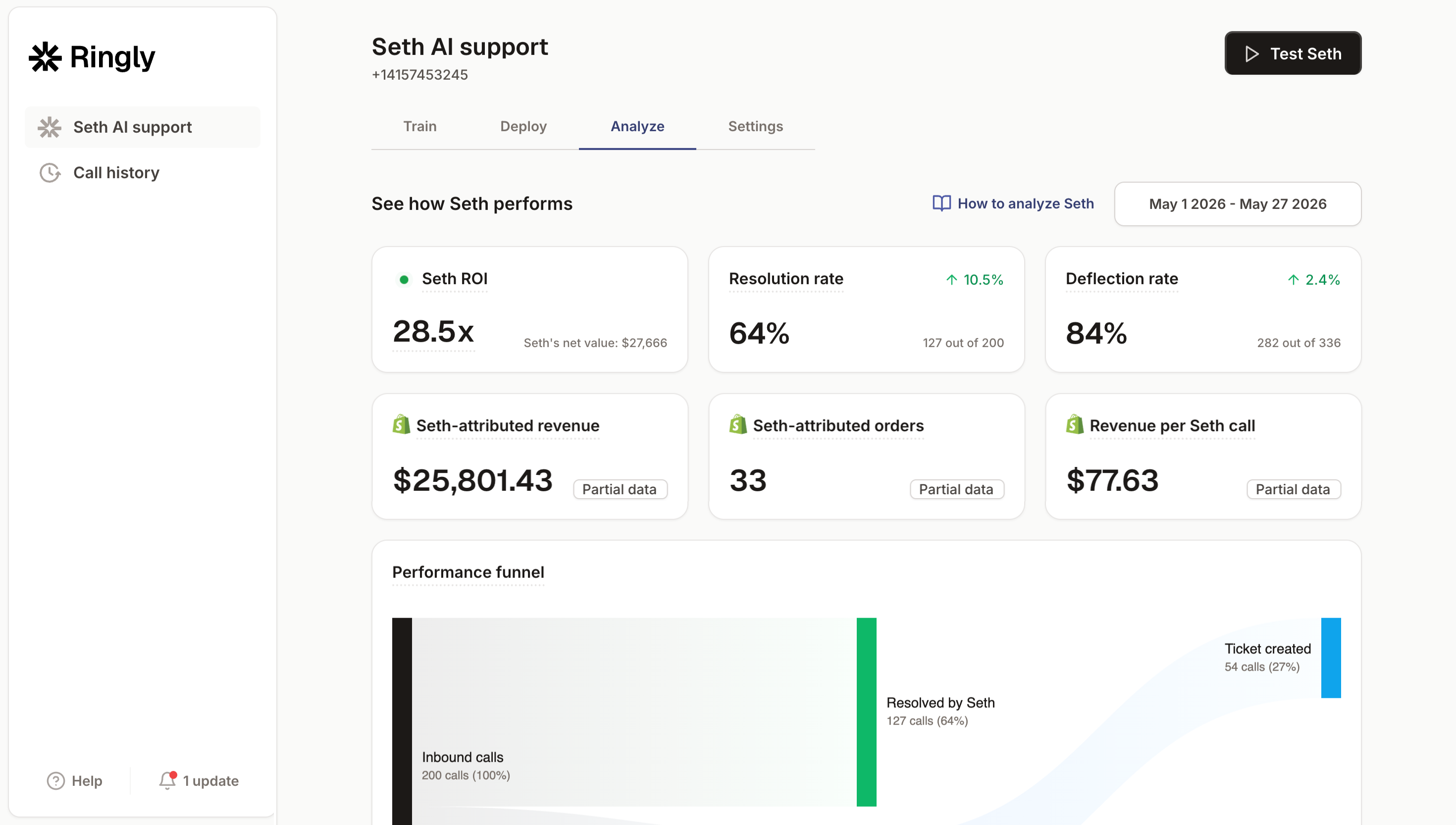
The economics are the reason this matters for the calculator. Seth resolves up to 90% of inbound calls autonomously for $1.99 a call after the first 50, versus the $7-$16 a BPO charges and the $4-$8 an in-house rep costs loaded. Go back to line J on your worksheet. That's the line this collapses.
"My customers also feel like it's a normal person. They feel like they can communicate if they have questions."
Claudia Droge, TechCraft Studio
The other thing it fixes is the leak you couldn't price. A 24/7 AI line doesn't go to voicemail at 8 p.m., so the 62%-switch-to-a-competitor problem stops being a problem. You can read more on 24/7 ecommerce phone support and how it fits a Shopify Plus support stack.
It's worth being clear about what this does and doesn't replace, because the honest version sells better than the hype version. The AI doesn't replace your CS team. It takes the routine status calls off them so the reps you already pay can spend their day on the calls that actually need a person: the angry customer, the complicated return, the order that went wrong. You keep your phone number, your helpdesk, and your workflows. The difference is that the cheapest-to-prevent, most-expensive-to-handle slice of your queue stops landing on a human. If you're weighing this against hiring more reps or signing a BPO, our breakdown of in-house versus outsourced support lays out where each one stops penciling out, and the ecommerce phone support guide covers the channel on its own.
What this costs you today versus with Ringly
Zoom out from the phone line to the whole repeatable-call load, because WISMO is the biggest slice but not the only one. Take a typical brand running a 6-rep CS team to cover order-status, returns, and the same product questions all day.
| Line item | Today | With Ringly |
|---|---|---|
| 6 reps x $4K loaded per rep | $24,000/mo | n/a |
| Ringly (around $5K/mo) | n/a | $5,000/mo |
| Net monthly CS spend | $24,000/mo | $5,000/mo |
| Monthly savings | n/a | $19,000/mo |
| Annual savings | n/a | $228,000/yr |
That's roughly 70% of repeatable calls, the order-status, returns, and product questions, routed to the AI. The other 30%, the genuinely complex calls, still go to your team, who now have time to actually solve them. Exact pricing gets set on a call, but the savings shape holds across the brands we run. You can see the self-serve tiers on the pricing page; Enterprise is scoped by call.
Once you've filled in your worksheet, book a 30-min call and we'll compare your real numbers to your current setup and do the math live.
Four things that quietly inflate your WISMO number
Before you treat the annual figure as fixed, it's worth knowing what's making it bigger than it has to be. A large share of WISMO is self-inflicted, which means it's also fixable, often without touching headcount at all.
- Slow or silent order confirmations. If a customer doesn't get a clear "shipped, here's tracking, here's the date" message, they'll contact you to ask. Tighten the post-purchase emails and a chunk of WISMO never starts. Shopify's own data shows proactive notifications cut the volume meaningfully.
- Tracking that lives off-site. Sending customers to a raw carrier page that hasn't updated is a guaranteed second contact. Branded, on-site order tracking keeps them out of your queue.
- A phone number with no after-hours plan. A visible phone line you only staff 9 to 5 doesn't reduce WISMO, it converts daytime emails into evening voicemails and lost sales. Either cover the line around the clock or expect the leak.
- Counting the wrong way. Some teams fold returns, exchanges, and product questions into their WISMO tag, which inflates the rate and muddies the math. Keep WISMO clean to status-only questions, or you'll over-budget for a problem that's smaller than it looks.
Fix the first two and your WISMO rate drops, which lowers every line of the worksheet. Fix the third and you stop bleeding revenue your reporting never caught. For the full playbook on cutting volume, see our guide to reducing WISMO tickets and the broader ecommerce customer service overview.
Frequently asked questions
What's the average cost of a WISMO ticket? It depends on the channel. Email runs $5 to $10 fully loaded, chat $4 to $10, and a phone call $7 to $16 through a BPO or $4 to $8 in-house. The blended figure most studies quote is $4 to $12 per interaction.
What percentage of support tickets are WISMO? Between 30% and 50% of all DTC support contacts in a normal week, climbing past 50% during peak season. For most Shopify brands it's the single largest support category, which is why it's the first place to look when you're trying to cut cost.
How do I calculate my own WISMO cost? Multiply monthly orders by your WISMO rate to get monthly contacts, split those by channel, multiply each channel by its per-contact cost, add them, then multiply by 12. The fill-in worksheet above walks every line so you can drop in your own four numbers.
Does phone WISMO cost more than email or chat? Yes, per contact it's the most expensive channel, and it carries a second hidden cost. Missed and after-hours calls never log as tickets, and 85% of callers who can't reach a person never call back, so the phone leaks revenue your helpdesk reporting never sees.
How much can I save by automating WISMO? On the phone line specifically, calls on Ringly cost $1.99 each after the first 50, versus $7 to $16 on a BPO. Across the whole repeatable-call load, a brand swapping a 6-rep team for AI phone support typically nets around $19,000 a month, backed by a 65% resolution guarantee.
What's the fastest way to reduce WISMO contacts? Prevent the preventable share with proactive shipping notifications and branded tracking, then automate the contacts that still happen. Most brands cut WISMO volume 60-70% within 60 days with proactive tracking alone, and automating the phone line handles what's left.
Does Ringly handle phone WISMO for Shopify? Yes. The AI answers inbound calls 24/7, checks order status in your Shopify store, and escalates complex calls to your existing helpdesk. It goes live in under an hour and is built specifically for Shopify brands.
Talk to us

If you run a $10M-$100M Shopify brand and the phone goes to voicemail after 6 p.m., a 30-min call is the fastest way to see what that line is really costing you. We'll pull your real call volume and run the calculator with you, live.
Our 3 promises.
- Live in under 1 hour. Setup and test calls are free.
- 30-day money back on the $99 plan fee.
- 65% resolution guarantee: if Seth resolves under 65% of your support calls in a month, that month comes back as credit (after 90 days on Pay per call).
Ruben (Ringly co-founder) takes these calls personally.