
This post in 30 seconds.
- Repeat buyers are roughly 21% of a DTC store's customer base but drive about 44% of revenue. The lever almost every retention list underweights is the live support interaction.
- The most expensive retention failure is the call nobody answers: 78% of people abandon a brand after one unanswered call. We pulled this from 200,000+ real support calls across the brands on Ringly.
- Built for founders, COOs, and Heads of CX at $10M-$100M Shopify brands running a paid helpdesk with a phone line on the site.
Here is the number that should reframe your whole retention budget: repeat buyers make up about 21% of the average ecommerce customer base, but they drive roughly 44% of the revenue (Peel Insights). Most retention playbooks answer that with email flows and a points program. Those help. But if you run a $10M-$100M Shopify brand with 3 to 12 reps and a phone line on your site, the cheapest retention move you are probably skipping is answering that phone, especially after 6 p.m. This is a best-practices guide, but it is an opinionated one. Support experience is not bullet number seven on the list. It is the spine.
Most $30M Shopify brands we talk to run a 5-rep CS team and a phone line that rolls to voicemail every evening, and they can't tell you what that voicemail costs them. We've launched AI phone support for Shopify brands trying to close that exact gap. If your store goes quiet after hours, book a 30-min call and we'll show you what the missed calls are costing in repeat orders, live.
Why retention is the only growth math that still works
Acquisition got expensive and it stayed expensive. Acquiring a new customer runs about five times the cost of keeping one you already have (HubSpot), and you have a 60-70% chance of selling to an existing customer versus 5-20% for a cold prospect. So the math tilts hard toward retention, and the returns compound.
A 5% lift in retention can raise profits anywhere from 25% to 95%, depending on your margins and repeat cadence (HubSpot). The repeat-purchase curve is why. After someone's first order, there's roughly a 27% chance they come back. After the second, it jumps to about 54%. After the third, 62%. Every reorder makes the next one more likely, which is why 60% of DTC revenue tends to come from returning customers.
The trap is treating retention as a marketing function. It isn't, not entirely. A customer's decision to come back is shaped less by the next email and more by how the last problem got handled. You can build the best replenishment flow in Klaviyo and still lose the customer who couldn't reach a human about a damaged order. For the full numbers behind the repeat-rate curve, our customer retention statistics for 2026 post has the source list.
The retention lever everyone underweights: the support interaction
Walk down any "customer retention best practices" list and you'll see service named as one bullet among ten, usually phrased as "deliver great support." That framing buries the lever. Half of consumers will switch to a competitor after a single bad experience, and 89% say they're more likely to buy again after a good one (Zendesk CX Trends via HubSpot).
Then there's the part that decides whether a customer churns quietly or stays: first contact. 67% of churn is preventable if the customer's problem gets resolved during their first interaction (HubSpot). Not the third email in a back-and-forth. The first time they reach you. That is a support-operations number wearing a retention costume, and it's why your resolution rate matters more to LTV than your subject lines do.
WashCo, a Shopify brand we launched, recovered $22,664 in attributed revenue in its first 7 days once its calls actually got answered. Most of that wasn't new demand. It was orders and reorders that used to leak out the bottom of the funnel while the phone rang. The brands that treat support as a retention channel rather than a cost center tend to find money sitting in the same place: the interactions they were dropping.
The most expensive retention failure is the missed call
Here's where it gets concrete. The single most expensive thing your support operation does is not answer the phone, and it does it most on the calls that matter most.
The data on missed calls is brutal. 85% of callers who can't reach a person never call back, and 62% switch to a competitor (PCN Answers). 78% abandon the brand entirely after one unanswered call. And voicemail doesn't save you: 80% of voicemail-routed callers hang up without leaving a message (Eden). The customer who can't get through doesn't file a ticket and wait. They buy from whoever picked up.
Now layer on timing. After-hours and weekend calls are the most valuable and the most frequently missed, because that's when people browse, hit a snag, and want a fast answer. 76% of consumers still prefer to pick up the phone for support, and that share climbs with order value and customer age. A lot of those calls are the same handful of questions: WISMO ("where's my order") alone is 30-40% of tickets in a normal week and 50%+ at peak (Salesforce).
I read through a stretch of real call logs to write this, and the pattern is always the same. The calls that churn customers aren't the hard ones. They're the routine ones that hit a voicemail at 8 p.m. We built this list off 200,000+ real support calls across the Shopify brands on Ringly, not off a competitor's blog, and the after-hours WISMO call is the most under-defended retention moment on the board. For a deeper breakdown of what those dropped calls cost, see our piece on missed calls in ecommerce.
"My customers also feel like it's a normal person. They feel like they can communicate if they have questions."
Claudia Droge, TechCraft Studio
7 customer retention best practices that actually move repeat rate
Skip the vague stuff. These are the practices that change repeat-purchase rate at a DTC brand, ordered by how much they move the number.
1. Answer the phone, especially after 6 p.m. and on weekends
This is the single biggest retention move on the list and the one most brands have no plan for. If your team clocks out at five, you're dark during the window when high-intent customers actually call. You don't need a night shift to fix it, but you do need something picking up. The brands that close the after-hours gap stop leaking the 78% who abandon after one unanswered call. Start by pulling your call log and counting how many calls land outside business hours, then decide what answers them.
2. Resolve it on the first contact, not the fastest contact
Speed gets the attention, but first-call resolution is the number that moves churn. 67% of churn is preventable when the issue gets solved on the first interaction (HubSpot). A two-minute call that fully resolves the problem beats a 20-second deflection that creates a second ticket. Track first-contact resolution as hard as you track response time, and read our guide on first-call resolution for ecommerce if you don't measure it yet.
3. Make the post-purchase moments effortless
WISMO, returns, and exchanges are where retention is quietly won or lost, because they happen after the customer already paid and is deciding whether you're worth a second order. A clean order-status answer and a no-friction return turn a complaint into a reorder. Sloppy ones turn a happy customer into a one-and-done. Tighten these flows the way you'd tighten a checkout, and lean on the same discipline you'd use for ecommerce returns best practices.
4. Personalize from order history, not just a first name
Inserting "Hi {first_name}" is not personalization. Knowing that someone's on their third reorder of the same SKU, or that their last order shipped late, is. Use what your store already knows so the support interaction feels like a relationship, not a lookup. Customers who get genuinely personalized service are meaningfully more likely to come back.
5. Run a replenishment nudge before they lapse
For any consumable or subscription product, the reorder window is predictable. Reach out before the customer runs out, not after they've drifted. This is the one classic marketing tactic that earns its place on a support-led list, because the nudge lands better when it's tied to a real account state your support team can see and act on. Pair it with a working loyalty program and the reorder rate climbs.
6. Close the loop on every complaint within the hour
A complaint is a retention fork. Handled fast and fully, it can leave the customer more loyal than if nothing had gone wrong. Ignored or slow-walked, it's a churn event and often a public one. Set a one-hour internal SLA on complaints specifically, separate from your general queue, and protect it.
7. Measure repeat-purchase rate and resolution rate, not just CSAT
CSAT tells you how a single interaction felt. It doesn't tell you whether the customer came back. Put repeat-purchase rate and first-contact resolution rate on the same dashboard, because that's the pair that actually predicts retention. A retention rate calculator is a fine place to start if you're not tracking it cleanly yet.
What the support gap costs you, and what it costs to fix
Let's put numbers on it. Most of the retention leak we've described traces back to one thing: not enough coverage on the routine, repeatable calls. Here's the math for a typical $50M Shopify brand running a 6-rep CS team.
| Line item | Today | With Ringly |
|---|---|---|
| 6 reps × $4K loaded per rep | $24,000/mo | n/a |
| Ringly (~$5K/mo) | n/a | $5,000/mo |
| Net monthly CS spend | $24,000/mo | $5,000/mo |
| Monthly savings | n/a | $19,000/mo |
| Annual savings | n/a | $228,000/yr |
That's roughly 70% of repeatable calls (order status, returns, the same five questions over and over) handled without a human, while your team keeps the 30% that genuinely need one. Ringly.io is AI phone support for Shopify brands. Instead of hiring a night shift every time call volume climbs, the AI answers inbound calls 24/7: it finds orders in your Shopify store, processes returns and exchanges, answers product questions from your knowledge base, and escalates cleanly to Gorgias, Re:amaze, or whatever helpdesk you already run.
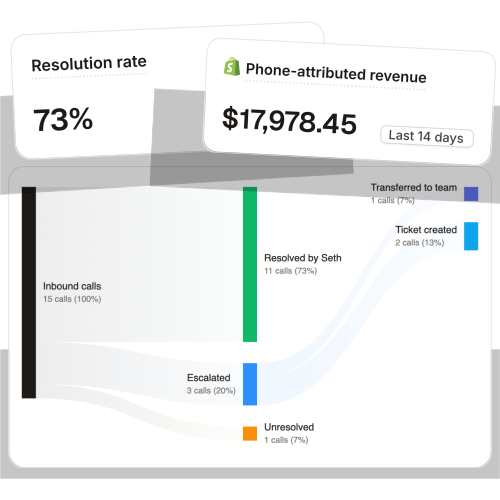
Seth resolves up to 90% of calls on its own for $1.99 a call after the first 50, versus $7-$16 per call for human BPO. BioLongevity Labs, a supplement brand on Ringly, hits 79% resolution on its own. The retention point isn't the cost savings, though that's real. It's that the calls stop going unanswered, which is where the repeat orders were leaking. If you want to see your own version of this table, book a 30-min call and we'll do the math against your actual call volume.
A 24/7 phone line you don't have to staff is also the simplest way to deliver the round-the-clock support that high-AOV customers now expect. If you're on Shopify Plus and feeling this most during launches and peak season, our Shopify Plus customer service breakdown goes deeper on the spike problem.
Frequently asked questions
What is the most effective customer retention strategy for a DTC brand?
Resolving customer problems quickly and completely, especially on the first contact. 67% of churn is preventable when the issue gets solved during the first interaction, which makes support quality a bigger retention lever than most email or loyalty tactics. Loyalty programs and replenishment flows help, but they can't save a customer you failed to reach when they needed you.
How does customer service actually affect retention?
Directly and heavily. Half of consumers switch to a competitor after one bad experience, and 89% are more likely to buy again after a good one. Because repeat customers drive the majority of DTC revenue, every poorly handled interaction compounds into lost lifetime value, not just one lost sale.
Does phone support still matter for ecommerce retention?
Yes, more than most brands assume. 76% of consumers still prefer to pick up the phone for support, and the share rises with order value and customer age. Phone calls are also where the highest-intent, highest-value retention moments happen, which is exactly why a missed call is so costly.
How do after-hours calls affect customer retention?
They're a major hidden leak. After-hours and weekend calls are among the most valuable and the most frequently missed, and 78% of people abandon a brand after a single unanswered call. Covering that window, even with AI, is one of the fastest retention wins available to a DTC brand.
How do I measure customer retention?
Track repeat-purchase rate and customer lifetime value as your headline retention metrics, then watch churn rate and first-contact resolution rate as leading indicators. CSAT is useful for individual interactions but doesn't tell you whether the customer came back, so don't rely on it alone.
Can AI phone support hurt the customer experience?
It can if it's a clunky menu tree, but a good voice agent does the opposite. The most repeated thing customers say after talking to Ringly's agent is "you don't sound like AI," and it resolves the routine calls so your human team has time for the ones that need a person. The risk is leaving the call unanswered, not answering it well.
Talk to us

If you run a $10M-$100M Shopify brand and your phone rolls to voicemail after 6 p.m., a 30-min call is the fastest way to see the repeat orders you're leaking. We'll pull your call patterns and run the retention math against your real numbers, not a generic example.
Our 3 promises.
- Live in under 1 hour. Setup and test calls are free.
- 30-day money back on the $99 plan fee.
- 65% resolution guarantee: if Seth resolves under 65% of your support calls in a month, that month comes back as credit (after 90 days on Pay per call).
Ruben (Ringly co-founder) takes these calls personally.