
The average business answers only 37.8% of its inbound calls. The other 62% hit voicemail or nothing at all (AmbsCallCenter). For a supplement brand, that number is worse than it looks, because your buyers skew older and reach for the phone instead of the tracking email, and because auto-ship creates a predictable delivery spike that lands on your line the same week every month.
So the question isn't whether to handle calls. It's how to handle them without putting your CS team on the phone all day or hiring a night shift you can't justify. This is the playbook the Shopify brands we run phone support for actually use: sort every call into one of five buckets, give each bucket a rule, then automate the routine ones and protect your reps for the rest.
If you run customer experience at a $10M-$100M Shopify supplement brand, you already know the Monday pile. WISMO, pause-my-auto-ship, "can I take this with my blood pressure meds," the same questions over and over. We build AI phone support for brands trying to stop that pile from eating their payroll. Book a 30-min call and we'll sort your last week of calls live so you can see what's routine and what isn't.
This post in 30 seconds.
- Sort every inbound call into 5 buckets (WISMO, auto-ship changes, ingredient questions, returns/billing, after-hours) and you'll find roughly 70% is repeatable.
- The ingredient bucket is the one most brands handle badly, because reps can describe a label but can't legally say a product treats or cures anything.
- Built for founders, COOs, and Heads of CX at $10M-$100M Shopify supplement brands running a paid helpdesk plus a visible phone line.
In this post:
Sort your calls into five buckets before you do anything
You can't fix a phone line you haven't sorted. Before you touch a tool or a script, pull a week of call logs and drop every call into one of five buckets. Most supplement brands are surprised by how lopsided the split is.
About 70% of a supplement brand's calls are repeatable, which means a handful of buckets account for almost all of your phone payroll. I sorted one supplement brand's after-hours pile a while back, and the handle bucket was almost entirely two things: where's my order, and pause my auto-ship. Everything genuinely hard fit in a much smaller pile.
Here's the triage table we hand operators:
| Call bucket | How often | Who should handle it | Why |
|---|---|---|---|
| WISMO ("where's my order") | 30-40% of tickets, 50%+ at peak | Automate | Same lookup every time, spikes around ship date |
| Auto-ship changes (cancel, pause, skip, swap) | Second-biggest pile | Automate with a save flow | Every saved cancel is roughly a year of LTV |
| Ingredient / dosage / "is this safe with X" | Smaller, high-stakes | Hybrid: describe label, escalate medical | FDA structure/function limits what anyone can say |
| Returns, refunds, billing disputes | Steady mid-size | Automate routine, escalate disputes | Lot/expiration and double-charge questions |
| After-hours / weekend overflow | The leak | Automate 24/7 | Voicemail loses the customer |
WISMO alone runs 30-40% of all ecommerce support tickets in a normal week and over 50% at peak, per Salesforce. In supplements it skews higher, because auto-ship means a wave of "did my order ship" calls lands on a predictable date and your older buyers call rather than refresh a page.
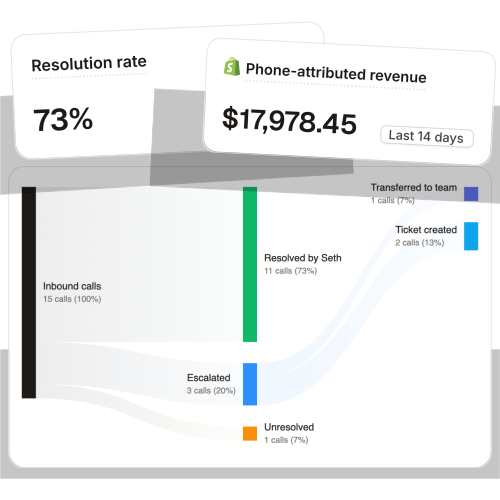
The point of the sort is simple. Once you can see the split, you stop trying to staff for the whole line and start staffing only for the calls that actually need a person. Everything else gets a rule. The next three sections give you the rule for each bucket. If you want the wider context first, our guide to ecommerce phone support covers why phone still matters for DTC.
The 70% you can route: WISMO and auto-ship
Start with the two buckets that account for most of your volume, because fixing these is where the payroll savings live.
WISMO and auto-ship changes are the calls your team dreads most and the calls a machine handles best, which is exactly the trade you want. Neither one needs judgment. WISMO is a lookup. An auto-ship change is a field update plus a save attempt. Both happen hundreds of times a month with almost no variation.
For WISMO, the rule is: connect the phone line directly to Shopify so the order status is read back from the real order, not a stale email. Pull the tracking, read the carrier and the date, and offer to text the link. If the order is genuinely late or lost, that's the only WISMO call that should ever reach a rep. Our WISMO automation guide for Shopify walks the setup, and the broader pattern is in our piece on WISMO calls.
For auto-ship, the rule is different and more valuable. A cancel call is a retention moment, not a data-entry task. Build a save flow into the script: before processing the cancel, offer to skip a month, change the frequency, or swap to a different product. Recharge and Skio both expose the actions to do this. Every cancel you turn into a skip is roughly twelve months of subscription LTV you keep, which is why we treat this bucket as a customer retention lever, not a support task. That's the bucket that decides whether automating the phone line pays for itself. If you want the refund-and-billing side of this, we cover it in Shopify refund and subscription handling.
BioLongevity Labs, a supplement brand on Ringly with comparable volume, resolves 79% of its calls end to end without a human. That's WISMO and auto-ship doing the heavy lifting, with the genuinely hard calls still routed to the team. The reps don't disappear. They just stop spending six hours a day reading tracking numbers out loud.
Ingredient calls without breaking FDA rules
This is the bucket most supplement brands handle badly, and it's the one with real downside if you get it wrong.
Anyone answering your phone, human or AI, can describe what's on the label but cannot say your product treats, cures, or prevents anything. That's not a style preference. FDA rules on structure/function claims are clear: a dietary supplement can't claim to diagnose, treat, cure, or prevent any disease, and any structure/function statement has to carry the standard disclaimer that the FDA hasn't evaluated it (FDA). The labeling guide spells out the line in detail (FDA Chapter VI).
So when a customer calls and asks "will this help my anxiety" or "can I take it with my blood pressure medication," the rule is two-part:
- Describe, don't diagnose. State what's on the label and the approved structure/function language, nothing more. "The label says it supports X" is fine. "It'll fix your Y" is not.
- Escalate anything medical. A drug-interaction question or anything that sounds like an adverse event goes to a human, every time, with a hard handoff rule. Do not let any script improvise here.
This is one place an AI phone agent can actually be safer than a tired rep on a Friday, because the guardrails are hard-coded. The agent physically can't make a health claim. It reads the approved language, then routes the medical question to a person. Brands like Ritual, AG1, and HUM live and die by this line in every channel, and the phone is no exception. If you want the broader operator view, our customer service playbook for supplement stores covers the compliance setup alongside the rest.
"My customers also feel like it's a normal person. They feel like they can communicate if they have questions."
Claudia Droge, TechCraft Studio
Returns, billing, and the after-hours leak
The last two buckets are returns and billing, plus the one that quietly costs the most: after-hours.
Returns and billing calls are mostly routine. A customer wants to send something back, asks about a lot number or expiration date, or calls because the card got charged again for an auto-ship they forgot about. The rule here is the same split as WISMO: automate the routine lookup and the standard return, escalate the genuine dispute. The agent can read the lot and expiration off the order, start a return, and confirm the next ship date. A real chargeback threat or a billing dispute goes to a person.
The after-hours bucket is where most supplement brands silently lose money, because the call doesn't get logged as a loss, it just rolls to voicemail and disappears. And voicemail is a dead end. Around 86% of callers who reach a business voicemail hang up without leaving a message (calljolt). Worse, 85% of callers who can't reach a person never call back, and 62% of them switch to a competitor (PCN). For a subscription brand, a missed evening call isn't one lost sale. It's a churned subscriber.
The rule for after-hours is the only one that's binary: cover it 24/7 or accept the leak. There's no halfway. Either the phone gets answered at 11 p.m. when an older customer is anxious about a delivery, or it doesn't. WashCo, a Shopify brand we launched, recovered $22,664 in attributed revenue in its first 7 days once those calls stopped going to voicemail. Our guides on after-hours answering and 24/7 ecommerce phone support go deeper on the coverage math.
If your phone goes to voicemail after 6 p.m., book a 30-min call and we'll show you what last week's missed calls were actually worth.
What this costs you today vs handling it differently
Sorting calls is free. Staffing for all of them isn't. Here's the math most supplement brands are quietly paying.
A typical $30M supplement brand runs a 5-rep CS team plus 2 part-time weekend reps to cover the subscription pause-and-skip calls:
| Line item | Today | With Ringly |
|---|---|---|
| 5 reps x $4K loaded | $20,000/mo | n/a |
| 2 part-time @ $2K | $4,000/mo | n/a |
| Ringly (~$5K/mo) | n/a | $5,000/mo |
| Net monthly CS spend | $24,000/mo | $5,000/mo |
| Monthly savings | n/a | $19,000/mo |
| Annual savings | n/a | $228,000/yr |
That assumes 70-80% of those WISMO, auto-ship, returns, and ingredient-label calls get routed to the AI. The 20-30% that need a human still go to your team, who now have time to actually solve them instead of reading tracking numbers. Seth resolves up to 90% of calls for $1.99 a call after the first 50, versus $7-$16 per call for a human BPO.
The savings aren't the only point. The point is you stop hiring rep #6 every time a launch spikes volume, and you stop paying weekend reps to sit idle between the bursts. If you want to compare this to your current setup, book a 30-min call and we'll do the math live against your real call volume.
A 4-step setup checklist
Here's how to put the playbook in place. I've run this setup with supplement brands enough times that the order matters: get the buckets and the compliance rule right before you turn anything on.
- Map your call types. Pull a week of logs and sort into the five buckets above. You're looking for your real repeatable percentage, not the industry average. Most land near 70%.
- Write the routing rule per bucket. WISMO and routine auto-ship changes get a script and connect to Shopify. Ingredient and medical questions get the describe-don't-diagnose rule plus a hard escalation line. Disputes and adverse events go to a person.
- Set the compliance guardrail. Hard-code the FDA structure/function language and the disclaimer so nothing on the phone can drift into a health claim. This is non-negotiable for supplements.
- Decide your human-escalation line. Pick exactly which calls a rep must take (genuine disputes, lost orders, anything medical) and make the handoff clean into your existing helpdesk, whether that's Gorgias, Gladly, or Re:amaze.
That's the whole build. Connect it to your store, load your knowledge base, and the routine 70% stops touching your team. Our phone support best practices for ecommerce and the supplements industry page cover the rest of the stack, and you can see how it slots in alongside your team in our supplement-store phone support guide.
Frequently asked questions
What percentage of supplement brand calls can be automated? Around 70% in most brands we sort. WISMO, auto-ship changes, routine returns, and label questions are repeatable enough to route. The remaining 20-30%, like genuine disputes and medical questions, still go to a person.
Can an AI phone agent legally answer supplement ingredient questions? Yes, within limits. It can read the label and the approved structure/function language, but it can't claim a product treats or cures anything, the same rule that binds a human rep under FDA structure/function guidance. Anything medical escalates to a human.
How do I handle subscription cancel calls without losing the customer? Build a save flow into the script. Before processing the cancel, offer to skip a month, change frequency, or swap products. Recharge and Skio both support these actions, and every saved cancel is roughly a year of LTV.
Should supplement brands take phone orders? Some older customers prefer it, but order-taking by phone is a separate workflow from support. The higher-value move is covering the support calls (WISMO, auto-ship, returns) 24/7 first, since that's where most of the volume and the after-hours leak sit.
What happens to calls after hours? Without coverage, they roll to voicemail, and about 86% of voicemail callers hang up without leaving a message. For a subscription brand a missed evening call often means a churned subscriber, which is why 24/7 coverage is the one bucket with no halfway option.
Does this replace my Gorgias or Gladly setup? No. The AI sits in front of your existing helpdesk and escalates cleanly into it. You keep your phone number, your knowledge base, and your team, and the routine calls just stop reaching them.
Talk to us

If you run a $10M-$100M Shopify supplement brand and your phone is eating your payroll after hours, a 30-min call is the fastest way to see what you're leaving on the table. We'll sort your real call buckets with you and show you the routine percentage.
Our 3 promises.
- Live in under 1 hour. Setup and test calls are free.
- 30-day money back on the $99 plan fee.
- 65% resolution guarantee: if Seth resolves under 65% of your support calls in a month, that month comes back as credit (after 90 days on Pay per call).
Ruben (Ringly co-founder) takes these calls personally.