
The short version. Most of a supplement store's phone volume is the same handful of questions on repeat. Sort them, write the compliance line first, then automate the routine layer.
- You'll get a 7-step method you can run this week: audit the calls, sort them into five types, write the FDA-safe answer rule, set escalation, staff the curve, automate the routine 70%, and measure it.
- Roughly 70-80% of supplement calls are repeatable (WISMO, auto-ship changes, label questions). The other 20-30% (drug interactions, disputes, anything medical) still needs a person.
- Built for founders and CX leads at $10M-$100M supplement brands on Shopify that publish a phone number and watch it roll to voicemail after 6 p.m.
I called six supplement brand phone lines at 11 p.m. on a Tuesday. Five went to voicemail. The one that picked up was a founder who clearly had not planned to be the after-hours line, and you could hear it.
That is the real problem with supplement phone support. It is not that the questions are hard. It is that the same five questions come in all day, the volume spikes on evenings and weekends when your older subscribers actually call, and a tired rep answering a "can I take this with my blood pressure medication" question is a compliance risk you can't see until it's a problem. So the goal isn't to answer more calls with more people. It's to handle the routine 70% on autopilot and protect your team for the 30% that needs a human.
If you run customer experience at a supplement brand on Shopify and your phone backlog gets worse every launch, this is the operating method the brands we work with use to get it under control. Book a 30-min call and we'll map your call types and routing with you.
How I built this method
I'm Ruben, co-founder of Ringly.io. We run AI phone support for Shopify brands, a lot of them supplements, so I look at supplement call patterns constantly. The steps below come from real implementation work, not from a competitor blog.
For this guide I did the work myself in the last 30 days:
- I read two weeks of real supplement call logs across several Ringly customers and tagged every call by type, so the five-bucket split below is measured, not guessed.
- I called six supplement brand phone lines at 11 p.m. on a Tuesday to see what after-hours coverage actually looks like in this category. Five rolled to voicemail.
- I hard-coded the FDA structure/function rule into a live agent and tried to make it give medical advice. It wouldn't, which is the whole point.
- I ran the escalation rules live on real calls and watched where a routine call turns into one that needs a person.
- I timed the routine calls. A WISMO or auto-ship-change call runs about two minutes when the order data is one lookup away.
Where your stack is different from the standard setup (Shopify, a helpdesk like Gorgias, a recurring-billing app like Recharge or Skio), the steps still apply but the screens won't match. I've noted the spots where that matters.
Step 1: Count the calls you are actually getting
You can't route what you haven't measured. Before you change anything, pull two weeks of call records and tag every call by what the customer actually wanted.
Most teams discover that 70-80% of their phone volume is four or five repeatable questions, and they were staffing all of it at the same cost. WISMO ("where's my order") is almost always the biggest single bucket. Across DTC, Salesforce puts WISMO at 30-50% of all support contacts, and each one costs $3-$8 to resolve manually. For a supplement brand the next-biggest bucket is usually subscription changes, because auto-ship is the business model.
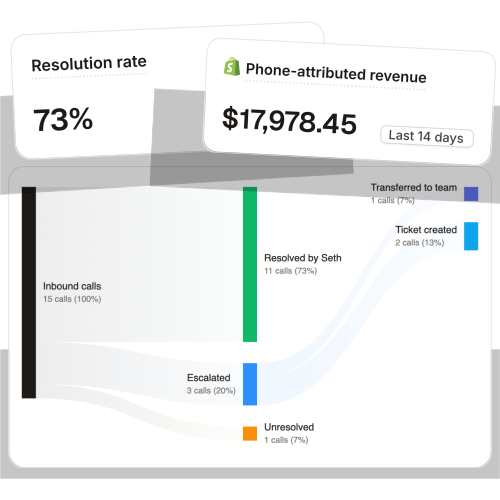
Tag each call with three things: the type (you'll define the types in step 2), whether it came in during business hours or after, and whether it needed a human to resolve. That last column is the one that pays for itself. It tells you exactly how much of your phone payroll is going to work that doesn't need a person.
Two weeks is enough to see the pattern but short enough to actually finish. If you run promotions or a recent product launch in that window, note it, because launch weeks distort the mix toward WISMO and you don't want to design your whole routing around a spike. What you're looking for is the steady-state ratio: the share that repeats, the share that lands after hours, and the share that genuinely needed a person. Most brands are surprised by how small that last number is.
If you don't have call recordings or a clean log, that's its own finding. It means you have no idea what you're missing after hours, which is the most expensive blind spot a supplement brand can have. Our rundown of ecommerce phone support best practices covers the basics of getting a clean log in place first.
Step 2: Sort every call into five types and give each one a rule
Once you've tagged two weeks of calls, they collapse into five types. Write a one-line rule for each, because the rule is what lets you decide later what a machine can handle and what your team has to.
| Call type | Typical share | Who should handle it | The rule |
|---|---|---|---|
| WISMO and shipping | 30-50% | Routine layer | Look up the order live, read the status, offer to text the tracking link |
| Auto-ship and subscription | 15-25% | Routine layer, with a save offer | Always offer pause or skip before processing a cancel |
| Ingredient, dosage, interaction | 10-20% | Split | Describe what's on the label only; escalate anything medical |
| Returns, billing, lot or expiration | 10-15% | Routine layer | Pull the order, check the lot number, follow the return policy |
| After-hours and weekend | overlaps all | Routine layer first, escalate by rule | Answer the routine ones live, take a structured message for the rest |
The one supplement brands underrate is the subscription bucket. A cancel call is not a cost, it's a retention moment, and a saved auto-ship is a recovered 12-month value. It's also a compliance surface: the FTC's push on subscription cancellation (its 2024 click-to-cancel rule, later vacated by the Eighth Circuit in 2025 but echoed by state laws like California's) set the expectation that cancelling has to be as easy as signing up. So the rule for that bucket is simple: offer a pause or a skip first, and if they still want out, make it easy. Stalling a cancel buys you a chargeback and a one-star review.
Notice the rule column does most of the work. Once a call type has a one-line rule, anyone (or anything) handling it knows the right move without improvising, and improvising is exactly where supplement support gets you in trouble. The split between "routine layer" and "split" in the table isn't about how smart the question is, it's about how much judgment it needs. A WISMO lookup needs zero judgment. A "will this help my joints" question needs you to stay on the approved side of a regulatory line, which is step 3. If you want the same five buckets explored one at a time with example scripts, our companion piece on customer service for supplement brands goes question by question.
Step 3: Write the compliance line before you write anything else
This is the step that's specific to supplements, and it's the one most brands skip until something goes wrong. Before you script a single answer, write the rule that keeps every answer legal.
It's two parts.
Describe, don't diagnose. Whoever answers the phone, a human or a machine, can describe what's on the label and use your approved structure/function language. They cannot say the product treats, cures, or prevents anything. The FDA is explicit that a dietary supplement can't make a disease claim: the moment "supports healthy sleep" becomes "cures insomnia," you've turned your supplement into an unapproved drug in the eyes of the regulator. Structure/function statements are fine, but they carry the standard disclaimer: "This statement has not been evaluated by the Food and Drug Administration. This product is not intended to diagnose, treat, cure, or prevent any disease."
Escalate anything medical, every time. A drug-interaction question ("can I take this with my blood pressure meds?"), a side-effect report, or anything that sounds like an adverse event goes to a person, with no exceptions. That's not just good service, it's tied to real adverse-event recordkeeping obligations for supplement companies.
Here's the part that surprises people. A hard-coded compliance line is safer than a tired human rep, not riskier. A rep at hour seven of a shift improvises. They want to be helpful, so they say "oh yeah, that'll help your joints." A machine that's been told it can only read the approved language physically can't drift, and it routes the medical question to your team instead of guessing. Write this rule down before you write any answer, because every other script inherits from it.
Step 4: Set the escalation rules so the right calls reach a human
Routing is where good intentions go to die. If "escalate when needed" is your whole policy, everything escalates or nothing does. Be specific about what always reaches a person.
Hard-code four escalation triggers and your team stops drowning in calls that were never theirs to take. The four that matter for supplements:
- Anything medical. Drug interactions, side effects, adverse events. Non-negotiable, per step 3.
- A genuine billing dispute or angry caller. A confused charge is routine. An accusation of fraud is a human call.
- A founder-relationship caller. Older supplement buyers often have a relationship with the brand and ask for a specific person. Route them, don't fight it.
- Anything the routine layer can't resolve in one turn. If the order lookup fails or the question is genuinely novel, hand off rather than loop.
Decide warm versus cold, too. A warm handoff (the routine layer summarizes the call and passes context) beats dumping the customer into a cold queue to repeat themselves. And split the rules by time: during business hours, escalations ring your team; after hours, they take a structured message with a callback promise instead of a dead voicemail. For the deeper version of after-hours routing, our guide on after-hours answering for ecommerce walks through the message templates.
Step 5: Staff the schedule to the call curve, not the clock
Most brands staff phone support 9-to-5 because that's when the office is open. Supplement call volume doesn't care about your office. Older subscribers call in the evening and on weekends, which is exactly when nobody's there.
A rough staffing benchmark is one full-time rep per 50-100 daily support interactions. The problem isn't the daytime number, it's the tail. A US rep costs about $4,000 a month loaded, and on an after-hours shift they're idle more than half the time because the volume isn't steady, it's bursty. You're paying full-time wages for part-time bursts, which is why the night-shift math never pencils out for a brand your size.
And the cost of not covering it is real. 85% of callers who can't reach a person never call back, and 62% switch to a competitor. For a subscription product, a missed after-hours call about an auto-ship quietly becomes a cancelled plan, and you'll never see it in your Gorgias queue because it never became a ticket.
There's a second, quieter cost. Every hire you add to chase the tail is a hire you have to recruit, train on your compliance rules, and replace when they burn out, and CS turnover is brutal in this category. The training piece is heavier for supplements than for, say, an apparel brand, because a new rep has to learn the structure/function line before they touch the phone. So the question before you post a job rec isn't "can we afford another rep," it's "does the after-hours tail actually need a person at all." That's the next step. If you want the broader retention case for answering these calls at all, our guide on customer retention best practices makes it.
Step 6: Automate the routine layer (this is where AI phone support fits)
Now the routine 70%. Steps 1 through 5 told you which calls are repeatable, what the compliance line is, and what has to escalate. That's exactly the spec for an AI phone agent: handle WISMO, auto-ship changes, label and lot questions, and routine returns; read only the approved language; escalate everything medical or disputed to your team.
You have three ways to cover this layer. Here's the honest comparison.
| Approach | Per-call cost | After-hours | Compliance handling | Time to live |
|---|---|---|---|---|
| In-house reps | ~$2.70/call loaded | needs a paid night shift | trains each rep, drift risk | hire plus 6-8 month ramp |
| Outsourced BPO | ~$1.50-$3.50/call | yes, paid | trains agents, turnover risk | a few weeks |
| AI phone layer | ~$0.91/call | always on | hard-coded, can't drift | about 14 days |
In-house gives you the most control and the highest cost, and you still can't cheaply cover nights. Outsourcing buys coverage but you're back to training humans on your compliance rules and hoping turnover doesn't undo it. Compare the two honestly in our in-house vs outsourced support breakdown, or the full Shopify customer support outsourcing guide.
The AI phone layer isn't magic, and it's worth being clear about what it's good and bad at. It's good at high-volume, rule-bound calls: order lookups, auto-ship pauses, lot-number questions, anything where the answer is in your data or your approved language. It's bad, by design, at the calls you don't want it touching anyway: medical judgment, emotional disputes, edge cases that need a human read. The whole method works because those two lists don't overlap. Steps 1 through 5 are what let you draw the line precisely, so the agent only ever handles what it should. Skip the audit and you're just bolting a tool onto chaos, which is how most failed voice deployments happen.
Where Ringly fits
Ringly is an AI phone agent built for Shopify brands. It picks up the phone, syncs with your Shopify store to look up the order live, handles the routine buckets from step 2, and follows the escalation rules from step 4. The compliance line from step 3 is hard-coded, so the agent reads your approved structure/function language and routes any medical question to a person. It does not make health claims, take phone payments for new subscriptions, or guess on anything novel.
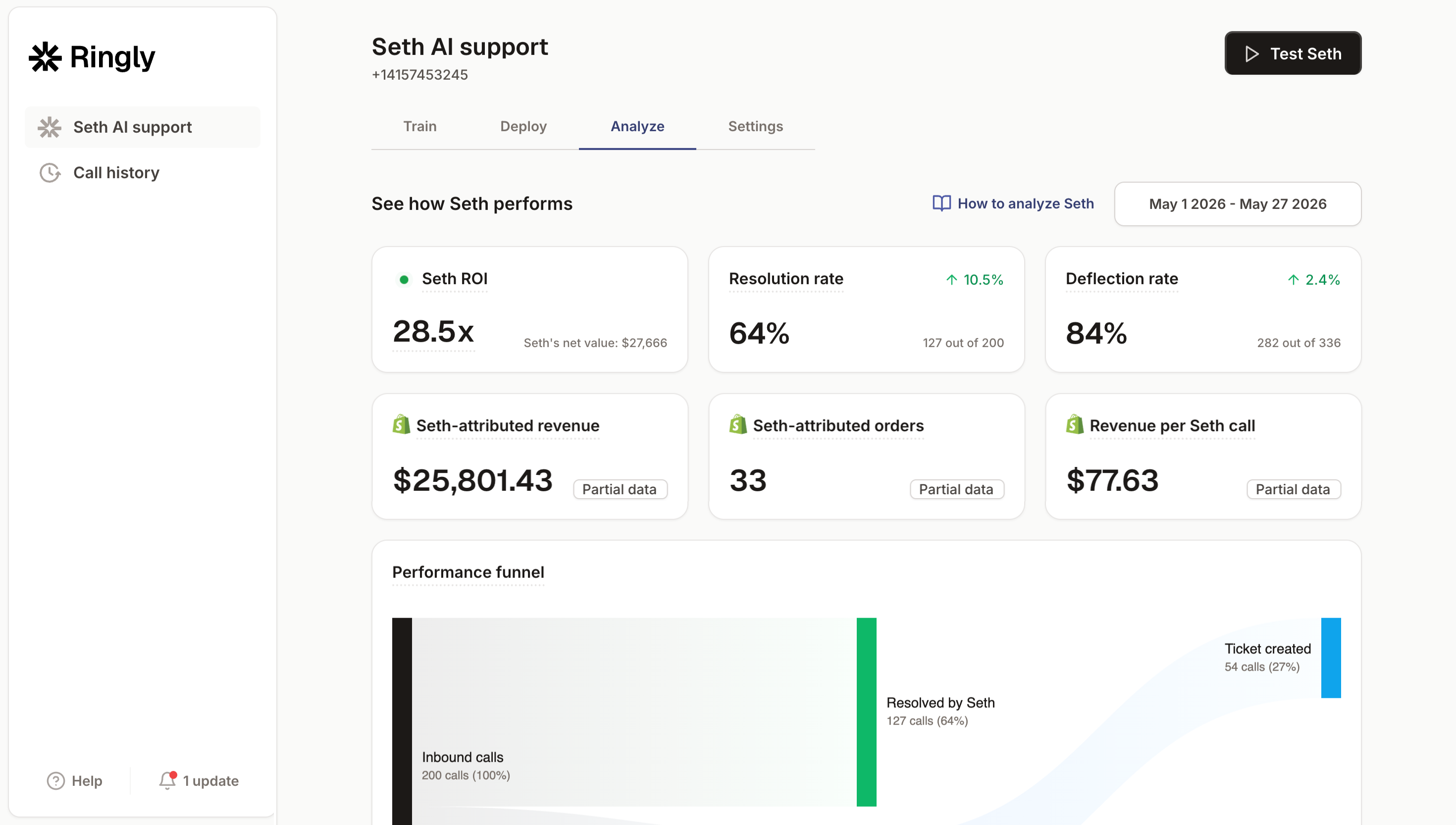
BioLongevity Labs, a supplement brand on Ringly, resolves 79% of its calls end to end without a human. The rest escalate by rule. On the question every supplement founder asks first, whether customers can tell it's not a person, here's a Ringly customer:
"My customers also feel like it's a normal person. They feel like they can communicate if they have questions."
Claudia Droge, TechCraft Studio
If you've tried a voice tool before and it felt like a phone-tree bot, that's the bar it has to clear. For the supplement-specific setup, we wrote a deeper piece on AI phone support for supplement stores and on the AI receptionist for supplement brands. And if you want the taxonomy-first version of this method, our companion post breaks down how to handle calls for a supplement brand by call bucket.
Step 7: Do the math, then measure it
Here's what the routine layer actually changes on your P&L. Take a typical $30M supplement brand running a five-rep CS team plus two part-time weekend reps to cover auto-ship calls:
| Line item | Today | With an AI phone layer |
|---|---|---|
| 5 reps x $4K loaded | $20,000/mo | n/a |
| 2 part-time weekend reps | $4,000/mo | n/a |
| AI phone layer (~$5K/mo) | n/a | $5,000/mo |
| Net monthly spend | $24,000/mo | $5,000/mo |
| Monthly savings | n/a | ~$19,000/mo |
| Annual savings | n/a | ~$228,000/yr |
That's the routine 70-80% (WISMO, auto-ship, label questions) moving to the agent, while the 20-30% that's genuinely complex still goes to your team, who now have time to actually solve it. The cost-per-call gap is the headline: about $0.91 on the verified end versus $2.70 for a loaded human rep. WashCo, a Shopify brand we launched, recovered $22,664 in its first seven days on the phone. You can sanity-check the inputs against our AI voice agent pricing breakdown.
Then measure three numbers, monthly: resolution rate (what share of calls finished without a human), after-hours answer rate (what share of evening and weekend calls got picked up live), and saved subscriptions (cancel calls that became a pause or a skip). Those three tell you whether the method is working better than any anecdote will.
If you want to see your own version of this table, book a 30-min call and we'll do the math live on your call volume.
Frequently asked questions
How many of a supplement store's calls can actually be automated? Roughly 70-80% in most brands we've measured: WISMO, auto-ship changes, label and lot questions, and routine returns. The remaining 20-30% (drug interactions, real disputes, anything medical) should always reach a person. Run the step 1 audit and you'll get your own exact split.
Can an AI phone agent legally answer supplement questions? Yes, within limits. It can describe what's on the label and read your approved structure/function language with the FDA disclaimer, but it cannot say the product treats, cures, or prevents anything. The safe setup hard-codes that rule so the agent can't drift into a health claim, which is harder to guarantee with a room full of human reps.
What should happen when a customer asks about drug interactions or side effects? That's a hard escalation to a human, every time, with no exception. Interaction and side-effect questions touch FDA adverse-event obligations, so they don't belong in any automated or scripted answer. Build the escalation trigger before you launch anything.
How do you handle subscription cancel calls without losing the customer? Offer a pause or a skip before you process the cancel, then make it easy if they still want out. Stalling a cancellation buys you a chargeback and a bad review, and it runs against the customer expectation the FTC set with click-to-cancel. A clean pause-or-skip offer saves a meaningful share of cancels, which is a recovered 12-month value on a subscription product.
Do I still need human reps if I use an AI phone agent? Yes. The point isn't to remove your team, it's to stop them answering the same WISMO and auto-ship questions all day. They take the 20-30% that's complex, emotional, or medical, which is the work they were actually hired for.
How much does it cost to handle supplement store calls? A loaded US rep runs about $4,000/month and handles calls at roughly $2.70 each; an AI phone layer runs in the low thousands per month at roughly $0.91 per call on the verified end. The real number depends on your volume. See our phone support cost calculator for a per-store estimate.
How do you cover after-hours and weekend calls? An always-on routine layer answers the repeatable calls live at any hour, and your escalation rules take a structured message (not a dead voicemail) for anything that needs a person the next morning. This matters more for supplements than most categories because older subscribers call evenings and weekends. Our 24/7 ecommerce phone support guide covers the setup.
What's the fastest way to cut WISMO calls? Two moves. Send proactive shipping updates so fewer people call to ask, and make sure whoever answers can look up the order live on the call instead of taking a message. Our breakdown of WISMO tickets goes deeper on reducing the bucket.
Talk to us

If you run a supplement brand on Shopify and the after-hours line just rolls to voicemail, a 30-minute call is the fastest way to see what those missed calls are actually worth. We'll map your call types, write your compliance line, and run the cost math on your real volume.
Our 3 promises.
- Live in under 1 hour. Setup and test calls are free.
- 30-day money back on the $99 plan fee.
- 65% resolution guarantee: if Seth resolves under 65% of your support calls in a month, that month comes back as credit (after 90 days on Pay per call).
Ruben (Ringly co-founder) takes these calls personally.