
This post in 30 seconds.
- Most of a coffee brand's phone load lands when the roastery is dark, so an AI customer support agent's first job is coverage and deflection: pick up the after-hours calls, clear the repeatable ones, and hand the rest to a person.
- The agent resolves up to 90% of inbound calls on its own, which is the routine load lifted off your team.
- Built for $10M-$100M Shopify coffee brands that keep a paid helpdesk and a visible phone line, and watch the queue back up the busier they get.
Search "AI customer support agent for coffee brands" and half the results are about the cafe on the corner: a kiosk that takes a latte order, a barista assistant, a chatbot for in-store. That is not your problem. Your problem is the phone number on your contact page, the volume that piles up after 6 p.m. and on weekends, and a support team that spends most of its day on the same handful of calls.
If you run support or operations at a Shopify coffee brand doing $10M-$100M, you already know the shape of the load: where's my order, will it still be fresh, can you move my gift's delivery, pause my subscription, which grind do I need. The question here isn't whether software can answer those. It's how much of that load an agent can actually carry off your team, how it covers the after-hours queue, and what it does with the calls it should never touch. If you'd rather see it on your own numbers, book a 30-min call and we'll pull your last week of calls and split the routine load from the escalations together.
Where a coffee brand's support load actually comes from
Two things drive most of your phone volume, and humans are badly built for both.
The first is timing. Roughly 30 to 40% of missed business calls happen outside business hours (getAira), and that skews even harder for a coffee brand whose customers run older and reach for the phone instead of a chat widget. They call in the evening, on the weekend, when the roastery is closed and nobody's at the desk. Small and mid-sized businesses miss about 62% of their calls, and 37.8% of callers land in a voicemail box (Numa). Of those, 85% never call back (PCN). That's not a service-quality gap. That's a coverage gap, and it's pure leak.
The second is repetition. A big share of the calls that do get answered are the same five things: where's my order, freshness and roast date, gift timing, subscription changes, and grind questions. Your reps know them cold, which is exactly the problem, because answering "where's my order" for the four hundredth time is work, not judgment.
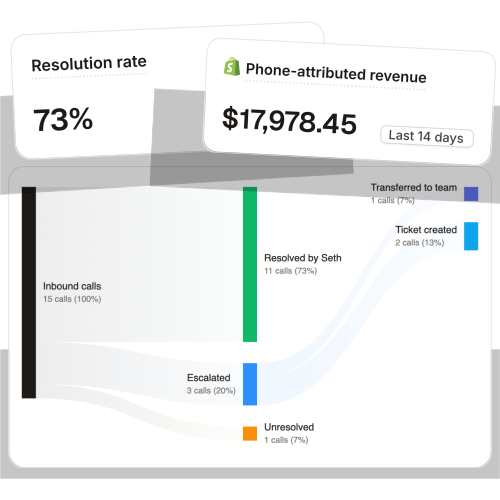
Put those together and most of your phone load is repeatable calls arriving when you're least staffed to take them. That combination is the whole case for an agent. It's always on, so the after-hours timing doesn't matter, and it never gets bored of the routine call, so the repetition doesn't wear it down. We broke down the single biggest slice of that load in the WISMO calls breakdown if you want the ticket math.
What deflection actually looks like on a coffee phone line
Deflection is a word that gets abused, so let me be plain about what it means here. It does not mean dodging the call or trapping the caller in a menu. It means the routine call gets fully resolved without pulling a person in.
On a coffee line that looks like this. A caller asks where their order is. The agent reads the live order status off your Shopify store, reads the carrier scan, and gives a real answer with the roast date and the arrival window. A caller wants to skip next month's box. The agent reads the subscription and runs the change as a defined action, so the box actually doesn't ship. A caller asks which grind for a pour-over. The agent answers from the knowledge base you already wrote. None of those needed a human, and none of them got dodged.
Gear Rider, a brand on Ringly, handled 1,595 calls in 90 days without a phone rep on the line, which is the volume of routine load an agent can carry off a team's plate in a single quarter. The agent resolves up to 90% of inbound calls on its own, for $1.99 a call after the first 50, versus the $7 to $16 a human-handled call runs at a typical BPO. The point isn't that the number is high. It's that the 73% is the boring 73%, which frees your people for the 27% that actually needs a person.
Covering the after-hours queue without staffing a night shift
The honest reason most coffee brands don't cover after-hours calls well is that the math on a human night shift is ugly. The volume is bursty. You get a cluster of evening reorders, a weekend run of gift questions, then long dead stretches. To answer it with people you pay a rep to sit idle through most of the shift, and you still miss the spikes.
The alternative most brands fall into is a queue or a voicemail box, and that leaks too. Customers don't wait. 54% of callers are gone within eight minutes on hold, and 75% hang up once they pass eight minutes (Nextiva). A voicemail box is worse, because the 85% never-call-back number kicks in. Either way the after-hours caller you spent ad money to acquire is now buying their next bag somewhere else.
An always-on agent answers on the first ring at 11 p.m. on a Sunday the same way it answers at 11 a.m. on a Tuesday, so there's no queue to abandon and no voicemail box to ignore. That's the part a night shift can't match at any reasonable cost: coverage that doesn't care what time it is. If keeping the line live around the clock is the goal, we wrote up the broader setup in 24/7 ecommerce phone support and the narrower case in after-hours answering.
Escalation handling: the calls it should never take
Here's the part the tool roundups skip, and it's the part that protects your brand. A good support agent is defined as much by the calls it refuses as the ones it closes.
Some calls have no business being handled on autopilot. A spoiled-gift complaint. A refund dispute. A customer who's angry before they finish the first sentence. Those are emotional calls, and the right move is a fast handoff to a person, with the call context already attached. You set that up by hard-coding an escalation rule with smart call transfer: anything that reads as a complaint, a dispute, or an upset caller goes straight to your team.
This is what separates an agent from the failure mode everyone fears, the phone tree that traps people in a loop. We've all heard the coffee line that says it's busy fulfilling orders and then drops the call with no option to hold. TechCraft Studio, a brand on Ringly, runs at 88% of calls handled without a human, and the other 12% is the point, not the leftover, because that 12% is where the escalation rule sends the calls a person should own.
Getting escalation right also defends recurring revenue. Coffee subscriptions are replenishment, and replenishment churn runs around 4 to 7% a month (Eightx), with DTC coffee specifically reported as high as 11% (Moriondo). A botched complaint call doesn't cost you one order. It cancels a subscription, which is twelve months of orders walking out the door.
How I tested the agent's support behavior
I'm Ruben, co-founder of Ringly. We run AI phone support for Shopify brands, so I evaluate this as the person on the hook for the support load, not a vendor running a clean demo. Before writing this I spent a few days putting our own agent through a real coffee call flow, and I tested two things specifically: how much load it actually cleared, and whether it knew when to stop.
Here's what I ran:
- Load cleared at 11 p.m. on a weekend. I called the line after midnight with the routine stack (where's my order, freshness, a grind question) and tracked how many of those it closed end to end without a human, the way the after-hours volume actually arrives.
- WISMO with a live order. I connected a test Shopify store and asked where my order was, then checked whether it read the real carrier scan or fell back to a canned "3 to 5 business days."
- Subscription skip as a real action. I asked it to skip next month's box and confirmed the box was actually paused on the store, not just acknowledged on the call.
- The escalation trip-wire. This was the real test. I deliberately fed it the calls it should never win: a spoiled-gift complaint and a refund dispute, in an annoyed tone. I wanted to see it refuse and transfer, not try to talk me down.
It cleared the routine load and, on the complaint and the dispute, it handed off to a human instead of fumbling an emotional call. That second result is the one that matters. Plenty of tools can close a WISMO call. The one worth buying is the one that knows a spoiled-gift call is not its call to win, and routes it to a person.
What after-hours coverage costs versus a seasonal team
Coffee brands can usually scrape by on the existing phone setup eleven months a year. The squeeze is November and December, when gift volume triples and the after-hours window gets busiest.
A typical $20M coffee brand staffs a small team year-round and a much bigger one for the gifting season:
| Line item | Today | With an AI agent |
|---|---|---|
| 4 reps × $4K loaded, year-round | $16,000/mo | n/a |
| 4 seasonal reps × $4K × 3 months | $48,000/yr peak | n/a |
| AI customer support agent (~$3K-$5K/mo) | n/a | ~$4,000/mo |
| True annual support spend | ~$240,000/yr | ~$48,000-$60,000/yr |
| Annual savings | n/a | ~$140,000-$180,000/yr |
The agent carries the WISMO, gift-timing, and subscription load year-round and absorbs the gifting spike at the same monthly cost it runs the rest of the year, which is the opposite of a seasonal team you hire green and pay for idle hours. On unit cost it's the same story: WashCo, a brand we launched, ran at $0.91 per call versus the $2.70 a human-handled call costs loaded. Want this run on your real call logs instead of a model brand? Book a 30-min call and we'll do the math live. The full cost breakdown lives in automated phone support cost and the published tiers are on pricing.
Setting it up so it actually reduces load
An agent that's set up badly doesn't reduce load, it adds a confused caller to your queue. Here's the order that keeps it lifting weight off your team:
- Write the knowledge base first. Roast dates, origin notes, a grind guide, shipping windows, subscription rules. The agent is only as useful as what you give it, and the routine calls live or die on this.
- Set the escalation rules early. Decide which calls always go to a human and write the rule before launch, not after the first angry caller gets stuck. Use custom actions for the subscription and order changes you want it to run.
- Connect Shopify so it reads live orders. Canned answers don't reduce load, they generate callbacks. Live order access is what makes the WISMO call a one-and-done.
- Demo the line to a skeptic. Call it yourself, then have your most AI-wary teammate try to break it. If it passes them, it'll pass your customers.
Choose an AI customer support agent if you run a Shopify coffee brand with real phone volume, a seasonal spike, and an after-hours window that currently rolls to voicemail. If more than half your revenue is genuinely phone-placed card orders, you're a different case, and you should talk to us about routing before you buy anything. The broader picture is in coffee brand customer service, the subscription angle in the coffee subscription customer service playbook, and the which-calls-to-route question in automated phone support for coffee brands.
Frequently asked questions
What's the difference between an AI customer support agent and an answering service for a coffee brand?
An answering service takes a message and a human calls back later, which still leaves the work for your team. An AI support agent resolves the routine call on the spot by reading your live Shopify order and knowledge base, and only routes the calls that genuinely need a person. For a coffee brand, that's the difference between deflecting load and just delaying it.
Can it cover after-hours and weekend calls?
Yes, that's the strongest case for it. It answers on the first ring at any hour, so the evening and weekend volume that usually rolls to voicemail gets handled instead of leaking. Around 30 to 40% of missed calls happen after hours, and 85% of voicemail callers never call back, so the coverage is where a lot of the recovered value sits.
How much of my support volume can it actually deflect?
The agent resolves up to 90% of inbound calls on its own, and that's the repeatable load: WISMO, freshness, gift timing, grind, and subscription changes. The remaining share is where your team focuses. Your real number depends on how much of your volume is routine, which we'll estimate from your call logs on a call.
What happens when a caller is angry or has a complaint?
It escalates to a human, fast, with the call context attached. You hard-code an escalation rule so anything that reads as a complaint, a refund dispute, or an upset caller transfers to your team rather than getting handled on autopilot. Escalation is a designed feature, not a failure.
Will it get stuck in a loop or trap callers like a bad phone tree?
Not if the escalation rules are set right, which is the whole point of configuring them before launch. The failure mode you're picturing, the line that drops a caller mid-queue, comes from a system with no clean handoff. A real agent resolves what it can and transfers what it can't.
Does it work with my Shopify store and helpdesk?
Yes. It reads orders, tracking, and subscriptions from Shopify, and escalations hand off cleanly to Gorgias, Richpanel, Reamaze, or whatever helpdesk you already run. You keep your current stack and your phone number, and the agent sits in front of the routine calls.
How much does it cost versus hiring seasonal reps?
Pricing starts at $99 a month for the first 50 conversations, then $1.99 each, so the bill follows your call volume. A typical coffee brand spending around $240K a year on a year-round-plus-seasonal team saves roughly $140K to $180K a year while keeping the after-hours line covered the whole time. See pricing for the published tiers.
Talk to us

If your after-hours line is a voicemail box nobody empties and your team spends its day on the same five calls, a 30-min call is the fastest way to see how much of that load you could lift and what's left for your people.
Our 3 promises.
- Live in under 1 hour. Setup and test calls are free.
- 30-day money back on the $99 plan fee.
- 65% resolution guarantee: if Seth resolves under 65% of your support calls in a month, that month comes back as credit (after 90 days on Pay per call).
Ruben (Ringly co-founder) takes these calls personally.