
This post in 30 seconds.
- Specialty food has a phone problem that the rest of your stack quietly ignores: older buyers who won't use the website, ship-by and arrives-by questions, and a gifting spike that buries your team every November.
- An AI customer support agent answers those calls 24/7, finds the order in Shopify, answers freshness and ingredient questions from your knowledge base, and hands the risky ones (spoiled-order refunds, allergen edge cases, phone orders) straight to a human.
- Built for founders, COOs, and Heads of CX at $10M-$100M Shopify specialty food brands running a paid helpdesk and a visible phone line.
Specialty food has a phone problem that the rest of your stack quietly ignores. Your customers are older than the DTC average, a good share of them won't place an order on the website, and the calls arrive in bursts right when your team is buried in fulfillment. Then November hits, gift orders triple, and the phone goes to voicemail nobody returns.
A chat widget doesn't touch this. An AI customer support agent that picks up the phone does. It takes the routine calls (where's my order, when does it ship, does this contain dairy) so your reps get their afternoons back, and it routes the calls that need a human, like a spoiled birthday cake, to your team with the context already attached.
If you run customer experience at a Shopify specialty food or gourmet brand doing $10M to $100M, you already know the gifting-season phone backlog. This is what the brands we work with do with theirs. Book a 30-min call and we'll map your call mix and your routing rules live.
Here's the quick version of what an AI support agent should and shouldn't touch for a food brand:
| Call type | AI handles it | Routes to a human |
|---|---|---|
| Where's my order, ship-by, arrives-by | Yes, pulled live from Shopify | n/a |
| Freshness, roast date, storage questions | Yes, from your knowledge base | n/a |
| Allergen or ingredient questions | Reads the labeled answer from your KB | Edge cases and "is it safe for my kid" go to a human |
| Spoiled or damaged perishable | Logs it, gathers details | Refund decision goes to your team |
| Phone order from an older customer | Sends a payment link by SMS | Or transfers to a rep if you prefer |
| Gift-delivery problem during peak | Confirms status, offers options | Reships and goodwill credits go to a human |
What calls a specialty food brand actually gets
The call mix at a food and beverage brand is more predictable than most founders expect. Order status and ship-by questions are the single biggest bucket, usually around a third of every call that comes in, and they spike past half during the holidays. That tracks with the broader pattern: order-status questions (the "where's my order," or WISMO, calls) make up 30 to 40% of support tickets in normal periods and over half at peak.
After order status, the next bucket is freshness and timing. Coffee buyers ask about the roast date. Olive oil and tea buyers ask about harvest. Everyone asks the same thing in different words: will it still be good when it gets here, and when exactly is "here." Cold-chain and perishable items raise the stakes because the answer isn't just "it shipped," it's "it shipped today so it arrives before the weekend."
Then there's the allergen and ingredient question, which is small in volume but heavy in consequence. "Does the dark roast share a line with nuts?" is not a question you want a tired rep guessing on at 6pm. And it matters more in food than almost anywhere else: undeclared allergens are the leading cause of FDA and USDA food recalls, running 26 to 34% of all cases. The answer has to come from your labeled knowledge base, word for word, or it has to go to a person.
The last two buckets are specialty-food specific. Gift orders, which pile up in November and December and come with their own anxiety about arrival dates. And phone orders from older customers who, in the words of one coffee founder we work with, "don't feel comfortable placing on the website." The specialty food category is now a $207 billion business in the US, up 149% in a decade, and a lot of that growth is older, repeat buyers who still prefer to call. That's a real revenue line sitting on hold.
What ties all of these together is timing. The calls don't arrive evenly. They come in bursts, usually right after a product drops or right when your warehouse is slammed, and the worst of them land after 6pm and on weekends when the office is empty. So the real question isn't "how many reps do we need on average." It's "who picks up at 8pm on the Saturday before a holiday," because that's the call you're actually losing. A few minutes on hold and most callers are gone: 60% hang up within the first minute, and for an older specialty-food buyer who already prefers the phone, they're not leaving a voicemail.
Why chat tools don't fix the specialty food phone problem
Most "AI support agent for food brands" tools you'll find are chatbots. They live in a website widget or WhatsApp, they answer typed questions, and for a younger audience that's fine. The food-brand chat agents on the market do real work: ingredient lookups, complaint triage, store locators.
The problem is the channel. Your specialty food customer who refuses to buy on the website is not going to open a chat window either. They're going to call. So a chat agent, however good, is solving for the customers you already reach and missing the ones who only call.
I went through the call mix across our food and beverage customers when we were building out this part of the product. Order status and ship-by was the biggest single bucket, freshness and gift-timing was next, and allergen or ingredient questions were the ones we decided to hard-route to a human every single time. None of that lives in a chat transcript, because those customers were never in the chat to begin with.
"My customers also feel like it's a normal person. They feel like they can communicate if they have questions."
Claudia Droge, TechCraft Studio
That "feels like a normal person" reaction matters more in this vertical than anywhere else, because your demographic is the most skeptical of AI on the phone. The most repeated thing customers say after talking to our agent is that it doesn't sound like AI, and with an older specialty-food audience that's the difference between a resolved call and a hang-up.
What an AI customer support agent actually does
Ringly.io is AI phone support for Shopify brands. Your team wasn't hired to answer the same ship-by question fifty times a day, especially not in December. Instead of adding seasonal reps every time call volume climbs, the AI takes the routine inbound calls so your team can handle the ones that actually need judgment.
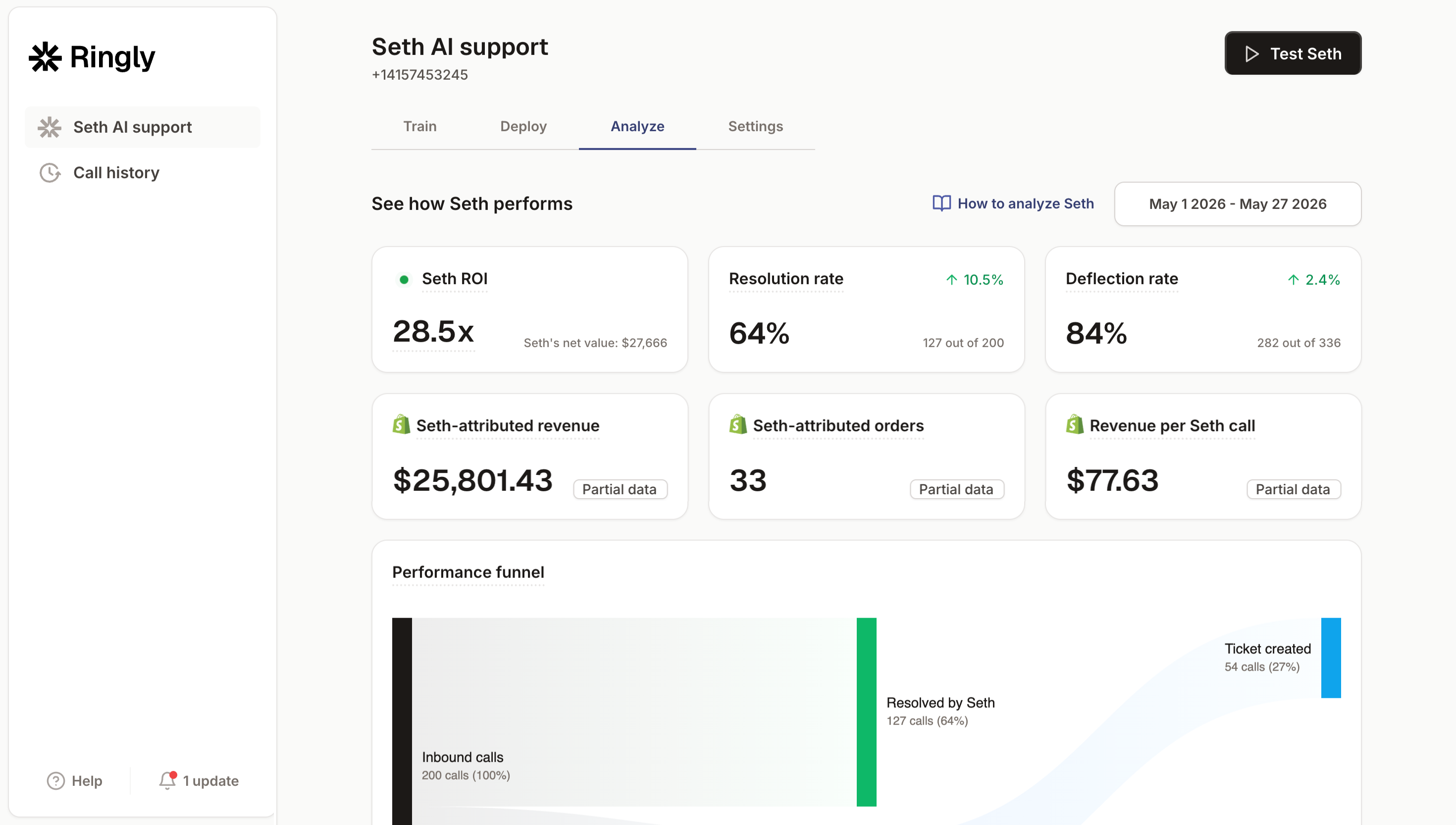
The agent answers inbound calls 24/7 in 40 languages. It finds orders in your Shopify store, processes returns and exchanges, answers product questions from your knowledge base, and cancels orders when a caller asks. It resolves up to 90% of calls on its own for $1.99 a call after the first 50, versus $7 to $16 per call at a human call center. Calls that need a person escalate cleanly to Gorgias, Richpanel, Reamaze, or whatever helpdesk you already run. You decide what escalates.
Best for: $10M-$100M Shopify specialty food, coffee, tea, and gourmet brands with a visible phone number and a paid helpdesk. Gear Rider, a Ringly customer, handled 1,595 sales calls in 90 days without a phone rep, which is the volume shape a lot of gift-heavy food brands hit at peak.
Pricing. Pay per call: $99 a month for the first 50 conversations, then $1.99 each. Free to try. Live in under an hour. There's a 65% resolution guarantee: if Seth resolves under 65% of your calls in a month, that month comes back as credit (after 90 days on Pay per call).
What works well for food brands
- Live order data: it reads ship-by and arrives-by straight from Shopify, so the biggest call bucket is fully automated.
- Knowledge-base answers: roast dates, storage, and labeled ingredient info come from your docs, not from a guess.
- Hard escalation rules: you set the calls that always go to a human (spoilage refunds, allergen edge cases, phone orders).
- Seasonal absorption: it doesn't blink at a December spike, so you stop hiring temps you'll let go in January.
What it doesn't do
- Take phone orders natively: it sends an SMS payment link or transfers to a rep instead (more on this below).
- Make refund or goodwill calls on perishables: those route to your team by design.
Handling allergens, freshness, and the calls AI should never wing
Food is different from selling phone cases. A wrong answer about a tracking number is an annoyance. A wrong answer about whether a product contains peanuts is a safety problem and, increasingly, a recall problem. There were more than 400 FDA food recalls in 2025, and undeclared allergens were a leading driver.
So the rule we build for every food brand is simple: the agent answers ingredient and allergen questions only from your labeled, approved knowledge base, in the exact language you've cleared. Anything outside that, like "is this safe for my kid with a tree-nut allergy," gets handed to a human with the question and the customer's order already attached. No improvising.
Spoiled and damaged perishables work the same way. A spoiled birthday cake is an emotional call, not a routine one, and it should never be resolved by a script. The agent logs the issue, gathers the order details and photos if you collect them, and routes the refund or reship decision to your team. Your reps spend their time on the calls that actually need a human, not on reading tracking numbers aloud.
Phone orders are the third one. Specialty food has the strongest phone-ordering demand of any vertical we serve, and we're honest that we don't take orders natively. The agent either sends a secure payment link by SMS so the customer can finish on their phone, or it transfers to a rep if you'd rather keep that human. Either way the call gets answered instead of rolling to voicemail.
What this costs vs a seasonal CS team
Here's the math for a typical $20M specialty food brand. You run a small team year-round and a much bigger one for the gifting season.
| Line item | Cost |
|---|---|
| 4 reps × $4K loaded, year-round | $16,000/mo ($192K/yr) |
| 4 seasonal reps × $4K × 3 months | $48,000/yr at peak |
| True annual CS spend | ~$240,000/yr |
An AI customer support agent at roughly $3K-$5K/mo handles the roast-date, ship-by, and gift-order questions year-round and absorbs the November spike without the temp hiring. Net savings land around $140K to $180K a year depending on volume, and the gifting-season experience gets better, not worse, because nobody's calling a voicemail box.
The savings aren't only on payroll. Every after-hours gift call you currently miss is a recoverable order. WashCo, a Shopify brand we launched, recovered $22,664 in attributed revenue in its first 7 days on the phone. For a gift-heavy food brand, the calls you're dropping in December are the ones worth the most.
If you're sizing this against your own seasonal hiring plan, book a 30-min call and we'll do the math against your real call volume.
How to set it up for your store
Setup is faster than most founders expect, because the agent learns from material you already have.
- Point it at your site and docs. It builds its knowledge base from your existing product pages, FAQ, and shipping policy. No new content to write.
- Set your escalation rules. You decide, in plain language, which calls always go to a human: allergen edge cases, spoilage refunds, phone orders, anything you want.
- Connect Shopify and your helpdesk. Order lookups go live, and handoffs flow into Gorgias or whatever helpdesk you already run.
- Forward your number. Keep your existing phone number and forward it. Customers never notice a change except that someone finally picks up.
You can be live in under an hour on a self-serve plan. We can also do the build for you, live in under 1 hour. You stay in control of every escalation rule the whole way.
Frequently asked questions
Can an AI agent take phone orders for my food brand? Not natively. When a customer calls to order, the agent sends a secure payment link by SMS so they can finish on their phone, or it transfers to one of your reps. The call gets answered either way instead of going to voicemail.
Will older customers accept an AI on the phone? This is the most common worry in specialty food, and voice quality is the answer. The most repeated thing customers say after a call is that it doesn't sound like AI. The best test is to hear it yourself on a call.
How does it handle allergen or ingredient questions? It answers only from your labeled, approved knowledge base, in the exact wording you've cleared. Anything outside that, like a specific allergy-safety judgment, routes to a human with the order and question attached. It never improvises on food safety.
Does it work with Gorgias or my current helpdesk? Yes. Calls that need a person escalate cleanly into Gorgias, Richpanel, Reamaze, or whatever you already run. You control what escalates and what doesn't.
How much does it cost? Pricing is $99 a month for the first 50 conversations, then $1.99 each. Free to try. There's a 65% resolution guarantee: a month under 65% comes back as credit (after 90 days on Pay per call).
What happens to spoiled-order and refund calls? The agent gathers the order details and any photos, then routes the refund or reship decision to your team. Emotional and money-back calls are handled by a person on purpose.
How fast can it go live? Under an hour on a self-serve plan once you connect your store and docs. We can also handle the build for you, live in under 1 hour.
Talk to us

If you run a $10M-$100M Shopify specialty food brand and you're losing gift-season and after-hours calls to voicemail, a 30-min call is the fastest way to see exactly what that's costing you.
Our 3 promises.
- Live in under 1 hour. Setup and test calls are free.
- 30-day money back on the $99 plan fee.
- 65% resolution guarantee: if Seth resolves under 65% of your support calls in a month, that month comes back as credit (after 90 days on Pay per call).
Ruben (Ringly co-founder) takes these calls personally.