
Search "AI for pet food brands" and you get a wall of chat widgets. Bubble in the corner of the site, deflects a question, links to an FAQ. That's not the thing most pet food operators actually need help with. The thing that's bleeding you is the phone, after 6pm, when a customer calls to cancel their autoship and nobody picks up.
If you run a $10M-$100M Shopify pet food brand, you know the shape of it. A small CS team that's fine Monday to Friday, weekends that go to voicemail, and a recurring fear that the calls you're dropping are the ones worth the most. An AI customer support agent is built for exactly that gap, but only if it answers the phone, not just chat. If you want to see what your own missed calls look like, book a 30-min call and we'll pull your last week of dropped calls live.
Most pet food brands we talk to run a 3-5 person support team plus a phone line that turns into a voicemail box every evening. The autoship-cancel calls, the "is this safe for my dog" calls, the recall-week panic calls, all of it stacks up. This guide is for that operator, and the reason a chatbot won't fix it is simple: those calls are spoken, urgent, and emotional. Book a 30-min call and we'll map which of your calls an AI agent should take and which should always go to a person.
What an AI customer support agent actually is, for a pet food brand
An AI customer support agent answers your pet food brand's phone line, understands the caller, takes action in your systems, and either resolves the call or hands it to a human. That last part is the whole game. A chatbot pattern-matches text and points the customer at a help article. An agent does the thing: it finds the order in Shopify, modifies the autoship, processes the return, then logs it in your helpdesk.
The cleanest way to think about the difference comes from a 2026 RingCentral breakdown of voice agents versus chatbots: chatbots deflect, agents resolve. A deflection is a customer being sent somewhere else. A resolution is the customer hanging up with their problem actually solved.
For a pet food brand, the agent that matters is the one that picks up the phone, because that's the channel your most valuable calls come in on. Ringly.io is AI phone support for Shopify brands. The AI resolves 73% of inbound calls autonomously across 50+ brands, so you can keep the phone line live without staffing a night shift.
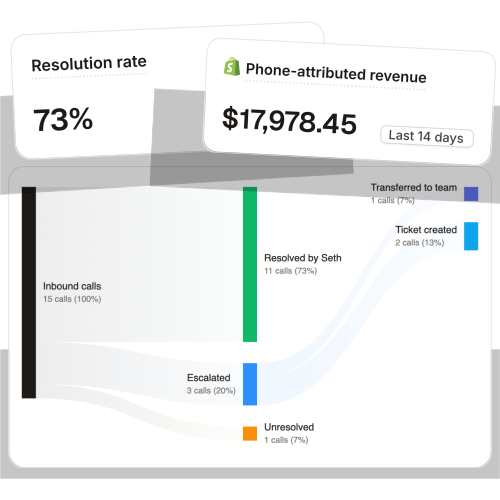
Here's what the agent actually does on a pet food call, end to end. It answers in your brand's voice. It pulls up the caller by phone number or order. It can check order status, change a subscription, swap a recipe, answer a product question from your knowledge base, and when the call needs a human, it transfers cleanly with the context attached. It doesn't replace your team. It takes the routine 80% so your reps can be present on the 20% that need them.
The six pet food calls it handles, and the one it shouldn't
Pet food support isn't generic ecommerce support. The calls are their own species. Here's how an AI agent handles the six that make up most of your volume, and the one it should never try to handle alone.
| Call type | What the agent does | Escalate to a human? |
|---|---|---|
| Autoship cancel | Offers pause, skip, frequency change, recipe swap before processing | Only if the customer insists after options |
| Recipe / frequency swap | Updates the subscription live in Shopify | No |
| Feeding / allergy question | Answers from product data ("contains chicken", "grain-free") | Yes if it crosses into health advice |
| Recall worry | Checks the lot against the recall notice, gives the official line | Yes for distressed or medical follow-up |
| Where's my order (WISMO) | Looks up the order, gives tracking, flags perishable delays | No |
| Grief / sick pet | Recognizes the trigger words and warm-transfers immediately | Always |
Let me walk the ones that matter most.
The autoship cancel is your single highest-value call. Autoship runs up to 80% of sales at the leading pet platforms, and the cancel call decides whether a customer buys 8 to 18 more orders or walks. Industry data puts online pet-retailer churn around 18%, with roughly 30% of that traced to poor post-purchase support. An agent that's awake at 9pm to offer a one-month pause or a recipe swap saves orders a voicemail box never will.
Then there's the recall-week spike. DTC pet food sees recall events three to eight times a year. Just in the last stretch there was the Raaw Energy frozen-raw recall over Listeria and a Farmina mislabeling recall of more than 8,000 bags. When a recall hits, frightened pet parents all call at once, and a human-only team drowns. An always-on agent absorbs the surge: it checks the caller's lot number against the notice, reads the official guidance, and routes anyone distressed to a person.
The line the agent will not cross is the emotional call. A customer whose dog is sick, or who just lost a pet, gets a human, every time, by a hard-coded rule. This is where the "we handle the routine so your people can be present for the rest" idea earns its keep. The agent isn't there to be compassionate about grief. It's there to make sure your team has the room to be.
I wanted to see how bad the gap really is, so I called the published phone lines of six DTC pet food brands on a Sunday night. Four went straight to voicemail, one sat me on a 9-minute hold, and one just rang out. Every one of those was a customer the brand will probably never hear from again, since 85% of callers who can't reach a person don't call back and 62% switch to a competitor.
TechCraft, a Ringly customer, handles 88% of calls without a person. The remaining calls, the ones that actually need judgment, land with their team already briefed.
If you want the full operational breakdown of these call families, our customer service playbook for pet food brands goes deeper on protocols and staffing, and the pet food brand phone support guide covers the missed-call math.
Phone agent vs chatbot: why the channel matters for pet parents
Almost every "AI for pet brands" product you'll find is a chatbot. Type a question, get a link. That's fine for "what are your shipping cutoffs." It's the wrong tool for the calls that actually drive your retention.
Pet parents call instead of typing for a reason. The call is usually urgent (a delayed frozen order), emotional (a sick pet), or high-stakes (cancel the whole subscription). A chatbot meets that moment with a deflection. A phone agent meets it with a resolution and, when needed, a warm human handoff.
| Channel | What it does | Pet food fit |
|---|---|---|
| Chat widget | Deflects to articles, collects tickets | Pre-sale questions, low-stakes WISMO |
| Email / help desk | Async, slow on time-sensitive issues | Documentation, follow-ups |
| AI phone agent | Resolves live, takes action, escalates voice | Autoship saves, recalls, urgent calls |
Phone wins for pet food because 92% of pet owners say fast response time is "very important" when they choose where to buy, and on the phone "fast" means picking up, not pinging back tomorrow. A chatbot can't pick up. An agent can.
This isn't an argument against chat. Run the chat widget for browse-stage questions. Just don't let it be the only thing standing between a panicked recall-week caller and your brand. If you're weighing the two, our ecommerce phone support breakdown lays out where each channel earns its place, and the pets industry page shows how brands route calls.
What to look for in an AI support agent for a pet food brand
Not every AI agent is built for the way pet food support actually runs. When you're evaluating one, here's what separates a real fit from a demo that falls apart in week two.
Choose an agent that:
- Connects natively to Shopify. It should pull the customer and order without a custom build, and write changes back. Order status lookup is the baseline.
- Modifies subscriptions live. Pause, skip, frequency, recipe swap. This is where the autoship-cancel save happens, so custom actions matter more here than in most verticals.
- Has hard escalation rules. Grief and sick-pet trigger words must force a warm transfer to a human, not a best-effort guess.
- Handles recall surges. When volume spikes 5x in an afternoon, the agent shouldn't degrade. That's the whole point of not staffing for the worst day.
- Keeps your stack. It should sit in front of Gorgias, Richpanel, or Re:amaze, not ask you to rip them out.
- Sounds human. The most repeated thing customers say after talking to a good one is "you don't sound like AI." Ask for a demo number and call it yourself.
- Is built for you, not by you. A done-for-you build means your team isn't the implementation crew.
Now the honest limits, because no agent does everything. It won't give feeding or health advice, by design, since that's a vet's job and a compliance line you don't want to cross. It's weak at taking full orders over the phone (an SMS payment link is the usual workaround). And inventory typically refreshes daily, not in real time, so a "do you have this in stock right this second" call still has a small lag.
What it costs vs a weekend pet food CS team
Pet food brands don't get steady high call volume. They get weekend spikes and emotionally heavy calls, which is the hardest pattern to staff. Here's what a typical $20M brand spends trying to cover it.
- 3 weekday reps × $4,000 loaded = $12,000/mo
- 1 weekend rep × $4,000 loaded = $4,000/mo
- Total: $16,000/mo, and weekends are still understaffed
An AI phone agent at roughly $3,000 to $5,000/mo handles the WISMO, subscription, and routine product calls, while the emotional ones escalate to your team through a hard handoff rule. TechCraft, a Ringly customer, hits 88% deflection on routine calls. Net savings land around $11,000/mo, or about $132,000/yr, and your weekend callers stop hitting voicemail.
The math rarely turns on the price of the agent. It turns on what one saved autoship is worth, multiplied by the cancel calls you're currently sending to voicemail. WashCo, a Shopify brand we launched, recovered $22,664 in attributed revenue in its first 7 days on the phone. That's the side of the ledger most teams never count.
If you want to run these numbers against your real call volume, book a 30-min call and we'll do the math live. You can also see how brands cut spend in our Shopify support cost reduction breakdown, or how the agent fits in the AI customer support phone agent for Shopify overview. Pricing is on the pricing page.
Frequently asked questions
What is an AI customer support agent for a pet food brand? It's software that answers your phone line, understands the caller, and takes action in Shopify and your helpdesk. For pet food specifically, it handles autoship changes, order status, recall lookups, and product questions, then escalates the emotional or medical calls to a human.
Can it handle autoship cancellations and recipe swaps? Yes. It can offer a pause, skip, frequency change, or recipe swap before processing a cancel, and update the subscription live in Shopify. That cancel call is your highest-value support moment, so it's the one worth getting right.
Will it give feeding or health advice? No. It answers factual product questions ("does this contain chicken") from your data, but anything that crosses into health or veterinary advice is handed to a person. That boundary is set on purpose.
What happens on a grief or sick-pet call? Trigger words like a sick or lost pet force an immediate warm transfer to your team. The agent isn't there to handle those calls. It's there to keep your reps free so they can.
Is this just a chatbot? No. A chatbot deflects text questions to articles. A phone agent picks up the call, resolves it, takes action in your systems, and escalates by voice when needed. For pet food, where the high-stakes calls come in by phone, that difference is the whole point.
How is it different from our current helpdesk? It sits in front of Gorgias, Richpanel, or Re:amaze rather than replacing them. The agent handles the call, then logs and escalates into the helpdesk your team already uses, so you keep your workflows.
Is it worth it if our call volume is low? Often yes, because pet food value isn't in volume, it's in which calls you catch. One saved autoship can be worth a year of subscription revenue, and after-hours coverage costs you nothing in headcount.
How fast can we go live? Live in under an hour for the self-serve plans. Add your website, docs, and knowledge base, and the agent is ready to take calls.
Talk to us

If you run a pet food brand on Shopify and your weekend calls are hitting voicemail, a 30-min call is the fastest way to see what those missed calls are costing you. We'll pull your real call patterns and show you which ones an AI agent should take and which should always go to a person.
The 3-layer guarantee.
- Live in 14 days or it's free until launched.
- 65% resolution in 90 days or we refund the last 3 months of subscription fees.
- We keep working free until we hit 65%.
Ruben (Ringly co-founder) takes these calls personally.