
This post in 30 seconds.
- Four of the five calls a coffee brand gets never need a human, and automating them in the right order is the whole game.
- The trigger to set this up usually isn't the after-hours gap. It's the November-December gifting spike, when call volume triples and a missed ship-by question costs you a sale and a gift recipient.
- Built for $10M-$100M Shopify coffee and specialty-food brands running a paid helpdesk with a phone number on the site.
Coffee is one of the few ecommerce categories where the phone never went quiet. A real slice of specialty-coffee revenue comes from older buyers who would rather call than fight a checkout form, plus the product is perishable, often gifted, and easy to get anxious about. So people call to ask when their beans were roasted, whether a gift will land by the 24th, and how to skip next month's subscription. Most of those calls hit voicemail after 5 p.m., and only 37.8% of inbound business calls ever reach a live person in the first place.
If you run customer experience or operations at a Shopify coffee or specialty-food brand doing $10M-$100M, you already know the seasonal spike I'm talking about. The point of this piece is the build order, not the pitch: which call types to automate first, what stays with your CS team, and how the routing actually works. We run AI phone agents for 50+ Shopify brands, and you can book a 30-min call if you want us to map your own call mix before December.
What actually rings a coffee brand's phone
I read a week of call logs from coffee roasters doing real volume, and the same handful of questions kept repeating. They cluster into five patterns, and four of them are pure routine. Across our 50+ brands the AI resolves 73% of inbound calls on its own, which tracks with the 60-70% of e-commerce calls that are standardized and the 20-40% that are pure "where's my order", climbing past 50% at peak.
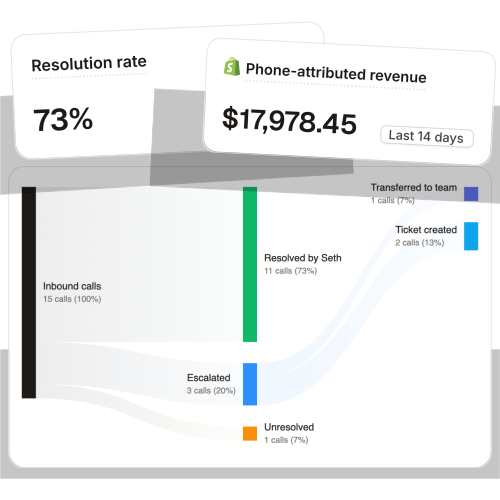
Here are the five buckets:
- WISMO and ship-by. "Where is my order, and will it arrive before the weekend?" This is the biggest pile, and it gets worse during gifting season because the deadline is fixed. A WISMO call is just an order lookup and a tracking link read out loud.
- Roast date and freshness. "When was this roasted?" and "is it still good?" These are real to coffee buyers in a way they aren't to most categories, and the answer lives in your product data or knowledge base.
- Subscription pause, skip, and swap. "Skip next month," "switch me to decaf," "move my ship date." Recurring revenue calls that a check-order-status flow plus a subscription action can handle without a rep.
- Product and brew questions. "Which roast is closest to the one I ran out of?" "Grind for a French press?" Knowledge-base answers, every time.
- The emotional or complex call. A gift that arrived spoiled, a grief gift, a wholesale account question. This is the one bucket that should always go to a human.
The first four buckets are 70-80% of the phone, and not one of them needs a person to pick up. The fifth is the reason you keep a team at all. The mistake brands make is staffing all five the same way, which means they pay reps to read tracking numbers and then run short on the calls that actually need empathy.
The freshness questions are the tell that this is coffee and not a generic store. A buyer who pays for single-origin beans cares about the roast date the way a wine buyer cares about the vintage, and a vague answer reads as a red flag. That's also why the volume holds up in December: 96% of shoppers track their orders when tracking is available, and a third of them check daily, which means the same anxious caller may dial twice before the box lands. A human team eats that repeat volume. The AI doesn't mind it.
The build order: which call to automate first
You don't automate everything on day one. You automate in the order of volume times simplicity, because that's where the payback shows up fastest and the failure risk is lowest. Here's the sequence I'd run for a coffee brand.
| Order | Call type | Share of volume | Automate? | How it resolves |
|---|---|---|---|---|
| 1 | WISMO / ship-by | 25-40% | Yes, first | Order lookup + tracking link texted to the caller |
| 2 | Roast date / freshness | 10-15% | Yes | Product data or knowledge-base answer |
| 3 | Subscription pause / skip / swap | 10-20% | Yes | Subscription action on the account |
| 4 | Product / brew questions | 10-15% | Yes | Knowledge-base answer |
| 5 | Emotional / wholesale / new order | 15-25% | No, route to a human | Smart transfer to your CS team |
Start with WISMO. It's the largest bucket, the script is the simplest, and it's the call your customers are most anxious about during the gifting rush. A WISMO answer is mechanical: look up the order, read the status, text the tracking link, done. There's almost no judgment in it, which is exactly why it's the safest place to start and the fastest to show a return. Get that resolving cleanly, listen to a few transcripts, and tune the edge cases before you add the next type.
Roast-date and freshness go second because the answer is deterministic once your knowledge base is loaded. Subscriptions third, since they touch billing and you want the WISMO flow proven first. Product questions fourth. By the time you're four layers in, the phone is mostly handling itself and your reps are back on the calls that move loyalty.
A note on why order matters and not just coverage. Every new automation type you add is a new set of edge cases to tune, and tuning one type at a time keeps the failure surface small. Turn on all five at once and you can't tell which flow is misfiring when a caller gets a wrong answer. Turn them on in sequence and each layer is proven before the next goes live. This is the same logic behind WISMO automation on Shopify: the highest-volume, lowest-risk flow earns its place first, then you expand. It's also why the after-hours win is almost a side effect. Once WISMO is automated, the 5 p.m. cutoff stops mattering, because the call that used to roll to voicemail now just gets answered.
Want us to sketch this build order against your real call mix? Book a 30-min call and we'll do it live.
What to keep human, and why naming it matters
Automating the routine four only works if the fifth bucket is handled with care. A late gift, a spoiled bag, a customer ordering beans for a parent who just passed. Trustpilot is full of coffee brands that fumbled exactly these moments, including one big roaster whose automated message told callers it was busy and then disconnected the call. That's the outcome you're trying to avoid, not create.
So the routing has to be explicit. Smart call transfer sends emotional, wholesale, and brand-new-order calls straight to your team, and everything else stays automated. You set the rules: a caller who mentions a refund on a gift, or who asks for the wholesale desk, or whose order lookup comes back as a problem rather than a tracking number, gets a human. The rest resolve on the line.
On phone orders specifically, the AI doesn't take a card number on the call. It either transfers to a rep or texts a payment link so the customer finishes checkout on their phone. That's the honest reframe for the "can it take orders" question your older callers will ask. It's a known limit, and saying so on the first call builds more trust than pretending the gap isn't there. If most of your revenue actually comes in as phone orders, call automation isn't your fit yet, and we'll tell you that on the call rather than after.
The voice quality is what makes this safe in a vertical full of skeptical, older customers. The single most repeated thing buyers say after a call is that it doesn't feel like AI. If you've ever lost a long-time customer because a missed call went to voicemail, you already know the stakes: 80% of callers who hit voicemail hang up without leaving a message, and a big share of those never try again.
"My customers also feel like it's a normal person. They feel like they can communicate if they have questions."
Claudia Droge, TechCraft Studio
Keep the calls that need a human, automate the ones that don't, and make the handoff a hard rule rather than a hope. That line is the difference between an automation your customers trust and one they screenshot.
How Ringly runs coffee-brand call automation
Ringly.io is AI phone support for Shopify brands. The phone shouldn't be a tax on your support team, and during the gifting spike it becomes exactly that if every WISMO call ties up a rep.
The AI answers inbound calls 24/7. It finds orders in your Shopify store, confirms roast and ship dates, handles subscription changes, answers product questions from your knowledge base, and texts tracking links. Calls that need a human escalate cleanly to Gorgias, Richpanel, Reamaze, or whatever helpdesk you already run, using smart call transfer. You keep your number, your stack, and the calls you want your people on.
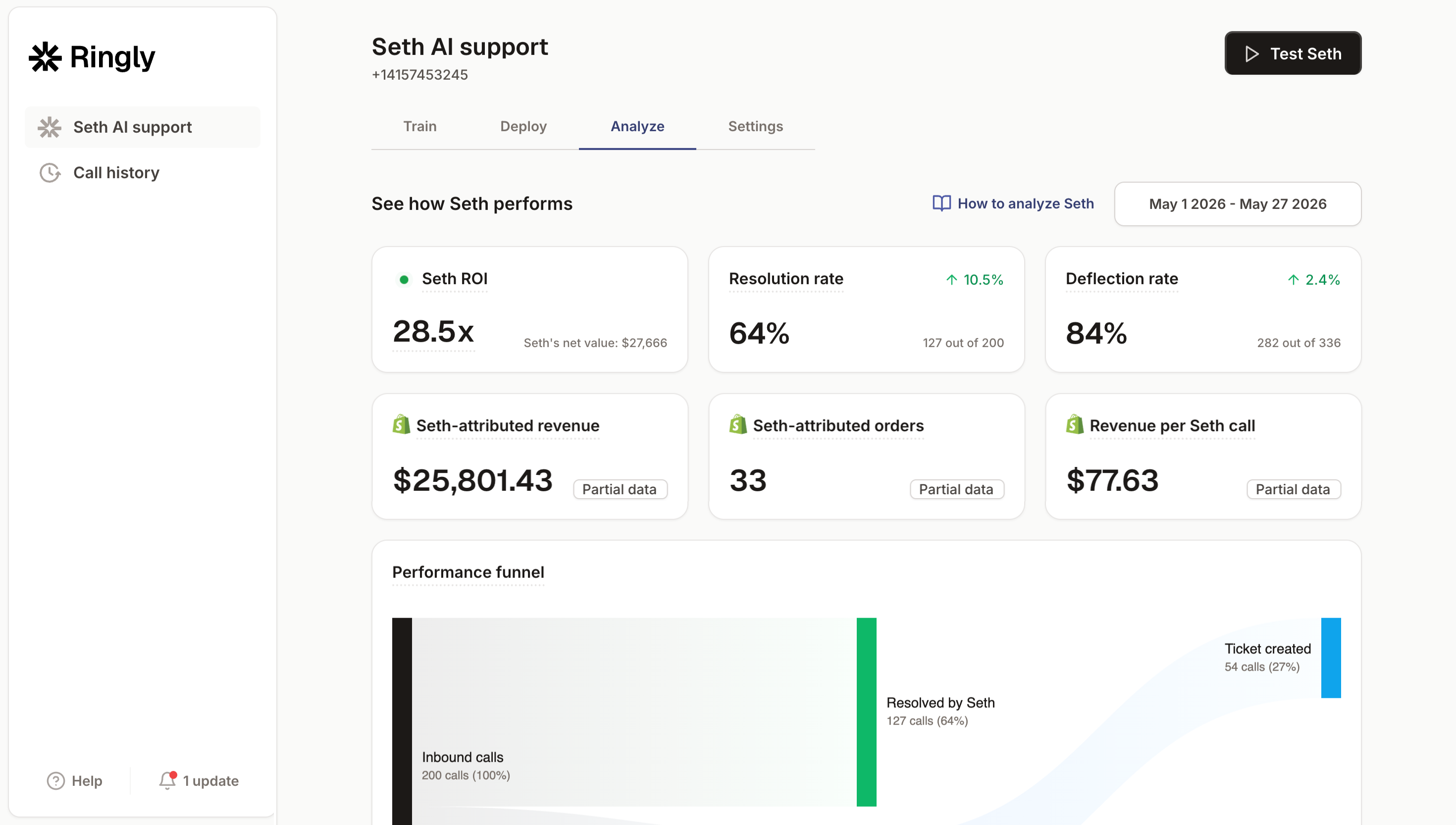
Across 50+ brands the AI resolves 73% of calls autonomously at roughly $0.42 per resolved call. Gear Rider, a specialty brand on Ringly, handled 1,595 sales and support calls in 90 days without a phone rep. Plans run Grow at $349/mo and Pro at $799/mo, with Enterprise scoped on a call. Live in under an hour, backed by a 65% resolution guarantee. If you want the deeper version, our writeups on coffee-brand phone support, AI for coffee-brand customer service, and voice AI for coffee-brand customer service walk through the same automation from different angles.
What this costs versus a seasonal phone team
The math is where coffee brands stop debating. Specialty food and coffee brands run a small team year-round and a much bigger one for the Nov-Dec gifting rush, and gifting is now a primary acquisition channel for coffee subscriptions, so the spike isn't going away.
Take a typical $20M specialty coffee brand:
| Line item | Today | With call automation |
|---|---|---|
| 4 reps x $4K loaded year-round | $16,000/mo ($192K/yr) | n/a |
| 4 seasonal reps x $4K x 3 months | $48,000/yr peak | n/a |
| AI call automation (~$3K-$5K/mo) | n/a | $36,000-$60,000/yr |
| True annual CS spend | ~$240,000/yr | net savings ~$140K-$180K/yr |
The seasonal pattern is the real reason to set this up. A human team has to be hired and trained for December and paid down the rest of the year, and the 62% of unanswered callers who go to a competitor don't wait around for you to staff up. The AI absorbs the same spike at the same cost it runs in February. On a per-call basis it's not close either: human voice support runs roughly $9-$16 per resolved contact, and the AI resolves the routine four at a fraction of that. If you're still weighing the broader case for picking up the phone at all, our ecommerce customer service guide covers the channel mix, and the pricing page has the self-serve plans.
That's roughly 70-80% of repeatable calls routed to the AI. The genuinely complex 20-30% still go to your team, who now have the time to actually solve them. If you want the numbers run against your store, book a 30-min call and we'll do the math with your real volume.
Frequently asked questions
Can call automation take orders over the phone for a coffee brand? Not by taking a card number on the call. The AI either transfers a new-order call to a rep or texts a payment link so the customer checks out on their phone. For older callers who only want to reorder a regular bag, the transfer keeps the human touch where it matters.
Will older coffee customers know they're talking to AI? The most common thing customers say after a call is that it doesn't sound like AI. Voice quality is the whole battle in this vertical, which is why we hand prospects a live number to hear it before they commit.
Which coffee customer calls should I automate first? WISMO and ship-by questions, because they're the highest volume and the simplest script. Add roast-date and freshness next, then subscription changes, then product and brew questions. Keep emotional, wholesale, and brand-new-order calls with your team.
Does coffee call automation work with Shopify and my helpdesk? Yes. It reads orders from your Shopify store and escalates to Gorgias, Richpanel, Reamaze, or whatever you run today. You keep your current phone number and workflows. See our notes on Shopify Plus customer service for the integration detail.
How does it handle the December gifting rush? It absorbs the spike at the same cost it runs the rest of the year, so you don't hire and train a seasonal phone team. WISMO and ship-by deadline calls, the ones that triple in December, are exactly the calls it handles best. See 24/7 ecommerce phone support for how the coverage works.
How fast can it go live? Live in under an hour. You add your website, docs, or knowledge base and the AI is ready to answer. A full tune-up for the edge cases takes a few days of listening to real calls.
Is there a guarantee? Yes. If the AI resolves under 65% of your calls in 90 days, we refund the last 3 months of subscription fees.
Talk to us

If you run a Shopify coffee or specialty-food brand and the phone goes quiet after 5 p.m., a 30-minute call is the fastest way to see what December is actually costing you. We'll map your call mix, show you the build order for your store, and run the numbers live.
The 3-layer guarantee.
- Live in 14 days or it's free until launched.
- 65% resolution in 90 days or we refund the last 3 months of subscription fees.
- We keep working free until we hit 65%.
Ruben (Ringly co-founder) takes these calls personally.