
This post in 30 seconds.
- The real choice was never automation or humans. It's which call goes to which.
- About 70% of a typical Shopify store's calls are repeatable (where's my order, order status, hours, simple changes). The other 30% need a person.
- The decision table below maps every common call type to automation, human, or either, with the reason for each.
Most of the "call automation vs human agents" debate gets framed as a swap. Pull the humans, drop in the AI, count the savings. That's the wrong question, and it's why so many AI phone projects fall over in the first month.
If you run support at a $10M-$100M Shopify brand with a visible phone number, a paid helpdesk, and 3 to 12 reps, you already know your call line splits itself into two piles. The same questions over and over, and the handful that actually need judgment. The decision isn't which pile to keep. It's how to route each one. When I sort a store's last 30 days of calls by type, the same six or seven questions are usually around 70% of the volume, and it climbs past 80% for brands with an older customer base. If your phone goes to voicemail after 6 p.m. and your reps spend their mornings reading tracking numbers off a screen, book a 30-min call and we'll sort your own call log into those piles with you.
Stop asking "automation or humans." Ask "which calls."
The binary framing assumes every call is the same. It isn't. A customer asking "where's my order" and a customer calling because their package arrived broken and they're furious are two completely different jobs. One is a lookup. The other needs a person who can read tone and make a call.
The smartest move isn't picking a side, it's matching each call type to whoever handles it best. Automation takes the lookups. Your team takes the judgment calls. Nobody's competing for the same work.
The data backs this split. AI now resolves up to 80% of routine inquiries and contains 70 to 80% of basic Tier-1 questions on its own, according to CloudTalk's 2026 comparison. At the same time, Metrigy's 2025-26 CX study found 84.7% of customers prefer a human for the hard stuff, and 80.1% still want a human even when they're told the AI would resolve their issue. Both things are true at once. The routine calls don't need a human. The hard calls really do.
So the brands getting this right aren't asking "can AI replace my team." They're asking "which calls can come off my team's plate so they can focus on the ones that matter." That reframe is the whole game. For a deeper look at where AI voice agents fit into customer support, the pattern is the same: automate the predictable, escalate the rest.
The decision table: route by call type
Here's the part the rest of the internet skips. Everyone agrees "hybrid is the answer" and then leaves you to figure out the hybrid yourself. So here's the actual map. These are the call types that come into a DTC phone line, and where each one should go.
| Call type | Route to | Why |
|---|---|---|
| Where's my order / order status | Automation | Pure lookup. The answer lives in Shopify, being wrong is cheap, and it's the single biggest chunk of volume. |
| Store hours, shipping policy, return policy | Automation | Answer is in your knowledge base. Same response every time. No judgment needed. |
| Simple order change (address before fulfillment) | Automation | Rule-driven. The system checks fulfillment status and edits or declines. |
| Return or exchange initiation | Automation | Policy-driven. Automation walks the customer through the steps and logs it. |
| In-stock / availability check | Automation | Live inventory lookup. Fast, factual, repeatable. |
| Basic product question (answerable from KB) | Automation | If the answer is documented, automation gives it instantly and consistently. |
| Subscription pause or skip (common path) | Either | Automate the standard request. Escalate disputes and "I want a refund for three months." |
| Multi-part request | Either | Handle the part it can resolve, hand the rest to a rep with context attached. |
| Angry, grieving, or safety-related call | Human | Needs empathy and judgment. Getting this wrong shows up on Twitter. |
| Subjective fit consult (does this suit me) | Human | No right answer in a database. Needs a person to weigh trade-offs. |
| High-value save or sales negotiation | Human | The account is worth a human's full attention and creativity. |
| Billing dispute where being wrong is expensive | Human | High stakes, legal exposure, emotional. Always a person. |
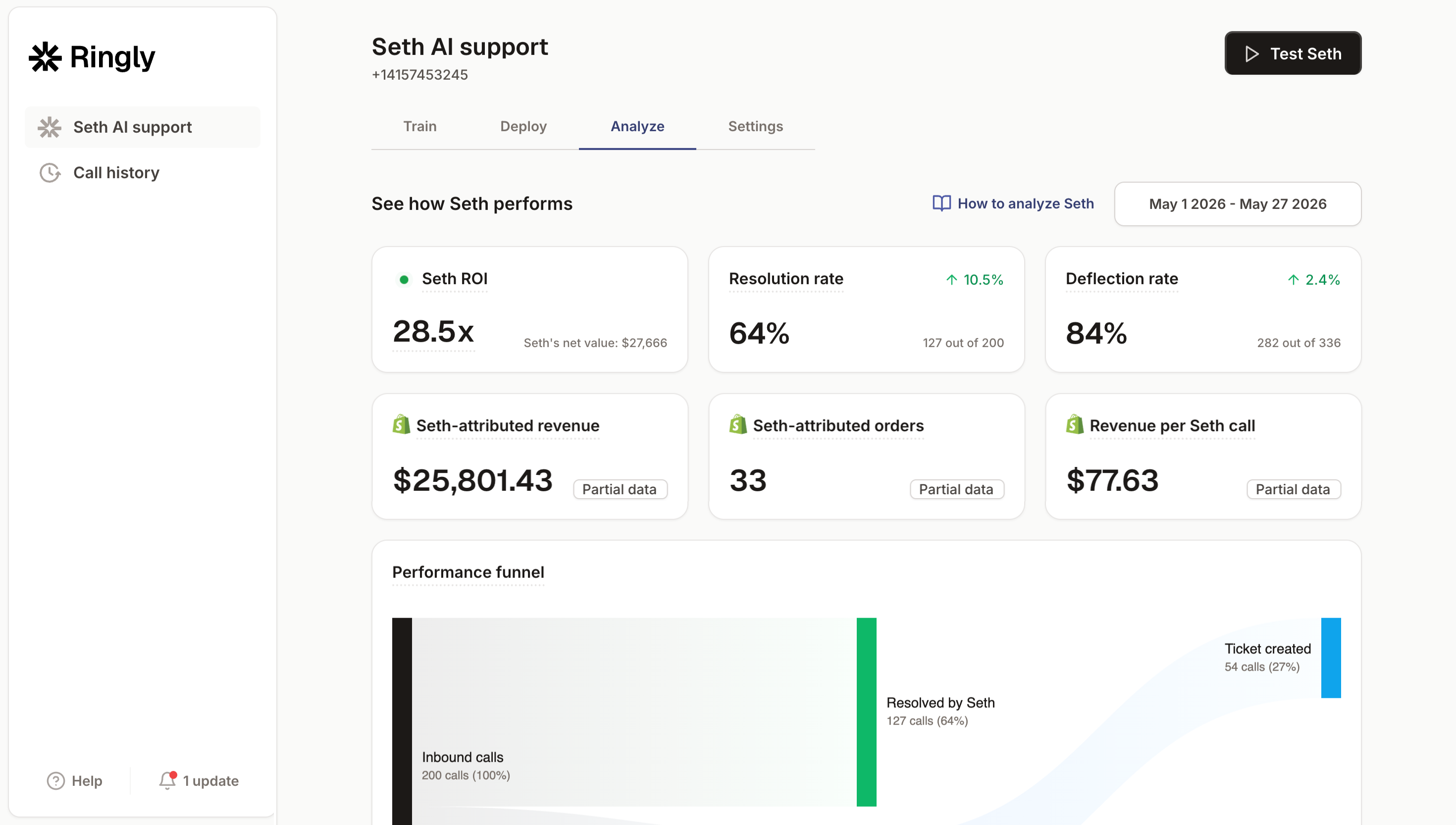
The rule underneath the table is simple. Automate the call when the answer is in your knowledge base and being wrong is cheap. Keep it human when the call needs judgment or when a mistake costs real money or real trust. BioLongevity Labs, a brand we work with, resolves 79% of its calls this way without a human ever touching them.
The biggest single row on that table is almost always where's my order. WISMO runs 30 to 40% of support tickets in normal periods and over 50% at peak, per Salesforce. That alone is reason enough to route it to automation and free your reps for the rows at the bottom.
What automation handles well, and what it gets wrong
Automation is genuinely better than humans at a specific list of things. It's also genuinely worse at another list. Pretending it's good at everything is exactly how AI deployments fail.
Where automation wins
Automation never sleeps, never gets tired of the same question, and answers the 200th "where's my order" exactly like the first. That consistency is the point.
- Volume and speed. It picks up on the first ring, every ring, no hold queue. 60% of callers hang up within 60 seconds on hold, so the pickup itself recovers calls you were losing.
- After-hours and weekends. Most businesses answer only 37.8% of inbound calls, with another 37.8% rolling to voicemail, per AmbsCallCenter. Automation covers the after-hours window your team can't.
- Consistency. No mood, no off day, no new hire still learning the return policy. The same correct answer at 2 a.m. on a Sunday as at 10 a.m. on a Tuesday.
- The missed-call leak. 85% of callers who can't reach a person never call back, and 62% switch to a competitor. Picking up is most of the battle.
Where automation should not take the call
This is the part vendors don't put on the landing page. There are calls automation should hand straight to a person, and a tool that tries to keep them is the tool that gets screenshotted.
- Emotional calls. Anger, grief, safety, a recall. A customer who's upset wants to feel heard, and 71% of people specifically want a human for complex or high-stakes issues, per SurveyMonkey's 2026 data.
- Ambiguous or subjective requests. "Will this work for my situation" has no database answer. Forcing automation to guess produces a confidently wrong response, which is worse than no answer.
- Anything expensive to get wrong. Billing disputes, large refunds, retention saves. The cost of a mistake outweighs the cost of a rep's time.
- Genuinely novel calls. If it's not in the knowledge base and it's not a pattern, escalate. Automation should know what it doesn't know.
The brands that get burned almost always made the same mistake: they pointed automation at every call instead of the right calls. Done correctly, customers usually can't tell. The most common thing our customers report hearing is "you don't sound like AI."
"My customers also feel like it's a normal person. They feel like they can communicate if they have questions."
Claudia Droge, TechCraft Studio
TechCraft handles 88% of its calls without a human and still gets that reaction, because the 12% that need a person actually reach one. If you want to hear what good voice AI customer support sounds like before you decide, that's the test.
Cost, availability, consistency: the three places the math differs
Once you've sorted calls by type, the comparison stops being philosophical and turns into numbers. Here's where automation and human reps actually diverge.
| Dimension | Human agents | Call automation |
|---|---|---|
| Cost per call | $9-$16 per resolved ecommerce contact | $2-$3 per contact (often less) |
| Hours covered | Business hours, plus overtime cost | 24/7, including weekends |
| Consistency | Varies by rep, mood, and tenure | Identical answer every time |
| Ramp to productive | 6-8 months to fully train | Live in about 14 days |
| Scaling for a spike | Hire, onboard, hope they stay | Instant, no headcount change |
Those cost numbers come from Alhena's 2026 ecommerce support analysis: voice support runs $9 to $16 per resolved human contact, while AI-assisted resolution lands at $2 to $3. CloudTalk puts it in a similar range, $3 to $6 per human interaction versus $0.25 to $0.50 for AI. WashCo, a Shopify brand we launched, runs at $0.91 per call against $2.70 for a human-handled one.
The consistency line matters more than founders expect. A rep on month two gives a different answer than a rep on year two, and your CSAT swings with it. This is also why the in-house vs outsource decision keeps coming back around. Both human options carry the same training and turnover tax. Automation doesn't.
None of this means firing your team. It means your team stops spending 70% of its day on lookups and starts spending it on the calls that actually move retention. If you're weighing this against outsourcing your customer service, the routing logic is the same either way.
What this costs you today vs what it costs with Ringly
Take a typical $50M Shopify brand running a 6-rep CS team.
| Line item | Today | With Ringly |
|---|---|---|
| 6 reps × $4K loaded per rep | $24,000/mo | n/a |
| Ringly (~$5K/mo) | n/a | $5,000/mo |
| Net monthly CS spend | $24,000/mo | $5,000/mo |
| Monthly savings | n/a | $19,000/mo |
| Annual savings | n/a | $228,000/yr |
That's roughly 70% of repeatable calls (order status, returns, product questions, the same five things over and over) routed to automation. The other 30%, the genuinely complex calls, still go to your team, who now have time to actually solve them instead of triaging a backlog. For most brands the real lever isn't the headcount line at all, it's reducing support cost while protecting CSAT.
Want to run these numbers against your own call volume? Book a 30-min call and we'll do the math live with your real ticket counts.
How to actually set up call-type routing
I've set this up for a lot of Shopify brands, and the sequence is always the same. You don't flip a switch and walk away. You sort, you start narrow, and you expand on confidence.
- Pull your last 30 days of calls. Export them from your helpdesk or phone system. You need the raw list before you can sort it.
- Tag each call by type. Use the rows from the decision table above. Most brands find their top six tags cover 80% of volume within an afternoon.
- Mark which are knowledge-base answerable. If the answer lives in a document or in Shopify, it's a candidate for automation. If it needs a person's judgment, it's not.
- Set the escalation rules first, not last. Decide exactly which call types hand off to a human and what context goes with them. The handoff is the part that earns trust, so build it before you go live.
- Listen to the first week. Review the automated calls. The ones that should have escalated tell you where to tighten the rules.
- Expand the automated set as confidence grows. Start with WISMO and order status. Add return initiation, then policy questions, then the rest. Don't automate a call type until you've watched it work.
This is how AI phone call automations get configured in practice, and it's why the route-by-type approach beats the all-or-nothing swap. The system that checks order status automatically is the same one that knows to escalate a refund dispute. Most of our customers reach 24/7 phone coverage inside two weeks doing exactly this.
Frequently asked questions
Which calls should you automate vs send to a human? Automate the repeatable, knowledge-base-answerable calls: order status, hours, policy questions, simple changes, returns, in-stock checks. Keep a human on emotional, ambiguous, high-value, or expensive-to-get-wrong calls. The decision table above maps the common ones.
Will customers be annoyed if AI answers the phone? Only if it tries to handle calls it shouldn't. When automation takes the routine calls and hands off the hard ones cleanly, most customers can't tell. The most common reaction our customers report is "you don't sound like AI."
What percentage of support calls can AI actually handle? Industry data puts routine-inquiry resolution at 70 to 80%, and that lines up with what we see. Brands we work with run between 73% and 88% resolution depending on how clean their knowledge base is and how much of their volume is WISMO.
Is call automation cheaper than hiring more reps? On a per-call basis, yes, usually by a wide margin. Ecommerce voice support runs $9 to $16 per human contact versus $2 to $3 automated. A 6-rep team at $24K/mo typically drops to around $5K once the repeatable calls move over.
What happens when an automated call gets too complex? It escalates to a human with the call context attached, so the customer doesn't repeat themselves. The escalation rules are something you set up front, which is why the handoff is the part to get right before going live.
Do I still need a support team if I automate calls? Yes, and they get more valuable, not less. Your reps move off the lookups and onto the 30% of calls that need judgment, the ones that actually protect retention. This isn't a reason to cut your team, it's a reason to point them at better work.
How is route-by-call-type different from a phone tree? A phone tree makes the customer do the routing by pressing buttons through a menu. Route-by-call-type means the system understands the request in natural speech and decides where it goes, resolving it outright or handing it to a person. No menus, no "press 1."
What call types should never be automated? Emotional calls (anger, grief, safety, recalls), subjective consults with no database answer, high-value retention saves, and any billing dispute where being wrong is costly. When the stakes or the emotions are high, a human takes it.
Talk to us

If you run a $10M-$100M Shopify brand and your phone line is doing the same five questions all day, a 30-min call is the fastest way to see which of those calls you can hand off this month, and which to keep on your team.
Our 3 promises.
- Live in under 1 hour. Setup and test calls are free.
- 30-day money back on the $99 plan fee.
- 65% resolution guarantee: if Seth resolves under 65% of your support calls in a month, that month comes back as credit (after 90 days on Pay per call).
Ruben (Ringly co-founder) takes these calls personally.