

This post in 30 seconds.
- Ecommerce technical support means the broken-thing-right-now calls: checkout errors, declined cards, login lockouts, app conflicts, and site bugs. It's a revenue problem, not just a support cost.
- Three ways to staff those calls, compared on cost per resolved call: an in-house team (
$2.70), an outsourced BPO ($7-$16 fully loaded), or an AI phone agent ($0.42).- Written for Shopify brands doing $2.4M+ a year with a visible phone line and a paid helpdesk, deciding how to handle the calls where something is actually broken.
We run AI phone support for 50+ Shopify brands, and we've handled more than 150,000 customer calls doing it. A lot of those calls are the "where's my order" kind.
But a stubborn slice is the other kind: a checkout that breaks at 11 p.m. on a launch night, a card that gets declined for no obvious reason, a customer locked out of the account they just paid from. That slice is what an ecommerce technical support call center is actually for, and it's the part almost nobody writes about honestly.
Most guides that rank for this term are 6,500-word lists of outsourcing vendors. Useful if you've already decided to outsource. Not useful if you're still deciding how to handle these calls at all.
So this is the other version: what technical-support calls really are, why they're costing you more than payroll, and how the three real options (in-house, outsourced BPO, and an AI phone agent) stack up on cost and on what they can actually resolve.
If you run a Shopify brand doing a few million a year and your team is fielding the same broken-checkout calls over and over, you don't have to keep hiring against them. Start a 14-day free trial and hear the AI answer your own store's calls. We set it up for you.
In this post:
What counts as ecommerce technical support (and why it's not the same as WISMO)
Start with a clean definition, because every other article blurs it. General customer service is "where's my order," "can I return this," "does this come in blue." Technical support is narrower and sharper. It's the calls where the store itself, or the customer's ability to use it, is broken.
Five things fall under it:
- Checkout errors. The cart won't advance, a discount code throws an error, the page hangs on the payment step.
- Payment and card declines. The card gets refused and the customer has no idea why, which is often a false decline from an overzealous fraud filter, not a real one.
- Login and account access. Password resets that don't arrive, accounts locked after too many attempts, order history that won't load.
- App and integration conflicts. A third-party app collides with the theme or the checkout, usually right after someone installed or updated it.
- Site-functionality bugs. Images won't load, a variant won't add, the mobile site behaves differently than desktop.
Technical support is the set of calls where something is broken right now, and the customer is standing at the register with their card out. That's the difference from a "where's my order" call (WISMO), where the money is already spent and the customer is just waiting.
The volume here is real. Nearly 33% of online shoppers hit a payment issue at checkout, according to Digivante. Most of them never call. They troubleshoot on their own first, poke at Settings and payment methods, disable an app or two, then give up. The ones who do call are the ones who really want to buy, which is exactly why these calls are worth answering fast.
This is also where an ecommerce call center run on an AI phone agent earns its place: most of these calls are the same handful of problems, asked a hundred different ways. Before you decide who should answer them, it helps to see what they're actually costing you. That's not payroll.
Technical support is a revenue problem, not a support cost
Every vendor guide frames technical support as a cost center to shrink. That's the wrong frame, and it's why brands underinvest in it. A broken checkout isn't a support ticket. It's a sale walking out the door.
Look at where the abandoned checkouts go. Up to 30% of shoppers who intend to buy abandon over a payment gateway issue, per Fibonatix. Card declines account for 9% of cart abandonment and trust or security concerns another 18%, according to Mindster. Mobile makes it worse: cart abandonment on mobile runs around 85%, and Liquid Web notes that roughly 20% of ecommerce sites have at least one basic mobile-checkout error. The industry average cart-abandonment rate sits near 70% overall.
Not all of that is technical, obviously. Plenty is price-shopping and window-browsing. But a meaningful chunk is a customer who wanted to pay and couldn't, and who would have finished the order if someone had picked up and walked them through it. The technical-support call you answer at checkout is the one place in the funnel where a human voice can turn an abandoned cart back into a paid order in real time.
That's not theory. WashCo, a Shopify brand we launched, recovered $22,664 in its first 7 days on the phone, mostly from calls that would otherwise have ended in a dropped cart or a voicemail nobody returned. The framing that matters here: money you leave on the table when a checkout breaks and nobody answers is bigger than the payroll you save by not staffing the line. If you want the deeper breakdown of where that revenue leaks, our cart-abandonment statistics roundup has the numbers, and order-status handling covers the post-purchase side.
So the useful question to ask is which setup resolves the most of these calls, fastest, without turning into its own money pit. Staffing the line as cheaply as possible is a different question, and usually the wrong one. Here's the quick version before the deep dive:
| Delivery model | Typical cost | Best for | The catch |
|---|---|---|---|
| In-house team | $4,000/mo loaded per US rep | Complex, judgment-heavy calls and full brand-voice control | Highest cost per call, 40-45% annual turnover |
| Outsourced BPO | $8-$55/agent-hour by region ($0.50-$4 per ticket) | Pure headcount for a seasonal surge | Brand-voice drift, uneven quality, vendor risk |
| AI phone agent | ~$0.42 per resolved call | The repeatable 70%+ (checkout, login, declines, code questions) | Genuine site outages still need a developer |
How I compared the three ways to handle these calls
I'm Ruben, co-founder of Ringly. I didn't score these three models off marketing pages. Over the last 30 days I ran the numbers against how a real Shopify brand handles its technical-support line, using data I actually have access to.
Here's what I looked at:
- Real cost per resolved call, not per hour. I pulled billing across the 50+ brands we run and converted everything to a per-resolved-call number, because "$18 an agent-hour" tells you nothing until you know how many calls that hour resolves.
- What the BPO route really quotes. I requested quotes from two outsourcing sales lines and priced the same call volume through their per-ticket and dedicated-FTE models.
- What the calls actually are. I sorted 30 days of our own production call logs to see how many technical-support calls the AI finished on its own versus handed to a human. That number shows up later in this piece.
- The in-house math, loaded. I used the commodity loaded cost of a US rep ($4,000/month), plus the soft costs that never make the salary line: training, ramp, turnover.
- The failure mode. I stress-tested what each option does when it can't fix the problem, because a technical-support line is only as good as its worst call.
I only sell one of these three (the AI phone agent), and it gets held to the same criteria as the other two below. Where it's the wrong tool, I'll say so.
The three delivery models, side by side
1. In-house technical support team
Best for: brands where most technical calls are complex, judgment-heavy, and worth the highest per-call cost for total brand-voice control.
You hire reps, train them on your store and stack, and own the whole experience. It's the highest-quality option when it's staffed well, and the most expensive by a wide margin.
The loaded cost of a US rep is about $4,000/month once you count salary, benefits, payroll tax, and training. The problem isn't the salary, it's the churn. Call-center turnover runs 40-45% a year, and higher in high-stress segments like technical troubleshooting, per Insignia Resources, with average tenure around 14-15 months. Replacing one agent costs $10,000 to $20,000 in direct expense, according to SymTrain, and more once you count the 6-to-8-month ramp before a new rep is fully productive.
What works: total control of tone and escalation, deep product knowledge over time, and a human who can improvise on a weird one-off problem.
What doesn't: the cost per call is the highest of the three, and you pay reps to sit idle during the quiet hours between spikes. Turnover means you're re-training constantly. If you're weighing this against outsourcing, we broke the trade-off down in in-house vs outsourced support.
Verdict: right when your technical calls are complex and high-value enough to justify the price, wrong when 70% of them are the same five repeatable issues.
2. Outsourced BPO / call center
Best for: brands that need pure headcount to absorb a seasonal surge and have the bandwidth to manage a vendor.
You hand the volume to an outside call center. Pricing lands in fairly consistent bands: offshore runs $8-$18 an agent-hour, nearshore $12-$25, onshore US or UK $20-$55, with per-ticket models at $0.50-$4 and dedicated FTEs at $2,500-$5,500 a month. Shopify's own estimate puts a 5-agent email-and-chat team at $15,000-$25,000 a month, per its outsourcing guide, before you add phone-specific staffing, which runs higher.
The catch is quality and risk. Outsourced reps often sound disconnected from the brand, and quality varies rep to rep. Vendor risk is real too: some of the BPOs that show up in every "best of" roundup sit below two stars on public review sites, which tells you that being featured in a listicle and actually being good aren't the same thing.
What works: you can scale headcount fast for Black Friday or a launch, and offshore rates are cheap per hour.
What doesn't: brand-voice drift, inconsistent resolution, time-zone gaps, and the oversight tax of managing a vendor. Cheap-per-hour is not the same as cheap-per-resolved-call.
Verdict: a fit for raw surge capacity if you can manage it. If outsourcing is your direction, start with a real shortlist rather than a blind pick. Ours are in best call center outsourcing companies and ecommerce call center services.
3. AI phone agent
Best for: the repeatable slice of technical-support volume, resolved 24/7 at cost, with a clean hand-off for anything genuinely broken.
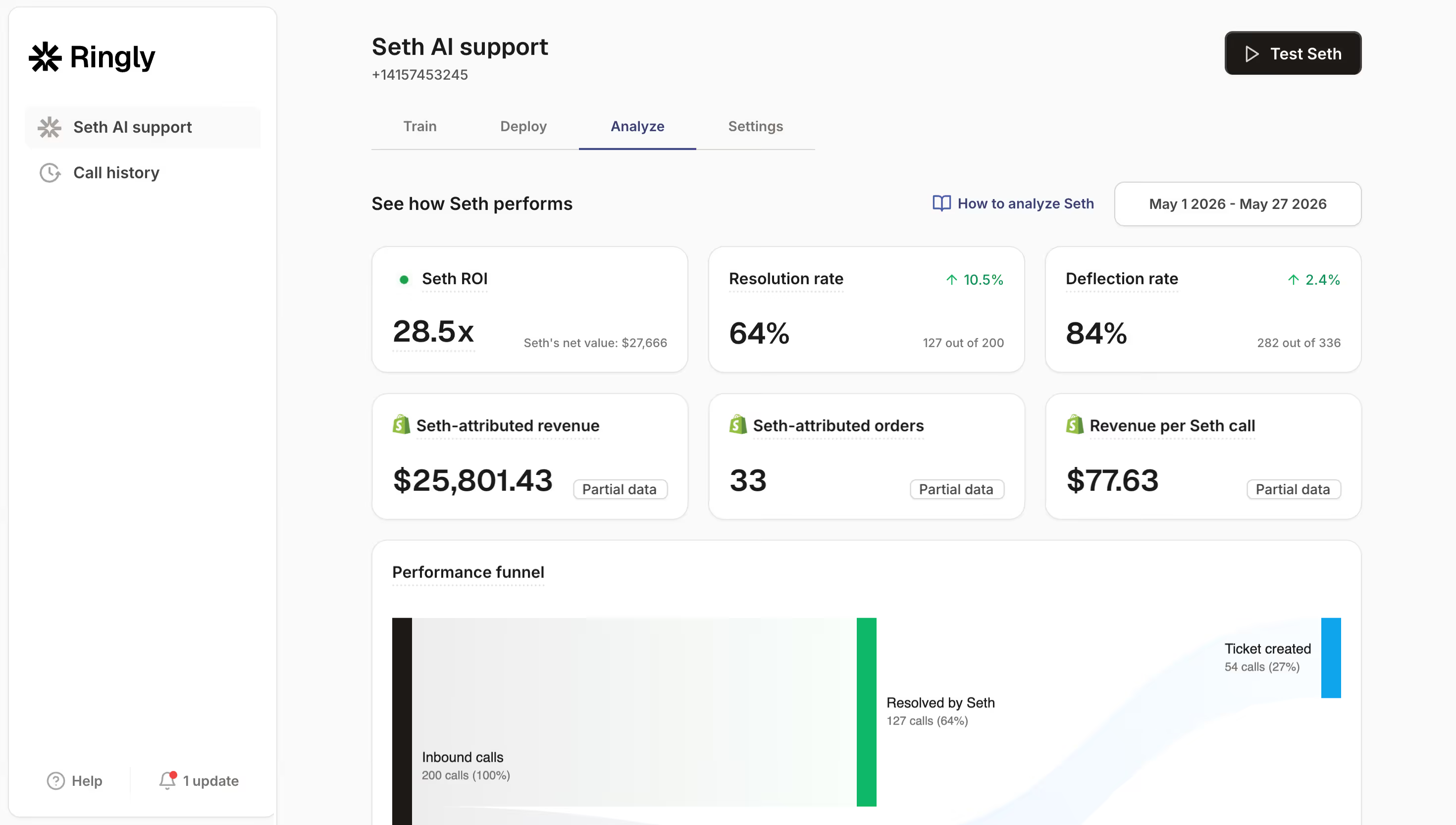
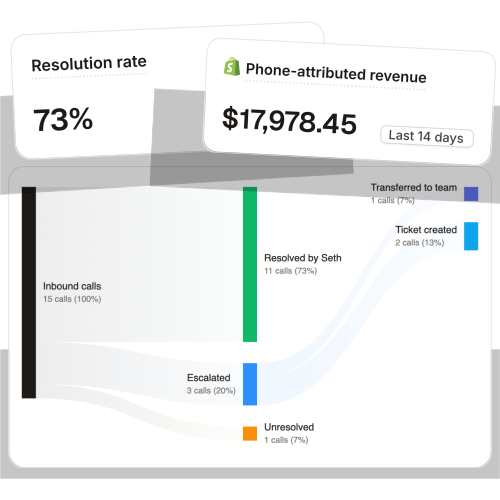
An AI phone agent answers the inbound line, pulls the customer's order and account from Shopify, answers from your knowledge base, and handles the routine technical questions end to end. Across 50+ brands, ours resolves 73% of inbound calls on its own at roughly $0.42 per resolved call, versus $7-$16 a call for a human BPO. It goes live in under an hour, and calls that need a person escalate cleanly to Gorgias, Richpanel, Re:amaze, or whatever helpdesk you already run.
This isn't just our claim that the hybrid model works. Companies running a blended AI-plus-human setup report 64% higher agent productivity and 39% lower cost per interaction than pure-human outsourcing, per Crescendo's 2026 report cited by Shopify. The AI takes the repeatable calls so your people get the hard ones.
What works: cost per resolved call is an order of magnitude below the other two, coverage is 24/7 with no night shift, and it plugs into your knowledge base and existing stack instead of replacing it. TechCraft Studio handles 88% of its calls without a human.
What doesn't: it's not a developer. A genuine site-wide payment-gateway outage or a bug in your store's code needs a person who can push a fix, and no phone agent of any kind changes that. It's honest about the boundary rather than pretending to be everything.
Verdict: the right first move for the 70%+ of technical calls that repeat, paired with a human or a dev for the rest. More on how that split works on the Shopify AI phone support page.
"My customers also feel like it's a normal person. They feel like they can communicate if they have questions."
Claudia Droge, TechCraft Studio
What each model actually costs per resolved technical-support call
Everyone quotes agent-hours. Almost nobody converts that into the number you actually care about, which is what it costs to resolve one call. This is the per-call comparison that matters:
| Channel | Cost per resolved call | Notes |
|---|---|---|
| In-house US rep | $2.70 | Loaded with payroll and benefits |
| Outsourced BPO | $1.50-$3.50 | Plus contract minimums and oversight |
| Human BPO, fully loaded | $7-$16 | The number most "what does a call cost" guides land on |
| AI phone agent | ~$0.42 | Plus 24/7 coverage, no night shift |
The gap widens when you scale it up. Take a brand running a 6-rep support team:
| Line item | Today | With an AI phone agent |
|---|---|---|
| 6 reps × $4K loaded | $24,000/mo | n/a |
| AI phone agent, done-for-you (illustrative ~$5K/mo all-in) | n/a | $5,000/mo |
| Net monthly spend | $24,000/mo | $5,000/mo |
| Monthly savings | n/a | $19,000/mo |
| Annual savings | n/a | $228,000/yr |
That's roughly 70% of repeatable calls (checkout, login, "why was my card declined," "is this code still valid") routed to the AI. The other 30%, the harder calls, still go to your team, who now have time to solve them properly. The dollar figure on the AI line is illustrative, not a quoted price. Exact pricing depends on your call volume, and you can see the plan tiers or the deeper math in Shopify support cost reduction.
If your technical-support line is quietly eating a rep's whole day, start a 14-day free trial and compare it to your current setup on real calls. We set the agent up for you. If you want the human-versus-AI side of it in more detail, AI voice support vs human goes deeper.
Where AI works, and where you still need a human
The honest objection to any AI answer is that AI support with no real escalation path just frustrates people more. That's a fair fear, and there's a well-documented example of it. When Shopify restructured its own frontline support toward AI chat back in 2023, merchants on the standard plans described the pattern clearly: the chatbot repeated generic suggestions, promised callbacks that never came, and let ticket escalations vanish into a queue for weeks. That's what AI support looks like when it's built without a real hand-off.
The fix isn't "less AI." It's an escalation design that works. The difference between AI support that helps and AI support that infuriates is entirely in how the call it can't finish gets handled. A phone agent should resolve what it can, and transfer the rest to a person immediately, with the context attached, not send the customer into a loop.
Here's the number I promised earlier from our own logs. Ringly agents transferred about 6% of calls to a human in the past 30 days; the rest were handled end to end or ended by the caller. That's across 12,837 calls. Low transfer rate, but a real transfer path that fires the moment the AI hits something it shouldn't handle alone, routed through smart call transfer.
Be clear about the boundary, though. A few things genuinely need a human or a developer, and no phone agent should pretend otherwise:
- A site-wide outage or a code bug. If the payment gateway is down or the theme is broken, that's a dev fix, not a phone call.
- Anything that needs a card taken live on the call. The workaround is a secure SMS payment link, not reading numbers over the phone.
- A judgment call outside policy. A refund exception or an angry escalation still belongs with a person.
That's the split most brands land on, and it's why the chatbot-versus-phone framing matters. If you want that comparison, we wrote it up in chatbot vs phone support, and the mechanics of a clean hand-off in support escalation.
How to choose the right setup for your store
You don't have to pick one and marry it. Most brands end up with a blend. But if you're deciding where to start, use the shape of your calls, not the sticker price.
Choose an in-house team if: most of your technical calls are complex, one-off, and high-value, you want total brand-voice control, and you can absorb the turnover cost. This is the premium option for premium problems.
Choose an outsourced BPO if: you mostly need bodies to survive a seasonal surge, you have someone internally to manage the vendor, and you can live with some quality variance. Best for raw headcount, not for consistency.
Choose an AI phone agent if: 70% or more of your technical-support calls are the same repeatable things (checkout errors, login resets, declined-card questions, "is this discount still valid"), you want them answered 24/7, and you want the cost per call an order of magnitude lower.
The setup most brands actually land on: the AI takes the repeatable slice, your team takes the complex calls, and a developer handles real outages. You stop hiring against a queue of identical questions and put your humans where judgment matters. That's also how you keep phone support live overnight without a night shift, which we covered in 24/7 ecommerce phone support and scaling support without hiring.
Frequently asked questions
What does an ecommerce technical support call center actually handle? The calls where something is broken or blocked at the point of purchase: checkout errors, declined cards, login and account lockouts, app or integration conflicts, and site-functionality bugs. That's distinct from general customer service like returns or "where's my order," where the sale is already done and the customer is just waiting.
How much does it cost to outsource ecommerce technical support? Outsourced call centers price at roughly $8-$18 an agent-hour offshore, $12-$25 nearshore, and $20-$55 onshore, with per-ticket models at $0.50-$4 and dedicated FTEs at $2,500-$5,500 a month. A 5-agent email-and-chat team runs $15,000-$25,000 a month before phone-specific staffing, per Shopify's own estimate.
Is it cheaper to hire in-house or outsource ecommerce support? In-house gives you the most control but the highest cost, about $4,000 a month loaded per US rep, plus 40-45% annual turnover and a 6-to-8-month ramp. Outsourcing is cheaper per hour but adds vendor oversight and quality variance. On a per-resolved-call basis, an AI phone agent (~$0.42) undercuts both.
Can AI actually handle ecommerce technical support, or does it need a human? It handles the repeatable majority (checkout, login, declined-card, and product-code questions) end to end. Across 50+ Shopify brands, ours resolves 73% of inbound calls on its own. Genuinely broken things, like a site outage or a code bug, still need a human or a developer, and the AI should transfer those cleanly rather than loop.
What's the difference between general customer service and technical support for an online store? General customer service answers questions about products, orders, and returns. Technical support fixes what's broken in the buying experience itself: a checkout that won't advance, a card that won't process, an account that won't unlock. Technical calls tend to happen mid-purchase, which makes them worth more revenue if you answer them fast.
What happens when an AI agent can't resolve a technical-support call? It transfers to a human with the call context attached, so the customer doesn't repeat themselves. In our data, that happens on about 6% of calls; the rest are handled end to end or ended by the caller. The whole point is a real escalation path, not a chatbot dead-end.
Does an ecommerce technical support call center work with Shopify? Yes. A Shopify-native AI phone agent pulls order and account data straight from your store and escalates cleanly to Gorgias, Richpanel, Re:amaze, or whatever helpdesk you already run. You keep your current number, helpdesk, and workflows.
How fast can I get technical phone support live for my store? An AI phone agent can be live in under an hour. Add your website, docs, or knowledge base and it's ready to answer. A human team, in-house or outsourced, takes weeks to hire, train, and ramp before it resolves calls at a comparable rate.
What's a realistic resolution rate for ecommerce technical support? Across 50+ Shopify brands, our AI resolves 73% of inbound calls autonomously, and we guarantee at least 65% within 90 days or we refund the last 3 months. The repeatable technical questions resolve at the high end; the complex or broken cases are the ones you route to a person.
Talk to us

If your store is dropping technical-support calls when a checkout breaks after hours, the fastest way to see what you're losing is to hear the AI answer your own store's calls. It handles the repeatable technical questions, escalates the rest cleanly, and plugs into the helpdesk you already run.
The 3-layer guarantee.
- Live in 14 days or it's free until launched.
- 65% resolution in 90 days or we refund the last 3 months of subscription fees.
- We keep working free until we hit 65%.
Ruben (Ringly co-founder) takes these calls personally.
Start your trial today and you get:
- A free dedicated phone number to test on, so you hear it answer real technical-support calls the same day.
- The agent built for you. We set it up, you lift zero fingers.
- It plugs into your helpdesk. Gorgias, Richpanel, Re:amaze, Zendesk, or whatever you already run.
Start your 14-day free trial →
Rather talk it through first? Book a 30-min call.