

This post in 30 seconds.
- A 24 hour virtual receptionist answers your phone around the clock, but most are built for law firms and plumbers, not stores. The difference matters when the 11 p.m. call is "where's my order."
- Across 11,000+ calls we handled in 30 days, roughly 29% arrived after business hours. For a Shopify brand those are order-status, returns, and stalled-cart calls, money either already spent or about to be.
- Built for Shopify brands doing $2.4M+ a year with a visible phone line and a paid helpdesk. Not for early-stage stores with no real call volume.
We've handled 150,000+ customer calls for 50+ Shopify brands, and across those brands the AI resolves 73% of inbound calls on its own. So we've watched what a 24 hour virtual receptionist actually does for a store at all hours, on real orders, not in a case study. That's why I can write this instead of rewording someone else's page.
Here's the problem. Almost every "24 hour virtual receptionist" you'll find is built for home services, legal, real estate, and healthcare. When you read Ruby or Smith.ai reviews, you're mostly reading reviews written by plumbers and law-firm office managers. So you end up guessing whether the thing handles an order-status call at midnight, or just takes a message and emails it to a support inbox nobody reads until 9 a.m. If you run a Shopify store, that guess is the whole decision. Want to skip the guessing and hear it on your own calls? You can start a free 14-day trial and listen to the AI answer a real call from your store.
Most Shopify brands past a few million a year run a small support team and a phone line nobody picks up after 6 p.m., so the after-hours calls turn into voicemails we never return. This guide is for the founder, COO, or Head of CX at one of those brands. It covers what a 24 hour virtual receptionist is, what after-hours calls really look like for a store, what the options cost, and how to tell a message-taker from something that actually resolves the call. Try it free for 14 days on your own store if you'd rather see it than read about it.
In this post:
What a 24 hour virtual receptionist actually is
A 24 hour virtual receptionist is a service that answers your inbound phone line 24/7 so calls don't hit voicemail. That's the whole promise. Someone (or something) picks up at 2 a.m. on a Sunday the same way they would at 2 p.m. on a Tuesday.
The category splits three ways, and the split matters more than any feature list.
Human-staffed. Real people answer your calls from a call center, take a message or route the call, and log it. Ruby and ReceptionHQ work this way. You're renting a friendly voice and a note-taker.
AI. Software answers the call, has an actual conversation, and tries to resolve it end to end. RingCentral's AI Receptionist, CloudTalk, and Ringly sit here. The good ones don't just read a script, they look things up and act.
Hybrid. AI handles the intake, a human backstops the calls it can't. Smith.ai runs this model, popular with law firms that want a human safety net on every call.
Here's the distinction the whole SERP skips: message-taking versus resolving. A generic virtual receptionist logs "customer called about order 1043, wants a tracking update." Then someone on your team calls the customer back the next morning, if they get to it. An ecommerce-native agent looks up order 1043 while the customer is still on the line and tells them where it is. One creates a task. The other closes it. For a store, that gap is the difference between a 24/7 receptionist that reduces your workload and one that just reschedules it.
And the cost of getting it wrong is real. About 78% of buyers abandon a brand after one unanswered call, according to PCN's missed-call revenue study. A message taken at midnight and returned at noon still left the customer hanging for twelve hours. If you want the plain version of "always-on," think of it as an always-on answering machine for a Shopify store that can actually do the lookup, not just record the message.
Why after-hours calls hit a Shopify brand differently
Every article on this keyword opens with the same fact: businesses answer only 37.8% of their inbound calls, and miss around 62% of them, per Aira's missed-call research. True, and it's not the number that should drive your decision, because it's not about your store specifically.
This one is. Across 11,000+ calls handled by Ringly agents in the past 30 days, roughly 29% of inbound calls arrived after business hours (6 p.m. to 9 a.m. US Eastern). About 18% of support calls in our data land on weekends. So nearly a third of your phone volume shows up when the lights are off, and the calls you're dropping aren't random.
For a Shopify brand, after-hours calls skew toward a few specific things:
- "Where's my order." WISMO makes up 30-40% of support tickets in normal periods and 50%+ at peak, per Salesforce. People check on orders at night, after dinner, when they finally remember. That call is about money they already spent.
- Returns and exchanges. The "does this fit / can I send it back" call that stalls a reorder if it goes unanswered.
- A pre-purchase product question. Someone with a full cart at 11 p.m. who needs one answer before they buy. That call is about money they're about to spend, and the timer is running.
- The seasonal spike. During a launch or a holiday week, that after-hours share doesn't shrink, it grows, right when your team is already drowning in calls.
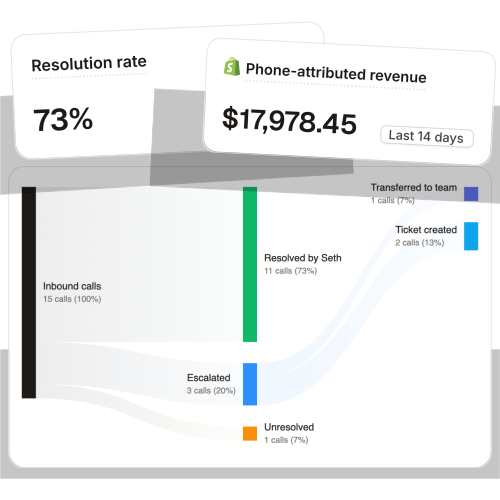
Put those together and the after-hours line isn't a support cost, it's a revenue leak. Around 27% of leads call outside normal 9-5 hours, and businesses with real after-hours coverage see roughly 28% higher revenue growth, according to NextPhone. WashCo, a Shopify brand we launched, recovered $22,664 in its first 7 days on the phone, most of it from calls that used to go nowhere. A message-taking receptionist can't do that, because by the time the message gets actioned, the buyer with the full cart has already closed the tab.
If you want the mechanics of the most common one, we broke down how to handle "where's my order" calls separately, and the order-status lookup is the single feature that decides whether a 24/7 receptionist is useful to a store or not.
How I pulled these after-hours numbers
I'm Ruben, co-founder of Ringly. For the last 30 days I pulled our own production call data instead of guessing, because the after-hours claims in this category are almost never backed by anything.
Here's what I actually did:
- Pulled the raw call log. 12,837 calls over the window, 11,001 of them phone calls, across the Shopify brands running on our platform.
- Timestamped every call against a US-Eastern business-hours boundary (6 p.m. to 9 a.m. counted as after-hours). That's where the 29% comes from. It's an approximation because callers span time zones, which is why I say "roughly."
- Read the after-hours transcripts to classify what those calls were about, not just count them. WISMO, returns, product questions, and stalled carts dominated, exactly the calls a store can't afford to miss.
- Compared the two behaviors on the same call type: what a message-taking service does with a WISMO call versus what a resolving agent does. One logs it, one answers it.
- Called competitor phone lines after hours to see who actually picks up, and how long it takes.
Nothing here is a projection. Where a number is an approximation, I've said so. The point of doing it this way is that a founder deciding on a 24/7 receptionist should see real after-hours behavior from real stores, not a stat borrowed from a call-center vendor selling to dentists.
What a 24/7 receptionist actually costs
There are three real ways to cover your phone 24/7, and they cost wildly different amounts.
| Option | Typical cost | Resolves ecommerce calls? | Best for |
|---|---|---|---|
| In-house night shift | $150,000-$200,000+/yr | Yes, but idle most of the shift | Brands with heavy, steady overnight volume |
| Human answering service | $200-$2,000/mo + $0.75-$1.50/min | No, takes messages | Low-volume, non-ecommerce message routing |
| AI phone agent | $349-$799/mo flat (Ringly) | Yes, order lookup + returns + product Q | Shopify brands with real after-hours call volume |
Staffing your own overnight desk runs $150,000 to $200,000+ a year for round-the-clock coverage, per NextPhone's cost breakdown, and the reps sit idle most of the shift because the volume isn't steady. A traditional human answering service is cheaper but takes messages, it doesn't resolve anything. The AI option is the only one where the flat monthly price includes actually closing the call.
Here's the math most brands land on:
Take a typical Shopify brand running a 6-rep support team.
| Line item | Today | With Ringly |
|---|---|---|
| 6 reps × $4K loaded per rep | $24,000/mo | n/a |
| Ringly, done-for-you (illustrative ~$5K/mo all-in) | n/a | $5,000/mo |
| Net monthly CS spend | $24,000/mo | $5,000/mo |
| Monthly savings | n/a | $19,000/mo |
| Annual savings | n/a | $228,000/yr |
That's roughly 70% of repeatable calls (order status, returns, product questions, the same questions over and over) routed to the AI. The other 30%, the genuinely complex calls, still go to your CS team, who now have time to actually solve them. On a per-call basis it's about $0.42 per resolved call versus $7-$16 per call for a human BPO, so the savings hold up whether you look at headcount or unit economics.
One warning the vendor pages won't give you: watch the billing model. The most common real complaint across this category isn't quality, it's the bill. Ruby was hit with a $12M class-action judgment in 2021 over deceptive billing. RingCentral counts a one-second pickup as a full billed minute. Smith.ai stacks add-ons at $2.25 a call. Flat, published pricing (the $349 and $799 tiers are on the pricing page, no contact-sales wall) is the boring feature that saves you the surprise. If you want to sanity-check the trade against building a night shift, we compared in-house support versus outsourcing for Shopify with real numbers.
Rather talk it through against your own volume first? Book a 30-min call and we'll do the math live on your call log.
What to look for in a 24/7 solution for a store
Most of the "features to look for" lists on this keyword are written for a dentist's office. Here's the version for a Shopify brand, in the order that actually matters.
- It resolves ecommerce calls, not just logs them. The one non-negotiable. Can it look up a Shopify order, start a return, and answer a product question from your own site, on the call? If not, it's a fancy voicemail.
- Flat, predictable pricing. As covered above, billing surprises are the number-one real complaint across Ruby, Smith.ai, RingCentral, and ReceptionHQ reviews. Per-minute stacking and add-on creep cost you the most right when volume spikes, which is when you need coverage most.
- It actually uses your knowledge base. RingCentral's AI Receptionist has a 500-character company-description limit and users report it "ignores uploaded documents" on harder questions. That's the AI version of "the temp didn't read the script." For a store this maps straight to: does it look up MY orders and quote MY return policy, or does it wing it?
- Clean escalation to your helpdesk. It should sit in front of Gorgias, Richpanel, Re:amaze, or Zendesk, log every call there, and hand off cleanly when a human is needed. You keep your stack.
- A real answer to "does it sound robotic." This is the fear behind every AI-receptionist evaluation, and it's fair.
On that last point, here's a customer who was skeptical:
"My customers also feel like it's a normal person. They feel like they can communicate if they have questions."
Claudia Droge, TechCraft Studio
TechCraft Studio handles 88% of calls without a human, and the reason it works isn't the voice tech, it's that the agent has something real to say because it can see the order. A good voice on top of no data still can't tell a customer where their package is. Setup honesty matters too: the "30-minute setup" claims across the category rarely account for a real Shopify store, a helpdesk, and an existing phone number, so ask what "live" actually means for your backend. If you want the ecommerce-specific version of this checklist, our guide to an AI receptionist for ecommerce goes deeper on each point.
The main options, compared
None of these are wrong. They're built for different jobs. Here's the honest lay of the land, Ringly first because it's the only one built specifically for a Shopify store.
| Product | Model | Pricing | Resolves Shopify calls? | Verdict |
|---|---|---|---|---|
| Ringly.io | AI, ecommerce-native | $349-$799/mo flat | Yes (order lookup, returns, product Q) | Best for a Shopify brand |
| Ruby | Human-staffed | $245-$1,640/mo | No, logs calls | Human touch, non-ecommerce |
| Smith.ai | Hybrid AI + human | From $95/mo + add-ons | Partial, not order-native | Law firms wanting a human backstop |
| ReceptionHQ | Human, US-day/AU-night | $25-$49/mo + per-call | No | Low-cost message baseline |
| RingCentral AIR | AI, phone-system bolt-on | Overage $0.50/min | Limited by KB caps | Already on RingCentral |
| CloudTalk | AI, call-center overflow | From $99/mo | No Shopify integration | Existing CloudTalk teams |
Ringly.io: AI phone support for Shopify brands
Best for: Shopify and Shopify Plus brands whose after-hours calls are order-status, returns, and product questions.
Ringly is AI phone support for Shopify brands. Your team wasn't hired to answer the same call 50 times a day, so the AI takes the routine inbound calls, at any hour, and your reps handle the ones that actually need a human. It's the one option on this list built around a store's data instead of a generic phone line.
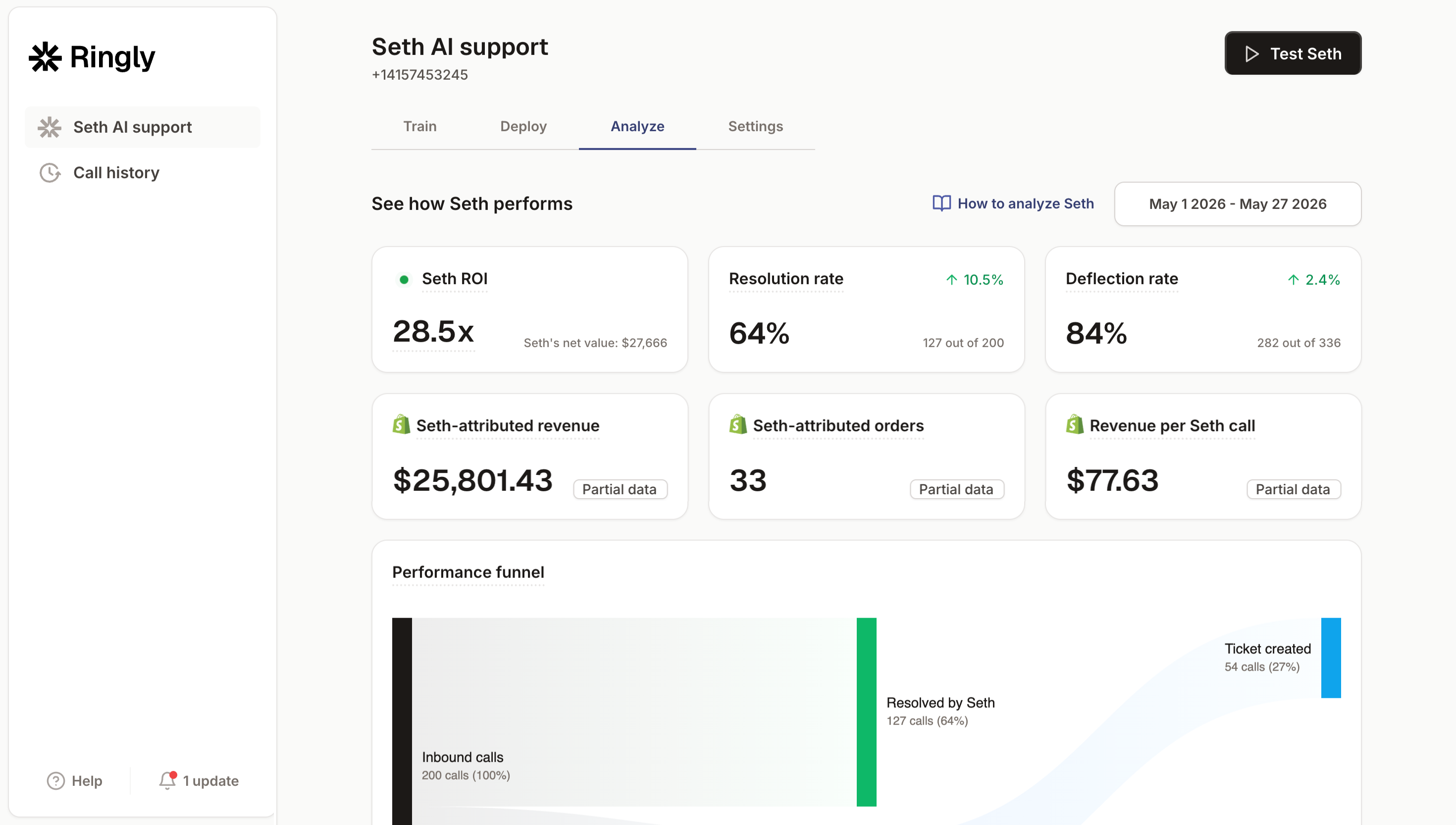
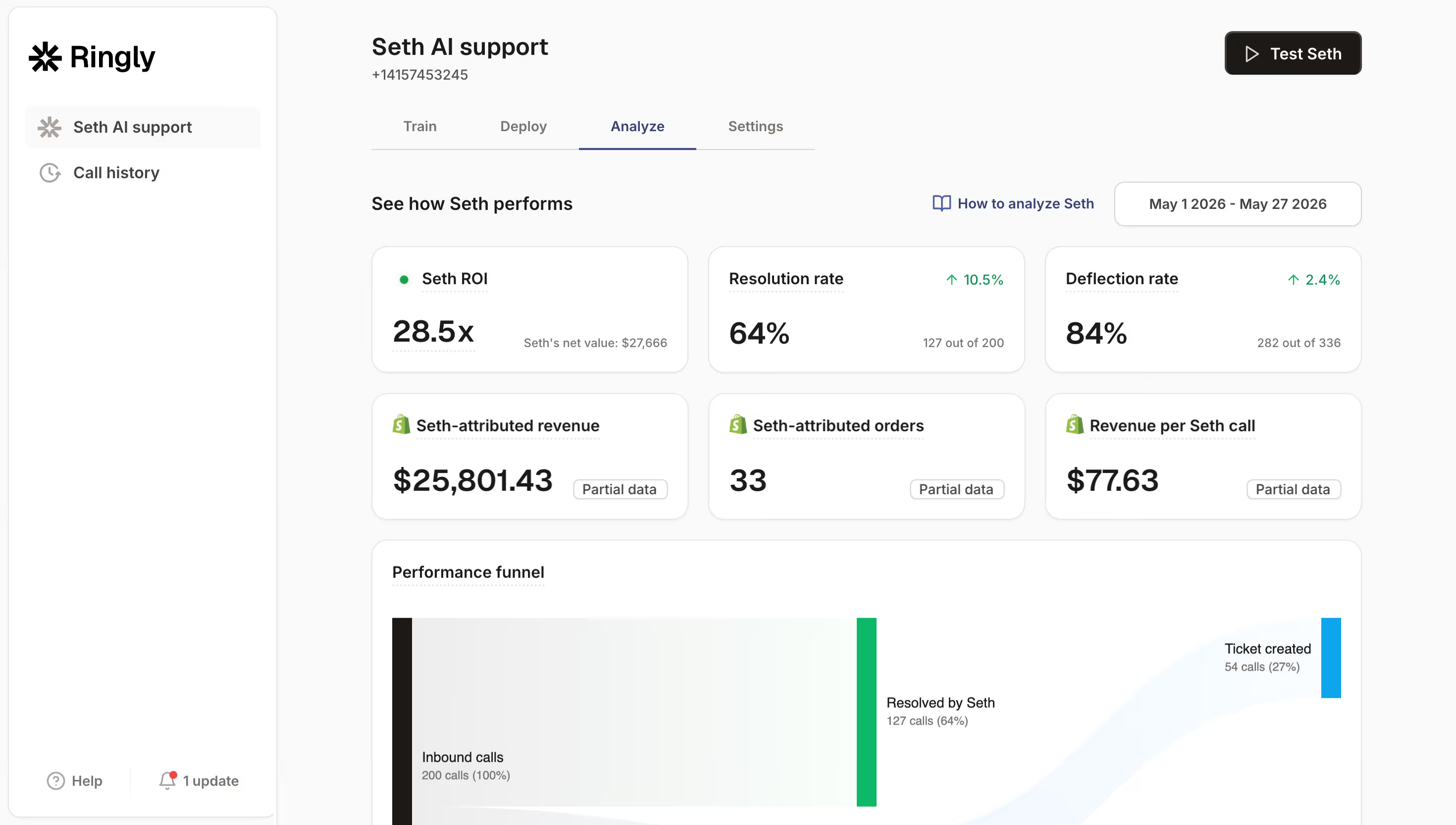
The AI answers inbound calls 24/7 in 40 languages. It finds orders in your Shopify store, processes returns and exchanges, answers product questions from a knowledge base built off your own site, and rescues stalled carts with outbound follow-up. Across 50+ brands it resolves 73% of calls autonomously at roughly $0.42 per resolved call. Calls that need a person escalate cleanly to Gorgias, Richpanel, Re:amaze, or whatever helpdesk you already run.
What works: real Shopify order lookup on the call, flat published pricing, live in under an hour, and a 65% resolution guarantee. What to know: it's phone-first and built for ecommerce, so if you need a general-purpose office receptionist for a non-store business, it's the wrong tool. Plans: Grow $349/mo, Pro $799/mo, 14-day free trial on Pro.
Ruby
Best for: businesses that want a human-only voice and can absorb per-minute cost.
Ruby is human-staffed live reception. Real people answer, take messages, and route calls. It scores 4.7/5 on G2 across 200+ reviews, and people genuinely like the warmth. The catch for a store: no order lookup, no Shopify integration. A Ruby receptionist logs a WISMO call and passes it to your team, it doesn't resolve it. Pricing runs $245 to $1,640/mo by minute bucket, and Trustpilot carries 844 reviews plus the documented 2021 billing lawsuit.
Smith.ai
Best for: law firms and service businesses that want a human safety net on every call.
Smith.ai runs a hybrid model, AI intake with live agents behind it, and rates 4.6-4.7/5 on G2. It's a solid pick in its lane. For a Shopify brand the gaps are that it isn't built around order data and the add-on billing (appointment booking, call recording, and the like at about $2.25/call) is exactly the "will the bill blow up" problem a DTC operator already worries about. If you're weighing it, we wrote up the Smith.ai alternatives for AI answering with the ecommerce angle spelled out.
ReceptionHQ
Best for: solo operators wanting a cheap human answering baseline.
ReceptionHQ is human-staffed with a US-day, Australia-night model, starting around $25-$49/mo plus per-call fees. It's inexpensive and fine for message-taking. The gaps for a store: no access to your order data, and after-hours calls route to a different country's team, so consistency varies. Trustpilot sits around 3.9/5.
RingCentral AI Receptionist
Best for: businesses already inside the RingCentral phone system.
RingCentral's AIR bolts AI call handling onto their phone platform. If you already live in RingCentral, it's convenient. The real-world limits show up in reviews: a 500-character knowledge-base limit, reports that it "ignores uploaded documents," and overage billed at $0.50/min counting a one-second pickup as a full minute. Its G2 sample is thin, only 6 verified reviews. For a store those KB limits are a direct problem, since your whole value is the agent knowing your products and policies. See the RingCentral alternatives breakdown for the ecommerce comparison.
CloudTalk
Best for: teams already running CloudTalk's call-center software.
CloudTalk's AI receptionist starts around $99/mo and handles overflow well for teams already on their platform. It's a general business-phone tool though, with no Shopify integration, so it won't look up an order or start a return. The CloudTalk alternatives guide covers where an ecommerce-native option pulls ahead.
So how do you choose? If you mostly need messages taken and routed and your volume is low, a human service like Ruby or ReceptionHQ is fine. If you already live inside a phone system and just want overflow handled, RingCentral or CloudTalk make sense. And if your after-hours calls are order-status, returns, and product questions that you want resolved rather than logged, an ecommerce-native agent like the Shopify phone agent is the only category that closes the call. For the wider view of the space, our roundup of 24/7 ecommerce phone support and the general virtual receptionist service guide are good next reads.
Frequently asked questions
What is a 24 hour virtual receptionist? It's a service that answers your inbound phone line 24/7 so calls never hit voicemail. It can be human-staffed, AI, or a hybrid of both. The key difference for a store is whether it just takes a message or actually resolves the call.
How does a 24/7 virtual receptionist work (human vs AI vs hybrid)? Human services route your calls to real receptionists who take messages and pass them on. AI services answer the call with software that can look things up and act on them. Hybrid puts AI on intake with a human backstop for anything it can't handle.
How much does a 24 hour virtual receptionist cost? Human answering services run $200-$2,000/mo plus $0.75-$1.50 a minute. AI phone agents are usually flat monthly: Ringly is $349/mo (Grow) or $799/mo (Pro). Staffing your own night shift runs $150,000-$200,000+ a year.
Is a virtual receptionist worth it for a small ecommerce business? If you're doing real call volume and dropping after-hours calls, yes, because roughly a third of your calls land after hours and many are about orders. If you barely get phone calls, wait until you do. The math works once missed calls are costing you actual orders.
Will customers know they're talking to AI? A good ecommerce agent sounds natural and, more importantly, is useful, because it can see the order and answer the real question. As one of our customers put it, "my customers also feel like it's a normal person." The complaint you want to avoid is a bot that sounds fine but can't actually help.
Does it work with Shopify and my helpdesk (Gorgias, Zendesk)? Ringly works with Shopify natively and sits in front of Gorgias, Richpanel, Re:amaze, Zendesk, or whatever helpdesk you already run. Every call is logged there and anything that needs a human escalates cleanly. You keep your current stack.
Can it look up my customers' order status? An ecommerce-native agent can. Ringly pulls the order from your Shopify store on the call and tells the customer where it is. Most generic virtual receptionists cannot, they only take a message for your team to action later.
What happens when it can't answer a question? It escalates to a human on your team, following rules you set, and logs the full call in your helpdesk. You decide what escalates and what the AI handles on its own. Nothing gets silently dropped.
Will per-minute or overage billing surprise me? That's the most common complaint in this category, so it's a fair question. Ringly plans are flat monthly with published overage rates, no per-call add-on stacking. And if the AI resolves under 65% of your calls in 90 days, we refund the last 3 months of subscription fees.
Talk to us

If your after-hours calls are order-status and returns, the fastest way to know if this works is to hear the AI answer your own store's calls. Not a demo video, your actual phone line, on the calls you're dropping tonight.
The 3-layer guarantee.
- Live in 14 days or it's free until launched.
- 65% resolution in 90 days or we refund the last 3 months of subscription fees.
- We keep working free until we hit 65%.
Ruben (Ringly co-founder) takes these calls personally.
Start your trial today and you get:
- A free dedicated phone number to test on, so you hear it answer real calls the same day.
- The agent built for you. We set it up, you lift zero fingers.
- It plugs into your helpdesk. Gorgias, Richpanel, Re:amaze, Zendesk, or whatever you already run.