
The short version.
- The four flows: almost every inbound call a coffee brand gets is one of four things, and three of them are routine.
- What the AI clears: Seth resolves up to 90% of inbound calls on its own, at $1.99 a call after the first 50.
- Who this is for: founders and CX leads at $10M-$100M Shopify coffee brands with a real phone number and a paid helpdesk.
Coffee customers don't email when their gift order is late. They call. And the phone is the one channel most coffee brands staff nine-to-five and leave silent the rest of the time.
So the person dialing at 9 p.m. to change their grind before the box ships, or to ask if the holiday order will land by Friday, hits voicemail. About 30% of callers put on hold or sent to voicemail hang up and never call back, and 71% of them just dial a competitor instead, according to 2026 business-phone data. That's the leak inbound call automation is meant to plug.
We work with coffee and specialty-food brands on Ringly, and when we read their actual inbound call logs, almost everything clusters into four flows. If you run customer experience at a Shopify coffee brand doing $10M to $100M and your phone backlog spikes every gift season, this is how to think about which of those calls a machine should take and which still belong to your team. Book a 30-min call and we'll map your inbound flows against your real call volume.
What counts as an inbound call for a coffee brand
Quick definition, because the word "automation" gets used for two opposite things. Inbound is the calls customers place to you: where's my order, change my grind, is this roast fresh. Outbound is the calls you place to them, like an abandoned-cart follow-up. This playbook is about inbound only.
For a coffee brand, inbound volume is lumpier than almost any other vertical: quiet most of the year, then a wall of gift-order calls in November and December. Your team isn't sized for the wall, so the wall goes to voicemail.
When you sort a coffee brand's inbound calls by what the caller actually wants, you get four buckets:
- Where's my order. "Did my subscription ship?" "When will it arrive?" "Is it coming before the weekend?"
- Change my order. Swap the roast, change the grind, update the shipping address, pause or skip the next box.
- Product and roast questions. "Which one's darker?" "Is it whole bean?" "What's the roast date?"
- The call that hurts. A spoiled shipment, a gift that arrived late, the wrong item, a refund someone's angry about.
The first bucket alone is huge. WISMO, the "where is my order" call, runs 20-40% of ecommerce support volume and up to 50% of inbound calls, per Salesforce. For a subscription coffee brand it's worse, because "where's my next box" happens every cycle, not once.
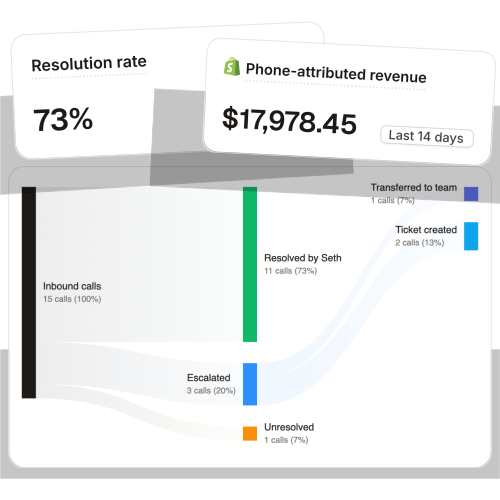
The point of automation isn't to take every call. It's to take the three buckets that repeat, so your team has room for the one that doesn't. For more on the WISMO side specifically, we broke that down in our guide to handling where's-my-order calls.
The four inbound flows, and how to automate each one
Here's the flow-by-flow version. Three of these a good AI phone agent handles end to end. One it should never try to close.
Flow 1: where's my order
This is the easy win and the biggest one. The caller wants a status and a date. An AI agent connected to your Shopify store looks up the order by name, email, or order number, reads back the tracking and the expected delivery, and texts the link if they want it. No hold, no rep, 24/7.
For a subscription coffee brand, the same flow covers "did my box ship this month" and "when's the next one." That's the question that, left to voicemail, sends people to a competitor. Wiring it to your store is the check-order-status action.
Flow 2: change my order before it ships
This one's underrated. A lot of coffee calls are someone trying to fix an order in the window before it leaves the warehouse: change whole bean to ground, swap a light roast for the dark, fix a typo in the shipping address, pause the subscription for a month.
The AI can do most of this against Shopify directly. The edge cases stay human: the order already shipped, the change touches payment, the customer wants something your policy doesn't allow. Those transfer. We go deeper on the subscription side in our coffee subscription customer service playbook.
A coffee brand that lets customers change a grind by phone at 10 p.m. without a rep keeps the order and the subscriber. A coffee brand that sends that caller to voicemail loses both.
Flow 3: product and roast questions
"Which of these is darker?" "Is this single-origin?" "How fresh is it when it ships?" These are knowledge-base questions. Feed the agent your roast notes, your grind guide, your roast-date and shipping policy, and it answers them in your voice, on the phone, instantly.
The trap here is stale or split information. One coffee brand on Trustpilot had grind preferences living in two different spots on the site, so customers kept calling confused. A single clean knowledge base the agent reads from fixes that.
Flow 4: the call that has to reach a person
A perishable order that spoiled in transit. A gift that arrived after the birthday. The wrong roast in the box right before a holiday. These are emotional, time-sensitive, and reputation-critical, and the worst thing automation can do is try to handle them.
There's a real cautionary tale here. One large coffee brand ran an automated line that told callers it was busy and then disconnected the call with no option to hold, which generated a wave of negative reviews. That's not automation working. That's a hang-up wearing a costume.
The fix is a hard-coded rule: anything that smells like a spoiled, late, wrong, or disputed order escalates to a human immediately, transferred cleanly with the context already gathered. Gear Rider, a Ringly customer, handled 1,595 inbound calls in 90 days without a phone rep, precisely because the routine calls never reached one and the hard calls always did.
Automate or escalate: the decision table
If you build nothing else, build this map. It's the whole difference between automation that earns trust and the kind that ends up screenshotted on Trustpilot.
| Inbound flow | What the caller wants | Automate or escalate | Why |
|---|---|---|---|
| Where's my order | Status + delivery date | Automate | Read-only Shopify lookup, zero risk |
| Change my order | Grind, roast, address, pause | Automate (escalate edge cases) | Safe write-back; payment/shipped cases go human |
| Product / roast question | Info from your KB | Automate | Knowledge base answers it in your voice |
| Spoiled / late / wrong / dispute | Empathy + a fix | Escalate | Emotional, time-sensitive, reputation-critical |
The split most coffee brands should aim for: the AI resolves the routine majority on its own, up to 90% of calls, and routes the rest to a human. That split is what we see across Shopify brands, and it maps almost exactly onto the four flows above.
What inbound call automation costs a coffee brand
Let's do the math the way an operator does it.
A typical $20M coffee brand runs a small team year-round and a much bigger one for the gift season:
- 4 reps year-round × $4K loaded = $16,000/mo ($192K/yr)
- 4 seasonal gift-season reps × $4K × 3 months = $48,000/yr peak
- True annual CS spend: roughly $240,000/yr
Ringly Enterprise at around $3K-$5K/mo handles the WISMO, change-order, and roast questions year-round and absorbs the gift-season spike without the temp hiring. Net savings land near $140K-$180K/yr depending on volume. Per call, the math is $1.99 on Ringly after the first 50, versus $7-$16 for a human BPO call. WashCo, a Shopify brand we launched, recovered $22,664 in its first 7 days on the phone, which is the revenue side of the same coin: the calls you were missing were also orders.
If you want to compare that against your current setup, book a 30-min call and we'll run your numbers live. You can also sanity-check tiers on the pricing page.
The cost question is really a volume question: inbound coffee calls are cheap to answer and expensive to miss.
How to set it up without breaking the calls that matter
The setup that works isn't complicated, but the order matters.
- Connect Shopify first. That powers the where's-my-order and change-my-order flows. Order lookup is the single highest-volume thing the agent does.
- Load a clean knowledge base. Roast notes, grind guide, roast-date and freshness policy, shipping and gifting cutoffs. One source of truth, not three.
- Hard-code the escalation rules before you go live. Spoiled, late, wrong-item, and refund-dispute calls transfer to a human, every time. This is the rule that protects your reviews.
- Keep your number and your helpdesk. You don't rip anything out. The AI sits in front of your phone line and escalates into Gorgias, Richpanel, or whatever you already run.
- Test with real recordings. Call it yourself. Have your team call it. Listen to the gift-order and the change-grind calls before you trust it with December.
The objection we hear most in coffee is "our older customers will hate a machine." It's a fair worry, and it comes down to voice quality. The most repeated thing customers say after a call with our agent is that it doesn't sound like AI.
"My customers also feel like it's a normal person. They feel like they can communicate if they have questions."
Claudia Droge, TechCraft Studio
For the after-hours piece specifically, here's how 24/7 phone coverage actually works, and our broader take on phone support for coffee brands if you're earlier in the decision.
Frequently asked questions
What's the difference between inbound and outbound call automation for a coffee brand? Inbound is the calls customers place to you: where's my order, change my grind, is this fresh. Outbound is the calls you place to them, like a cart-recovery follow-up. This playbook is inbound only, because that's where coffee brands leak the most revenue to voicemail.
Can AI handle "where's my order" calls for a coffee subscription? Yes, and it's the strongest use case. The agent looks up the order in Shopify, reads back tracking and the expected delivery date, and can text the link. For subscriptions it answers "did my box ship" and "when's the next one" without a rep, 24/7.
Will it take orders over the phone? Not natively, and we'd rather be honest about that. For a customer who wants to place an order by phone, the agent can send an SMS payment link or transfer to a person. If more than half your revenue is phone orders, we're not your fit yet.
What happens with a spoiled shipment or a late gift call? Those escalate to a human, on purpose. You hard-code a rule so any spoiled, late, wrong-item, or dispute call routes straight to your team with the context already gathered. Automation handles the routine so your people are free for exactly these.
Will older customers accept an AI on the phone? That's the right thing to worry about, and it's a voice-quality question. The most common reaction we hear is that it doesn't sound like AI, which matters most with the older, more skeptical buyers that coffee brands tend to have.
Does it work with my Shopify store and helpdesk? Yes. It connects to your Shopify store for order and subscription data and escalates into Gorgias, Richpanel, Re:amaze, or whatever helpdesk you already run. You keep your number and your stack.
How much does it cost, and is there a guarantee? Pay per call is $99 a month for the first 50 conversations, then $1.99 each. There's a 65% resolution guarantee: if Seth resolves under 65% of your calls in a month, that month comes back as credit (after 90 days on Pay per call).
Talk to us

If your phone goes quiet after five and your gift-season queue rolls to voicemail, a 30-min call is the fastest way to see what those missed calls are costing you. We'll map your four inbound flows against your real call volume and show you the split.
Our 3 promises.
- Live in under 1 hour. Setup and test calls are free.
- 30-day money back on the $99 plan fee.
- 65% resolution guarantee: if Seth resolves under 65% of your support calls in a month, that month comes back as credit (after 90 days on Pay per call).
Ruben (Ringly co-founder) takes these calls personally.