
This post in 30 seconds.
- A coffee caller judges your whole brand by one phone call, so an AI customer service agent's real job is to make that call land the same way every time, not just to take it off your reps' plate.
- Across 50+ Shopify brands the agent resolves 73% of inbound calls on its own, and the service quality doesn't dip in December the way a green seasonal team's does.
- Built for $10M-$100M Shopify coffee brands that keep a paid helpdesk and a visible phone line, and watch the experience get inconsistent the busier they get.
Search "AI customer service agent for coffee brands" and most of what comes back is for the cafe down the street: order kiosks, barista assistants, a chatbot that helps someone pick a latte. None of that is the problem a DTC coffee brand has. Your problem is the phone line on your contact page, the one that rings most when the roastery is dark, and the fact that the person who picks up sets the tone for how your brand gets remembered.
If you run support or operations at a Shopify coffee brand doing $10M-$100M, you already know the calls: where's my order, will it still be fresh, can you move my gift's delivery, pause my subscription, which grind do I need. The question this post answers isn't "can software take those calls." It's "can it deliver the same service your best rep would, every time, including the week before Christmas when your team is buried." If you want to skip the reading, book a 30-min call and we'll pull your last week of calls and grade the service quality together.
What an AI customer service agent actually is (and what it isn't)
Start by ruling out what the search results are selling you. A coffee-shop order bot takes a drink order at a counter. A website chatbot answers a typed question in a widget. Neither of those is a customer service agent for a coffee BRAND, and neither touches the channel that actually breaks for you.
An AI customer service agent for a coffee brand is a voice agent that answers your phone and delivers a finished service outcome, not a deflection. It picks up, understands the caller, reads your live Shopify order, gives a real answer in your brand's voice, and either resolves the call or hands it to a person. The difference between that and a chatbot bolted onto a phone line is the difference between a rep and a phone tree.
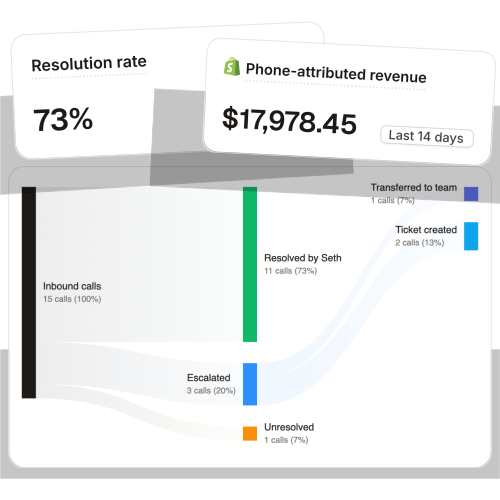
This matters more for coffee than for almost any other category. Your customers skew older than a typical DTC brand's, and a lot of them call instead of typing. When they call, they're not just looking for an answer. They're forming an opinion about whether you're the kind of brand that has its act together. That's why we treat the agent as a member of the service team, configured with your tone and your knowledge, rather than a gadget that "automates" anything. If you want the deeper version of how a voice agent handles this channel, we wrote that up in voice AI for coffee brands.
The service-quality bar a coffee caller actually holds you to
Here's the reframe that the tool roundups miss. A coffee customer on the phone isn't grading you on whether a bot answered. They're grading you on four things, and so should you when you evaluate any agent.
- Accuracy. Did the answer match reality? On a freshness call that means the agent knows the roast date and the transit time, not a generic "3 to 5 business days." On a WISMO call it means it read the actual carrier scan off your Shopify order.
- Tone. Did it sound like your brand or like a call center? A specialty coffee buyer notices this instantly, and an off-brand voice cheapens everything else you spent money building.
- Follow-through. Did the thing the caller asked for actually happen? Pausing a subscription means the next box doesn't ship, not that the caller gets told "someone will look into it."
- Escalation judgment. Did it know when to stop and get a human? A spoiled-gift complaint is not a call to win on autopilot.
Where's-my-order alone runs 30-40% of ecommerce support tickets and climbs past 50% at peak (Salesforce), so the agent that nails accuracy and follow-through on that one call is already carrying the bulk of your service load. Get those four dimensions right and the caller hangs up thinking your brand is buttoned-up. Miss one and they remember the brand as the one that disconnected them, which is a real coffee-brand failure mode (Black Rifle's automated line has hung up on callers mid-queue, per its Trustpilot reviews).
Service quality isn't a soft metric here either. Research from Oliver Wyman found that variations in customer experience account for up to one-third of the difference in sales and profitability between a chain's individual stores, and where service got more consistent, sales typically rose at least 10% (Perfect Daily Grind). The spread between your best phone interaction and your worst is leaking money.
Why consistency is the real argument for an AI agent
A human team's service quality is a band, not a line. Your best rep on a Tuesday morning is excellent. The same rep at 5:55 p.m. on the Friday before a holiday, on their fortieth "where's my gift" call, is not. And the temp you hired in October to survive December is delivering your worst service in your highest-stakes window, to the customers who are buying gifts and judging hardest.
An AI customer service agent collapses that band to a line: call number one and call number four thousand get the same accuracy, the same tone, and the same follow-through. It doesn't get tired, it doesn't improvise off-script, and it gives the December gift-buyer the exact answer it gave the March subscriber.
That consistency is what customers actually expect, and what they punish you for missing. Verint found 70% of consumers say they'd switch to a competitor after a poor service experience, and the single biggest driver of "poor service" is having to call a company repeatedly to get something handled (Nextiva). PwC puts it sharper: 32% of customers will walk away from a brand they love after one bad experience, and 59% leave after several (Envive). Coffee is a repeat-purchase, subscription-heavy business, so each of those walk-aways is recurring revenue, not a one-time order.
Gear Rider, a brand on Ringly, handled 1,595 calls in 90 days without a phone rep on the line, which is the kind of volume where human consistency falls apart but an agent's doesn't. Brand voice holds up the same way. You configure it once and it sounds the same on every call, which is the part skeptical coffee customers notice first.
"My customers also feel like it's a normal person. They feel like they can communicate if they have questions."
Claudia Droge, TechCraft Studio
How I tested an AI agent's service quality on a coffee call flow
I'm Ruben, co-founder of Ringly. We run AI phone support for 50+ Shopify brands, so I look at this as the person who has to keep the service bar up, not as a vendor running a happy-path demo. Before writing this I spent a few days putting our own agent through a real coffee call flow and scoring it the way a CX lead scores a new rep on a ride-along: not "did it answer," but "would I let it represent the brand unsupervised."
Here's what I actually graded:
- Accuracy on freshness. I loaded a knowledge base with roast dates, origin notes, and a grind guide, then asked the freshness question a real caller asks. I checked whether it gave the roast date and a real transit window, or hid behind a canned shipping estimate.
- Tone against a brand guide. I wrote a short voice guide ("warm, a little nerdy about coffee, never corporate") and listened to whether the agent actually sounded like that, or defaulted to call-center cadence.
- Follow-through on a subscription. I connected a test Shopify store with a live subscription and asked it to skip a delivery, then confirmed the next box was actually paused, not just acknowledged.
- Disambiguation. Coffee buyers describe products by name, not SKU. I gave it the vague request that trips chatbots ("send me the dark one, ground for a Moka pot") to see if it asked the right clarifying question instead of guessing wrong, the way Trade Coffee's site kept shipping the wrong grind.
- Escalation judgment at 11 p.m. I called after midnight with a messy "my gift arrived smashed" complaint to confirm it handed off to a human instead of trying to resolve an emotional call on its own.
It cleared accuracy, tone, and follow-through, and it escalated the complaint instead of fumbling it. That's the bar. If an agent can't read your Shopify order graph or doesn't know what a roast date is, it isn't built for a coffee brand, no matter what its marketing page claims.
What it handles to a finished outcome, and what it hands off
Good service isn't the agent doing everything. It's the agent doing the routine work completely so your people get the calls that need a person, with time to do them well.
The calls it should close on its own:
- WISMO with a freshness tail. It pulls the order from Shopify, reads the tracking, and reassures on roast date and transit in one breath. The full ticket math is in our WISMO calls breakdown.
- Gift timing. "Will it arrive before the 24th?" Same order lookup, framed around the arrival date the caller cares about. The FTC requires sellers to ship within the window they promised or offer a refund (FTC), so a confident, accurate ETA is service and compliance at once.
- Subscription skip and swap. It reads the subscription and runs the change as a defined action, which is the single biggest churn-saver in coffee. We go deeper in the coffee subscription customer service playbook.
- Grind and roast questions. Answered from the knowledge base you already wrote.
The call it shouldn't:
A spoiled-gift call or a twice-wrong order is an emotional call, and good service means a person picks it up, fast. So you hard-code an escalation rule with smart call transfer: anything that reads as a complaint, a refund dispute, or an upset caller goes to your team. Treating escalation as a feature, not a failure, is what separates an agent that protects your brand from a bot that traps people in a loop. Death Wish Coffee learned the hard way what the loop costs, with reviewers reporting unanswered calls and ignored emails despite a stated two-day promise.
What consistent service is actually worth
Coffee brands can usually limp along with the existing phone setup eleven months a year. November and December are where the service quality cracks, and that's the window where it counts most.
A typical $20M coffee brand staffs a small team year-round and a much bigger one for the gifting season:
| Line item | Today | With an AI agent |
|---|---|---|
| 4 reps × $4K loaded, year-round | $16,000/mo | n/a |
| 4 seasonal reps × $4K × 3 months | $48,000/yr peak | n/a |
| AI customer service agent (~$3K-$5K/mo) | n/a | ~$4,000/mo |
| True annual CS spend | ~$240,000/yr | ~$48,000-$60,000/yr |
| Annual savings | n/a | ~$140,000-$180,000/yr |
The agent absorbs the roast-date, gift-order, and subscription calls year-round and swallows the gifting spike at the same cost it runs the rest of the year. The savings are real, but the bigger win is that your December service quality stops being the worst service you deliver all year. Across 50+ brands the agent holds 73% resolution, and unlike a green seasonal team, that number doesn't slide when volume triples. WashCo, a brand we launched, recovered $22,664 in its first seven days on the phone, which is the revenue side of the same coin: calls that used to roll to voicemail get answered and turn into orders instead.
Want us to run this math on your real numbers? Book a 30-min call and we'll do it live off your call logs.
How to deploy it without cheapening the experience
The fear with any AI on the phone, especially for an older coffee demographic, is that it sounds cheap and undoes the service quality you built. That's a setup problem, not a technology problem. Here's the order that keeps the bar high:
- Write the knowledge base first. Roast dates, origin notes, a grind guide, your shipping windows, your subscription rules. The agent is only as accurate as what you give it. See check order status for the live-order piece.
- Configure the brand voice before you go live. Tone is a setting, not an afterthought. Inconsistent brand presentation already confuses customers for 71% of businesses (Envive), so don't let the phone be the channel where you drift.
- Set escalation rules early. Decide which calls always go to a human and write the rule before launch, not after the first angry caller.
- Demo the voice to a skeptic. Call the line yourself and have your most AI-wary teammate call it. If it passes the person who didn't want it to work, it'll pass your customers.
Choose an AI customer service agent if you run a Shopify coffee brand with real phone volume, a seasonal spike, and a service reputation you don't want to gamble in December. If more than half your revenue is genuinely phone-placed orders, you're a different case, and you should talk to us about routing before you buy anything. More on the broader setup in coffee brand customer service and our take on keeping it running 24/7.
Frequently asked questions
What's the difference between an AI customer service agent and a chatbot for a coffee brand?
A chatbot answers typed questions in a website widget. An AI customer service agent answers your phone, reads your live Shopify order, and resolves the call or transfers it to a person. For coffee, where customers skew older and call instead of typing, the phone agent is the one that touches your real service load.
Will it sound robotic or off-brand to older coffee customers?
Tone is configurable, and good agents sound close enough to human that callers tell us it feels like a normal person. The fix for the older-demographic worry is to demo the voice before launch and let your most skeptical teammate try to break it.
Can it handle subscription skips and pauses?
Yes. It reads the subscription off Shopify and runs the skip, swap, or pause as a defined action, so the change actually happens instead of becoming a ticket. Full cancellations are usually set up as a separate action or an escalation, depending on how you want to handle save offers.
What happens on a complaint or a spoiled-gift call?
It escalates to a human. You hard-code an escalation rule so anything that reads as a complaint, a refund dispute, or an upset caller transfers to your team. Escalation is the feature, not the failure.
Does it work with Shopify?
Yes. It connects to your Shopify store to read orders, tracking, and subscriptions, which is what lets it give accurate freshness and ETA answers instead of canned ones. That live order access is the difference between real service and a phone tree.
How much does it cost, and what's the ROI?
Plans start at $349/mo for lower volume; brands with real call volume usually land in a custom range. A typical coffee brand spending around $240K a year on a year-round plus seasonal team saves roughly $140K-$180K a year while making December service more consistent, not less. See pricing for the published tiers.
Talk to us

If you run a $10M-$100M Shopify coffee brand and your service quality gets shaky exactly when it matters most, a 30-min call is the fastest way to hear what your phone line sounds like today and what it could sound like.
The 3-layer guarantee.
- Live in 14 days or it's free until launched.
- 65% resolution in 90 days or we refund the last 3 months of subscription fees.
- We keep working free until we hit 65%.
Ruben (Ringly co-founder) takes these calls personally.