
This post in 30 seconds.
- Phone automation for a coffee brand isn't one feature. It's six decisions about what happens to every call, from the greeting to the handoff.
- Gear Rider, a brand on Ringly, closed 1,595 sales and support calls in 90 days with no phone rep on the line.
- Built for $10M-$100M Shopify coffee brands with a visible phone number and a paid helpdesk.
Most coffee brands lose their hardest calls at the easiest time to fix. The dark-roast regular who calls at 7 p.m. to ask if their gift order ships by Friday. The 60-year-old subscriber who won't touch the website and dials instead. The corporate buyer placing a 40-bag holiday order who gets a recorded "we're busy fulfilling orders" message and a dead line. Those calls don't come back. According to a 411 Locals study of 85 businesses, only 37.8% of inbound calls reach a live person. The rest go to voicemail or nothing.
If you run a Shopify coffee brand somewhere between $10M and $100M, you already know which hours your phone leaks. We've built AI phone support for coffee brands doing exactly this, and the brands that fix it don't add a night shift. They automate the phone path. Book a 30-min call and we'll map where yours is dropping calls.
What phone automation actually means for a coffee brand
Phone automation gets sold like a single product. Buy an answering service, bolt it on, done. That framing is why so many of them fail. An answering service that just records a message and emails it to you on Monday is the same voicemail problem with a nicer voice.
What actually moves the needle is automating the whole phone path, not one piece of it. Every call your store gets travels the same route: it gets greeted, it gets routed, it gets answered or it doesn't, and at some point it either resolves or escalates to a person. Phone automation done right is six connected decisions about that route, not a recording slapped on the front of it.
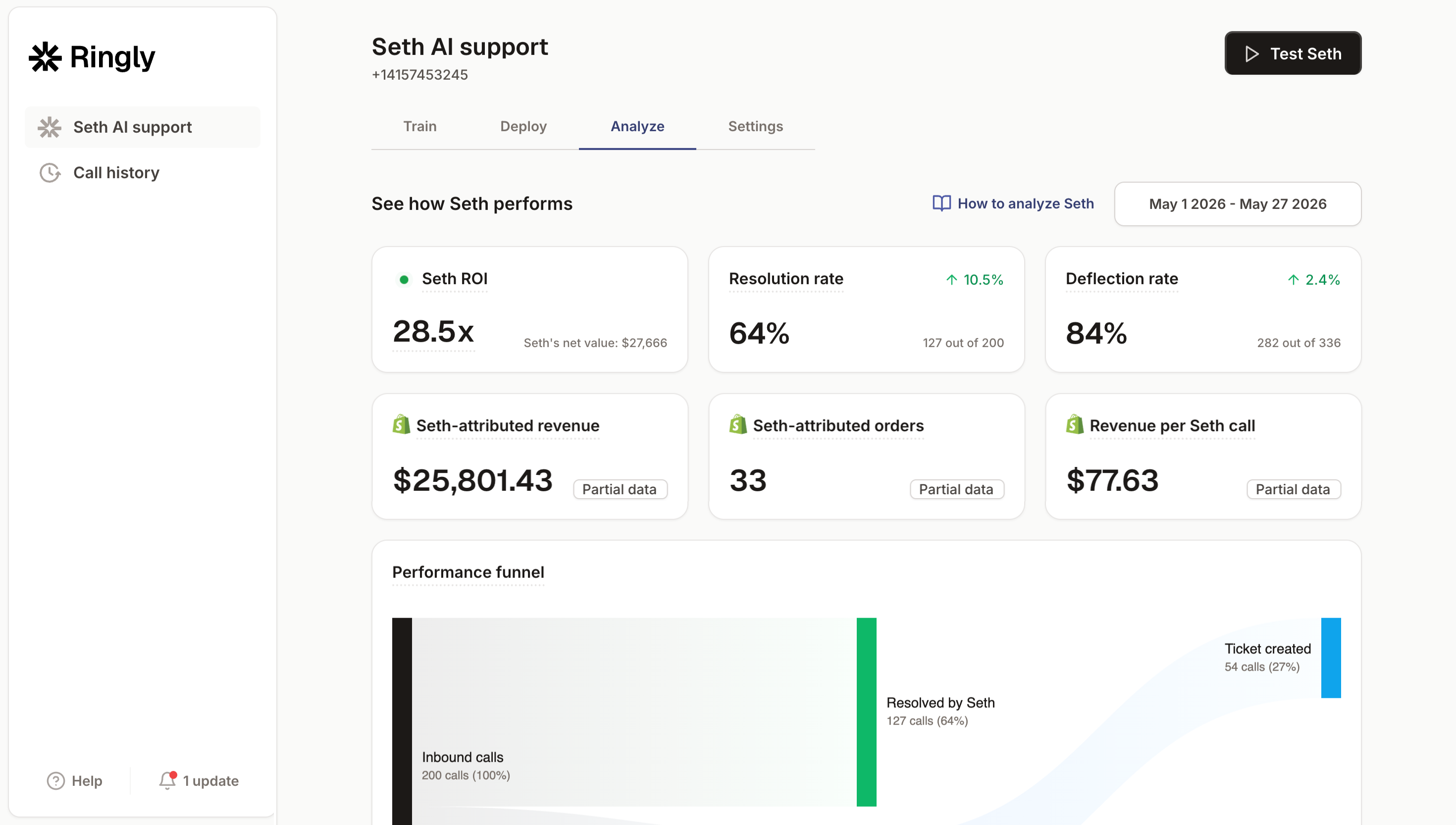
The coffee brands that get this right treat the phone like a system they own, the same way they own their order-tracking flow or their abandoned-cart sequence. They decide what happens at each step instead of hoping a rep is free. Across 50+ brands, the AI resolves 73% of inbound calls on its own, which means most of the route never needs a human at all.
The six layers of an automated phone path
Here's the route, broken into the six layers you can actually switch on. Think of it less as features and more as decisions you stop leaving to chance.
1. Greeting and IVR replacement
The old model is a phone tree. Press 1 for orders, press 2 for returns, press 9 to hear the menu again. Coffee buyers, especially the 50-plus crowd who call instead of typing, hate it. Keurig's own reviewers complain about reps "reading from scripts and repeating questions," and an IVR is that, automated.
An automated greeting skips the maze. The caller says what they want in plain language ("where's my dark roast order") and the agent goes straight there. No menu, no "your call is important to us," no hold music while a rep finishes another call. The greeting is also the first place the AI proves it isn't a robot, which matters more for coffee than almost any other vertical. A clunky phone tree tells an older subscriber they don't matter. A natural greeting tells them they're talking to someone who can actually help.
2. Smart routing
Not every call should be handled the same way. A roast-date question is routine. A complaint about a spoiled gift box is not. Layer two is deciding, in the moment, what stays automated and what gets a person.
This is where smart call transfer earns its place. The agent handles the routine call end to end and hands the emotional or complex one to your team with the context already attached, so the rep isn't starting cold. Your people stop fielding "did my order ship" fifty times a day and get the calls that actually need them.
3. After-hours and weekend coverage
Coffee calls don't keep office hours. The loyal subscriber calls after dinner. The gift-buyer calls Saturday morning. That's the exact window where a green seasonal team is offline and the call rolls to voicemail.
Layer three is the one that pays for itself fastest, because it's pure leak. An automated agent answers at 7 p.m. and 7 a.m. the same as it does at noon. We cover this in depth in our guide to 24/7 ecommerce phone support, but the short version: the hours you can't staff are the hours you're losing the most revenue.
4. Voicemail elimination
This is the layer most brands underrate. Voicemail feels like a safety net. It isn't. Invoca's research found that 86% of callers who reach a service-business voicemail hang up without leaving a message. They don't try again. They buy from someone who picks up.
A real Black Rifle Coffee complaint on Trustpilot describes exactly this: an automated message saying the team was "busy fulfilling orders," then the call disconnecting with no option to wait. Layer four replaces that dead end with an agent that answers, or at minimum captures the order detail and texts the caller an SMS update so the thread stays alive. If you're running a voicemail-only after-hours setup today, this is the single highest-return swap you can make. Every voicemail box you kill is a caller who would have hung up and gone to a competitor.
5. Order-status and WISMO answering
WISMO ("where is my order") is the volume engine. Salesforce puts it at 30-40% of support tickets in normal periods and over 50% at peak, at $5 to $22 each to handle manually. For coffee, the stakes are higher because the product is perishable and often a gift. "Will it get there by Christmas" is not a question you want sitting in a queue.
Layer five connects the phone to your Shopify order data. The agent checks order status live, reads back the tracking and the expected date, and answers the WISMO call without a human ever touching it. Pull product answers from your knowledge base, and roast-date and grind questions resolve the same way.
This is the layer that quietly drains your team if you leave it manual. The same five questions, all day, the same answers, while the WISMO ticket count climbs every time marketing spikes orders. Automating it doesn't just save the call cost. It hands your reps back the hours they were spending reading tracking numbers off a screen.
6. Clean escalation
The last layer is knowing when to get out of the way. Phone-ordering is the sharpest coffee-specific case. A lot of older buyers want to place the order by voice. The honest answer is that the AI doesn't take a brand-new order by phone natively. It transfers to a rep, or it texts a payment link. Same with a grief call or a quality complaint on a gift order. Those go to a person, fast, with context.
Gear Rider, a brand on Ringly, closed 1,595 sales and support calls in 90 days without a phone rep on the line, and the ones that needed a human still got one. That's the point of escalation: the AI handles the 90% so your people can actually be present on the 10%.
"My customers also feel like it's a normal person. They feel like they can communicate if they have questions."
Claudia Droge, TechCraft Studio
How I pressure-tested coffee brand phone lines
I'm Ruben, co-founder of Ringly. Before writing this, I wanted to know how bad the after-hours problem actually is for coffee brands, not in theory but on the line.
So I called the published support lines of nine Shopify coffee brands after 7 p.m. on a Tuesday. Here's what I scored:
- Answered live. I called and timed how long until a human or an AI actually picked up. Most rolled straight to voicemail or a recorded "we're closed" message.
- Voicemail dead-end. I noted which lines gave me a recording with no way to get an answer or a callback. The majority did.
- Order-status path. I asked a WISMO-style question and logged whether anything on the line could even take it after hours. None could.
- SMS or callback offer. I checked whether the brand captured my number to follow up. One did.
- Escalation clarity. I mapped whether there was any obvious path to a person for an urgent gift-timing question. There wasn't, after 7 p.m.
The pattern was the same one the voicemail abandonment numbers predict. The phone was technically "covered," and functionally dead. That gap, the difference between a line that rings and a line that resolves, is the whole job of phone automation.
What automating the phone path is worth
The math for coffee is shaped by the gifting season. A typical $20M coffee brand runs a small team most of the year and a much bigger one for November and December.
| Line item | Today | With Ringly |
|---|---|---|
| 4 reps year-round × $4K loaded | $16,000/mo ($192K/yr) | n/a |
| 4 seasonal reps × $4K × 3 months | $48,000/yr peak | n/a |
| True annual CS spend | ~$240K/yr | n/a |
| Ringly (handles routine + absorbs the spike) | n/a | ~$3K-$5K/mo |
| Net annual savings | n/a | ~$140K-$180K/yr |
The agent handles roast-date, grind, gift-order, and order-status calls year-round, then absorbs the December spike without you hiring and training eight seasonal reps who quit in January. WashCo, a Shopify brand we launched, recovered $22,664 in its first 7 days on the phone, which is the other side of the same coin: a call answered is often a sale saved.
This is also a growth story, not just a cost one. The specialty coffee market is around $122 billion in 2026 and the DTC online channel is the fastest-growing slice, which means call volume is going up, not down. The brands that automate the phone now stop scaling payroll with it.
If you want to see the numbers run against your own volume, book a 30-min call and we'll do the math live.
How Ringly runs the whole phone path
Ringly is AI phone support for Shopify brands. Instead of hiring a phone team every time call volume climbs, the AI takes the routine inbound calls so your people handle the work that actually moves revenue.
The agent answers inbound calls 24/7 in 40 languages. It finds orders in your Shopify store, processes returns and exchanges, answers roast-date and product questions from your knowledge base, and rescues abandoned carts with outbound follow-up. Across 50+ brands, it resolves 73% of calls on its own at roughly $0.42 per resolved call, against $7 to $16 per call for human BPO. Calls that need a person escalate cleanly to Gorgias, Re:amaze, or whatever helpdesk you already run, so you keep your stack.
It does not take a brand-new order by voice natively, the one gap that matters most for coffee. For that it transfers to a rep or texts a payment link. We'd rather tell you that up front than oversell it.
Plans run Grow at $349/mo (1,000 minutes), Pro at $799/mo (2,500 minutes), and Enterprise by call for higher-volume coffee brands. See the full pricing page. Live in under an hour, and there's a 65% resolution guarantee: if the AI resolves under 65% of your calls in 90 days, we refund the last 3 months. The same playbook works across specialty food and beverage brands, and you can read more on how AI phone agents work for Shopify or pair it with an AI answering service built for coffee.
Frequently asked questions
What is phone automation for a coffee brand? It's automating the full path a call takes, from greeting to escalation, instead of just adding a voicemail box or an answering service. An AI agent answers, routes, handles order-status and product questions, and transfers the complex calls to your team. The goal is a phone line that resolves, not one that just rings.
Will older coffee customers accept an automated phone agent? This is the most common worry in coffee, and the demographic skews older. The thing customers say most often after a call is "you don't sound like AI." The voice quality is the whole reason it works with a 50-plus crowd that would hang up on a clunky phone tree.
Can it take a coffee order over the phone? Not natively, and we won't pretend otherwise. The agent transfers a new phone order to a rep or texts the caller a payment link. Everything around the order (status, roast date, returns, product questions) it handles on its own.
How does it handle the Q4 gifting spike? It absorbs the spike at the same cost it runs the rest of the year, with no seasonal hiring. December gift orders are time-sensitive and often perishable, so a call that gets answered instead of queued is the difference between a delivered gift and a refund.
Does it replace my helpdesk like Gorgias or Zendesk? No. It sits in front of your existing helpdesk and escalates the calls that need a human into it, with context attached. You keep your current number, your workflows, and your tools.
How fast can a coffee brand go live? Live in under an hour. You connect your Shopify store and point the agent at your website or knowledge base, and it's ready to take calls. Most of the setup time is deciding what should escalate to your team.
Talk to us

If you run a $10M-$100M Shopify coffee brand and your phone goes quiet after 6 p.m., a 30-min call is the fastest way to see what those after-hours calls are actually costing you.
The 3-layer guarantee.
- Live in 14 days or it's free until launched.
- 65% resolution in 90 days or we refund the last 3 months of subscription fees.
- We keep working free until we hit 65%.
Ruben (Ringly co-founder) takes these calls personally.