
This post in 30 seconds.
- A virtual receptionist for a coffee brand answers the phone 24/7, finds the order in Shopify, handles the roast-date and ship-by questions, and routes the rest to a human. The AI version resolves about 73% of those calls on its own.
- The calls that matter most (gift deadlines, subscription saves) come in after 6 p.m. and on weekends, exactly when no human is at the desk.
- Built for founders and CX leads at $10M-$100M Shopify coffee brands running a real helpdesk and a phone line that goes to voicemail at night.
Coffee callers don't ring during business hours. They ring at 9 p.m. with a gift deadline, and your front desk is empty. I called the published support lines of several specialty-coffee brands one weeknight after six, and every single one gave me voicemail or an automated line that said it was busy and hung up. That caller doesn't leave a message. They order their dad's holiday gift from the next roaster down the search results.
If you run a coffee brand on Shopify doing $10M-$100M, you already know the phone is a strange channel. A real chunk of your revenue comes from older customers who don't want to type a card into a website, plus gift buyers in a hurry and subscribers checking on a shipment. None of them are calling Tuesday at 2 p.m. They call nights and weekends, and that's the front desk you can never quite afford to staff. If your phone goes to voicemail after six, book a 30-min call and we'll show you what those missed calls are quietly costing you.
What a virtual receptionist actually does for a coffee brand
Strip away the buzzwords and a virtual receptionist is one thing: the person (or system) that picks up when someone calls your brand. For a coffee company, that job is specific. It's not "answer the phone." It's answer the phone, know which roast the caller is asking about, find their order in Shopify, tell them whether it ships before the holiday, and only pull in a human when the call actually needs one.
A good virtual receptionist resolves the routine call end to end, not just greets the caller and takes a message. That distinction is the whole game. A message-taker still leaves your team a pile of callbacks the next morning. A receptionist that resolves the call closes it on the spot.
Here's what the AI version handles on a live coffee-brand line:
- Where's my order. It looks up the order in your Shopify store and reads back the status, the tracking, and the expected delivery. WISMO is 30-40% of support tickets in normal weeks and over 50% at peak, according to Salesforce.
- Roast and ship timing. "When was this roasted?" and "will it get here by Friday?" are answered from your knowledge base, not guessed.
- Returns and exchanges. Wrong grind, damaged bag, duplicate subscription shipment. It processes the fix or files the exchange.
- Subscription questions. Pause, skip, change the next ship date. The save-the-subscription calls you don't want hitting voicemail.
- Everything else gets routed. A complaint that needs a person, a wholesale question, a billing dispute. It transfers cleanly to your team with the context attached.
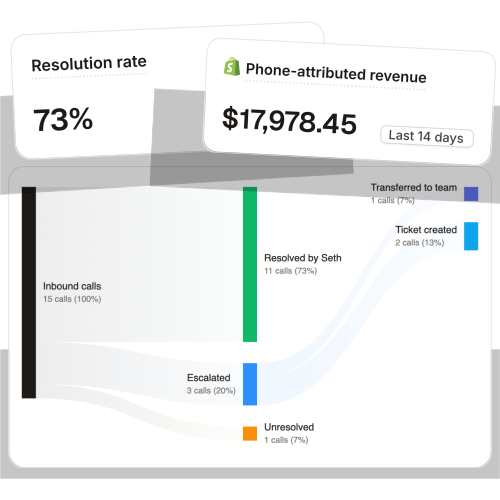
Across the 50+ Shopify brands we run, the AI resolves 73% of inbound calls without a human touching them. The other 27% are the calls your team should be on anyway. For more on the full picture of what a coffee line looks like day to day, our AI receptionist for coffee brands guide goes deeper on the after-hours pattern.
The reason this matters for coffee specifically is freshness. A bag of beans is a perishable with a clock on it, so "when was this roasted" and "will it still be fresh when it lands" aren't idle questions. They're the questions that decide whether a first-time buyer becomes a subscriber or a one-star review. A receptionist that can answer them accurately, at 9 p.m., on the first ring, is doing real retention work, not just clearing a queue.
The calls it should take, and the one it shouldn't
Most posts about virtual receptionists imply the thing will do everything. It won't, and pretending otherwise is how you end up with the Black Rifle Coffee situation, where the automated line told callers it was "busy fulfilling orders" and then disconnected them. So let's be straight about the line between what an AI receptionist owns and what it shouldn't touch.
It owns the repeatable stuff. Order status, roast and ship-by timing, returns, exchanges, subscription pause and skip, gift-order status. These are the same handful of questions over and over, and they're 70-80% of a coffee brand's call volume. Gear Rider, a brand we run, handled 1,595 calls in 90 days without a single phone rep on staff. That's the volume an AI receptionist is built to absorb.
The one it shouldn't take is the card-by-phone order. This is the sharpest tension in coffee, because a real slice of your callers are older customers who want to read a credit-card number to a human. We don't do that, and you shouldn't want an AI doing it either. Instead, the receptionist offers the caller a text with a secure payment link, or transfers them to a human if you'd rather. It tells the truth instead of fumbling a card number on a recorded line.
That honesty matters more here than in any other vertical, because your customers skew skeptical of phones-that-aren't-people. The good news is voice quality is where this is won. The single most repeated thing customers say after a call is "you don't sound like AI."
"My customers also feel like it's a normal person. They feel like they can communicate if they have questions."
Claudia Droge, TechCraft Studio
Specialty coffee is one of the few categories where customer service is treated as a core part of the brand, not a cost center. A receptionist that handles the routine warmly and routes the human calls to humans protects that. One that fumbles or disconnects torches it. If you want the call-by-call breakdown, our coffee brand phone support playbook maps which calls go where.
Your options, compared
There are really four ways to staff a coffee brand's phone, and most brands drift into one by accident rather than choosing it. Here's how they actually stack up for a $10M-$100M Shopify brand once you account for the bursty, seasonal, older-skewing call pattern coffee is known for.
| Option | What it costs | Best for | Coffee fit | Verdict |
|---|---|---|---|---|
| AI receptionist (Shopify-native) | $349-$799/mo + usage | 24/7 routine call resolution | Strong: knows the order, the roast, the ship date | Best for bursty after-hours + gifting volume |
| Human answering service | $0.75-$1.50/min or $5-$12/call | Low, steady call volume | Weak: generic scripts, no Shopify context | Cost spikes in gifting season |
| In-house front-desk hire | $4,288-$5,808/mo loaded | A dedicated human face | Poor: one person can't cover nights + weekends | Idle on bursty volume |
| Voicemail / status quo | "Free" | Nobody | Worst: loses the call when it's worth most | A slow revenue leak |
A few honest notes under the table.
A human answering service sounds like the safe choice until you read the pricing. Per-minute and per-call models, which run $0.75-$1.50 a minute or $5-$12 a call, punish you in exactly the window you need them: the Nov-Dec gifting spike. They also have zero idea what's in your Shopify store, so most calls still become a message your team works the next day.
The in-house hire is the most expensive option people underestimate. A full-time receptionist is a $51,450-$69,700 a year line item once you load in benefits, payroll tax, training, and turnover, which lands around $4,288-$5,808 a month. And one person still can't cover nights, weekends, and the holiday rush.
Voicemail feels free. It isn't. 80% of voicemail-routed callers hang up without leaving a message, and 85% of people who can't reach anyone never call back, with 62% switching to a competitor. For a coffee brand, that lost caller was often holding a gift order with a hard delivery deadline, which the FTC's holiday delivery rules make even higher-stakes.
What this costs vs a night-shift hire
The math is what makes the decision obvious. A coffee brand can't justify a dedicated overnight rep, because after-hours volume is bursty: nothing for an hour, then five calls in ten minutes when an email blast goes out or a podcast ad runs.
And the value of a single after-hours call is wildly uneven. A 9 p.m. caller asking about a gift order with a Friday deadline isn't worth one transaction. If you save that gift, you often save the relationship, because gift recipients become subscribers. A subscriber save on a save-the-skip call is a full year of LTV that would otherwise have walked to a competitor. That's the call you cannot afford to send to voicemail, and it's also the call no human is sitting at the desk to take.
Take a $20M specialty-food brand that staffs a small team year-round and scrambles for the holidays:
| Line item | Today | With a virtual receptionist |
|---|---|---|
| 4 reps year-round at $4K loaded | $16,000/mo | n/a |
| 4 seasonal reps for the Nov-Dec spike | $48,000 peak | n/a |
| AI receptionist (Grow/Pro) | n/a | $349-$799/mo + usage |
| True annual support spend | ~$240,000/yr | a fraction of it |
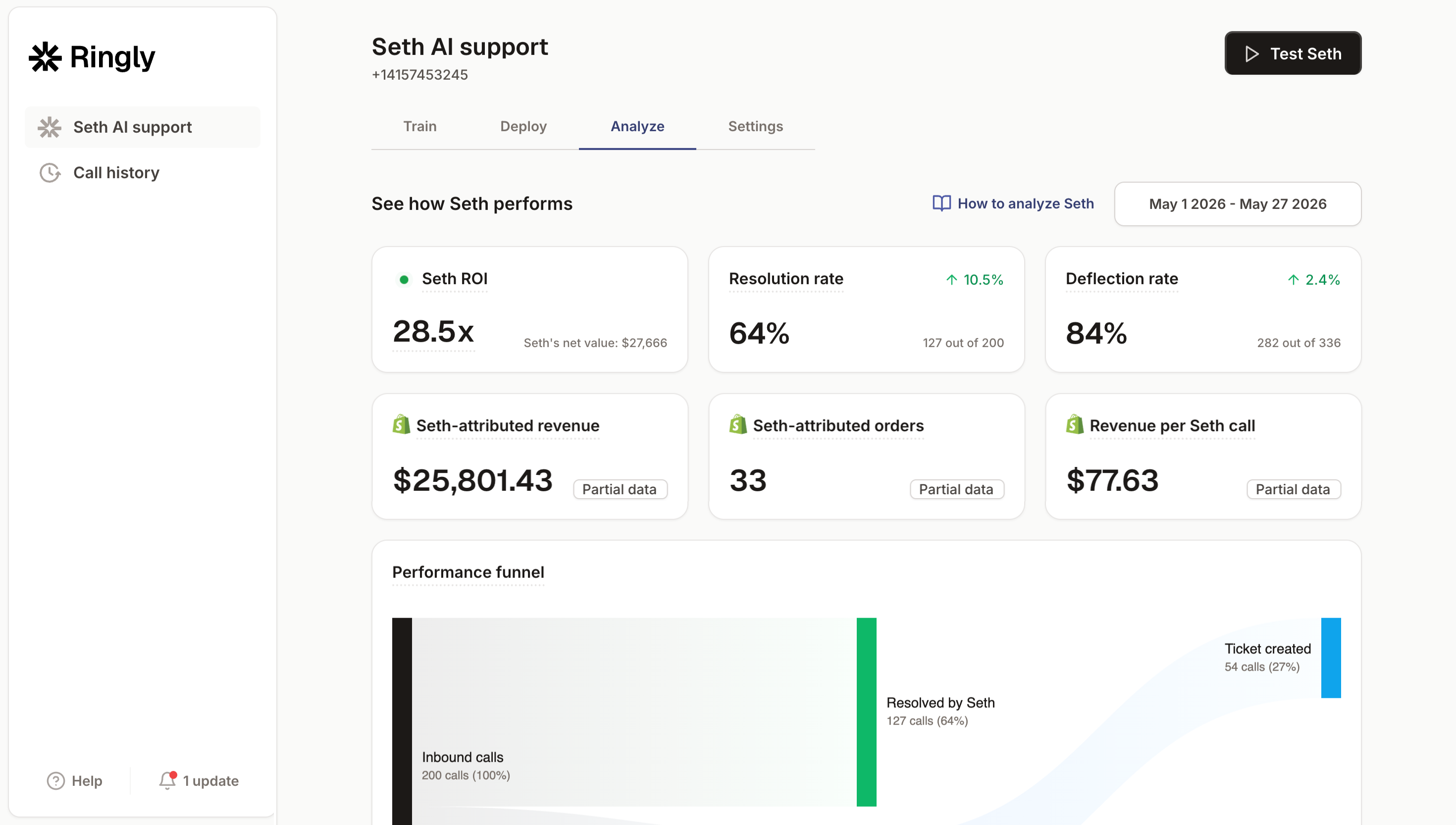
The per-call number is where it really lands. A human-handled call runs about $2.70 loaded; the AI resolves a call at roughly $0.42. WashCo, a Shopify brand we launched, recovered $22,664 in its first 7 days on the phone, which is the kind of number that shows up when calls stop going to voicemail.
You're not replacing a person with a virtual receptionist. You're covering the hours and the spikes a person was never going to cover. Your team keeps the calls that need a human. Want to see this run against your actual call volume? Book a 30-min call and we'll do the math live. Our 24/7 ecommerce phone support breakdown has more on the coverage gap, and the WISMO calls guide covers the single biggest call type.
How to set up a virtual receptionist for your coffee brand
I've set this up for coffee and specialty-food brands on Shopify enough times that the order of operations is pretty fixed. Here's how I'd run it, and how we run it for the brands we launch.
- Connect Shopify first. The receptionist needs to see orders to be useful, so the order lookup gets wired in before anything else. This is what lets it answer WISMO and check order status without a human.
- Load the roast, ship, and return knowledge. Roast dates, ship-by cutoffs, freshness answers, and your return policy go into the knowledge base so the answers are yours, not generic.
- Set the escalation and phone-order rules. Decide what transfers to a human and how the card-by-phone caller is handled, usually a secure SMS payment link or a clean transfer to your team.
- Test it after hours yourself. Call your own line at 9 p.m. and run the questions your customers actually ask. This is the step most brands skip, and it's the one that catches the awkward answers before a customer does.
- Go live before the rush. Setup runs in under an hour for a basic line, and a full done-for-you build runs on a 14-day Launch Sprint, so you're covered before the holiday spike instead of during it.
That's the whole sequence. For the full operator view, our how to handle calls for a coffee brand playbook and the coffee brand customer service software buyer's guide both go deeper, and Ringly's Shopify phone agent page shows the integration in detail. You can also check current pricing directly.
Frequently asked questions
What is a virtual receptionist for a coffee brand?
It's the system that answers your brand's phone, finds the order in Shopify, handles roast-date, ship-by, return, and subscription questions, and routes the rest to a human. The AI version does this 24/7 and resolves about 73% of calls on its own.
Can a virtual receptionist take an order over the phone?
Not by reading a credit-card number on the line, and you don't want one that does. Instead it texts the caller a secure payment link or transfers them to a human, which keeps the older customer who wants to order by phone happy without the security and fumble risk.
Will my older customers accept an AI receptionist?
This is the most common worry in coffee, and voice quality is the answer. The most repeated customer comment after a call is "you don't sound like AI," and the receptionist hands off to a human the moment a call needs one.
Does it work with my Shopify store and helpdesk?
Yes. It reads orders directly from Shopify and escalates cleanly to Gorgias, Richpanel, Reamaze, or whatever helpdesk you already run. You decide what escalates and what it handles.
How much does a virtual receptionist for a coffee brand cost?
Plans start at $349/mo (1,000 minutes) and $799/mo (2,500 minutes), with Enterprise priced by call. Compare that to a human answering service at $0.75-$1.50 a minute or an in-house hire at $4,288-$5,808 a month loaded.
What happens to calls it can't resolve?
They transfer to your team with the call context attached, so nobody starts from scratch. You set the rules for exactly which calls escalate, like complaints, wholesale, or anything emotionally heavy.
How fast can it go live before the holidays?
A basic line goes live in under an hour, and a full done-for-you build runs on a 14-day Launch Sprint. Set it up before the gifting spike, not during it.
Talk to us

If you run a $10M-$100M Shopify coffee brand and the phone goes to voicemail after six, a 30-minute call is the fastest way to see what that's quietly costing you. We'll pull the picture together with you, no deck required.
The 3-layer guarantee.
- Live in 14 days or it's free until launched.
- 65% resolution in 90 days or we refund the last 3 months of subscription fees.
- We keep working free until we hit 65%.
Ruben (Ringly co-founder) takes these calls personally.