
This post in 30 seconds.
- A receptionist for a Shopify brand isn't a front desk. It's the phone line that rings with "where's my order" all day, plus returns, gift orders, and the occasional furious VIP.
- We pulled the patterns below from 150,000 real support calls our AI has handled. Roughly 70% of them are routine and repeatable. The other 30% genuinely need a person.
- Built for founders, COOs, and Heads of CX at $10M-$100M Shopify brands with a visible phone number, deciding whether a virtual receptionist, a human, or a mix should answer it.
A virtual receptionist at a $40M skincare brand and a receptionist at a dental office do almost nothing in common. The dental office books appointments. Your phone rings with "where's my order," a return that's three days past the window, a gift order someone wants to change before it ships, and once a week, a customer who is genuinely upset and needs a human who can read the room.
So when people search "virtual receptionist vs human," the honest answer for a Shopify brand isn't one or the other. It's which receptionist takes which call. We read that split in the 150,000 calls our AI has answered for brands like yours, and it's remarkably consistent. Most of the line is repeatable. A real slice of it isn't.
Most $20M-$100M Shopify brands keep a phone number live and a small team behind it, then watch that team spend its day reading tracking numbers instead of solving the calls that actually need a brain. That's the gap this comparison is really about. If you want to see what your own line looks like, book a 30-min call and we'll walk your missed calls and your call mix with you.
Here's the at-a-glance version before the detail.
| In-house human | Remote human (answering service) | AI virtual receptionist | |
|---|---|---|---|
| Monthly cost | ~$4,000/rep loaded | $319-$1,299+ (per-minute) | $349-custom (flat) |
| After-hours / 24-7 | Night-shift premium | Surcharge, off-hours quality dips | Included, no surcharge |
| Consistency | Varies by person/day | Varies by operator | Identical every call |
| Complex / emotional | Best | Good | Escalate to a human |
| Scale (launch spike) | Hire more | Queue / overage | Unlimited concurrent |
| Setup | Weeks to hire + train | Days | Live in under an hour |
What a receptionist actually does for a Shopify brand
Strip away the front-desk image and the job is simple: answer the call, greet the caller in your brand voice, figure out what they want, and either handle it or get it to the right person. For a service business that means booking and message-taking. For a Shopify brand it means something much more specific.
The single biggest job your phone receptionist does is tell people where their order is. WISMO ("where is my order") runs 30% to 50% of ecommerce support contacts, spiking past half during peak, and each one costs around $5 to handle manually. That's a receptionist reading a tracking number off a screen, over and over, all day. After that come returns and exchanges, "can you change my order before it ships," product questions, and the after-hours calls nobody is staffing.
That after-hours piece is where the role quietly leaks money. Roughly 30% of calls to small businesses arrive outside standard hours, and about 35% of those callers have buying intent. If your only receptionist is a person who logs off at 6pm, that's a third of your inbound volume going to a voicemail nobody returns. Sixty-two percent of business calls go unanswered, and 85% of those callers never call back.
You already need a receptionist. The choice is whether a person, a remote service, or an AI receptionist picks up first, and what happens when the call gets hard.
The three ways to staff that phone
There are really three options on the table, and "virtual" doesn't mean one thing. It means "not sitting at your front desk," which covers both a remote human and an AI.
An in-house human receptionist is an employee on your payroll, or a CS rep covering the line. They know your brand and they can handle anything a person can handle. The cost is the catch: a fully-loaded in-house receptionist runs about $53,700 a year once you add payroll tax, benefits, PTO, turnover, and equipment. Call it $4,000 a month loaded. And they work business hours. Covering nights and weekends means a premium or a second hire.
A remote human virtual receptionist, or phone answering service, is a person (often a shared pool) answering under your script. Think Ruby or Smith.ai. Pricing runs $319 to $800+ a month at low volume, and managed unlimited tiers sit around $1,299. The two things to watch: most of these bill per minute, so a busy month spikes the bill, and after-hours, weekend, and holiday coverage often carries a surcharge. The shared pool also rarely knows your products, so the answers can come out generic.
An AI virtual receptionist is software that answers the call, greets in your voice, checks order status against your store, answers from your knowledge base, and routes the call to a human when it should. Generic AI answering tools run $25 to $300 a month. An ecommerce-grade one that's actually wired into Shopify, like Ringly, runs $349 to custom on a flat monthly plan, with no per-minute meter and no after-hours surcharge.
Virtual vs human, dimension by dimension
Six things decide this, and the honest answer flips depending on which one you care about most.
Cost
This is the least close one. A human on the line is the most expensive option per hour, and most of what they do on a Shopify phone is the cheap, repeatable stuff. In-house CS runs about $2.70 per call loaded; a BPO answering service lands $1.50 to $3.50; an AI receptionist comes in well under that. Across our customers the resolved-call cost is roughly $0.42. The point isn't that humans are bad value. It's that paying $2.70 a call to read tracking numbers is.
Availability
A person is available when they're clocked in. An answering service is available on whatever tier you pay for, and off-hours lines are often staffed by less-experienced operators. An AI receptionist is on at 2am on a holiday with the same quality as 10am on a Tuesday, with no premium. Given that a third of calls arrive after hours and 67% of customers hang up when they can't reach anyone, this dimension usually decides more revenue than people expect.
Consistency
A human has good days and rough days; an AI answers identically every single time. That cuts both ways. Consistency is a strength when the script matters and you want every caller to hear the same accurate return policy. It's a weakness when the caller needs someone to go off-script and figure out what they actually meant. Which brings up the dimension where the human clearly wins.
Escalation and empathy
Here's where I'll be straight with you, because most comparison posts won't. The human wins this one, and it isn't close. Around 75-80% of consumers prefer a human for complex or emotional issues, and 79% prefer a human in general. The calls that need real judgment, a grieving pet owner, a customer whose wedding order is late, a fraud worry, a furious VIP who wants to feel heard, those should reach a person. A good AI receptionist knows this and escalates cleanly instead of pretending. The interesting stat is the third one: 87% of consumers actually prefer a hybrid, AI for the routine, a human for the rest. That's not a compromise. That's the answer.
Scale
When a creator post or a paid spike sends 3x your normal call volume tomorrow, a human team queues and an answering service hits overage. An AI receptionist takes every call at once, so a launch-week spike doesn't turn into a hold-music graveyard. The flip side: humans flex up only by hiring, which is slow and expensive.
Setup and control
Hiring and training an in-house receptionist is weeks. An answering service is days. An AI receptionist that connects to your store and your knowledge base goes live in under an hour, and you control exactly what escalates. The trade is that an AI is only as good as the knowledge base you give it, so a thin or messy KB hurts.
Which receptionist should take which call
Stop thinking about it as a single hire and start thinking call by call. When we sort the 150,000 calls our AI has handled by type, the routing almost picks itself.
| Call type | Best handled by | Why |
|---|---|---|
| Where's my order (WISMO) | AI | High volume, fully repeatable, needs store data not judgment |
| Order status / tracking | AI | Same. The most common call, the least human-needed |
| Returns and exchanges (in policy) | AI | Rule-based, fast, 24/7 |
| Hours, shipping, product FAQs | AI | Knowledge-base answers |
| After-hours and weekend calls | AI | A human's 100% miss unless you pay a premium |
| Gift order changes pre-ship | AI, escalate edge cases | Mostly routine, occasional judgment |
| Grief, illness, sensitive returns | Human | Empathy and discretion, not a script |
| Angry VIP / reputation risk | Human | Needs someone who can flex and own it |
| Fraud or billing dispute | Human | High stakes, judgment, trust |
Roughly 70% of a Shopify brand's phone falls in the top rows, and that's exactly what a virtual receptionist was built for. The bottom rows are the 30% your team should be free to actually solve. WashCo, a Shopify brand we launched, recovered $22,664 in attributed revenue in its first 7 days once the routine calls stopped going to voicemail.
"My customers also feel like it's a normal person. They feel like they can communicate if they have questions."
Claudia Droge, TechCraft Studio
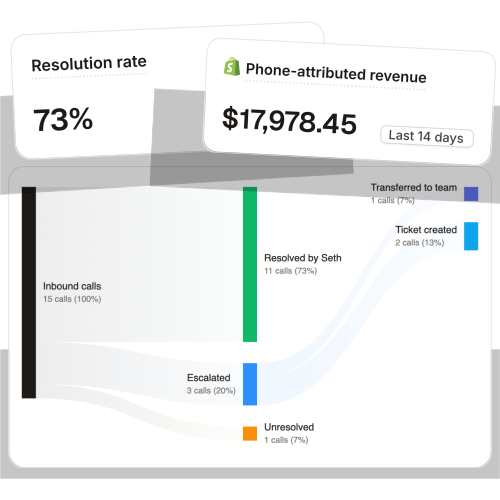
That's the bar an AI receptionist has to clear to take the routine call: the caller shouldn't feel downgraded. Across our brands the AI resolves 73% of calls on its own and hands the rest to a person.
What this costs you, three ways
Here's the math that actually moves the decision. Take a $50M Shopify brand running a 6-rep CS team.
| Line item | Today | With an AI receptionist |
|---|---|---|
| 6 reps × $4K loaded per rep | $24,000/mo | n/a |
| AI receptionist (~$5K/mo) | n/a | $5,000/mo |
| Net monthly CS spend | $24,000/mo | $5,000/mo |
| Monthly savings | n/a | $19,000/mo |
| Annual savings | n/a | $228,000/yr |
That's roughly 70% of calls (order status, returns, the same five questions over and over) routed to the AI. The other 30%, the complex ones, still go to your team, who now have time to handle them well instead of clearing a WISMO backlog. You're not firing anyone. You're moving them off the calls a system does for cents and onto the calls that need a person.
For most brands this isn't an in-house vs outsource decision either. It's "put an AI on the front of the line and keep your people for the calls that matter." If you want to run your real numbers, book a 30-min call and we'll do the math live against your call volume.
Ringly: the AI receptionist for Shopify brands
Ringly.io
Best for: $10M-$100M Shopify brands that want the routine 70% of their phone handled around the clock while their team keeps the calls that need judgment.
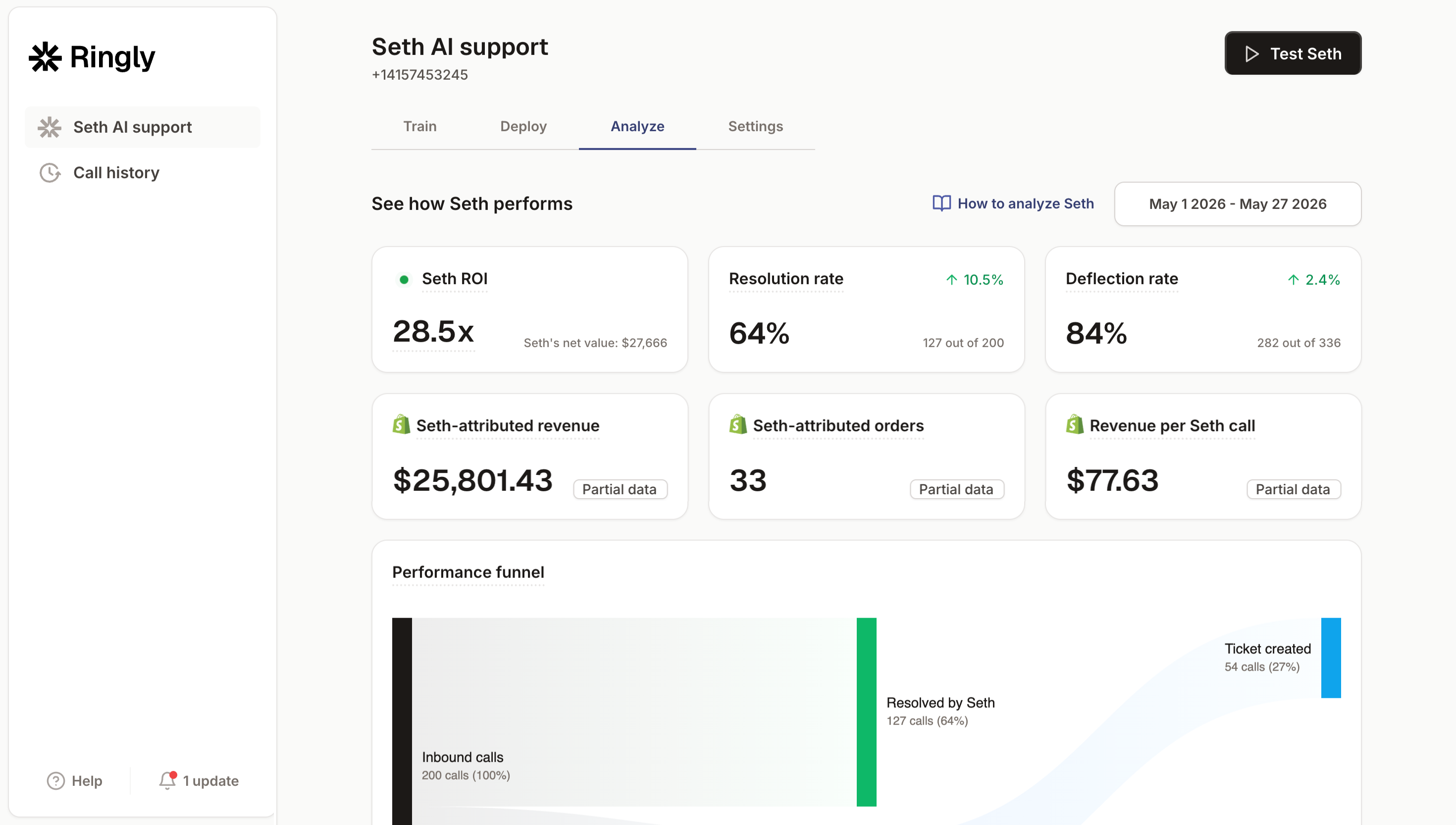
Ringly.io is AI phone support for Shopify brands. The AI answers inbound calls 24/7, finds orders in your Shopify store, processes returns and exchanges, answers product questions from your knowledge base, and rescues abandoned carts. Calls that need a human escalate cleanly to Gorgias, Richpanel, Reamaze, or whatever helpdesk you already run. Across 50+ brands it resolves 73% of calls on its own, at roughly $0.42 per resolved call.
What works
- Always on, no surcharge. 24/7 in 40 languages, with unlimited concurrent calls so a launch spike doesn't queue.
- Shopify-native. It looks up real orders and handles status, returns, and exchanges against your store, not a generic script.
- Same brand voice every call. Consistent greeting and accurate answers, and the most common compliment we hear is "you don't sound like AI."
- You control escalation. You decide which calls hand off to a person and where they land.
- Flat monthly pricing. Grow $349/mo, Pro $799/mo, Enterprise custom. No per-minute meter.
What doesn't
- It's not for the hard 30%. Grief, serious disputes, and reputation-risk calls should go to a human, and Ringly routes them there rather than forcing a script.
- It needs a clean knowledge base. A thin or messy KB means weaker answers; the setup is fast but the inputs matter.
- No free tier. Plans start at $349/mo, so it fits brands with real call volume, not a store doing a handful of calls a week.
Why it fits: for a Shopify brand, the receptionist job is mostly repeatable and partly human. Ringly takes the repeatable part at full volume and hands you back the part that needs a person. It backs that with a 65% resolution guarantee.
How to choose
- Choose an in-house human if your call volume is low, nearly every call needs brand-deep judgment, and the loaded cost of a full-timer is easy to absorb.
- Choose a remote answering service if you want a human voice but can't justify a hire, and your volume is steady enough that per-minute billing won't surprise you.
- Choose an AI virtual receptionist if WISMO, returns, and after-hours calls dominate your line, and you want 24/7 coverage without growing headcount every time volume climbs.
- Choose a hybrid if you're a $10M-$100M Shopify brand with a real phone line. This is most of you. Put the AI on the front of the line and keep your people for the 30% that needs them. If you're on Shopify Plus, the same logic and the same virtual receptionist setup apply at higher volume.
Frequently asked questions
Is an AI virtual receptionist as good as a human? On routine calls, yes, and often faster and more consistent. On complex or emotional calls, no, and it shouldn't try. The honest setup is an AI on the routine 70% and a human on the 30% that needs judgment, which is the hybrid 87% of customers say they prefer.
How much does a virtual receptionist cost compared to a human? A fully-loaded in-house receptionist runs about $53,700 a year. A remote answering service runs $319 to $1,299+ a month, usually billed per minute. An AI receptionist like Ringly is a flat $349 to custom per month with no per-minute meter (see pricing).
Can a virtual receptionist check order status or take orders? An AI receptionist wired into Shopify can look up real orders and handle status, returns, and exchanges against your store. A generic answering service usually can't, because it's reading from a script, not your order data.
Will customers know they're talking to AI? Most don't clock it on routine calls. The most common compliment our customers report is "you don't sound like AI." The goal isn't to trick anyone, it's that the caller gets a fast, accurate answer and never feels downgraded.
What happens when a call is too complex for the AI? It escalates to a human on your team, based on rules you set. You decide which call types always hand off (grief, disputes, VIPs) and where they land in your helpdesk.
Do I have to replace my receptionist or CS team? No. The point is to move your people off the repeatable calls a system handles for cents and onto the complex calls that need a person. The team gets smaller queues, not pink slips.
How fast can an AI receptionist go live? Ringly is live in under an hour once you connect your store and knowledge base, with a 14-day Launch Sprint for a full rollout. Hiring a person takes weeks; an answering service takes days.
Talk to us

If your phone goes quiet after 6pm and the voicemails pile up, that's the gap a virtual receptionist was built to close. A 30-min call is the fastest way to see your real call mix and what the routine 70% is costing you to answer by hand.
The 3-layer guarantee.
- Live in 14 days or it's free until launched.
- 65% resolution in 90 days or we refund the last 3 months of subscription fees.
- We keep working free until we hit 65%.
Ruben (Ringly co-founder) takes these calls personally.