This post in 30 seconds.
- The 7 subscription apps actually worth comparing against Recharge, with real pricing and the one honest reason to switch.
- The number that decides it isn't the sticker price. It's the blended take rate (monthly fee plus percentage plus per-order fee) at your GMV.
- Fresh context: Recharge bought Skio for $105 million on April 30, 2026, so if you're shopping for an independent alternative, the board just changed. Written for founders, COOs, and Heads of CX at $10M-$100M Shopify subscription brands who own the recurring revenue and the support queue.
Most brands don't go looking for a Recharge alternative because Recharge stopped working. They go looking because the math gets uncomfortable at scale. Recharge's Starter plan is $99 a month, which sounds fine until you stack the 1.49% plus $0.19 per order on top, and watch the take rate eat a real slice of recurring revenue you already worked hard to earn. Then on April 30, 2026, Recharge acquired Skio for $105 million, which quietly merged two of the names on most shortlists into one company.
I run AI phone support for Shopify brands, so I looked at every app on this list through a second lens nobody else seems to use. Not just the take rate, but how many cancel, skip, swap, and where's-my-order calls each portal actually keeps off your phone line. Below is the fair version: 7 real alternatives, honest pros and cons, who each one fits, and a straight answer on whether you should switch at all.
If you run a $10M-$100M Shopify subscription brand and the routine recurring-order calls (cancel, skip, charge me early, WISMO) are quietly eating your support team's week, that's a separate problem from your billing app, and it's the one I can actually help with. Book a 30-min call and we'll look at what those calls are costing you. The app comparison comes first.
The 7 Recharge alternatives at a glance
Here's the shortlist with the numbers that matter. The figure to watch isn't the monthly fee, it's the blended cost (monthly plus percentage plus per-order) at your actual subscription GMV. A $99 plan with a 1.49% take rate costs more at $3M/year than a $399 plan at 0.75%.
| App | Monthly entry | Take rate + per-order | Best for |
|---|---|---|---|
| Recharge (baseline) | $99 | 1.49% + $0.19 | the incumbent, largest ecosystem |
| Loop Subscriptions | $99 | 1.0% (0.75% on Pro) | Shopify-native + retention |
| Skio | $0 (Scale $599) | 1.0% + $0.20 | UX and conversion (now Recharge-owned) |
| Smartrr | $499 | 1.0% + $0/order | loyalty and membership brands |
| Stay AI | $499 | 1.0% + $0.19 | retention experimentation |
| Appstle | free or $10 | 0% | budget, most-reviewed |
| Seal Subscriptions | free or $5.95 | 0% | cheapest, simplest |
| Recurpay | free or paid | lower than Recharge | low cost, free migration |
Pricing is from each vendor's own pricing page and comparison data published in mid-2026. Take rates move, so confirm at your volume before you sign anything.
How I evaluated these subscription apps
I'm Ruben, co-founder of Ringly. I don't sell a subscription app, so I have no horse in the Recharge-versus-everyone race. What I do all day is run AI phone support for Shopify brands, which means I see the support side of subscriptions that the billing vendors never show you.
I scored these 7 apps against five things:
- Blended cost at real GMV. Not the sticker price. The monthly fee plus the percentage take plus any per-order fee, run against a realistic subscription revenue number.
- Customer portal and self-serve. Can a subscriber skip, swap, pause, or update a card without emailing or calling you? Passwordless login matters here, because every password reset is a support contact.
- Dunning and failed-payment recovery. Failed payments drive up to 40% of subscription churn, so retry depth and smart card logic are worth more than most flashy features. It's the same passive-churn problem retention-focused brands fight everywhere.
- Migration risk. Moving live subscribers means moving payment tokens and keeping dunning healthy through the cutover. This is where switches go wrong.
- Support-load deflection. The criterion nobody else scores: how many cancel, skip, swap, and where's-my-order contacts the portal actually absorbs, versus how many it dumps on your phone line and helpdesk.
When I ran the same five-task test across these apps, the take-rate winners and the support-load winners weren't always the same app. That gap is the whole reason I wrote this the way I did.
7 best Recharge alternatives
1. Loop Subscriptions
Best for: brands that want a Shopify-native platform with serious retention and cancellation tooling. Loop is built directly on Shopify's official subscription APIs, which is a real architectural difference from the older players.
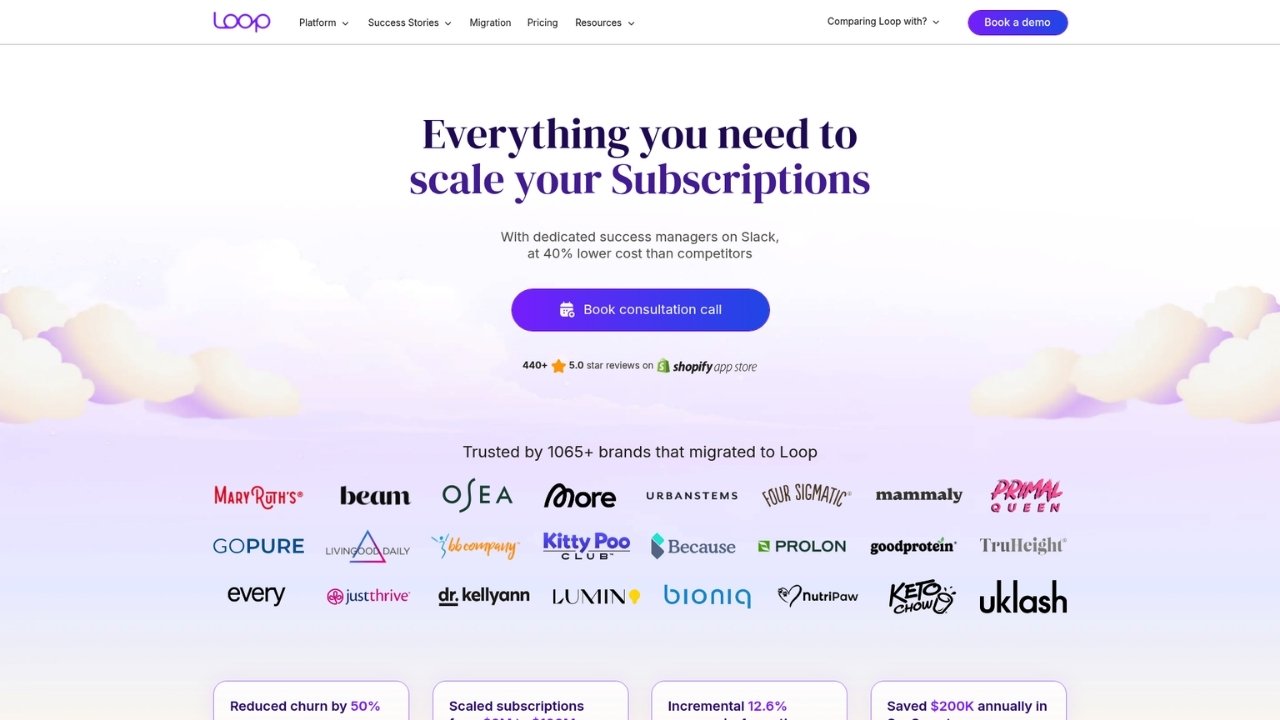
Loop has become the default Recharge alternative for retention-minded brands, and the numbers back it up. It's trusted by 2,400+ Shopify brands, has processed $4B+ in subscription revenue, and has run 1,100+ migrations including 400+ brands that moved off Recharge specifically.
Pricing
| Plan | Price | Take rate |
|---|---|---|
| Starter | $99/mo | 1.0% |
| Pro | $399/mo | 0.75% |
No per-order fee. That 0.75% on Pro is one of the lowest take rates among the serious players.
What works
- Shopify-native architecture. Built on Shopify's subscription APIs, so it sits cleanly inside the platform rather than alongside it.
- Reason-specific cancellation flows. Instead of one generic "are you sure" popup, Loop offers targeted save offers based on why the customer is leaving.
- Lower take rate than Recharge. 1.0% (and 0.75% on Pro) versus Recharge's 1.49%, with no per-order fee.
- Proven migration path. 400+ brands have already moved from Recharge, so the path is well-worn.
What doesn't
- Heavy for simple needs. If you just want recurring billing, the retention surface can feel like more than you need.
- Pro tier for the best rate. The 0.75% take rate lives on the $399 plan, not the $99 one.
Why it ranks first: it's the most complete independent alternative for a brand that cares about both cost and retention, with the cleanest Shopify-native story and a migration path hundreds of Recharge brands have already walked. It holds 4.9 stars across 650+ reviews on the Shopify App Store.
2. Skio
Best for: brands that win or lose on customer-portal UX. Skio built its name on passwordless login and a frictionless checkout that reduces churn at the experience layer.
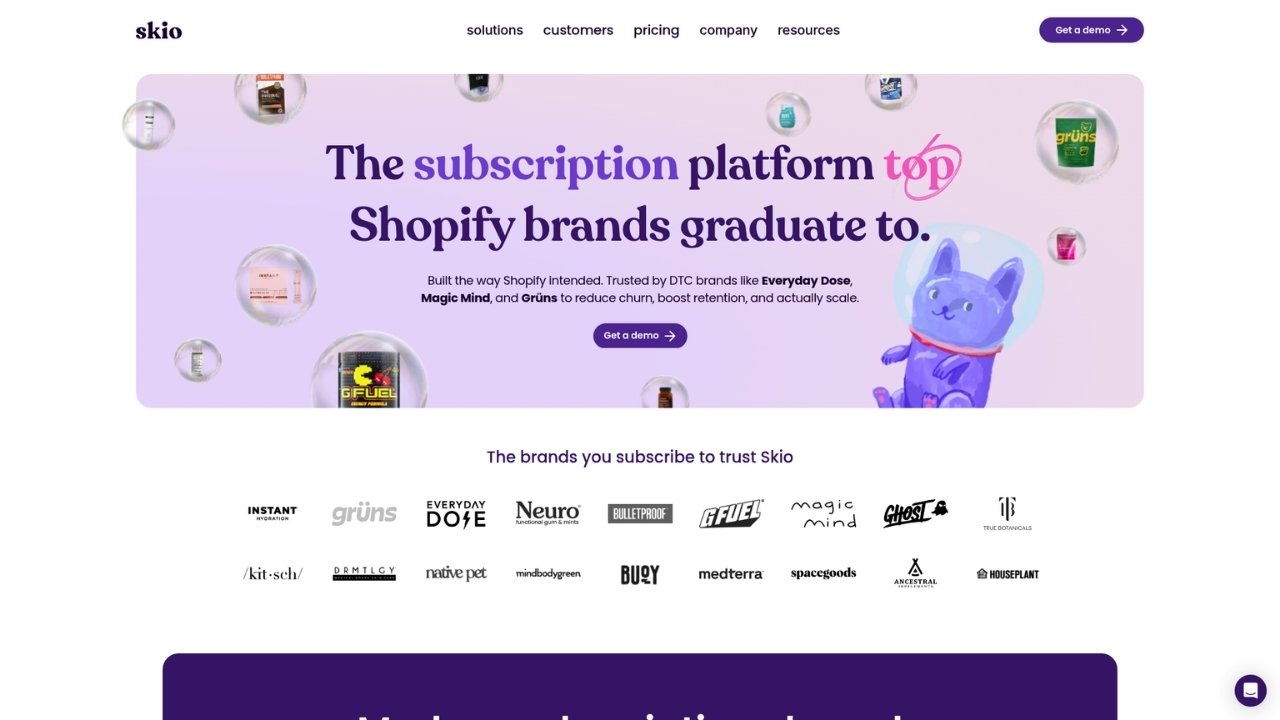
Skio was the modern challenger that took a chunk of the mid-market on user experience alone. The catch, and it's a big one: as of April 30, 2026, Skio is now a Recharge company. If you're specifically shopping for an alternative to Recharge, you should know you'd be buying a product Recharge now owns.
Pricing
| Plan | Price | Take rate |
|---|---|---|
| Starter | $0/mo | 1.0% + $0.20 |
| Growth | $399/mo | 1.0% + $0.20 |
| Scale | $599/mo | 1.0% + $0.20 |
What works
- Best in the category portal UX. Passwordless login is genuinely good, and it directly cuts the password-reset tickets that bury support teams.
- Conversion focus. The checkout and portal are built to reduce friction, which shows up in retention.
- Free entry tier. The $0 Starter lets smaller brands start without a monthly commitment.
What doesn't
- No longer independent. Recharge owns it now, so the roadmap and pricing are subject to a new parent's priorities.
- Higher Scale tier. $599 at the top is the steepest entry among these picks.
Why it ranks second: the product is excellent and the passwordless portal really does deflect support load. It drops below Loop purely because "an independent Recharge alternative" is no longer an accurate description of it.
3. Smartrr
Best for: community-driven brands where the subscription is part of a membership, not just a recurring charge. Smartrr combines billing with native membership tiers, points, and exclusive content.

Smartrr leans into loyalty. If your retention strategy is built on community, perks, and a sense of belonging rather than pure convenience, it's the most natural fit on this list.
Pricing
Smartrr starts at $499/mo + 1.0% GMV, with no per-order fee. The zero per-order fee is marketed as a guarantee, and at high order counts it produces real structural savings versus apps that charge $0.19-$0.20 per shipment.
What works
- Loyalty and membership built in. Tiers, points, and gated content live alongside the subscription, not in a separate app.
- No per-order fee. At high shipment volume, skipping the per-order charge adds up.
- Branded, community-feel portal. Fits brands selling identity, not just product.
What doesn't
- $499 entry is steep. Too much for a small subscription program.
- Overkill for plain billing. If you don't need the loyalty layer, you're paying for surface you won't use.
Why it ranks third: for the specific brand that runs subscriptions as a membership, Smartrr is the best answer here. For everyone else, the loyalty layer is weight you don't need.
4. Stay AI
Best for: DTC brands that treat recurring revenue like a performance channel and want to run experiments on it.
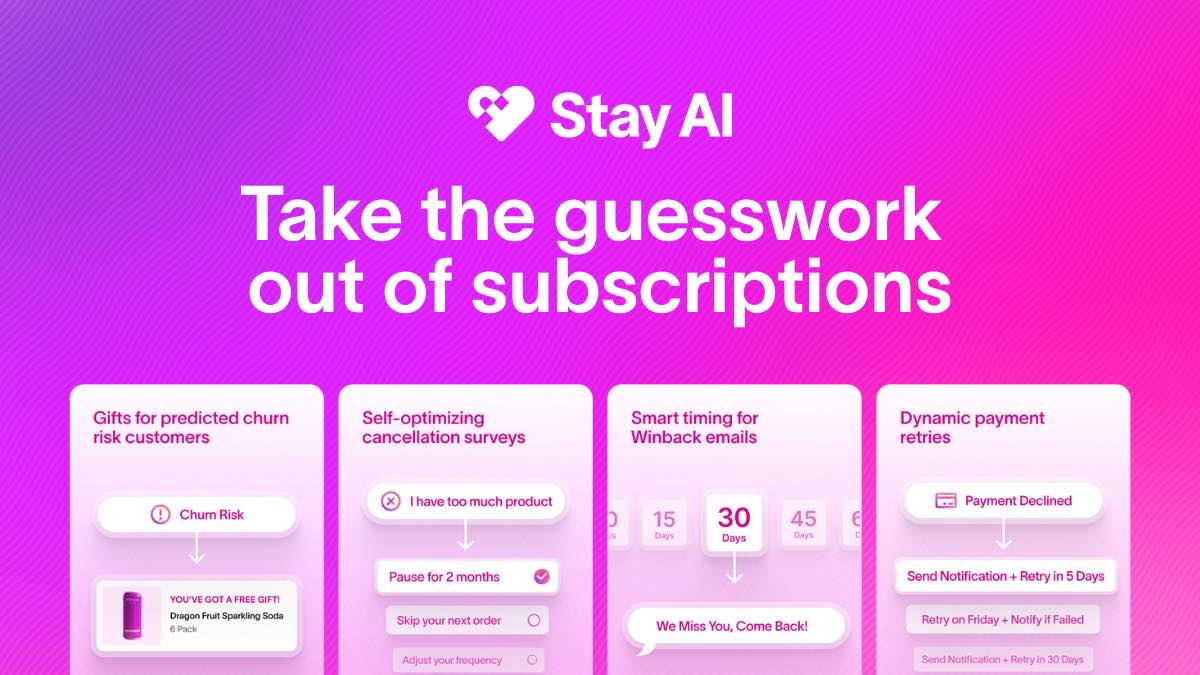
Stay AI is the retention-experimentation play. Its ExperienceEngine runs multivariate tests across the subscriber journey, and its RetentionEngine forecasts churn so you can act before a customer leaves. The drag-and-drop portal lets subscribers swap bundles, pause shipments, and add trial products without opening a ticket, which is exactly the kind of self-serve that keeps people off your phone.
Pricing
Stay AI runs $499/mo + 1.0% + $0.19/order, with a 30-day free trial.
What works
- AI-driven retention testing. Real multivariate experimentation on the subscription journey, not just a static portal.
- Strong self-serve portal. Swap, pause, and trial flows that absorb support contacts.
- Churn forecasting. RetentionEngine flags at-risk subscribers early.
What doesn't
- $499 entry. Same steep starting point as Smartrr and Stay AI's peers.
- Wasted on small programs. The experimentation depth only pays off at meaningful subscriber volume.
Why it ranks fourth: it's the strongest pick for a retention-obsessed brand with the scale to actually run experiments. It holds a 5.0-star rating across 140+ Shopify App Store reviews, which is rare. The price floor is what keeps it out of the top three for most brands.
5. Appstle Subscriptions
Best for: brands that want a feature-rich subscription app without a take rate. Appstle charges 0% transaction fees on every plan, which is the headline.
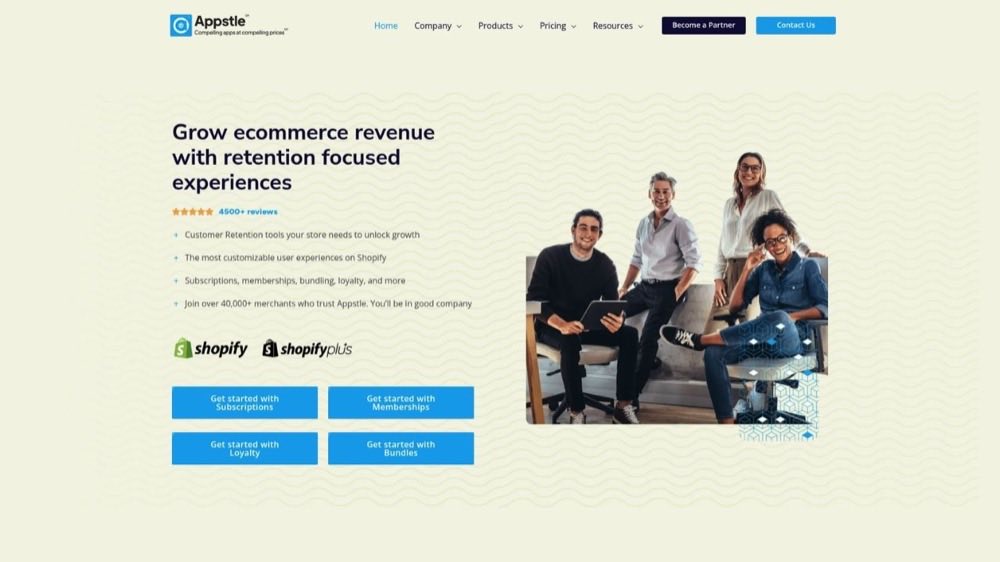
Appstle is the most-reviewed subscription app on the Shopify App Store, with 5,443+ reviews, and it earns the volume by being cheap and capable at the same time. The free plan covers stores doing up to $500/mo in subscription revenue, and the paid tiers stay genuinely affordable.
Pricing
| Plan | Price | Covers |
|---|---|---|
| Free | $0 | up to $500/mo sub revenue |
| Starter | $10/mo | up to $5,000/mo |
| Business | $30/mo | up to $30,000/mo |
| Business Premium | $100/mo | up to $100,000/mo |
0% transaction fees on every plan.
What works
- 0% take rate. No percentage skim on your subscription revenue, which is the biggest cost lever at scale.
- Cheap and capable. Build-a-box, bundles, and upsell tools at $10-$100/mo.
- 24/7 support and huge review base. 5,443+ reviews is the largest proof base on the App Store.
What doesn't
- Tier caps on revenue. Plans are gated by subscription revenue, so you climb tiers as you grow.
- Denser UI. It's more utilitarian than the premium-priced players.
Why it ranks fifth: for a cost-conscious brand, the 0% take rate makes Appstle the smartest money on this list. It ranks here, not higher, because the premium players still win on portal polish and retention depth.
6. Seal Subscriptions
Best for: brands that want the cheapest, simplest serious option. Seal is dead simple to set up and charges 0% transaction fees across every plan.
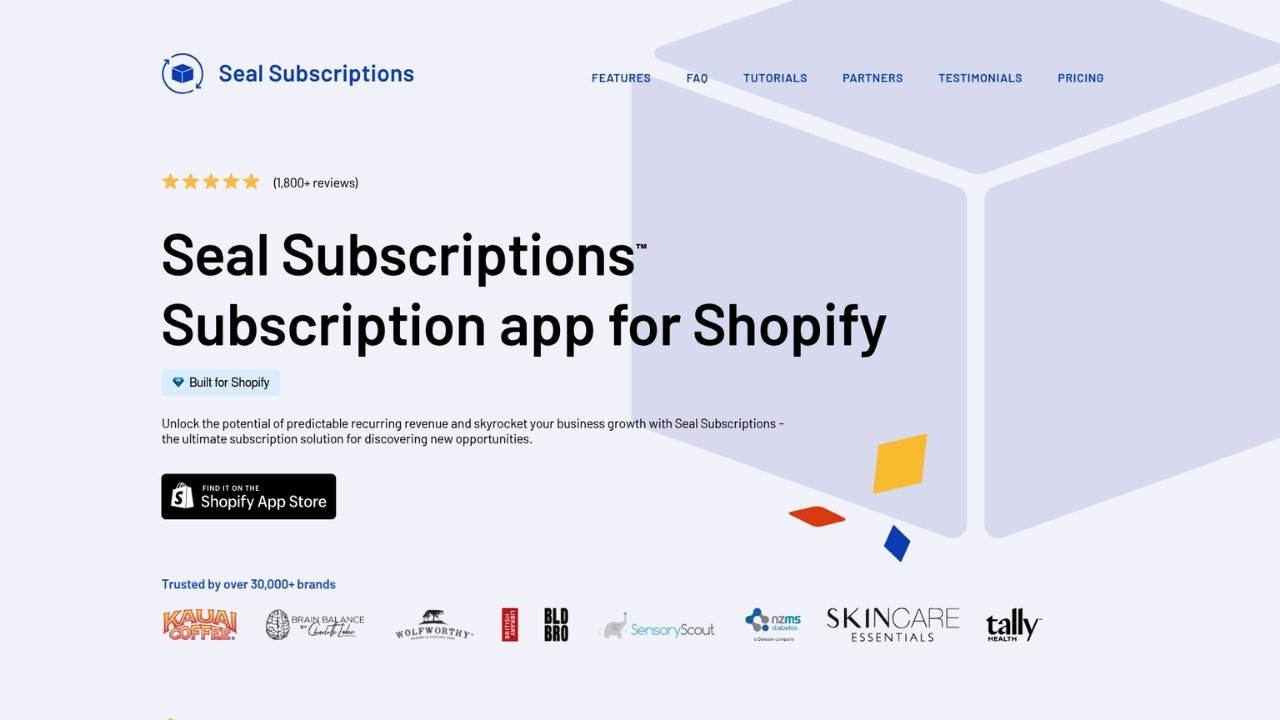
If Appstle is the value pick, Seal is the budget pick. The free plan is free forever for up to 50 active subscriptions, and the paid tiers start at $5.95/mo. It won't run experiments for you, but it will run clean recurring billing without skimming your revenue.
Pricing
| Plan | Price | Covers |
|---|---|---|
| Free | $0 | up to 50 active subscriptions |
| SUPERSALE | $5.95/mo | 0% fees, passwordless portal |
| Higher tiers | $9.95 / $24.95/mo | more subscriptions + features |
0% transaction fees on every plan.
What works
- Cheapest serious option. $5.95/mo with a free-forever tier underneath it.
- 0% fees and passwordless portal. No take rate, plus a passwordless customer portal on paid that cuts reset tickets.
- Genuinely simple setup. The fastest path from install to a live subscription.
What doesn't
- Light on retention depth. No experimentation, minimal save flows.
- Not built for $10M-plus scale. It's a strong small-and-mid pick, not an enterprise platform.
Why it ranks sixth: Seal is the right answer for a brand that wants subscriptions handled cheaply and simply. It ranks below Appstle only because Appstle offers more headroom as you grow.
7. Recurpay
Best for: growth brands that want lower costs than Recharge and a low-friction migration.
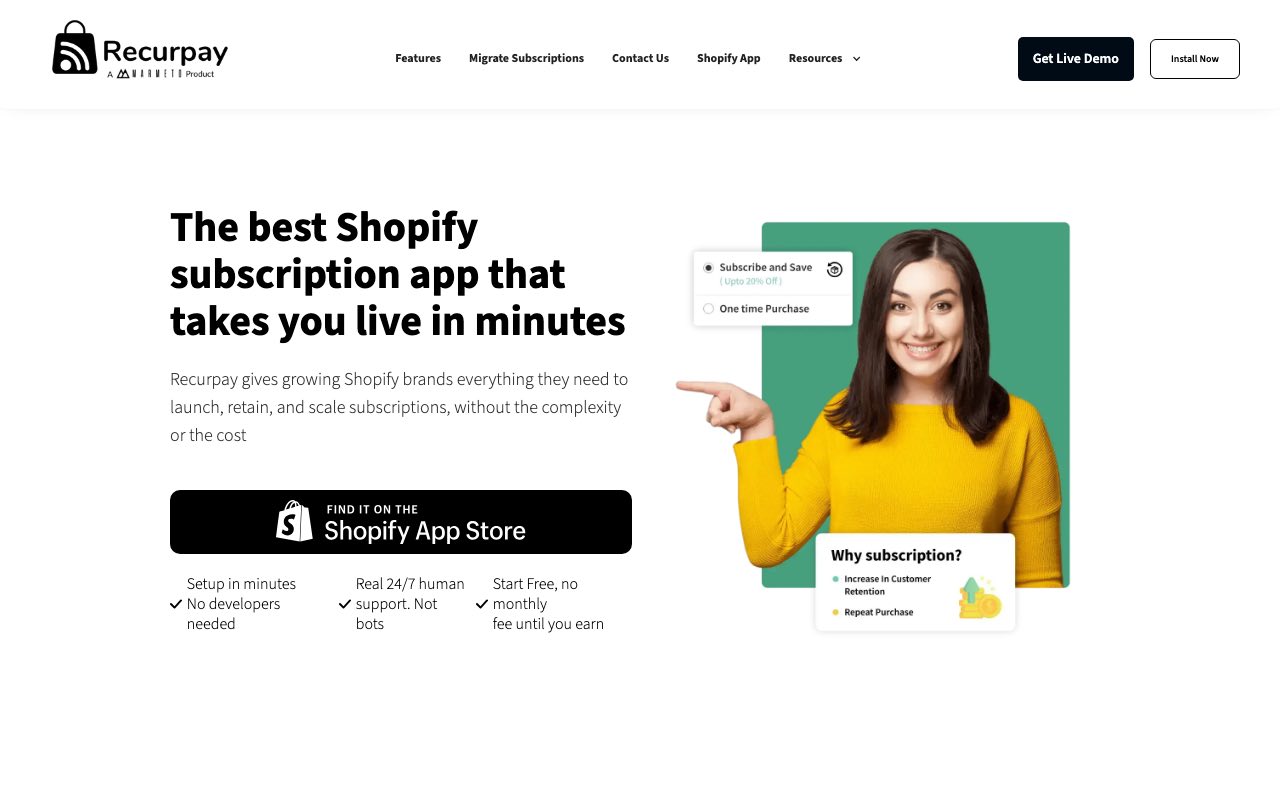
Recurpay positions itself squarely as the cheaper Recharge alternative, and it leads with a free-migration offer to take the risk out of switching. For a brand that's mostly leaving Recharge over cost, that's a sensible front door.
Pricing
Recurpay runs a free tier plus paid plans priced below Recharge. Confirm the exact take rate at your volume, since the savings pitch is the whole point.
What works
- Low cost. Built to undercut Recharge on the blended take rate.
- Free migration. Removes the biggest objection to switching, which is migration risk.
- Simpler than Recharge. Less surface, faster to run.
What doesn't
- Smaller ecosystem. Less brand footprint and fewer integrations than Loop or Skio.
- Less proven at the top end. Strong for growth brands, lighter track record at large scale.
Why it ranks seventh: Recurpay is a clean cost-driven switch, especially with free migration. It rounds out the list as the value-plus-low-risk option rather than the feature leader.
Should you even switch off Recharge?
Here's the part the vendor blogs won't tell you straight. "Recharge is old" is not a reason to switch. Switch for a number you can name, not a vibe.
Recharge still runs 20,000+ merchants and holds 4.8 stars across 2,100+ reviews, and plenty of brands migrate onto it smoothly with responsive support. The real risk in switching isn't the new app, it's the migration itself. Moving live subscribers means moving payment tokens and keeping dunning healthy through the cutover. I read one merchant account of a 2025 migration where renewal success collapsed within weeks, new decline codes appeared, and the brand spent four months working through it while absorbing real losses. That's the downside scenario, and it's why you don't switch casually.
The math has a threshold. According to one agency analysis, the cost crossover sits around $100K/mo in subscription GMV, with migration costs landing between $8,000 and $15,000. Below that line, the savings rarely justify the disruption. Above it, the take-rate gap compounds fast: 0.75% versus 1.49% on $3M of annual subscription revenue is about $22,200 a year, every year.
So the honest framework is short. Switch if you have a specific, money-costing gap: a take rate that's measurably bleeding you at your GMV, a portal that converts worse than the alternative, or a dunning setup that's quietly costing you renewals. Don't switch because a competitor's homepage looks newer. The same discipline applies to how you handle subscription refunds and cancellations on the support side: fix the leak you can measure, not the one you imagine.
The part no subscription app covers: the phone
Every app above competes on billing, portal, and retention. None of them answers your phone.
Subscription brands generate a very specific support load, and it's heavier than most founders expect, especially on Shopify Plus stores running high subscriber counts. Customers call to cancel before they get charged again. They call to skip a month, swap a flavor, or move a delivery date. They call asking "charge me early, I ran out." And they call with WISMO on the recurring shipment that didn't show up. The best portals on this list deflect a chunk of that through self-serve. The rest lands on your phone line and in your helpdesk, where it turns into the same questions over and over, all day. It's the single biggest reason subscription brands scale support headcount faster than they want to.
That's the gap I work in. Ringly.io is AI phone support for Shopify brands. Instead of growing your support headcount every time subscription volume goes up, the AI takes the routine recurring-order calls 24/7 (cancel, skip, swap, order status) and escalates anything genuinely complex to whatever helpdesk you already run, whether that's Gorgias, Richpanel, or Reamaze. Seth resolves up to 90% of inbound calls autonomously for $1.99 a call after the first 50, versus $7-$16 per call for a human BPO.
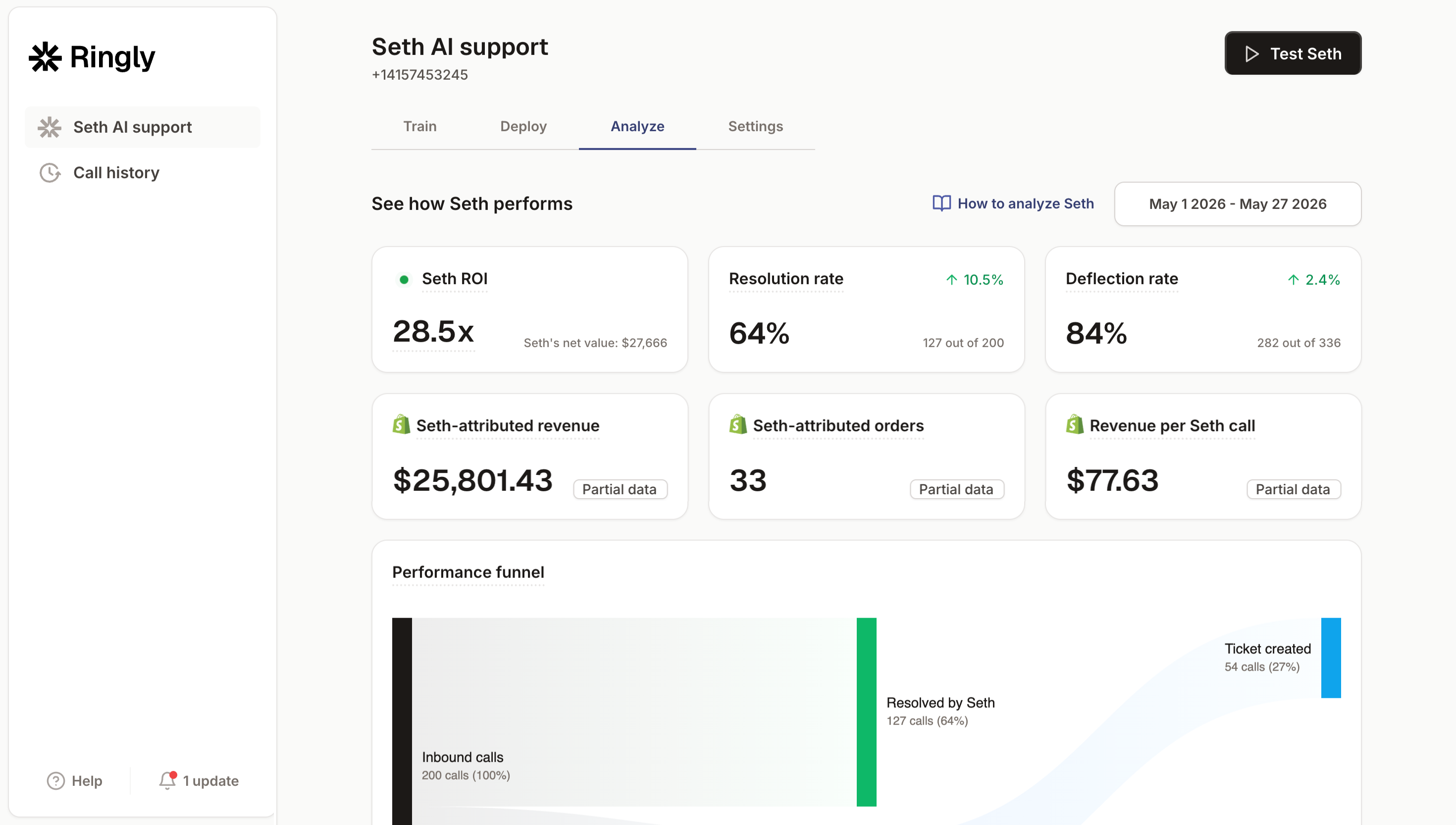
The math on the phone side looks like this. Take a brand running a 6-rep support team to keep up with subscription calls:
| Line item | Today | With Ringly |
|---|---|---|
| 6 reps × $4K loaded per rep | $24,000/mo | n/a |
| Ringly (illustrative) | n/a | $5,000/mo |
| Net monthly support spend | $24,000/mo | $5,000/mo |
| Monthly savings | n/a | $19,000/mo |
Roughly 70% of those calls are the same routine requests (cancel, skip, status), which is exactly what the AI handles. The other 30%, the genuinely tricky ones, still go to your team, who now have time to actually solve them. If you've debated chat versus phone for subscription support, this is the part where phone usually wins for an older or higher-value subscriber base. If your recurring-order calls are eating real payroll, book a 30-min call and we'll do the math on your actual call volume.
How to choose the right Recharge alternative
Match the app to the problem you actually have, not the feature list that sounds best.
- Choose Loop if you want a Shopify-native platform with strong retention and the lowest take rate among the serious players.
- Choose Skio if portal UX and passwordless login are your priority, and you're comfortable that it's now a Recharge product.
- Choose Smartrr if your subscription is really a membership and loyalty drives your retention.
- Choose Stay AI if you have the scale to run retention experiments and want churn forecasting.
- Choose Appstle if you want a capable, feature-rich app with a 0% take rate at a low monthly cost.
- Choose Seal if you want the cheapest, simplest serious option and don't need experimentation.
- Choose Recurpay if you're switching mainly to cut cost and want a free, low-risk migration.
And whichever you pick, remember that the app handles the billing and the self-serve portal. The phone calls it can't deflect still need a human or an AI phone agent. The brands that keep support quality high while subscription volume climbs are the ones that solved both halves. (If you want the phone-side numbers, Ringly's plans and pricing are public.) One TechCraft Studio operator put the voice quality this way:
"My customers also feel like it's a normal person. They feel like they can communicate if they have questions."
Claudia Droge, TechCraft Studio
Frequently asked questions
What is the best Recharge alternative for Shopify?
For most independent brands, Loop Subscriptions is the strongest all-around alternative: Shopify-native, a lower take rate than Recharge, and a proven migration path. The "best" pick depends on your priority, though. Appstle and Seal win on cost, Smartrr on loyalty, and Stay AI on retention experimentation.
Did Recharge acquire Skio?
Yes. Recharge acquired Skio for $105 million in cash on April 30, 2026. Skio keeps its branding for now, but it's no longer an independent company, so if you're specifically shopping for an alternative to Recharge, factor that in.
Which subscription app has the lowest fees?
Appstle and Seal Subscriptions both charge 0% transaction fees on every plan, which is the biggest cost difference at scale. Seal starts at $5.95/mo (free for up to 50 subscriptions), and Appstle is free up to $500/mo in subscription revenue, then $10/mo and up.
Is it worth migrating off Recharge?
Only if you have a specific, money-costing gap. The cost crossover sits around $100K/mo in subscription GMV, and migration runs roughly $8,000-$15,000. Below that line, switching rarely pays for itself, and migration carries real dunning risk.
Which Recharge alternative is Shopify-native?
Loop Subscriptions is built directly on Shopify's official subscription APIs, which is its main architectural advantage over older platforms. That native foundation is a big part of why 400+ brands have migrated to it from Recharge.
Do subscription apps handle cancellation phone calls?
No. Subscription apps handle self-serve cancellation through their customer portal, but they don't answer the phone. Cancel, skip, and swap calls that don't go through the portal still hit your support team, which is where an AI phone agent like Ringly fits in alongside whatever subscription app you run. For high-volume brands, that's often the difference between outsourcing support and keeping it in-house.
How much does migrating off Recharge cost?
Migration typically costs $8,000-$15,000 depending on subscriber count and complexity, and the payback window runs anywhere from 3 to 15 months once you factor in the lower take rate. Some alternatives, like Recurpay, offer free migration to remove that upfront cost.
Talk to us

Whichever subscription app you land on, the recurring-order calls it can't deflect still land on your team. If you run a $10M-$100M Shopify subscription brand and your support line is drowning in cancel, skip, and where's-my-order calls, a 30-min call is the fastest way to see what those calls are costing you and what an AI phone agent would take off the queue.
Our 3 promises.
- Live in under 1 hour. Setup and test calls are free.
- 30-day money back on the $99 plan fee.
- 65% resolution guarantee: if Seth resolves under 65% of your support calls in a month, that month comes back as credit (after 90 days on Pay per call).
Ruben (Ringly co-founder) takes these calls personally.