
Searchspring isn't really Searchspring anymore.
- It merged with Klevu and Intelligent Reach in January 2025 to form Athos Commerce, so the alternative most lists push first is now the same company.
- The transparent, lower-cost picks are Doofinder and Fast Simon. The enterprise-depth picks are Constructor and Bloomreach. Klevu and Nosto sit in the middle on a custom quote.
- Written for ecommerce founders, merchandisers, and ops leads picking a site search platform, with one honest note on the support calls bad search quietly creates.
You went looking for a Searchspring alternative, and the first thing nearly every list tells you is "just use Klevu." There's a catch nobody mentions. Searchspring and Klevu are the same company now. They merged in January 2025, along with Intelligent Reach, to form a new parent called Athos Commerce. So if you're swapping Searchspring for Klevu to escape rising prices or slow support, you're moving sideways inside the same building.
This is a vendor-neutral list. We don't sell site search, so there's no tool here we're quietly trying to rank first. Below are eight real alternatives, with the pricing I could actually verify and an honest read on why people leave Searchspring in the first place.
If you run a Shopify or BigCommerce brand and you're frustrated that on-site search keeps sending shoppers to the phone instead of the cart, the fix isn't always the search engine. Sometimes it's who answers the call. We build AI phone support for Shopify brands, and we see those exact calls every day. Book a 30-min call and we'll show you what your missed calls look like.
Quick comparison: 8 Searchspring alternatives at a glance
Pricing transparency is the loudest reason merchants switch, so I led the table with it. Doofinder, Fast Simon, and Algolia publish real numbers. The rest make you book a sales call, and I've labeled their figures as reported approximations.
| Tool | Pricing (real / reported) | Best for | Verdict |
|---|---|---|---|
| Fast Simon | $39.99-$499.99/mo (public) | Shopify search + merchandising | Best mid-market Shopify pick |
| Klevu | ~$449/mo (reported, custom) | AI search on Shopify/Magento | Good, but it's now Athos too |
| Nosto | ~$500/mo (reported, custom) | Personalization with search bundled | Pick it for recs, not search alone |
| Algolia | Free to $50K/yr+ (public) | Dev teams building custom search | Powerful, watch the overages |
| Doofinder | $35-$549/mo (public) | Budget-friendly SMB search | Cheapest credible option |
| Constructor | Custom (~$150K ACV) | Enterprise product discovery | Revenue-optimized, enterprise-only |
| Bloomreach Discovery | $60K-$120K/yr (reported) | Enterprise search + merchandising | Deep, complex, costly |
| Coveo | $30K-$500K+ (reported) | Multi-surface enterprise relevance | Overkill for pure ecommerce search |
A quick note on the stat behind all of this: shoppers who use site search convert two to three times more often than those who don't, and search drives roughly 14% of ecommerce revenue, up to 40% on some sites (Nosto). So this isn't a small decision. The tool you pick is sitting on a real slice of your revenue, which is why it belongs in the same conversation as the rest of your ecommerce conversion rate optimization work.
How I evaluated these Searchspring alternatives
I'm Ruben, co-founder of Ringly. I don't sell site search, which is exactly why I can be honest about who's good at it. We run AI phone support for Shopify brands, so I see the downstream of bad search constantly: the shopper who couldn't find a product on the site and called instead.
I scored every tool below against the five things mid-market operators actually argue about, and I read the real review complaints, not the vendor landing pages.
- Pricing transparency. I checked each vendor's pricing page for real numbers. Published pricing scored higher than "contact sales," because quote-only pricing is the single most common gripe I found in reviews.
- Shopify and BigCommerce depth. I looked at how native the integration is, whether it installs without a developer, and how long setup actually takes (Doofinder claims a day, Searchspring reviews say four weeks).
- Merchandising without a developer. Can a merchandiser re-rank products, run promotions, and tune relevance on their own, or does every change need engineering time?
- Relevance on the edge cases. I weighted how each engine handles typos, plurals, synonyms, and zero-result queries, since that's where native Shopify search falls apart and where shoppers give up.
- Support and implementation. I pulled responsiveness signals from G2, Capterra, and the Shopify App Store. The spread is brutal: Klevu reviewers say support replies in minutes, Searchspring reviewers report three-week ticket turnarounds unless you mark them urgent.
One more thing the other lists skip: the 2025 merger. Searchspring and Klevu being the same company changes the math on a few of these picks, and I've flagged it where it matters.
The 8 best Searchspring alternatives
1. Fast Simon (formerly InstantSearch+)
Best for: Shopify and Shopify Plus brands that want strong search plus visual merchandising without enterprise pricing.
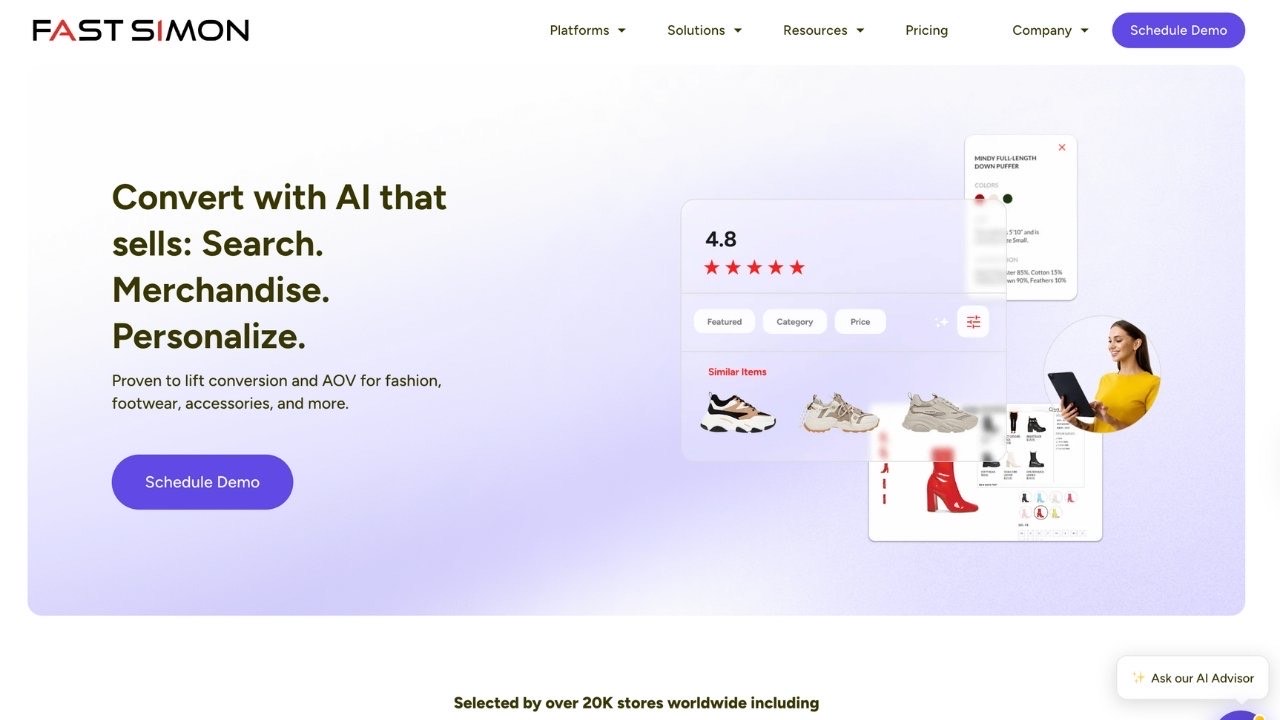
Fast Simon is the closest like-for-like swap for Searchspring if you're on Shopify. It does search, merchandising, personalization, smart collections, and visual discovery, and it installs without a developer. For a lot of mid-market stores, this is the one that covers the most Searchspring ground at a fraction of the commitment.
Pricing
| Plan | Price | Included |
|---|---|---|
| Free | $0 | 100 sessions/mo |
| Starter | $39.99/mo | 2,000 sessions |
| Essential | $99.99/mo | 10,000 sessions, SKU search |
| Growth | $499.99/mo | 100,000 sessions, merchandising rules, landing pages |
Source: Fast Simon pricing, via ExpertRec. Larger volumes move to a custom quote.
What works
- Published pricing. You can size your plan before talking to anyone, which Searchspring won't let you do.
- Visual and text search. Multimodal discovery is built in, not a top-tier add-on.
- No-code setup. Merchandisers can run it without booking dev time.
- Native Shopify. Integration is clean and fast on Shopify Plus.
What doesn't
- The Growth jump is steep. $99.99 to $499.99 is a big gap with nothing in between.
- Support is mixed. Reviews swing on responsiveness depending on your tier.
Why it ranks first
It's the most direct Searchspring replacement for Shopify merchants, with real pricing and merchandising a non-developer can actually run. If you're mid-market and on Shopify, start here.
2. Klevu
Best for: Shopify Plus and Magento merchants who want AI semantic search with very little setup.
Klevu is genuinely good AI search. Its natural-language engine handles intent well, merchandisers can boost and bury products without code, and reviewers consistently call it the easiest Shopify search integration they've done. Support, by the reviews, replies in minutes.
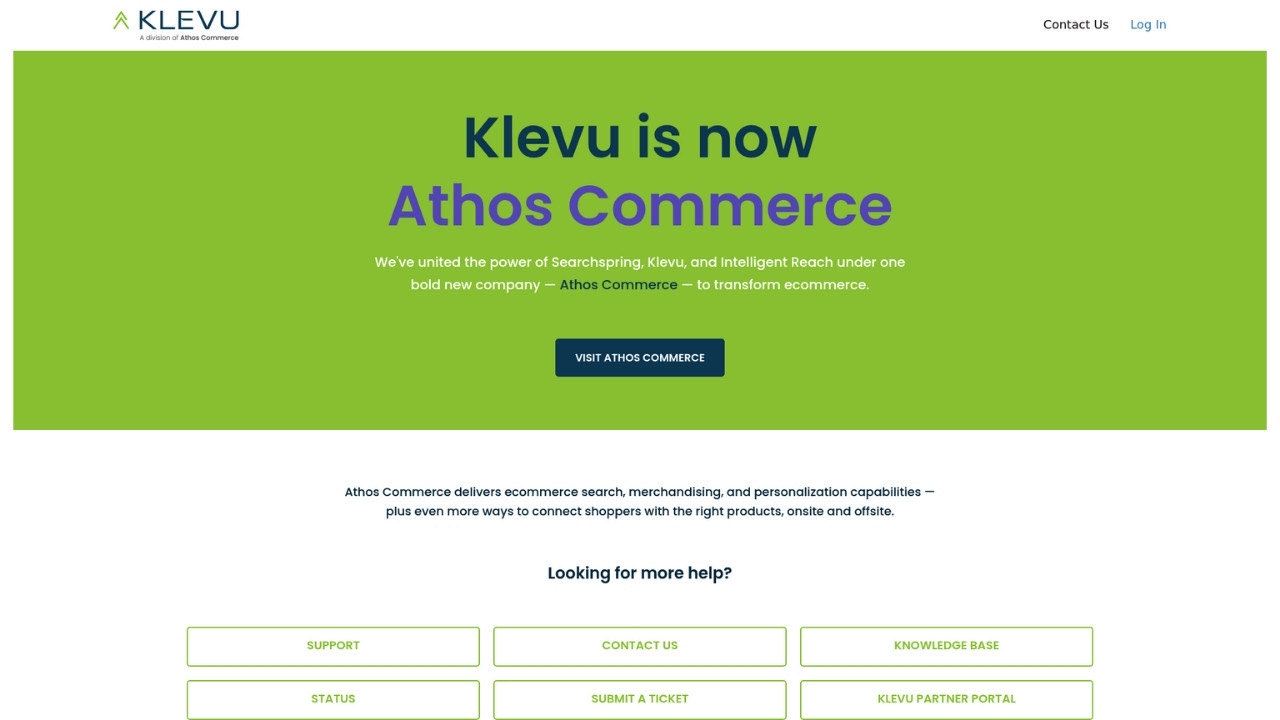
Here's the asterisk: Klevu is now part of Athos Commerce, the same parent as Searchspring. If your reason for leaving is the company behind the product, you're not really leaving.
Pricing
Klevu doesn't publish granular pricing post-merger. Reported entry is around $449/mo on a custom quote, with older Shopify tiers referenced near $299/mo. You'll need a sales call for an exact number.
What works
- Strong NLP search. Semantic understanding is a real step up from native search.
- Fast support. Reviewers single out response time as a strength.
- Easy Shopify install. Among the smoothest in the category.
What doesn't
- Same parent as Searchspring. The 2025 merger undercuts it as an escape route.
- Features gated upward. The better merchandising tools sit on higher tiers.
Why it ranks second
On product quality, Klevu earns a top-two spot. The merger is the only reason to hesitate, and for some merchants that reason matters a lot.
3. Nosto
Best for: DTC brands where personalization and recommendations are the main goal and search comes along for the ride.
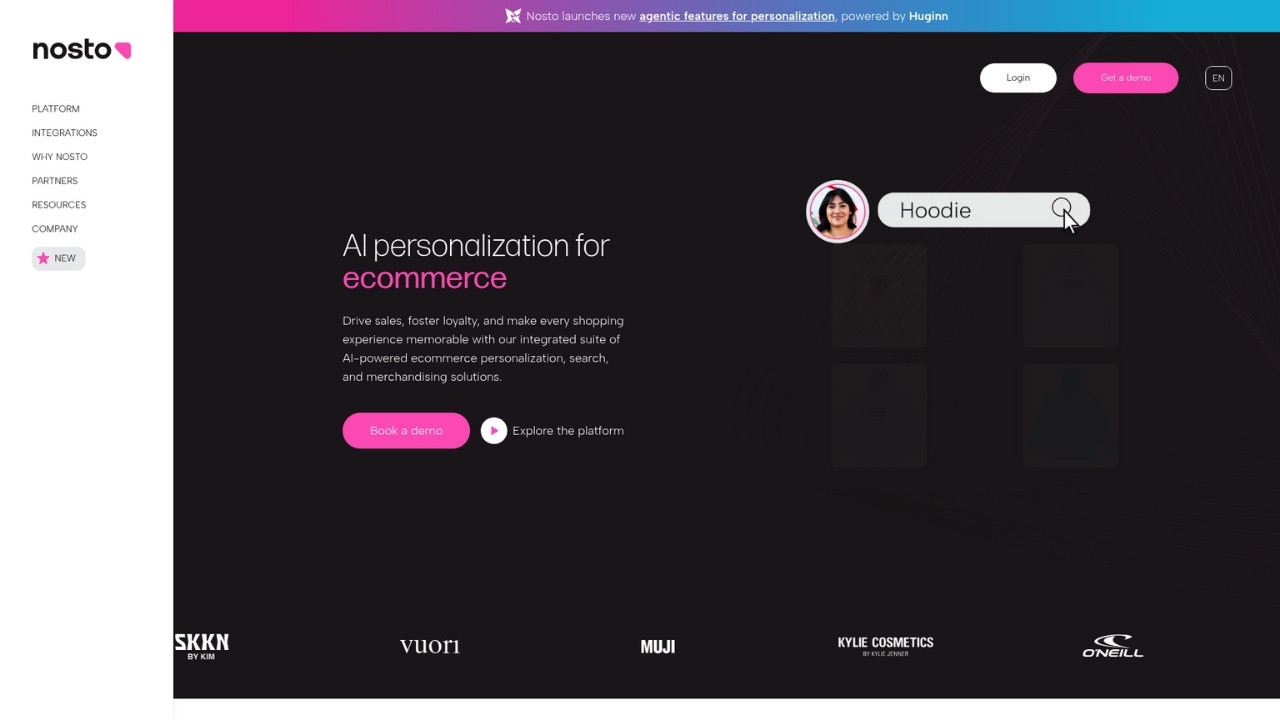
Nosto is a commerce experience platform first and a search tool second. Its personalization and recommendation engines are best in the category, the UI is genuinely intuitive, and it carries a G2 score of 4.6/5 across roughly 235 reviews. If your real problem is "my product pages don't adapt to the shopper," Nosto is a stronger answer than a pure search swap.
Pricing
Custom, based on store size and traffic. Reported starting point is around $500/mo across three editions. Like most of this list, you'll be quoted on a call.
What works
- Best in the category personalization. Recommendations and dynamic content lead the category.
- Responsive support. A recurring positive in reviews.
- Proven scale. 1,500+ brands including Muji and Dermalogica.
What doesn't
- Search is secondary. It's bundled, not search-native, so it's less deep than Klevu or Algolia on pure relevance.
- Opaque pricing. No public numbers, and a full suite gets expensive.
Why it ranks third
Pick Nosto when personalization is the headline and search is a supporting act. If search is your actual pain, one of the search-native tools fits better.
4. Algolia
Best for: Technical teams that want to build a fully custom search experience on a well-documented API.
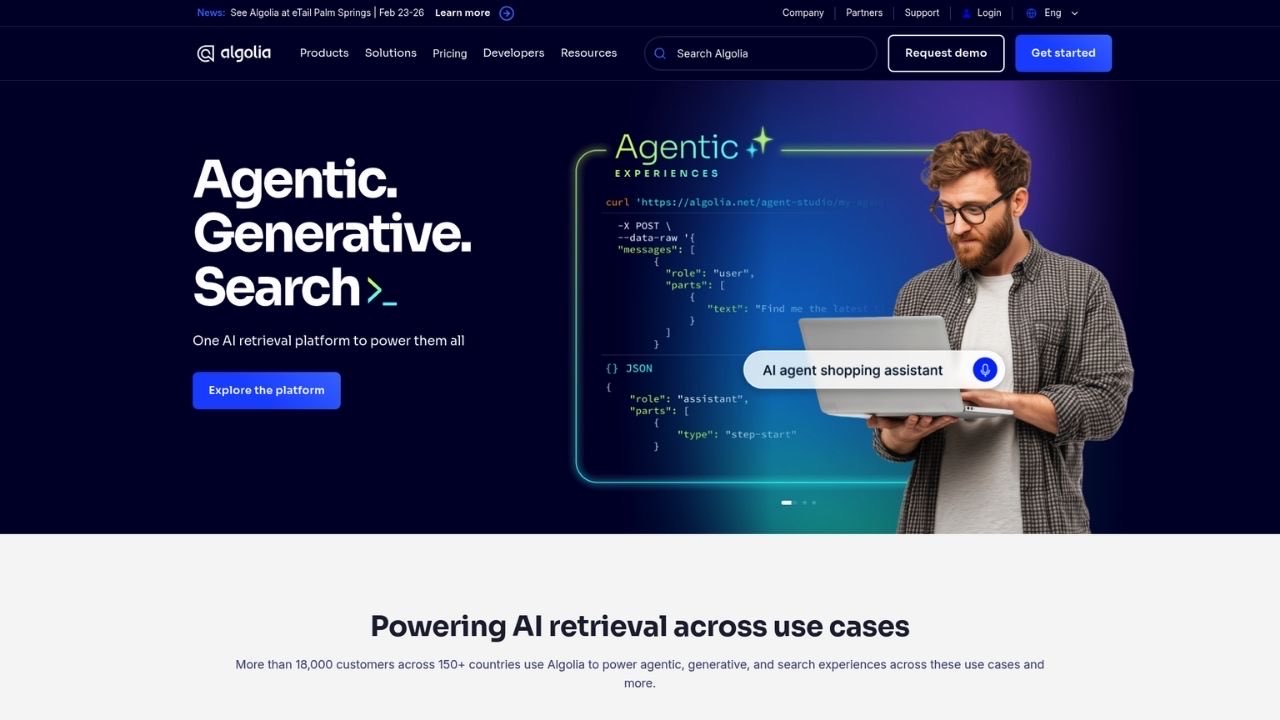
Algolia is the developer's default. Indexing is fast, the API is mature, and the InstantSearch UI libraries are excellent. It scales from a free tier to enterprise. The trade-off is real: it's a toolkit, not a turnkey merchandising suite, so you need engineering time to make it shine for ecommerce. If you want to go deeper here, we wrote a full breakdown of Algolia alternatives for ecommerce.
Pricing
| Plan | Price | Notes |
|---|---|---|
| Build | Free | 1M records, 10K requests/mo |
| Grow | Pay-as-you-go | $0.50 per 1,000 search requests |
| Premium | Custom | Adds AI synonyms, personalization |
| Elevate | ~$50,000/yr+ | Enterprise, NeuralSearch |
Source: Algolia pricing page.
What works
- Transparent, usage-based pricing. Public numbers from free to enterprise.
- Fast and well-documented. A favorite of engineering teams for a reason.
- Scales cleanly. Same platform from startup to Lacoste and Gymshark.
What doesn't
- Usage overages bite. Reviewers describe surprise bills and call it a "financial sinkhole" at scale.
- Not merchandiser-friendly. Out of the box, this is dev work, not a point-and-click suite.
Why it ranks fourth
If you have the engineering muscle, Algolia is powerful. If you don't, the build cost and overage risk push it below the turnkey options for most mid-market stores.
5. Doofinder
Best for: Small and mid-size stores that want good search on a tight budget with same-day setup.
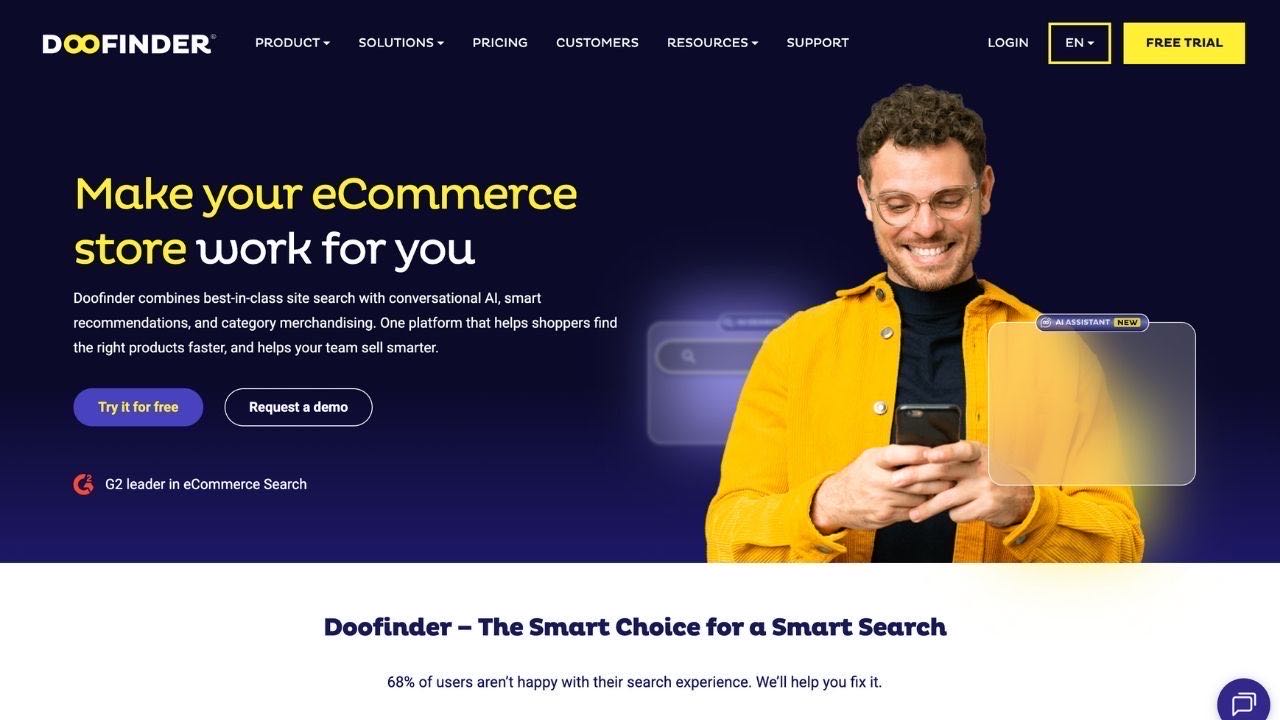
Doofinder is the budget pick, and it earns it. Pricing is fully public, install is fast (the company pitches going live in a day), and even the low tiers include voice search. It supports a broad set of platforms, not just Shopify. For a smaller catalog, this covers the basics at a third of what Searchspring's entry tier reportedly costs.
Pricing
| Plan | Price | Included |
|---|---|---|
| Free | $0 | 1,000 searches/mo |
| Basic | ~$39/mo | 10,000 searches, voice search |
| Pro | ~$59/mo | Custom results, banners, boosting |
| Enterprise | ~$389-$549/mo | Visual search, real-time stats |
Source: Doofinder pricing page. 10% discount on annual.
What works
- Cheapest credible option. Real published pricing, low entry.
- Fast install. Live quickly, no long implementation.
- Broad platform support. Not locked to one ecommerce stack.
What doesn't
- Lighter on merchandising. Enterprise personalization isn't its strength.
- Top features gated. Visual search and advanced analytics sit on the top tier.
Why it ranks fifth
If cost is the reason you're leaving Searchspring and your catalog isn't huge, Doofinder is the easiest yes on this list.
6. Constructor
Best for: Large retailers that want product discovery optimized to revenue, not just relevance.
Constructor is enterprise product discovery built to move a KPI. Instead of ranking purely on relevance, it optimizes search, browse, recommendations, and collections toward revenue, and it backs that with a 4.8/5 G2 score and strong ease-of-use marks. Customers include Sephora and Petco. We also have a dedicated Constructor alternatives guide if you're comparing the enterprise tier specifically.
Pricing
Custom enterprise only. No public numbers, no free trial. Reported ACV lands around $150K, so this is a different budget conversation than the mid-market tools above.
What works
- Optimizes to revenue. The pitch is measurable lift, not just better relevance.
- Strong ease of use. High marks for a tool this powerful.
- Proven enterprise customers. Sephora, Petco, Birkenstock.
What doesn't
- Enterprise-only pricing. Out of reach for most mid-market brands.
- No transparency, no trial. You commit before you see a number.
Why it ranks sixth
Excellent if you're enterprise and discovery drives serious revenue. If you're mid-market and price-sensitive, it's the opposite of what you're looking for.
7. Bloomreach Discovery
Best for: Enterprise retailers wanting AI search and deep merchandising at large scale.
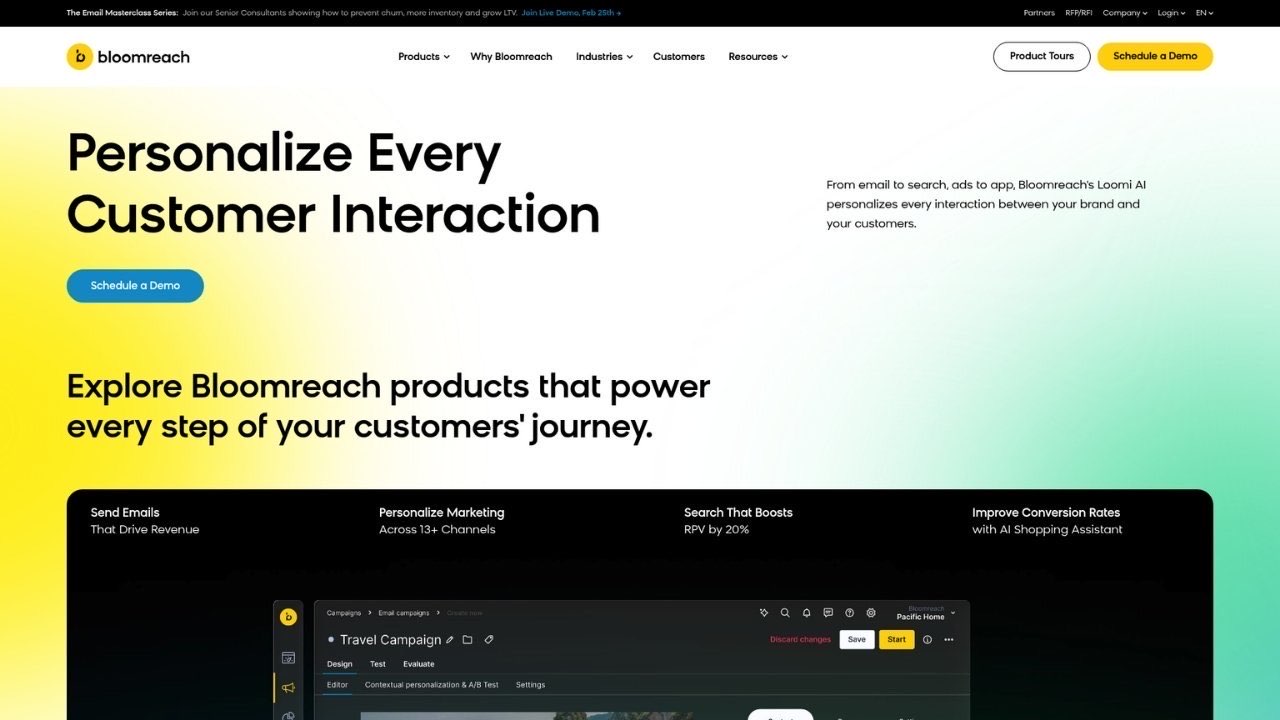
Bloomreach Discovery brings AI search, merchandising, and recommendations together under its "Loomi" intent engine, and it's proven at enterprise scale with 1,400+ customers like Puma and Marks & Spencer. It holds a 4.6/5 G2 score across 480+ reviews. The depth is real, but so is the complexity.
Pricing
No public pricing. Discovery-only typically runs $60K-$120K/yr, with the broader suite climbing well past that. This is a six-figure annual decision.
What works
- Deep merchandising. Among the most capable in the category.
- Intent-aware AI. Loomi handles shopper intent well.
- Enterprise-proven. Scales to very large catalogs.
What doesn't
- Complex implementation. Steep learning curve, longer rollout.
- Three-product friction. Discovery, Engagement, and Content don't always feel like one tool.
Why it ranks seventh
Strong for enterprise, but the cost and complexity rule it out for the mid-market brands most likely to be reading this.
8. Coveo
Best for: Large enterprises, often on Salesforce, that need AI relevance across commerce, service, and the workplace.
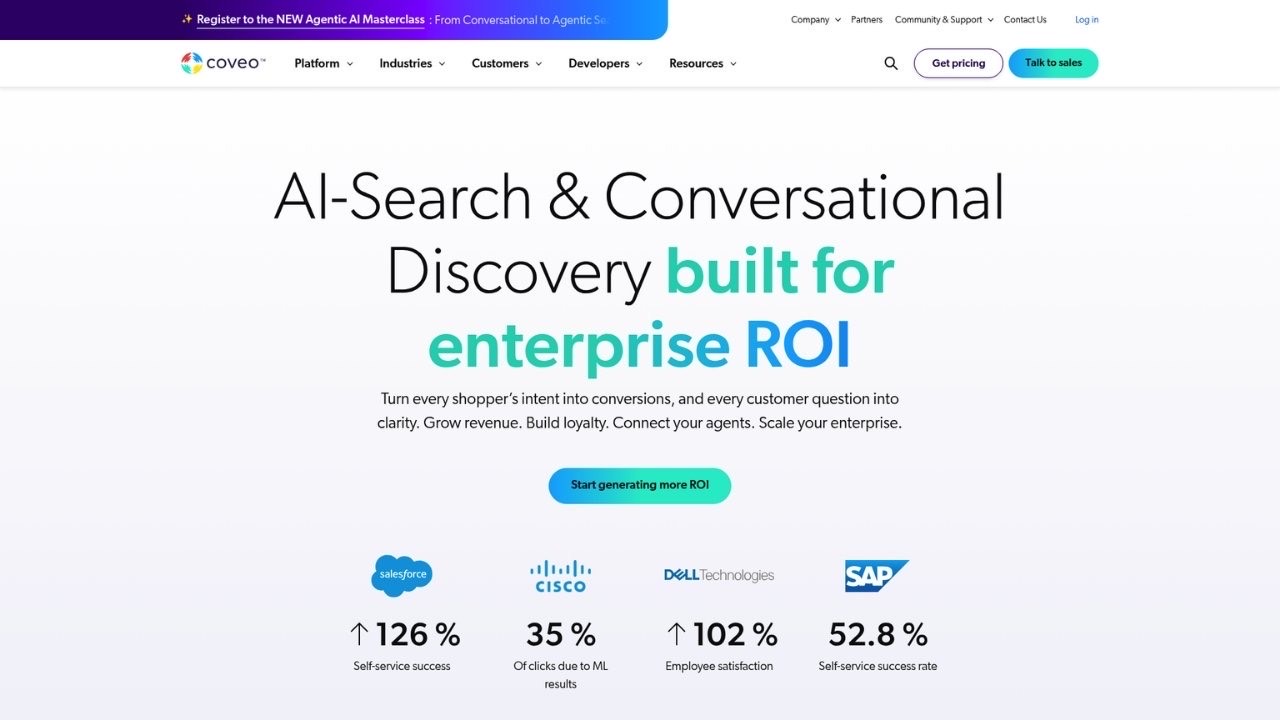
Coveo is an AI-relevance platform that spans far beyond ecommerce: commerce search, customer service, and internal workplace search all run on it, with deep Salesforce integration. For a pure ecommerce site-search need, it's more platform than you require, and the consumption-based pricing is hard to predict.
Pricing
Consumption-based and custom. Third-party benchmarks range from around $30K for smaller deployments to $500K+ at enterprise scale. Budget unpredictability is a known trade-off.
What works
- Powerful AI relevance. Strong across multiple surfaces.
- Deep Salesforce integration. A real edge if you're a Salesforce shop.
- Multi-surface. One relevance engine for commerce and support.
What doesn't
- Complex and expensive. Needs technical resources to deploy well.
- Overkill for ecommerce search. You'd pay for breadth you won't use.
Why it ranks eighth
A fit for enterprises that need relevance everywhere, not just on the storefront. For most ecommerce teams choosing a Searchspring alternative, it's the wrong shape.
Why people leave Searchspring
The reasons people switch are consistent across G2, Capterra, and review roundups, and they're worth naming plainly because they tell you what to test for in a replacement.
The most common complaint isn't the product, it's the price and the contract around it. Reviewers describe Searchspring as "very expensive" with "continued price increases," and note that you're locked into a 12-month auto-renewing contract that's hard to exit. When the support also lags, that lock-in stings.
Here's the recurring stack of frustrations, in roughly the order they show up:
- Price relative to value, plus increases. The entry tier reportedly starts near $699/mo, several times what Doofinder charges, and the cost adds up fast for mid-sized stores.
- Annual lock-in. A 12-month auto-renew that teams say they have to start unwinding months early.
- Slow support. Multiple reviewers cite three-week ticket turnarounds unless an issue is marked urgent.
- Merchandising complexity. "Powerful, but you really need a dedicated person to manage it." Anything beyond basic config tends to need development resources.
- Long implementation. Reviews put setup at a minimum of four weeks.
- Post-merger seams. The Athos consolidation of three platforms is still settling, and some users report rough edges between search, merchandising, and feed workflows.
It matters because the stakes are high. Around 80% of shoppers leave a site after a poor or unsuccessful search (Nosto), and Baymard's research found that 31% of search-led product-finding tasks end in failure while 41% of ecommerce sites fail to support key query types shoppers actually use (Baymard). A search tool that's expensive, slow to support, and hard to tune is leaking revenue while it costs you money. For high-volume stores, the same logic shows up in Shopify Plus customer service planning too.
The part switching site search won't fix
Here's the thing the other lists won't tell you. A better search engine helps the shopper who's already on your site. It does nothing for the shopper who gives up and calls.
And they do call. When search returns nothing useful, a chunk of shoppers don't bounce, they pick up the phone: "do you carry the blue one," "does this come in a wide," "is this back in stock yet." Plenty of them are where's my order calls too. I see these calls every week across our customers. They're the on-site search failure, just moved to a different channel, and a new search platform won't make them stop ringing.
That's the lane we're actually in. Ringly.io is AI phone support for Shopify brands. While you're picking a search tool to fix discovery on the site, the AI handles the calls that discovery gaps create: order status, product questions, returns, the same questions over and over. Seth resolves up to 90% of calls on its own, and it escalates anything genuinely complex to whatever helpdesk you already run. If you want the wider picture, here's how we think about ecommerce customer service end to end.
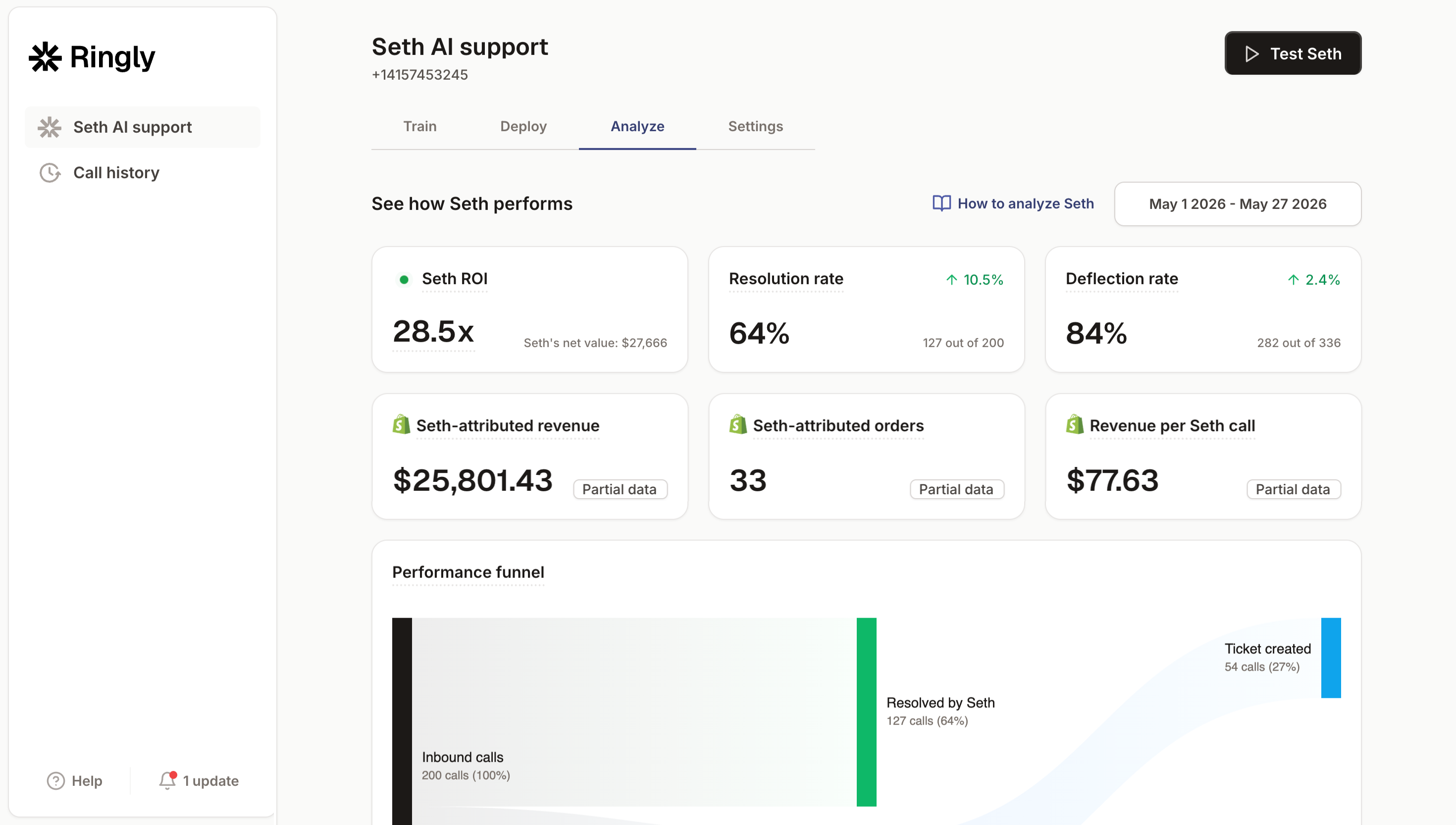
WashCo, a Shopify brand we launched, recovered $22,664 in its first 7 days on the phone. That's revenue from calls that would otherwise have gone to voicemail. The point isn't that phone support replaces good search. It's that the two solve different halves of the same lost-sale problem, and most brands only fix one.
"My customers also feel like it's a normal person. They feel like they can communicate if they have questions."
Claudia Droge, TechCraft Studio
If your search tool decision is really a "we're losing sales we can't see" decision, the phone is part of that picture. Book a 30-min call and we'll review the calls your store is dropping right now.
How to choose the right Searchspring alternative
Match the tool to why you're leaving, not to whichever list ranks itself first.
- Choose Fast Simon if you're a mid-market Shopify brand that wants the closest Searchspring replacement with real pricing and no-code merchandising.
- Choose Klevu if AI search quality is the priority and the Athos merger doesn't bother you.
- Choose Nosto if personalization and recommendations matter more than pure search depth.
- Choose Algolia if you have engineering resources and want to build a custom search experience.
- Choose Doofinder if cost is the reason you're leaving and your catalog is small to mid-size.
- Choose Constructor or Bloomreach if you're enterprise and discovery drives serious revenue, with the budget to match.
- Choose Coveo if you need AI relevance across commerce and support, usually as a Salesforce shop.
One buyer move worth more than any feature comparison: before you sign anything, ask each vendor to run a batch of your actual search queries through their engine and show you the results. Test the typos, the plurals, the long-tail terms your shoppers really use. That's where the difference between "great demo" and "great on my catalog" shows up.
And remember the part the search switch won't cover. If your team is also drowning in calls, look at 24/7 ecommerce phone support alongside the search decision, not after it.
Frequently asked questions
What happened to Searchspring? Is it Athos Commerce now? Yes. In January 2025, Searchspring merged with Klevu and Intelligent Reach to form Athos Commerce. The Searchspring product still exists, but it's now one brand inside a larger company.
How much does Searchspring cost? Searchspring doesn't publish pricing. Reported figures put the entry tier near $599-$699/mo on a custom quote with a 12-month annual contract. You'll need a sales call for an exact number, which is itself a common complaint.
What is the best Searchspring alternative for Shopify? Fast Simon is the closest like-for-like swap for Shopify, with public pricing and no-code merchandising. Klevu and Doofinder are strong runners-up depending on whether you prioritize AI search quality or budget. If you're auditing your wider stack, our roundup of the best AI tools for Shopify covers the adjacent categories.
What is a cheaper alternative to Searchspring? Doofinder is the most affordable credible option, starting around $39/mo with fully public pricing. Fast Simon is the next step up, with plans from $39.99 to $499.99/mo.
Searchspring vs Algolia: which is better? Searchspring is a merchandiser-friendly, turnkey platform. Algolia is a developer-first API you build on. If you have engineering resources and want full control, Algolia wins. If you want point-and-click merchandising, Searchspring or Fast Simon fit better.
Is Klevu the same as Searchspring now? They share a parent company, Athos Commerce, as of the 2025 merger. They're still sold as separate products, but if your reason for switching is the company behind Searchspring, moving to Klevu won't change that.
Do I need a developer to use these tools? It varies. Algolia, Constructor, and Coveo lean technical and usually need engineering time. Fast Simon, Doofinder, and Klevu are more no-code and a merchandiser can run them. Searchspring sits in between and reviewers say it needs a dedicated person. The same no-code versus dev-heavy split shows up across the best Shopify customer service apps, so it's worth weighing for your whole stack.
How much does ecommerce site search actually improve conversion? A lot. Shoppers who use search convert two to three times more than those who don't, and search can drive up to 40% of revenue on some sites (Nosto). That's why the tool you pick is worth getting right.
Talk to us

A better search engine fixes discovery on your site. It won't stop the phone from ringing when a shopper can't find what they need. If you run a Shopify brand and you're losing calls after-hours and during spikes, a 30-min call is the fastest way to see what that's costing you.
Our 3 promises.
- Live in under 1 hour. Setup and test calls are free.
- 30-day money back on the $99 plan fee.
- 65% resolution guarantee: if Seth resolves under 65% of your support calls in a month, that month comes back as credit (after 90 days on Pay per call).
Ruben (Ringly co-founder) takes these calls personally.