

This post in 30 seconds.
- The lens: Klevu nails AI-driven discovery. It's also pricey, custom-quoted, and now part of Athos Commerce alongside Searchspring, so we ranked 7 alternatives by how well they actually understand shopper intent.
- Top picks: Algolia for teams with developers, Searchspring for merchandiser-led brands, Luigi's Box if you want predictable pricing.
- Built for Founders, COOs, and Heads of CX at $10M-$100M Shopify brands deciding where their search-and-discovery budget goes.
Klevu is genuinely good at what it does. The AI search understands long-tail and voice queries, the merchandising is strong, and the support team gets praised in nearly every review (4.7 on the Shopify App Store). So why do so many brands shop around? Two reasons. The pricing isn't published, it scales with your catalog and traffic, and the most common complaint in reviews is sticker shock. And since January 2025, Klevu sits under the Athos Commerce umbrella next to Searchspring, which has people asking whether the product they're buying is still getting its own roadmap. If you run a $10M-$100M Shopify brand and you're weighing where your discovery budget goes, this is the honest field.
I'm Ruben, co-founder of Ringly. We don't sell site search, so I have no horse in this race, which is exactly why I wanted to write the neutral version. If your store is the kind where shoppers can't always find what they want and the overflow lands on your support team, the calls that search can't catch are their own problem. Book a 30-min call and we'll look at what your store is leaving on the table when search comes up empty.
The 7 best Klevu alternatives at a glance
Here's the whole field in one table before the deep dives. The real split is between discovery-first engines that understand intent and merchandising-first tools that are easier to run without a developer.
| Tool | Best for | Discovery approach | Starting price | Verdict |
|---|---|---|---|---|
| Algolia | Teams with dev resources | NeuralSearch (semantic) + API | Free tier, ~$85+/mo at volume | Most flexible, needs a developer |
| Constructor | Large catalogs (100K+ SKUs) | Behavioral ML, revenue-optimized | Custom (enterprise) | Best ranking, enterprise price |
| Searchspring | Merchandiser-led mid-market | Merchandising-first + AI | $699/mo | Turnkey, now same parent as Klevu |
| Nosto | Personalization + search in one | Behavioral personalization | ~$1,000/mo | Deep personalization, pricey entry |
| Fast Simon | Fast-growing Shopify brands | Visual + merchandising | Mid-market tiers | Cost-effective, less enterprise depth |
| Luigi's Box | Predictable budgets | Search + discovery analytics | €140/mo | Transparent pricing, smaller US footprint |
| Bloomreach | Enterprise, multi-channel | AI discovery + content | Custom (high floor) | Powerful, overkill under $50M |
Site search earns its budget. Shoppers who use search convert at roughly 4.63% versus 2.77% for the site average, and on many stores searchers are about 15% of visitors but close to 45% of revenue. Getting this decision right moves real money, and it ties straight into your wider ecommerce conversion rate optimization work, so it's worth more than a coin-flip off a feature grid.
How I evaluated these Klevu alternatives
I'm Ruben, co-founder of Ringly. Over the past few weeks I looked at every tool in this list the way a $20M-$50M Shopify operator would, not as a search engineer. I ran the same store-search queries through each, read the real Shopify App Store and G2 reviews, and pulled current pricing.
Here's what I scored against:
- Semantic depth. Does it actually understand intent (a query like "warm jacket for a 6 month old") or just match keywords faster? This is Klevu's home turf, so the bar is high.
- Shopify-native setup. Can a merchandiser install and tune it, or do you need a developer for weeks?
- Merchandising controls. Can a non-technical person pin products, build rules, and run a campaign without filing a ticket?
- Pricing predictability. Is the cost clear up front, or does it balloon as your catalog and traffic grow? This is the most common Klevu complaint, so it carries weight.
- What happens when search misses. Every search tool fails on some queries. Where do those shoppers go, and what does that cost you?
Two things nobody else in the search-roundup space will tell you. First, since January 2025, Klevu and Searchspring both sit under Athos Commerce, so a brand "switching from Klevu to Searchspring" is often switching within the same parent company. Second, after reading real call logs across the Shopify brands on Ringly, I'll say the thing no search vendor says out loud: your on-site search and your phone line are two halves of the same product-discovery problem. Better search shrinks the overflow. It never gets it to zero.
The 7 best Klevu alternatives in 2026
1. Algolia
Best for: brands with developer resources that want the most flexible, lowest-entry discovery engine. Algolia is a hosted search API with NeuralSearch (its semantic, vector-based layer), a Recommend product, and a merchandising UI on top.
It's the closest thing to Klevu's AI discovery if you have the team to wire it up. The semantic search is real, the infrastructure is fast and global, and the free tier lets you start at zero. The catch is that "flexible" means "you build it."
Pricing
| Plan | Price | Included |
|---|---|---|
| Build | Free | 10,000 search requests/mo |
| Grow Plus (with AI) | ~$85-100/mo | ~50K searches/mo, AI features |
| Scale | ~$875/mo+ | ~500K searches/mo (search only) |
Usage-based, billed per 1,000 requests. Costs climb with traffic.
What works
- NeuralSearch is genuinely semantic, not just a faster keyword index, so intent queries surface the right products.
- Free Build tier lets you prototype before you commit a dollar.
- Huge ecosystem and docs, rated around 4.5 on G2, with fast global performance.
What doesn't
- You need a developer to implement and tune it. Merchandisers can't run it solo the way they can a Shopify-native tool.
- Merchandising is less turnkey than Searchspring or Fast Simon out of the box.
- Cost is harder to predict because it tracks search volume, not a flat tier.
Why it ranks 1st: if you have engineering and want the deepest semantic discovery for the lowest starting cost, nothing else here matches Algolia's flexibility.
2. Constructor
Best for: large catalogs (100K+ SKUs) and brands with a data team. Constructor optimizes ranking for revenue and conversion, not just relevance, using behavioral machine learning.
This is the one tool here that can genuinely out-rank Klevu on discovery quality, because it tunes results to what actually converts rather than what merely matches. It earns one of the highest ratings in the category (around 4.9 on G2). It's also priced for enterprise.
Pricing
Custom, enterprise-only. Not published. Expect a premium quote tied to catalog size and traffic.
What works
- Revenue-optimized ranking, so results are tuned to conversions, not just text relevance.
- Built for huge catalogs, where keyword search and even semantic search start to strain.
- Top-tier ratings from data-driven retail teams.
What doesn't
- Enterprise pricing puts it out of reach for most $20M brands.
- Overkill below 100K SKUs, where simpler tools deliver most of the value.
- Longer onboarding that assumes you have a team to feed it data.
Why it ranks 2nd: the best discovery engine on this list, gated behind enterprise pricing and complexity that a mid-market brand doesn't need.
3. Searchspring
Best for: merchandiser-led mid-market DTC brands that want turnkey control. Searchspring leads with merchandising, search, personalization, and insights, all Shopify-native. Worth noting: it's now under the same parent as Klevu (Athos Commerce).
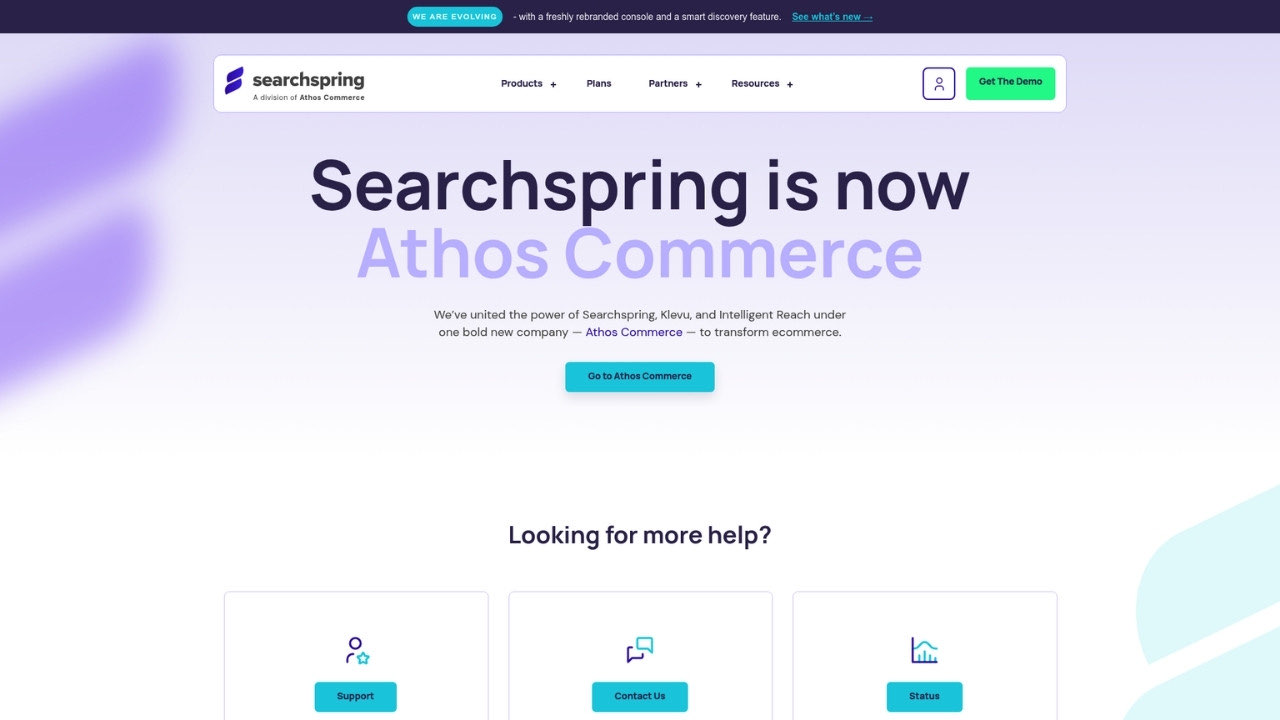
If Klevu's appeal is the AI and Searchspring's is the merchandising, the two are now siblings. That changes the calculus. Switching from Klevu to Searchspring for a fresh roadmap may keep you inside the same company. Still, the merchandising tooling is excellent and a non-technical merchandiser can actually run it.
Pricing
| Plan | Price | Included |
|---|---|---|
| Essential | $699/mo | Core search + merchandising |
| Advanced | $899/mo | + personalization |
| Expert | $1,099/mo | + advanced insights |
Transparent tiers, which is a relief after Klevu's custom quotes.
What works
- Merchandiser-friendly, so your team builds rules and campaigns without dev tickets.
- Shopify-native with fast setup.
- Transparent pricing, unlike Klevu's custom quotes.
What doesn't
- Same parent as Klevu now, so "switching for a fresh roadmap" may not mean what you think.
- Less raw semantic NLP than Klevu or Constructor.
- Pricier entry than Algolia or Luigi's Box.
Why it ranks 3rd: the most natural Klevu swap for a merchandising-led team, with the honest asterisk that you'd be staying inside Athos Commerce.
4. Nosto
Best for: brands that want personalization and search in one platform. Nosto started as a personalization engine and added Commerce Search and Categories, all powered by behavioral data and Shopify-native. If ecommerce personalization is the lens you're buying through, that's Nosto's home ground.
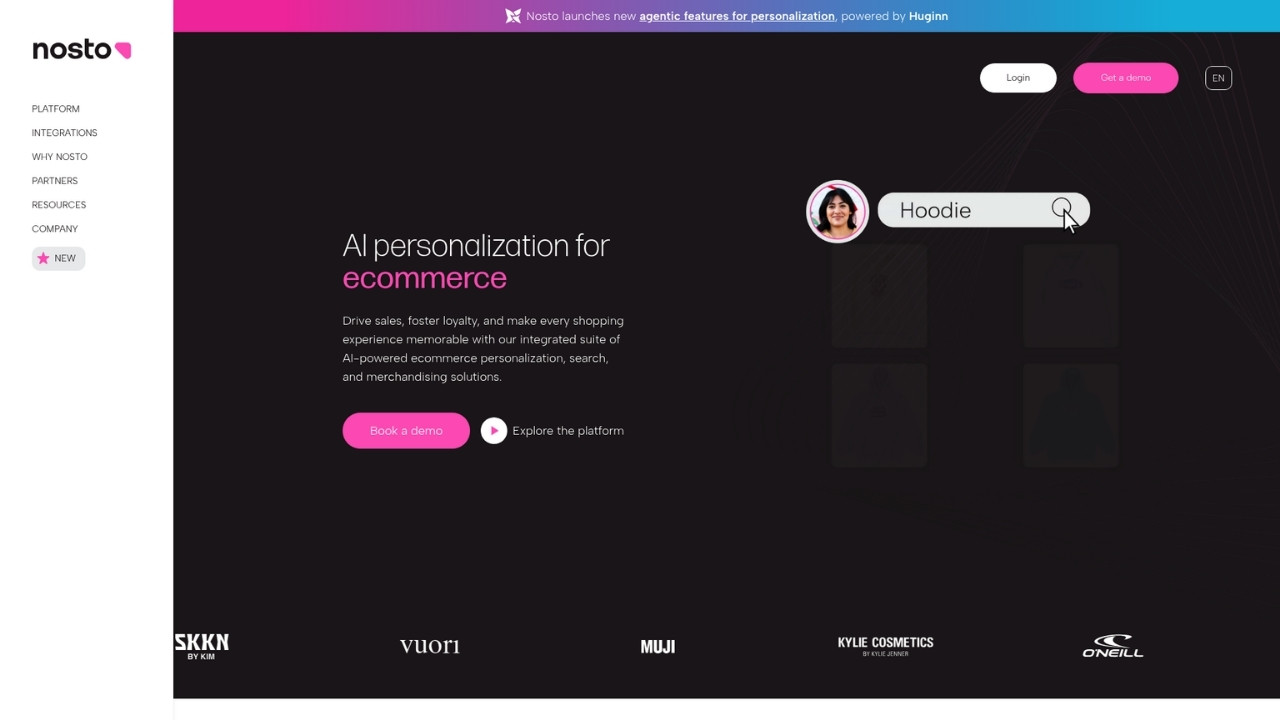
If your real goal is personalization with search as part of the bundle, Nosto is a strong single-vendor answer. The behavioral targeting is deep, and recommendations plus search live under one roof. It rates around 4.6 on G2. The entry price is the friction.
Pricing
Starts around $1,000/mo for basic personalization, scaling with traffic, visitors, and add-ons like email personalization. Custom-quoted at higher tiers.
What works
- Deep behavioral personalization, its original strength.
- Search and recommendations unified, so you run one platform instead of two.
- Shopify-native with a mature app.
What doesn't
- Expensive entry at roughly $1,000/mo before add-ons.
- Search is newer than its personalization core, so it's catching up to discovery-first tools.
- Custom-quote pricing above the base tier.
Why it ranks 4th: the best pick if personalization is the priority and search is the bonus, not the other way around.
5. Fast Simon
Best for: fast-growing Shopify brands that want visual search and merchandising without a developer. Fast Simon runs across Shopify, BigCommerce, Magento, WooCommerce, and Wix, with visual discovery, merchandising, and personalization.
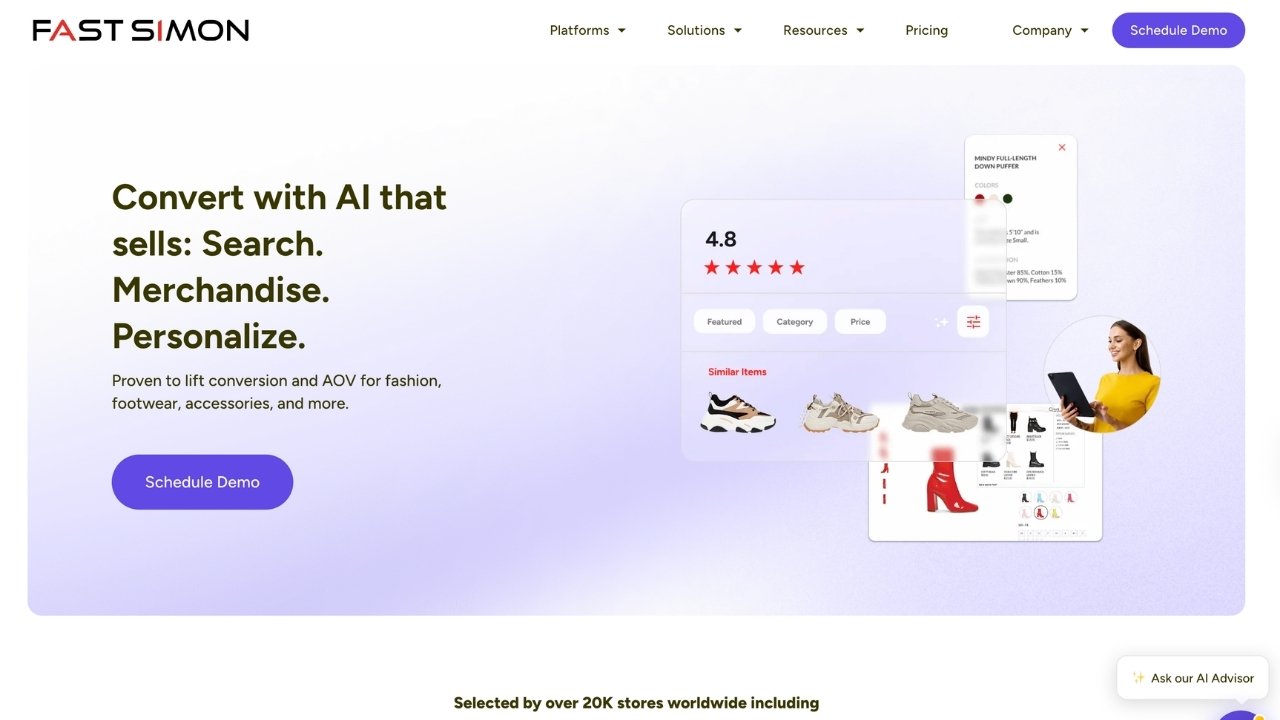
This is the cost-effective, get-it-live-fast option. Visual and image search are a real differentiator, especially for apparel and home brands where shoppers search by look. Setup is quick and a merchandiser can own it.
Pricing
Tiered and mid-market friendly, generally below Klevu and Nosto on entry. Exact tiers vary by catalog and traffic, so confirm on a demo.
What works
- Visual and image search, strong for visual verticals like apparel and home.
- Fast setup with no developer required.
- Multi-platform and cost-effective relative to enterprise tools.
What doesn't
- Less enterprise semantic depth than Algolia or Constructor.
- The UI can feel busy with many features surfaced at once.
- Analytics are lighter than the enterprise options.
Why it ranks 5th: the value pick for visual-heavy Shopify brands that want fast setup over enterprise depth.
6. Luigi's Box
Best for: price-conscious mid-market brands that want predictable cost. Luigi's Box pairs search and product discovery with genuinely strong analytics, and it publishes its pricing, which almost no one else here does.

If the Klevu complaint that pushed you here was pricing opacity, Luigi's Box is the antidote. Self-integration search starts at €140/mo for up to 50,000 pageviews, and it's rated around 4.8 on G2, among the highest in the category. The trade-off is a smaller US presence.
Pricing
| Plan | Price | Included |
|---|---|---|
| Search (self-integration) | €140/mo (annual) | Up to 50,000 pageviews |
| Higher tiers | Scales by pageviews | Discovery + analytics add-ons |
Transparent and predictable, billed annually.
What works
- Transparent, low entry price, the opposite of Klevu's custom quotes.
- High G2 rating (around 4.8) and strong search-term analytics.
- Solid discovery and insights for the money.
What doesn't
- Smaller US footprint, so it's less known in US DTC circles.
- Fewer deep Shopify-native merchandising rules than Searchspring.
- Brand recognition lags the bigger names with US sales teams.
Why it ranks 6th: the value-and-transparency pick, ideal if predictable pricing is what drove you off Klevu.
7. Bloomreach
Best for: enterprise brands that need discovery, content, and marketing in one stack. Bloomreach combines AI-driven search and discovery (its Loomi AI) with content and email, aimed at large, data-rich enterprises.
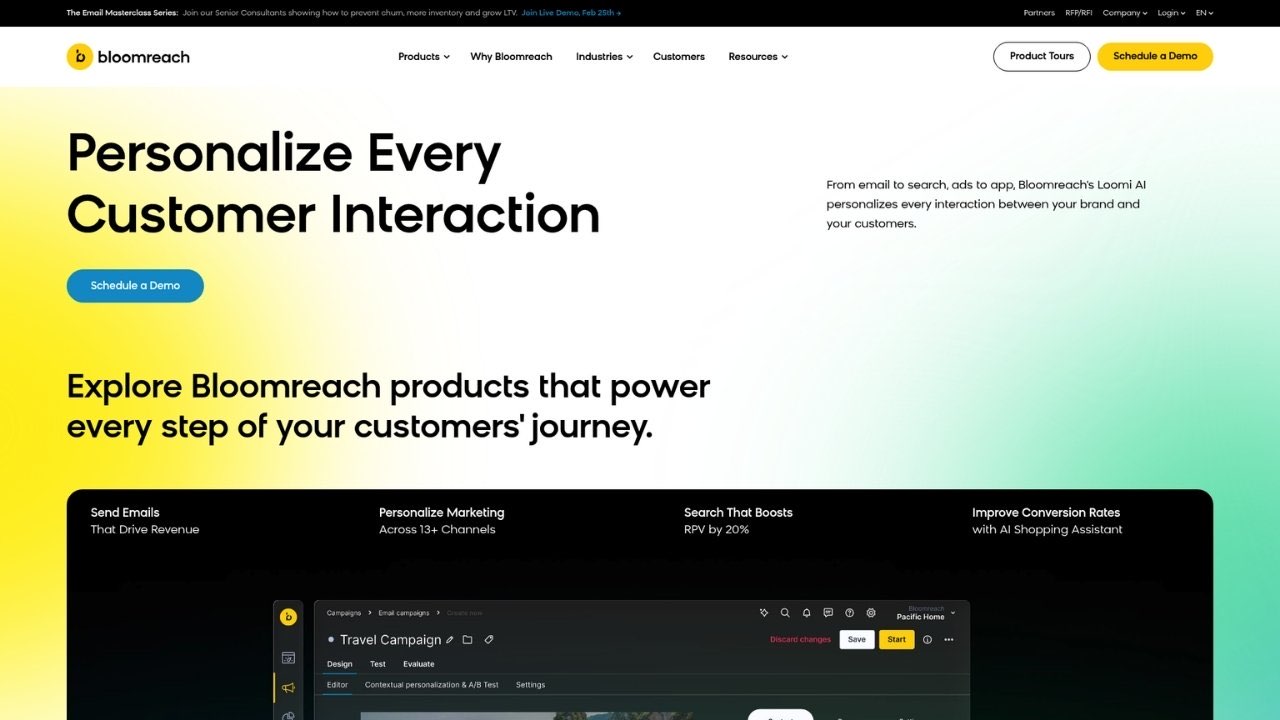
This is the most powerful tool on the list and the heaviest. If you're a large enterprise that wants one vendor for discovery plus content plus marketing, Bloomreach delivers. For a $20M Shopify brand, it's more platform than you'll use.
Pricing
Enterprise custom, with a high floor. Not published. Built for brands with dedicated teams.
What works
- Discovery, content, and marketing in one enterprise stack.
- Enterprise-grade AI across multiple channels.
- Scales to very large, complex catalogs and orgs.
What doesn't
- Cost and complexity put it out of reach below roughly $50M.
- Needs a dedicated team to run well.
- Overkill if all you want is better on-site search.
Why it ranks 7th: the right answer for enterprises consolidating their stack, the wrong one for a brand that just wants Klevu-quality search without the Klevu bill.
Search is only half of product discovery
Here's the part the search vendors leave out. Every search engine on this list will still miss queries, and when search misses, the shopper doesn't disappear, they call or email instead.
Think about the questions that don't resolve cleanly in a search bar. "Is this back in stock soon?" "Which one fits a 6-month-old?" "Do you ship to Canada?" "What's the difference between the two travel sizes?" Plenty of these are where's-my-order questions and order tracking asks that no search index will ever answer. A great search tool surfaces products. It doesn't answer the human question behind the search, and a meaningful slice of shoppers pick up the phone instead. That's the half of product discovery no search vendor sells you.
This is where Ringly fits, and I want to be honest about the scope. Ringly is not a site-search tool and won't pretend to be one. It doesn't index your catalog or rank results. What it does is answer the phone when search comes up short, the kind of AI voice support for Shopify that picks up where the search bar stops.
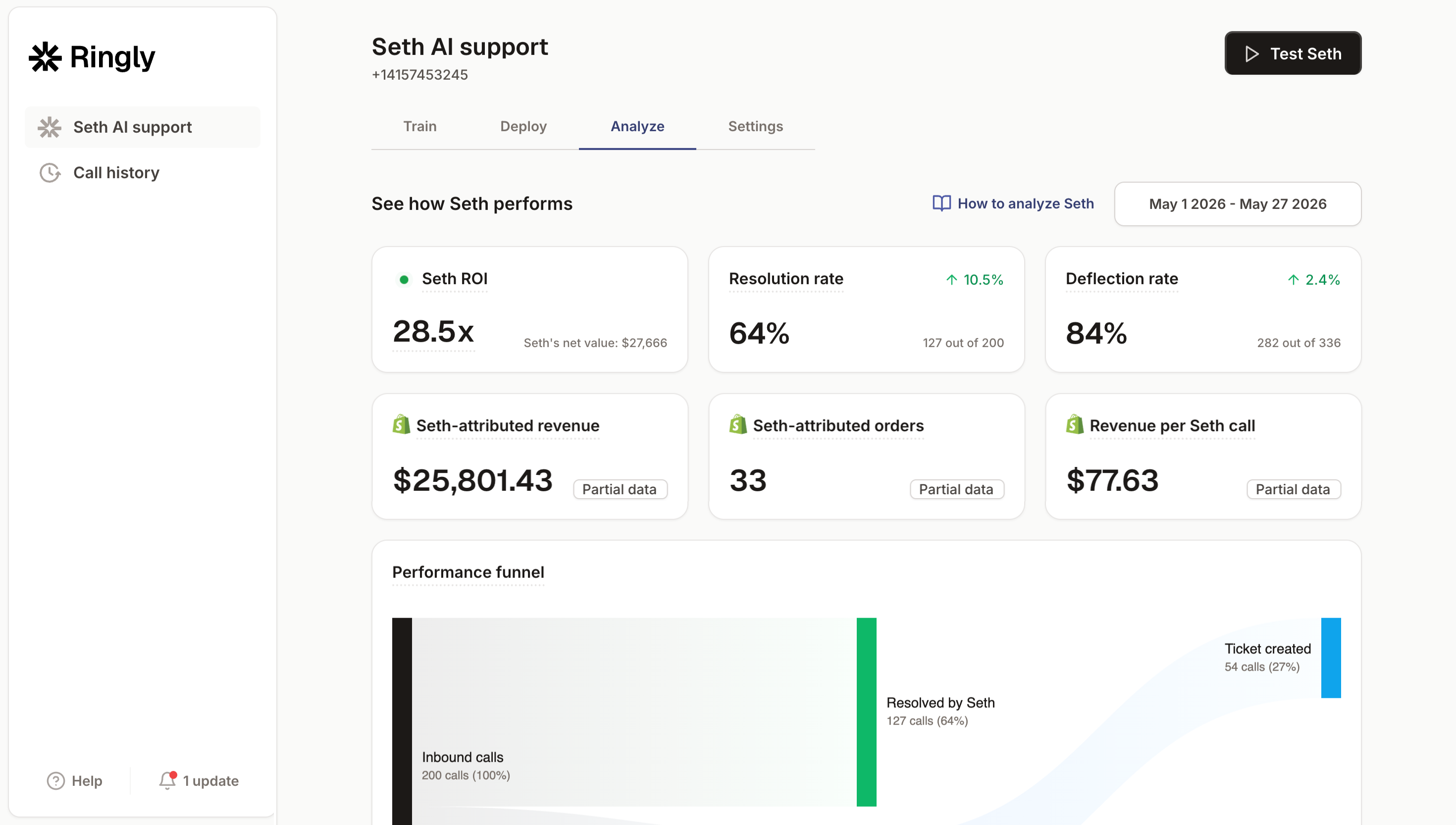
Ringly.io is AI phone support for Shopify brands. The phone shouldn't be a tax on your support team. The AI answers inbound calls 24/7: it finds orders in your Shopify store, answers product questions from your knowledge base, processes returns, and cancels orders when a caller asks. It resolves up to 90% of calls autonomously, and the calls that need a human escalate cleanly to Gorgias, Richpanel, Reamaze, or whatever helpdesk you already run. Live in under an hour, no code.
"My customers also feel like it's a normal person. They feel like they can communicate if they have questions."
Claudia Droge, TechCraft Studio
The economics matter because the overflow isn't free. Take a typical $50M Shopify brand running a 6-rep support team:
| Line item | Today | With Ringly |
|---|---|---|
| 6 reps × $4K loaded per rep | $24,000/mo | n/a |
| Ringly (~$5K/mo at this volume) | n/a | $5,000/mo |
| Net monthly spend | $24,000/mo | $5,000/mo |
| Monthly savings | n/a | $19,000/mo |
That's roughly 70% of repeatable calls (order status, returns, the same product questions over and over) handled by the AI, with the genuinely complex calls still going to your team. WashCo, a Shopify brand we launched, recovered $22,664 in its first 7 days on the phone. Better search lowers the volume hitting your phone. The calls that get through still cost payroll, and that's the math worth running alongside your search decision.
If your store loses shoppers to questions search can't answer, book a 30-min call and we'll do the numbers live.
How to choose the right Klevu alternative
The field sorts cleanly once you know your constraint:
- Choose Algolia if you have developers and want the deepest semantic search for the lowest starting cost.
- Choose Constructor if you run a 100K+ SKU catalog, have a data team, and have enterprise budget.
- Choose Searchspring if you want turnkey merchandising a non-technical team can run, and you're comfortable staying inside Athos Commerce.
- Choose Nosto if personalization is the real goal and search is the bonus.
- Choose Fast Simon if you want visual search and fast setup without a developer.
- Choose Luigi's Box if predictable, transparent pricing is what pushed you off Klevu.
- Choose Bloomreach if you're an enterprise consolidating discovery, content, and marketing into one stack.
And whichever search tool you pick, remember it solves half the discovery problem. The questions it can't answer still ring your phone. Pairing better search with something that actually handles the inbound calls is how the best operators close the loop. For a wider view of the tooling stack, our roundup of the best AI tools for Shopify covers more of the ecosystem, and our take on AI shopping assistants digs into the discovery side.
Frequently asked questions
What is the best Klevu alternative?
It depends on your constraint. Algolia is the best fit if you have developers, Searchspring is the most natural swap for a merchandising-led team, and Luigi's Box is the value pick with transparent pricing. There's no single winner, only the right match for your stack and budget.
Is Klevu the same as Searchspring now?
They share a parent. Since January 2025, Klevu and Searchspring both sit under Athos Commerce. They're still distinct products with different strengths (Klevu leads on AI search, Searchspring on merchandising), but switching from one to the other can mean staying within the same company.
What's a cheaper alternative to Klevu?
Luigi's Box starts at €140/mo for up to 50,000 pageviews with transparent pricing, and Algolia has a free Build tier (10,000 requests/mo) plus low-cost paid tiers. Both are materially cheaper than Klevu's custom quotes for a mid-market catalog.
Does Klevu work with Shopify?
Yes, Klevu is a Shopify App Store app rated 4.7, and most alternatives here (Searchspring, Nosto, Fast Simon) are Shopify-native too. Algolia and Bloomreach work with Shopify but lean on developer setup.
What's the difference between site search and product discovery?
Site search is the bar where shoppers type a query. Product discovery is the broader job of connecting shoppers to the right products, including recommendations, merchandising, and the questions that happen off the search bar entirely, like a phone call asking if an item ships in time.
How does site search affect customer support volume?
When shoppers can't find what they need, a slice of them contacts support instead. Better search reduces that overflow, but it never eliminates it, which is why pairing search with strong phone and chat support matters for the full discovery picture.
Talk to us

Whichever Klevu alternative you land on, it's solving for the shoppers who search. If your store runs on Shopify and the calls search can't catch are piling up after hours, a 30-min call is the fastest way to see what you're leaving on the table.
Our 3 promises.
- Live in under 1 hour. Setup and test calls are free.
- 30-day money back on the $99 plan fee.
- 65% resolution guarantee: if Seth resolves under 65% of your support calls in a month, that month comes back as credit (after 90 days on Pay per call).
Ruben (Ringly co-founder) takes these calls personally.