
Customer service is eating your margins. The average ecommerce store spends 15-20% of revenue on support, and that number climbs as you scale.
Hiring more agents isn't the answer, it's the problem.
AI customer service tools have matured beyond simple chatbots.
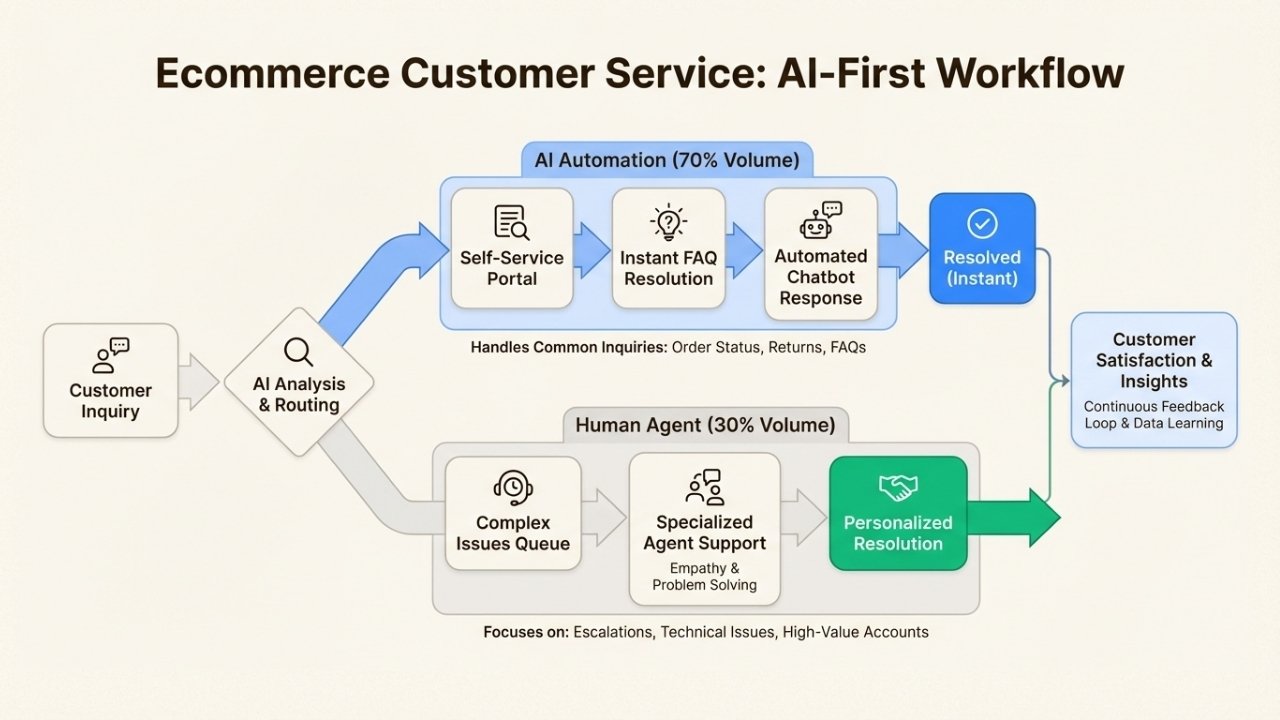
The best platforms now resolve 60-80% of inquiries without human intervention, handling everything from "Where's my order?" to returns, refunds, and even product recommendations.
They're not just deflecting tickets, they're solving problems.
We analyzed the leading platforms to find which ones actually deliver for ecommerce. Here's what we found.
Editor’s note: Want to hear some sample AI support calls made for your Shopify store?
- Just paste your store URL
- Get sample calls in under 20 seconds (no email required)
- Listen to demo calls for my store
What is AI customer service for ecommerce?
AI customer service for ecommerce refers to intelligent systems that handle customer inquiries automatically.
Unlike basic chatbots that follow rigid scripts, modern AI agents understand context, access your order management system, and complete tasks from start to finish.
The key capabilities include:
- Order tracking (WISMO - Where Is My Order) - the most common ecommerce query
- Returns and exchanges - processing refunds, generating labels, scheduling pickups
- Product recommendations - suggesting alternatives when items are out of stock
- Subscription management - skip, pause, or modify recurring orders
- Multilingual support - handling customers in their native language
These tools integrate directly with your ecommerce platform (Shopify, Magento, WooCommerce) and helpdesk software.
They pull real-time data about inventory, shipping status, and customer history to provide accurate, personalized responses.
The best part? They work 24/7 without breaks, sick days, or overtime pay.
How we evaluated these tools
We focused on criteria that matter for ecommerce operations:
- Automation rate - what percentage of tickets can be fully resolved without human intervention
- Ecommerce integrations - depth of connection to Shopify, order management systems, and shipping carriers
- Pricing transparency - whether you can understand costs without sitting through a sales demo
- Setup complexity - how long from signup to handling real customer inquiries
We analyzed official documentation, customer testimonials, and third-party reviews.
Every claim below is backed by data from the platforms themselves or verified user feedback.
AI customer service tools compared
| Tool | Best for | Automation rate | Starting price | Key strength |
|---|---|---|---|---|
| Gorgias | Shopify stores | 60% | $10/mo + AI add-on | Deep Shopify integration |
| Siena AI | Premium brands | Up to 80% | Custom pricing | Human-like empathy |
| Yuma AI | Multichannel ops | 40-60% | Custom pricing | Sales + support combined |
| Fin by Intercom | Cost-conscious teams | 73% | $0.99/resolution | Predictable pay-per-use |
| DigitalGenius | Enterprise ecommerce | 90% (reported) | Enterprise pricing | Deep workflow automation |
| Ada | Global brands | 40% | Enterprise pricing | 100+ languages |
| Neople | Distributed teams | 80% (claimed) | Custom pricing | Works across all tools |
1. Gorgias

Best for: Shopify stores wanting all-in-one support
Gorgias is built specifically for ecommerce, and it shows.
The platform handles customer conversations across email, chat, SMS, and social media from a single inbox. Their AI Agent resolves approximately 60% of support inquiries automatically.
The standout feature is Shopify integration. Agents can view and edit orders directly from the ticket, no tab-switching required.
This includes checking inventory, applying discounts, and processing refunds without leaving the conversation.
Key features:
- 60% inquiry resolution rate
- 100+ ecommerce integrations
- Marketing Suite for proactive campaigns
- Voice and SMS support
Pricing: Starts at $10/month for basic helpdesk; AI Agent is an additional add-on. Higher tiers unlock more automation and channels.
Pros:
- Deep Shopify integration (also supports Magento and BigCommerce)
- All-in-one platform (support + marketing)
- Trusted by 15,000+ brands including MrBeast and Reebok
Cons:
- Limited functionality outside the Shopify ecosystem
- Can get expensive at scale with per-seat pricing
- AI Agent requires separate subscription
Verdict: If you run on Shopify and want a single platform for support and marketing, Gorgias is hard to beat. The ability to edit orders directly from tickets saves massive time.
2. Siena AI

Best for: Brands prioritizing empathetic, human-like AI
Siena positions itself as an "empathic AI CX agent" designed specifically for commerce.
Unlike tools that feel robotic, Siena aims to mirror your brand voice and handle conversations with emotional intelligence.
The platform connects to your helpdesk, commerce stack, and customer data to run commerce-specific workflows.
Brands using Siena report up to 80% automation rates with faster response times and higher customer satisfaction scores.
Key features:
- Up to 80% automation rate
- Brand voice mirroring across all channels
- Subscription management (skip, pause, swap)
- Social media engagement and moderation
Pricing: Custom pricing based on volume; enterprise-focused.
Pros:
- Exceptional response quality that feels human
- Strong emotional intelligence in conversations
- Handles complex post-purchase workflows
- Platform agnostic (works with any helpdesk)
Cons:
- Pricing not transparent (contact sales)
- May be overkill for smaller stores
- Newer player with less track record than established tools
A VP of Supply Chain at Coterie shared: "With Siena, we've shifted CX from being a cost center to a revenue driver.
That transformation has been a game-changing unlock for our business."
Verdict: Best for premium brands where customer experience is a differentiator. If you need AI that doesn't feel like AI, Siena delivers.
3. Yuma AI
Best for: Multichannel ecommerce operations
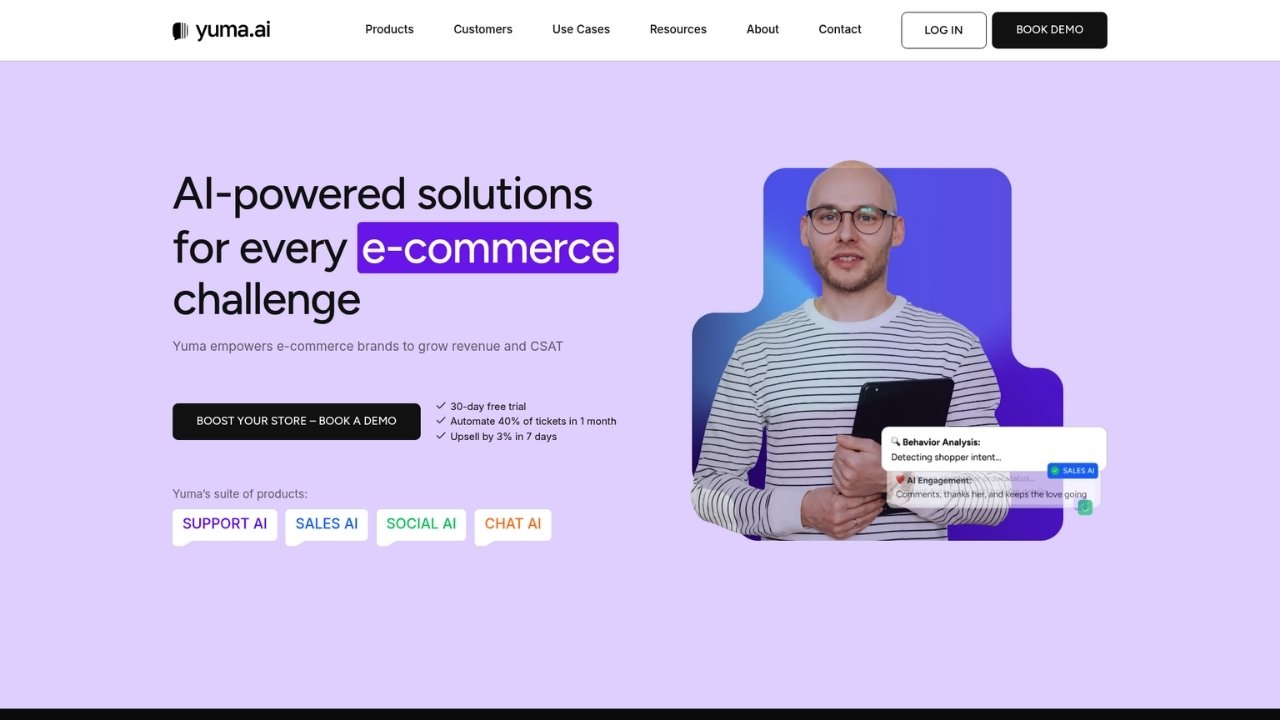
Yuma takes a modular approach with four distinct AI products: Support AI, Sales AI, Social AI, and Chat AI.
This lets you deploy AI where you need it most, whether that's handling tickets or driving revenue through personalized recommendations.
The platform is particularly strong for brands selling across multiple channels.
Yuma integrates with Shopify, helpdesks, and social platforms to provide consistent support everywhere customers reach out.
Key features:
- 40-60% automation typical (up to 70% for some merchants)
- 30-day free trial
- Upsell capabilities during support conversations
- Real-time order tracking and WISMO handling
Pricing: Custom pricing based on ticket volume and modules used.
Pros:
- Strong multichannel support (web, social, chat)
- Sales-focused features that drive revenue
- Quick setup (deploy in under an hour)
- Good for high-growth brands
Cons:
- Less customization flexibility than some competitors
- Newer player in the market
- Pricing requires sales consultation
A Director of Omnichannel Customer Experience at Glossier noted: "We barely had to think about the technical side.
Yuma just worked, right out of the box. That was a huge relief, so we could focus on customer experience rather than implementation."
Verdict: Ideal for brands wanting AI across both support and sales functions. The modular approach means you only pay for what you need.
4. Fin by Intercom
Best for: Businesses wanting predictable, pay-per-resolution pricing
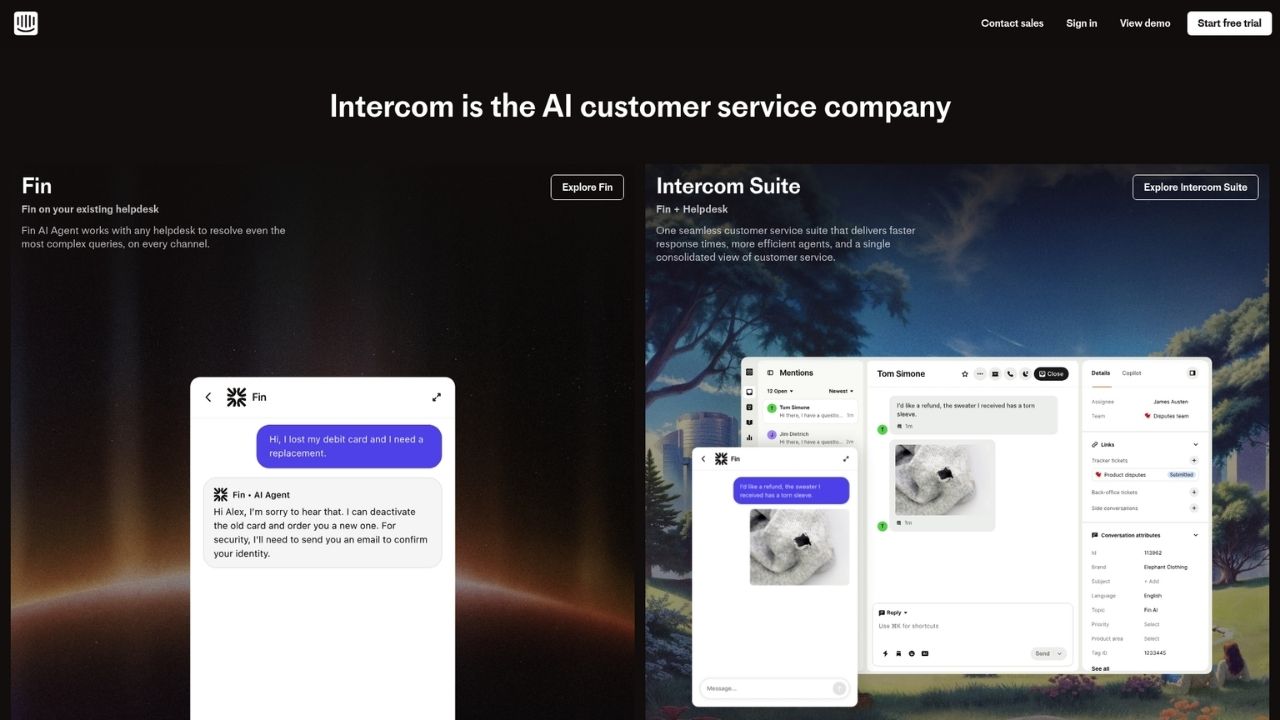
Fin is Intercom's AI agent, and it comes with bold claims: #1 on G2, #1 in bake-offs, and a 73% resolution rate that beats competitors by significant margins.
The Fin AI Engine uses proprietary models specifically trained for customer service.
The standout feature is pricing transparency. At $0.99 per resolution, you know exactly what you're paying for. No per-seat fees, no usage tiers, just simple per-ticket pricing.
Key features:
- $0.99 per resolution
- 73% resolution rate (independent testing)
- Works with any helpdesk (Zendesk, Salesforce, HubSpot)
- Full simulation testing before going live
Pricing: $0.99 per resolution as standalone; or $0.99/resolution + $29/helpdesk seat if using Intercom's platform.
Pros:
- Predictable costs that scale with volume
- Strong performance benchmarks
- Extensive testing capabilities before deployment
- Seamless escalation to human agents
Cons:
- Requires Intercom for full feature set
- Resolution pricing adds up at high volume
- Less ecommerce-specific than dedicated tools
A VP of Global Support at Lightspeed reported: "Fin is in a completely different league. It's now involved in 99% of conversations and successfully resolves up to 65% end-to-end, even the more complex ones."
Verdict: Best for teams wanting simple, predictable pricing without sacrificing capability. The pay-per-resolution model aligns costs with actual value delivered.
5. DigitalGenius
Best for: Enterprise ecommerce with complex workflows
DigitalGenius positions itself as an AI concierge with deep integrations that enable true end-to-end resolution.
The platform doesn't just respond to customers, it takes action: generating return labels, processing refunds, and even detecting defects through visual AI.
The visual AI capability is unique. Customers can upload photos of damaged products, and the AI identifies issues and triggers appropriate workflows automatically.
This is particularly valuable for fashion and electronics retailers.
Key features:
- Visual AI for warranty and defect detection
- Deep carrier integrations for lost package resolution
- Proactive AI that detects issues before customers complain
- Purchase AI for product recommendations
Pricing: Enterprise pricing (contact sales).
Pros:
- Deepest integration capabilities in the market
- 600% ROI reported by enterprise customers
- Visual AI for automated defect detection
- Handles complex multi-step workflows
Cons:
- Enterprise-focused (likely too complex for small stores)
- Pricing opaque
- Significant setup and training required
The Global Head of DTC CX at On Running stated: "Our expectations of what was possible with AI were not only met, but exceeded. We regained control of our inbox and cut customer wait times by 93%."
Verdict: Best for large operations with complex support needs. If you're processing thousands of tickets daily with intricate workflows, DigitalGenius can handle it.
6. Ada

Best for: Global brands needing multilingual support
Ada's ACX Platform is built for scale. The platform supports 100+ languages and delivers consistent experiences across web, mobile, messaging apps, and voice. For international ecommerce brands, this is a significant advantage.
The automation rates vary by implementation, with Ada reporting 40% as typical and some customers achieving 84% automated resolution.
The platform also claims to make human agents 2x more productive when handoffs are needed.
Key features:
- 100+ language support
- Omnichannel deployment (web, mobile, voice, messaging)
- 40% automated resolution rate (up to 84% for some)
- 2x agent productivity improvement
Pricing: Enterprise pricing (contact sales).
Pros:
- Strong multilingual capabilities
- Extensive channel support
- Proven enterprise track record
- Comprehensive analytics and reporting
Cons:
- Expensive for smaller businesses
- Complex feature set can be overwhelming
- Requires significant implementation investment
The Head of Customer Care at IPSY shared: "Every dollar we save through efficiency gets channeled back into elevating the member experience.
That's how you turn Customer Care from a cost center into a growth driver."
Verdict: Best for international ecommerce brands serving customers in multiple languages. The global scale capabilities are hard to match.
7. Neople

Best for: Teams wanting AI as a "digital coworker"
Neople takes a different approach. Instead of being a standalone platform, Neople integrates into your existing tools (Zendesk, Freshdesk, Slack, Teams) and acts like a real team member.
You can train it in plain language using your existing documentation.
The platform supports 160+ languages and provides a control panel (Neople Studio) where you can configure tone of voice, upload new documentation, and track performance.
This transparency is refreshing in a space where many AI tools are black boxes.
Key features:
- 160+ language support
- Integrates with existing tool stack
- Neople Studio for configuration and monitoring
- Learns from multiple media formats
Pricing: Custom pricing based on usage.
Pros:
- Works across existing tools (no migration needed)
- Highly trainable with real documentation
- Strong brand voice control
- Transparent performance analytics
Cons:
- Not ecommerce-specific (general purpose)
- Newer platform with less market presence
- Requires existing helpdesk investment
A Team Lead at Haarspullen.nl explained: "We use full automation only when we're confident that our Neople, Hanna, can answer with 99-100% accuracy.
We can manually add new options to this group of automated answers. For example, WISMO questions are very easy for Hanna to handle."
Verdict: Best for teams that want AI everywhere they already work. If you're not looking to rip and replace your existing stack, Neople fits right in.
How to choose the right AI customer service tool
With seven solid options, how do you pick? Here's a simple framework:
Start with your ecommerce platform. If you're on Shopify, Gorgias offers the tightest integration. For other platforms, look at Siena, Yuma, or Neople for their platform-agnostic approach.
Consider your ticket volume. High-volume operations (10,000+ tickets/month) should look at DigitalGenius or Ada for enterprise-grade handling. Smaller stores might find Tidio or simpler tools sufficient.
Evaluate pricing models. Per-resolution pricing (Fin) works well if your volume fluctuates. Per-seat pricing (Gorgias) is predictable for stable teams. Enterprise tools (DigitalGenius, Ada) require sales conversations.
Factor in your tech stack. If you love your current helpdesk, Neople or Fin can augment it. If you want an all-in-one solution, Gorgias or Ada provide complete platforms.
Start with a pilot. Don't automate everything on day one. Begin with WISMO queries and FAQs, then expand as you build confidence. Most platforms allow you to set automation rules so you can test before fully deploying.
Getting started with AI customer service
The biggest mistake is trying to automate everything at once. Here's a better approach:
Start with your most repetitive inquiries. "Where is my order?" represents 20-30% of ecommerce support volume.
Automate this first, and you'll immediately see impact.
Train your AI with real historical tickets. The more examples you provide, the better the AI understands your brand voice and common scenarios.
Most platforms improve significantly after analyzing a few thousand past conversations.
Monitor and refine continuously. AI isn't "set it and forget it." Review conversations weekly, identify where the AI struggles, and add training data or adjust rules accordingly.
Keep humans in the loop for complex issues. The goal isn't to eliminate human agents, it's to let them focus on high-value conversations while AI handles the routine. Your best agents should handle escalations, not password resets.
Ready to see what AI can do for your support operation? Start your free trial and automate your first workflow in minutes.
Frequently Asked Questions
What is AI customer service for ecommerce?
AI customer service for ecommerce refers to intelligent systems that handle customer inquiries automatically, from order tracking and returns to product recommendations. Unlike basic chatbots, modern AI agents understand context, access your order management system, and complete tasks from start to finish without human intervention.
How much can AI customer service for ecommerce actually automate?
Most platforms report automation rates between 40-80%, depending on your ticket types. Simple queries like 'Where is my order?' can be automated 90%+ of the time, while complex issues requiring judgment still need human agents. The best implementations start with high-volume, low-complexity tickets and expand from there.
What's the typical pricing for AI customer service tools for ecommerce?
Pricing varies by model. Per-resolution pricing (like Fin at $0.99/ticket) aligns costs with value delivered. Per-seat pricing (like Gorgias starting at $10/month) works for predictable volumes. Enterprise tools often require custom pricing based on ticket volume and feature needs.
Do I need to replace my existing helpdesk to use AI customer service for ecommerce?
Not necessarily. Tools like Neople and Fin integrate with existing helpdesks (Zendesk, Freshdesk, Salesforce) to add AI capabilities without migration. However, all-in-one platforms like Gorgias or Ada require switching to their ecosystem for full benefits.
How long does it take to implement AI customer service for ecommerce?
Simple implementations can go live in under an hour for basic chatbots. More sophisticated AI agents that integrate with your order management system typically take 2-4 weeks to configure, train, and test. Enterprise deployments with custom workflows may take 1-3 months.
Can AI customer service for ecommerce handle returns and refunds?
Yes, the best platforms can process returns end-to-end. They generate return labels, verify eligibility against your policy, process refunds, and update inventory. DigitalGenius and Siena are particularly strong here, with deep workflow automation for post-purchase scenarios.
Will AI customer service for ecommerce work with my Shopify store?
Most AI customer service tools offer Shopify integration, but depth varies. Gorgias has the deepest native integration, allowing order edits directly from tickets. Yuma, Siena, and Neople also integrate well with Shopify, pulling real-time order data for accurate responses.