
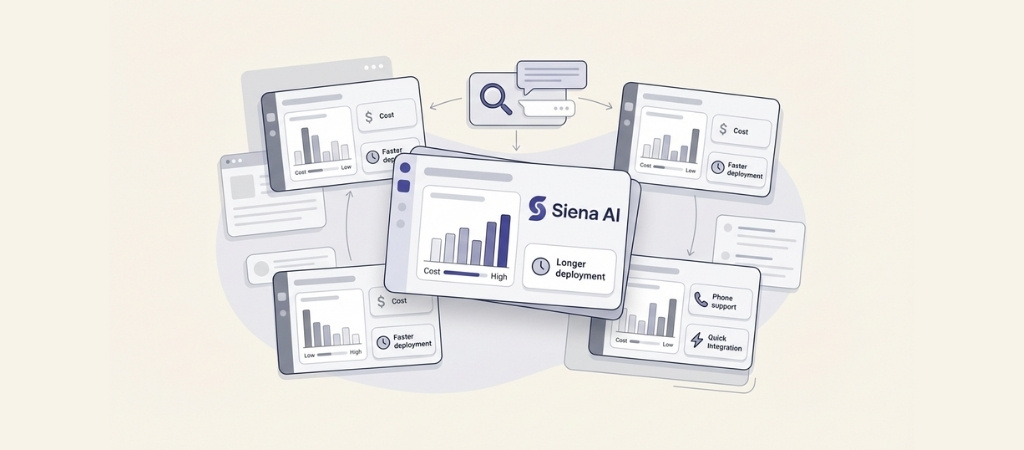
Siena AI has made a name for itself as an empathy-driven AI agent built specifically for ecommerce.
But at $750/month as a starting point, it's not the right fit for every team.
Maybe you're running a leaner operation. Or you need faster deployment than Siena's multi-week timeline allows.
Some stores need phone support automation, which Siena doesn't cover.
Whatever your reason, there are solid alternatives worth considering.
This guide breaks down seven Siena AI alternatives across different price points and use cases.
You'll find detailed pricing, automation claims, and integration specifics so you can match the right tool to your store's needs.
Editor’s note: Want to hear some sample AI support calls made for your Shopify store?
- Just paste your store URL
- Get sample calls in under 20 seconds (no email required)
- Listen to demo calls for my store
Why ecommerce teams look for Siena AI alternatives
Siena AI positions itself as an "empathic AI agent for commerce." The platform handles email, SMS, social DMs, WhatsApp, and comments with a focus on human-like responses. For DTC brands wanting polished, autonomous support across text channels, it delivers.
But three factors consistently push teams to explore other options.
Pricing sits in the premium tier. Siena starts at $750/month with usage-based scaling that can push costs past $1,000/month at higher volumes. For stores doing under $5M in revenue, that's a significant chunk of the support budget.
Implementation takes weeks, not days. Siena requires custom configuration to reach meaningful automation. Competitors like Yuma AI claim 40% automation within three days. If you're heading into a peak season or need to move fast, the timeline matters.
Channel coverage has gaps. Siena excels at text-based channels but doesn't handle phone support. For stores where phone calls remain a core support channel, you'll need a separate solution or a platform that covers voice natively.
None of these are deal-breakers for every team. But if one of them resonates with your situation, the alternatives below offer different trade-offs worth evaluating.
Quick comparison: Siena AI alternatives at a glance
Before diving into individual tools, here's how the options stack up on the metrics that matter most.

Pricing varies 10x between cheapest and enterprise options while automation rates cluster around 60-70%
| Alternative | Starting Price | Automation Rate | Best For |
|---|---|---|---|
| Ringly.io | $349/mo | ~73% | Phone-first automation for Shopify |
| Yuma AI | $350/mo | 70–89% | D2C brands needing deep "agentic" workflows |
| Gorgias | $10/mo | Up to 60% | Shopify teams wanting native helpdesk + AI |
| Tidio | Free tier | Up to 70% | Small businesses and real-time chat leads |
| Zendesk | $19/agent/mo | Varies (High) | Global enterprise & complex multi-channel |
| Freshdesk | $15/agent/mo | Varies | Cost-conscious teams using modular AI bots |
| Ada | $60,000/yr | 80%+ | Large-scale enterprise & multi-industry scale |
The detailed breakdowns below cover what each tool does well, where it falls short, and which types of stores get the most value from each option.
7 best Siena AI alternatives
1. Ringly.io

Ringly.io takes a different approach than most Siena alternatives. Instead of competing on chat and email, it focuses entirely on phone support automation through its AI agent called the AI.
The AI handles inbound calls 24/7, answering questions, looking up orders, processing returns and exchanges, and escalating to human agents only when necessary.
The platform integrates natively with Shopify to pull order data, product information, and customer history in real-time.
What sets it apart:
- Phone-first AI (the only option in this list with full voice automation)
- ~73% call resolution rate without human intervention across Shopify stores
- 30 languages supported
- Most stores go live within an hour, not weeks
- Deep Shopify integration for order tracking, returns, and exchanges
Pricing:
| Plan | Monthly Price | Minutes Included | Overage Rate | Key Features |
|---|---|---|---|---|
| Grow | $349/mo | 1,000 minutes | $0.19/minute | Self-learning AI, Shopify order/return handling, call insights |
| Enterprise | Custom | 5,000+ minutes | $0.19/minute | Custom integrations, private Slack channel, white-glove setup |
Overage runs $0.19/minute. The trial lets you test for 14 days free, and you can get your last 3 months refunded if the AI resolves under 65% of calls in 90 days over 100 calls in the first 21 days.
Best for: Shopify stores with significant phone support volume wanting fast deployment and predictable pricing.
If your customers still pick up the phone regularly, this fills a gap that text-based tools like Siena don't cover.
2. Yuma AI
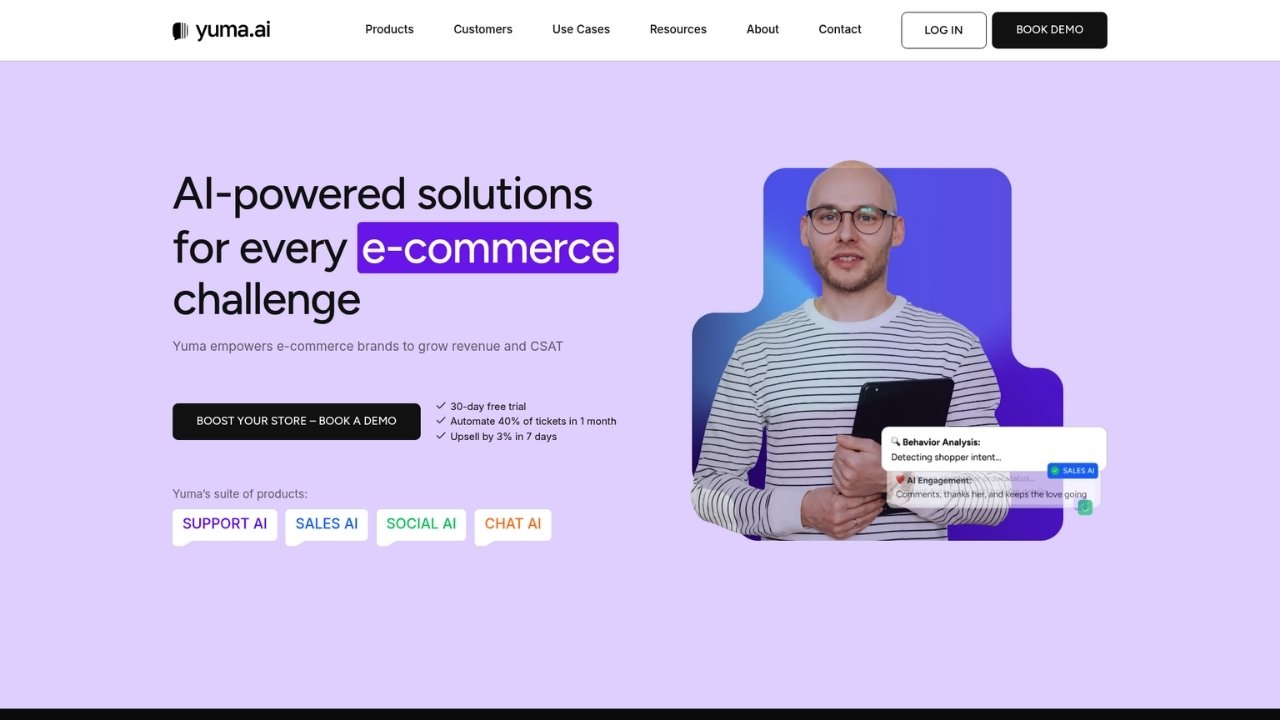
Yuma AI positions itself as the speed-focused alternative with ROI guarantees baked into the contract.
The platform specializes in ecommerce automation across email, chat, WhatsApp, Instagram, Facebook, and review sites.
The standout claim is time-to-value. Yuma says stores can hit 40% automation within three days of deployment, compared to the weeks most platforms require for meaningful results.
Key capabilities:
- Omnichannel coverage including social media and review sites
- Support AI for autonomous ticket resolution
- Chat AI for real-time conversations
- Social AI that turns social conversations into conversions
- Integrates with Gorgias, Zendesk, and Kustomer
Case study results:
- EvryJewels: 89% full automation, 63% cost per ticket reduction
- Clove: 70% automation, 3x ROI in 3 months
- Glossier: 87% response time reduction
Pricing:
| Plan | Monthly Price | Included Resolutions | Overage Rate |
|---|---|---|---|
| Starter | $350/mo | 500 resolutions | $1.50/resolution |
| Growth | $650/mo | 1,000 resolutions | $1.40/resolution |
| Pro | $900/mo | 1,500 resolutions | $1.30/resolution |
| Enterprise | Custom | Custom (Unlimited) | Negotiated / ROI-based |
The 30-day free trial includes an ROI guarantee, which is rare in this space.
Best for: High-volume ecommerce stores wanting fast time-to-value and multi-channel coverage.
The ROI guarantee makes it easier to justify internally if you need to prove results quickly.
3. Gorgias

Gorgias differs from pure AI add-ons because it's an all-in-one helpdesk platform with native AI capabilities.
Instead of bolting AI onto your existing setup, you get a unified inbox with automation built in.
The AI Agent handles ecommerce-specific workflows like order queries, returns, refunds, and subscription management.
The key trade-off is that using Gorgias fully means migrating away from your current helpdesk if you're already on Zendesk or Freshdesk.
What it does well:
- Unified inbox for email, chat, SMS, social, and voice
- 60%+ ticket resolution with proper knowledge base setup
- Native Shopify and BigCommerce integration
- Revenue attribution tracking
- Unlimited users (no per-seat pricing)
Pricing:
| Plan | Monthly Price (Annual) | Tickets Included | Overage Rate | Key Features |
|---|---|---|---|---|
| Starter | $10/mo | 50 tickets | $0.40 / ticket | 3 seats, Shopify/BigCommerce, basic Macros |
| Basic | $50/mo ($60 monthly) | 300 tickets | $40 / 100 tickets | Unlimited seats, 150+ integrations, basic rules |
| Pro | $300/mo ($360 monthly) | 2,000 tickets | $36 / 100 tickets | Revenue statistics, CSAT surveys, Magento support |
| Advanced | $750/mo ($900 monthly) | 5,000 tickets | $36 / 100 tickets | Dedicated Success Manager, custom workflows |
| Enterprise | Custom | 5,000+ | ~$32 / 100 tickets | Custom services, SLAs, multi-brand support |
Gorgias currently offers 2 months free on all plans. The conversation-based pricing model (rather than per-agent) works well for stores with fluctuating volume.
Limitations: Requires helpdesk migration if you're on another platform. AI effectiveness depends heavily on knowledge base quality.
Best for: Teams wanting a single platform for helpdesk and AI automation. If you're starting fresh or willing to migrate, the unified approach simplifies the stack.
4. Tidio (Lyro AI)

Tidio hits the budget-friendly end of the spectrum with a free tier and the lowest paid entry point in this comparison.
The Lyro AI agent is GPT-based and can be deployed standalone (adding to any helpdesk including Zendesk or Salesforce) or within Tidio's native platform.
That flexibility makes it attractive if you don't want to overhaul your existing setup.
What makes it work:
- Up to 70% automation for common questions
- Smart Actions for refunds, address updates, order status, and scheduling
- Multi-channel support (email, Messenger, Instagram, WhatsApp)
- No-code chatbot builder
- Free tier with 50 conversations/month
Pricing:
| Plan | Monthly Price (Annual) | Conversations Included | Key Inclusions |
|---|---|---|---|
| Free | $0 | 50 / month | Live chat, ticketing, 50 one-time Lyro AI credits |
| Starter | $24.17 / mo | 100 / month | Basic analytics, live visitor list, operating hours |
| Growth | Starts at $49.17 / mo | 250 – 2,000 / month | Advanced analytics, automatic chat assignment, no branding (add-on) |
| Plus | Starts at $749 / mo | Custom / High Volume | Dedicated Success Manager, multi-brand support, OpenAPI access |
| Premium | Starts at $2,999 / mo | Unlimited | Guaranteed 50% AI resolution, priority support, managed AI service |
Overage costs $0.50 per conversation beyond included limits. Annual billing gives you 2 months free.
Limitations: No voice support. Automation quality depends on your help center content. Lower automation ceiling than specialists like Yuma.
Best for: Small-to-medium ecommerce stores starting with AI support. The free tier lets you test the concept before committing budget.
5. Zendesk

Zendesk is the enterprise incumbent in customer service software.
The platform covers ticketing, omnichannel support, knowledge base, workforce management, and quality assurance. AI features come through Answer Bot, intent detection, sentiment analysis, and the newer AI Agents.
For ecommerce teams, Zendesk is often overkill unless you're at enterprise scale or already using it across multiple departments.
AI capabilities:
- Answer Bot for FAQ automation
- Intent detection and intelligent ticket routing
- Sentiment analysis for prioritization
- AI Agents for autonomous conversations
- Agent Copilot for suggestions during conversations
Pricing:
| Plan | Monthly Cost | Key Inclusions |
|---|---|---|
| Team Essentials | $19/agent/mo | Basic ticketing, email |
| Professional | $49/agent/mo | Multi-channel, advanced features |
| Higher Plans | $55+/agent/mo | Enterprise features, AI |
AI features may require additional costs beyond base pricing.
Limitations: Ecommerce-specific workflows (returns, subscriptions, refunds) require custom development.
Per-agent pricing scales quickly with team size. Longer implementation timeline (4-12 weeks) compared to ecommerce specialists.
Best for: Enterprise teams already using Zendesk or needing extensive customization across multiple departments.
If you're under 50 support agents and purely ecommerce-focused, specialist tools offer faster time-to-value.
6. Freshdesk (Freddy AI)

Freshdesk offers the most affordable per-agent pricing in this comparison.
The platform provides multi-channel ticketing with Freddy AI for automation, chatbot responses, and agent assistance.
The trade-off is depth. Freddy AI handles categorization and common queries but lacks the ecommerce-specific intelligence that platforms like Yuma or Gorgias provide.
What it includes:
- Multi-channel ticketing (email, chat, social, phone)
- Freddy AI chatbot for common inquiries
- Auto-categorization and ticket routing
- Knowledge base and self-service portal
- Agent productivity tools
Pricing:
| Plan | Monthly Cost | Key Inclusions |
|---|---|---|
| Free | $0 (1-2 agents, 6 months) | Limited features |
| Growth | ~$15/agent/mo | Ticketing, customer portal, reports |
| Pro | Higher tier | Advanced features, more channels |
| Enterprise | Custom | Full platform |
Note: First 500 chat sessions are free, then $49 per 100 sessions.
Limitations: AI depth lags behind specialized ecommerce tools. No native ecommerce workflows.
Per-agent pricing means costs scale with team size rather than conversation volume.
Best for: Cost-conscious small-to-medium businesses wanting basic automation without the complexity of enterprise platforms.
If you're already in the Freshworks ecosystem (CRM, HR, IT service), it integrates well.
7. Ada

Ada operates at enterprise scale, handling 5.5B+ interactions since 2016 across retail, fintech, healthcare, and telecom.
The platform supports 100+ languages natively, making it the go-to for global operations.
For ecommerce specifically, Ada is the heavy option. It doesn't come with built-in return label generation, subscription management, or refund workflows that Siena provides. You'll need custom implementation for ecommerce-specific use cases.
What it offers:
- 100+ languages built in (not translation overlay)
- Multi-industry focus (retail, fintech, healthcare)
- Omnichannel across chat, email, messaging, phone
- Trusted by Square, Pinterest, Canva, monday.com
- Deep integration APIs for custom workflows
Pricing:
| Plan | Cost | Details |
|---|---|---|
| Enterprise | Custom | Contact sales required |
No public pricing tiers. Expect minimum commitments in the $5K+/month range based on typical enterprise positioning.
Limitations: No ecommerce-native workflows. Requires custom development for returns, subscriptions, and refund automation.
Implementation typically takes 3-6 months. Priced for large enterprises, not growing DTC brands.
Best for: Large enterprises needing multi-language, multi-industry support at scale.
If you're running global operations across 10+ languages with 100+ support agents, Ada's infrastructure handles that. For smaller ecommerce operations, it's more capability than you need.
How to choose the right Siena AI alternative
With seven options covering different price points and capabilities, the right choice depends on your specific situation. Here's a quick framework.
Choose by business size:
Revenue TierBest FitsUnder $5MTidio, Ringly.io, Freshdesk$5M-$50MYuma AI, Gorgias, Ringly.io$50M+Zendesk AI, Ada
Choose by channel priority:
Primary ChannelBest OptionPhone supportRingly.io (only full voice AI option)Chat + emailGorgias, Tidio, Yuma AISocial mediaYuma AI (Social AI feature), GorgiasOmnichannelYuma AI, Ada
Choose by integration needs:
Integration FocusRecommended ToolsShopify-firstRingly.io, Gorgias, Yuma AISubscription management (Recharge, Skio)Yuma AI, GorgiasReturns (Loop Returns)Gorgias, Yuma AIExisting Zendesk setupZendesk AI, Yuma AI
Choose by budget:
| Budget Range | Options |
|---|---|
| Free/Low budget | Tidio (free tier), Freshdesk ($15/agent) |
| Mid-range | Ringly.io ($349+), Gorgias ($10+) |
| Premium | Yuma AI ($350+), Siena ($750+), Ada (custom) |
The decision often comes down to one question: what channel matters most? Text-based support has more options. Phone support narrows the field significantly.
Automate your ecommerce phone support with Ringly.io
Most Siena alternatives compete on chat and email. If phone support is a significant part of your customer service, that leaves a gap.
Ringly.io fills that gap with the AI, an AI phone agent built specifically for Shopify stores.
Instead of handling calls yourself or hiring more agents, the AI picks up every call and resolves about 73% without human intervention.
Why stores switch to Ringly.io:
- Phone support automated (not just chat and email)
- 73% call resolution rate
- Shopify-native integration for orders, returns, exchanges
- Setup in minutes, not weeks
- 30 languages supported
- get your last 3 months refunded if Seth resolves under 65% of calls in 90 days
The 14-day free trial includes full features so you can test it with real calls before committing.
Frequently Asked Questions
What are the main Siena AI alternatives for ecommerce phone support?
Ringly.io is the primary Siena AI alternative that handles phone support natively. Most other alternatives focus on chat and email channels. Ringly.io's the AI AI agent resolves about 73% of calls without human intervention and integrates directly with Shopify for order lookups and returns.
How do Siena AI alternatives compare on pricing?
Siena AI alternatives span a wide range. Tidio offers a free tier, Freshdesk starts at $15/agent/month, Ringly.io begins at $349/month, Gorgias from $10/month, Yuma AI at $350/month, and Ada uses custom enterprise pricing. Siena itself starts at $750/month.
Which Siena AI alternative has the fastest deployment time?
Yuma AI claims 40% automation within 3 days. Ringly.io advertises setup in minutes. Tidio can be deployed same-day with its no-code approach. Enterprise platforms like Zendesk and Ada typically take 4-12 weeks for full implementation.
What Siena AI alternatives work best for Shopify stores?
Ringly.io, Gorgias, and Yuma AI all have native Shopify integrations. Ringly.io connects directly to pull order data for phone support. Gorgias provides a full helpdesk with ecommerce-specific features. Yuma AI integrates with Gorgias for Shopify workflows.
Are there free Siena AI alternatives available?
Tidio offers a free tier with 50 AI conversations per month. Freshdesk has a free plan limited to 1-2 agents for 6 months. Most other Siena AI alternatives require paid plans, though many offer free trials (Ringly.io 14 days, Yuma AI 30 days with ROI guarantee).
Which Siena AI alternatives support multiple languages?
Ada supports 100+ languages natively. Ringly.io covers 30 languages for phone support. Yuma AI includes auto-translate capability. Tidio and Gorgias offer multilingual support though specific language counts vary by plan.
What's the best Siena AI alternative for small ecommerce businesses?
For small stores on a budget, Tidio's free tier or $29 starter plan makes sense. Ringly.io at $349/month works well if phone support is important. Freshdesk at $15/agent offers basic helpdesk features. Siena AI alternatives at this tier prioritize simplicity and low commitment over enterprise features.
Also read: