

Every missed call is a potential lost sale. When a customer has a question about sizing, shipping, or an order status, they want answers fast.
If they hit voicemail or get stuck in a phone tree that goes nowhere, they might just abandon their cart and buy from a competitor instead.
A dedicated business phone system for ecommerce isn't just a nice-to-have anymore. It's essential infrastructure that directly impacts your revenue.
The right system routes calls to the right person, integrates with your Shopify or WooCommerce store, and lets you handle customer conversations professionally even when you're away from your desk.
Let's break down the seven best options for ecommerce stores in 2026, with real pricing, features that matter for online sellers, and honest assessments of where each one shines.
Editor’s note: Want to hear some sample AI support calls made for your Shopify store?
- Just paste your store URL
- Get sample calls in under 20 seconds (no email required)
- Listen to demo calls for my store
What is a business phone system?
At its core, a business phone system is a VoIP (Voice over Internet Protocol) platform that handles calls, texts, voicemail, and video meetings over the internet instead of traditional phone lines.
Think of it as a professional communication hub that goes far beyond what your personal cell phone can do.
Unlike using your mobile number for business, these systems offer call routing, automated attendants, team extensions, and integrations with your ecommerce tools.
You can set business hours, route calls to different departments (sales vs. support), and see full customer history when someone calls.
For ecommerce specifically, this means when a customer calls about order #45892, your support rep can instantly see their purchase history, shipping status, and previous conversations without asking the customer to repeat themselves.
Why ecommerce stores need a dedicated phone system
Running an online store creates unique communication challenges that personal phones simply can't handle:
Order status inquiries flood in during peak seasons. Customers want to know where their package is, and they expect you to have that information at your fingertips.
Returns and exchanges require clear communication. A phone call often resolves return issues faster than email threads that stretch across days.
Trust signals matter. Displaying a business phone number on your site increases conversion rates. Shoppers feel more confident buying from stores they can actually call if something goes wrong.
Scaling gets complicated fast. When you're a solo founder, your cell phone works fine. But adding your first support rep means you need call routing, shared inboxes, and the ability to transfer calls without giving out personal numbers.
Integration with your stack saves hours every week. The best phone systems connect directly to Shopify, WooCommerce, Zendesk, or HubSpot so call data syncs automatically.
How we evaluated these business phone systems for ecommerce
We looked at each platform through the lens of what actually matters for online store owners:
- Ecommerce integrations: Does it connect to Shopify, WooCommerce, or your helpdesk software?
- Pricing transparency: Are there hidden fees, or is the pricing straightforward?
- Mobile app quality: Can you manage calls professionally while away from your computer?
- Call management features: How robust are the routing, IVR, and queue capabilities?
- Support quality: When something breaks, how quickly can you get help?
Here's how the top seven compare at a glance:
| Provider | Starting Price | Free Trial | Best For | Key Ecommerce Feature |
|---|---|---|---|---|
| RingCentral | $20/user/mo | 14 days | Established stores | AI Receptionist + CRM sync |
| Nextiva | $15/user/mo | 7 days | Growing teams | Message Pro team texting |
| Aircall | $30/user/mo | 14 days | Helpdesk users | Shopify + Zendesk integration |
| Quo | $15/user/mo | 7 days | Startups | 24/7 AI answering |
| Ooma | $19.95/user/mo | 30-day guarantee | Easy setup | Square + QuickBooks sync |
| Zoom Phone | $10/user/mo | None | Video consultations | 40-country unlimited calling |
| Vonage | $13.99/line/mo | 30 days | Text-heavy stores | Unlimited US SMS |
1. RingCentral
Best for: Established ecommerce businesses needing robust collaboration

RingCentral has built a reputation as the go-to solution for businesses that need reliable, feature-rich communication.
With over 500,000 businesses using the platform, it's clearly doing something right.
Pricing starts at $20 per user per month when billed annually, or $30 if you prefer month-to-month flexibility.
Their mid-tier plan runs $28-35 monthly, while the top tier reaches $45 per user for month-to-month billing.
What sets RingCentral apart for ecommerce is the depth of their integration ecosystem.
They connect natively with Salesforce, HubSpot, Zoho, and dozens of other CRMs. When a customer calls, your support rep sees their full order history, lifetime value, and previous interactions without switching tabs.
The AI Receptionist feature is genuinely useful for ecommerce stores.
It can handle common questions like "What are your hours?" or "Where's my order?" without human intervention. For stores with 5+ support agents, the call queue management and real-time analytics help you spot bottlenecks during busy periods.
What works well:
- Team collaboration tools are best-in-class with one-click video huddles
- Call quality and uptime are consistently reliable
- Analytics dashboards are incredibly detailed (though complex)
- Up to 200 video participants for team meetings or webinars
What to watch out for:
- SMS limits are frustrating: 25 messages on the entry plan, 100 on mid-tier, 200 on top tier
- The analytics have a steep learning curve
- Customer support hold times can exceed 10 minutes during peak hours
Bottom line? RingCentral is overkill for solo store owners, but if you're running a team of 5+ and need serious collaboration features, it's hard to beat.
2. Nextiva
Best for: Value and customer support

Nextiva consistently ranks as one of the best values in the business phone space.
Their pricing starts at just $15 per user per month for the Core plan, which includes voice, SMS, call routing with IVR menus, and live chat.
The Engage plan at $25 adds call center features like queues and toll-free minutes, while the Power Suite at $75 includes intelligent routing for larger operations.
For ecommerce stores, Nextiva's Message Pro feature stands out. Launched in early 2025, it expands texting capabilities beyond one-to-one messages.
You can route incoming texts to specific team members or departments, which is perfect for handling order inquiries or support requests that come in via text.
The desktop app combines phone, texting, team chat, and video in one clean interface.
During testing, call routing between sales and support took about 5 minutes to configure. The system includes built-in contact management and calendaring, so you don't need separate tools for basic CRM functions.
What works well:
- Excellent value for the feature set
- Customer support is responsive and knowledgeable
- Desktop app is intuitive without overwhelming bells and whistles
- Every user gets a dedicated local number and extension
What to watch out for:
- Only 19 third-party integrations (competitors offer 100+)
- Mobile app notifications can lag, especially for voicemails
- Video meetings lack advanced features like breakout rooms
Nextiva hits a sweet spot for growing ecommerce stores that want solid features without enterprise complexity or pricing.
3. Aircall
Best for: Customer communication and helpdesk integration

Aircall positions itself as the phone system built specifically for customer-facing teams.
At $30 per user per month (billed annually), it's pricier than some competitors, but the feature set justifies the cost for stores that prioritize support quality.
The platform integrates deeply with Shopify, Pipedrive, Zendesk, Freshdesk, and HubSpot.
When a customer calls, the integration pulls up their Shopify order history, previous support tickets, and conversation history. Your team answers calls with full context instead of asking customers to repeat their story.
Aircall offers local and international numbers in 100+ countries, making it ideal for stores with international customers.
The call monitoring and real-time analytics let managers listen in on calls, whisper coaching to agents, or take over when needed.
What works well:
- Best-in-class integrations with helpdesk and ecommerce tools
- Real-time call metrics help optimize team performance
- Warm transfer feature lets agents brief each other before handing off calls
- Easy to set up and configure without IT expertise
What to watch out for:
- Higher price point than competitors
- Video conferencing limited to 5 participants
- Support is 24/5, not 24/7
If you're already using Zendesk or another helpdesk and want your phone system to feel like a natural extension of that workflow, Aircall is worth the premium.
4. Quo
Best for: Startups and small ecommerce stores
.jpeg)
Quo (formerly OpenPhone) underwent a major rebrand in 2025, raising $105 million and launching new AI features.
The platform has grown from a simple business phone app to a full AI-powered communication system.
Pricing is startup-friendly, with plans that won't break the bank for small teams. The platform brings calls, texts, voicemails, and contact history into one unified view.
You can see the complete conversation history with each customer, so your team always has context.
The standout feature for ecommerce is Sona, Quo's AI agent that can answer calls 24/7.
It handles common questions, takes messages, and ensures you never miss a sales opportunity even when you're asleep or handling other tasks. For solo founders who can't be glued to their phones, this is a genuine competitive advantage.
What works well:
- Modern, clean interface that's easy to navigate
- AI features included without enterprise pricing
- Simple number porting with step-by-step guidance
- Shared numbers let teams collaborate on customer conversations
What to watch out for:
- Newer platform with less track record than established competitors
- Fewer enterprise-grade features for complex call routing
- Still building out some advanced integrations
Quo is ideal for solo founders and small teams who want modern AI features without the complexity and cost of legacy systems.
5. Ooma
Best for: Ease of use and quick setup
Ooma Office has earned a reputation as the easiest business phone system to set up.
If you want professional phone capabilities without technical headaches, this is your platform.
Pricing runs $19.95 per user per month for the Essentials plan, $24.95 for Pro, and $29.95 for Pro Plus.
The 30-day money-back guarantee gives you a risk-free window to test everything. Unlike competitors that require 14-day trials, Ooma lets you run a full month before committing.
The setup process genuinely takes minutes, not hours. First-time administrators can configure business hours, call handling, and auto receptionists through an uncluttered manager interface.
For ecommerce stores using Square or QuickBooks, Ooma integrates to show caller information and payment history.
What works well:
- Easiest setup process in the industry
- No technical expertise required
- Reliable service with good call quality
- Video meetings support up to 100 participants on higher tiers
What to watch out for:
- Fewer advanced features than competitors
- Limited international number options
- Not ideal for complex call routing scenarios
Ooma is perfect for store owners who want a professional phone system without spending weekends configuring settings or training staff on complicated interfaces.
6. Zoom Phone
Best for: Video-first ecommerce businesses

Zoom Phone takes everything people love about Zoom Meetings and adds a full business phone system.
If you're already using Zoom for team meetings or webinars, the phone system integrates seamlessly.
Pricing is surprisingly affordable, starting at just $10 per user per month for the pay-as-you-go plan.
The unlimited domestic calling plan runs $15 monthly, with options for unlimited calling in 40 countries at $22.49 per user per month.
For ecommerce stores offering virtual consultations, product demos, or personalized shopping assistance, Zoom Phone is unmatched.
You can start a video call with a customer directly from a phone call, share screens to walk through products, and record sessions for quality assurance.
What works well:
- Best video quality and reliability in the industry
- Most affordable entry-level pricing
- Intuitive mobile app that mirrors the desktop experience
- Unlimited calling in 40 countries (unique among competitors)
What to watch out for:
- Real-time analytics require a separate Power Pack add-on
- No feature flexibility, every user gets the same capabilities
- No free trial offered
If your ecommerce business involves video consultations, virtual styling sessions, or product demonstrations, Zoom Phone should be at the top of your list.
7. Vonage
Best for: Customization and unlimited texting
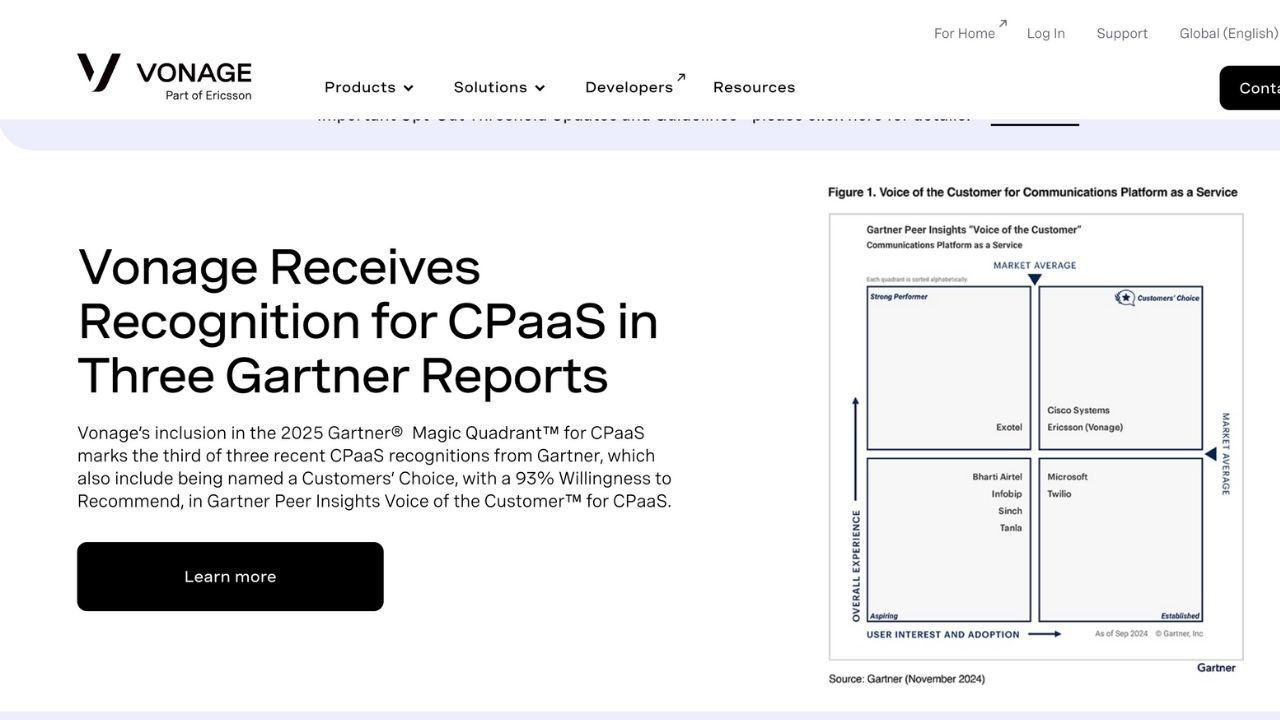
Vonage has been in the VoIP business longer than most competitors, and that experience shows in their feature depth and customization options.
Their current promotion offers 30% off, bringing the starting price down to $13.99 per line per month.
The platform shines for stores that communicate heavily via text. Vonage offers unlimited SMS within the US, making it ideal for order confirmations, shipping updates, and delivery notifications.
The Virtual Receptionist feature lets you build sophisticated call flows that route customers to the right department based on their needs.
Vonage's API platform is also noteworthy. If you have developer resources, you can build custom integrations that connect your phone system directly to your ecommerce platform in ways that off-the-shelf integrations can't match.
What works well:
- Best value pricing, especially with current promotions
- Unlimited US texting on all plans
- Highly customizable call flows and IVR
- Strong API for custom integrations
What to watch out for:
- Limited customer support hours compared to competitors
- Promotional pricing requires a 1-year contract
- Early termination fees apply if you cancel during the contract term
Vonage is ideal for text-heavy ecommerce operations that send frequent order updates, shipping notifications, and promotional messages to customers.
Key features to look for in a business phone system for ecommerce
When evaluating options, prioritize these capabilities:
Shopify or WooCommerce integration lets you see customer order history when they call. No more asking customers to dig up order numbers while they're frustrated.
Call routing and IVR direct callers to the right department immediately. Set up simple menus like "Press 1 for sales, 2 for support, 3 for returns."
Mobile app quality matters more than you think. You'll answer calls from your phone when away from your desk, so the app needs to work flawlessly.
SMS capabilities are essential for modern ecommerce. Customers expect text updates about orders, shipping, and delivery.
Call recording helps with quality assurance and dispute resolution. When a customer claims they were promised something, you have the recording.
Voicemail transcription saves time. Reading a transcript is faster than listening to a 3-minute voicemail.
Making the right choice for your ecommerce store
The best phone system depends on where you are in your business journey:
Solo store owners should look at Quo or Ooma. Both offer simplicity and affordability without overwhelming features you'll never use.
Growing teams of 2-5 will get the most value from Nextiva or Vonage. Both scale well without breaking the budget.
Established businesses with 5+ support agents need the robust features of RingCentral or Aircall. The collaboration tools and advanced routing justify the higher cost.
Stores offering video consultations should prioritize Zoom Phone. The video quality and seamless meeting integration are unmatched.
Budget-conscious sellers can get excellent value from Vonage or Zoom Phone, both starting under $15 per user per month.
Start improving your ecommerce customer experience today
The right business phone system for ecommerce pays for itself through better customer experiences, faster issue resolution, and fewer lost sales from missed calls. Most providers offer free trials, so you can test drive the interface and call quality before committing.
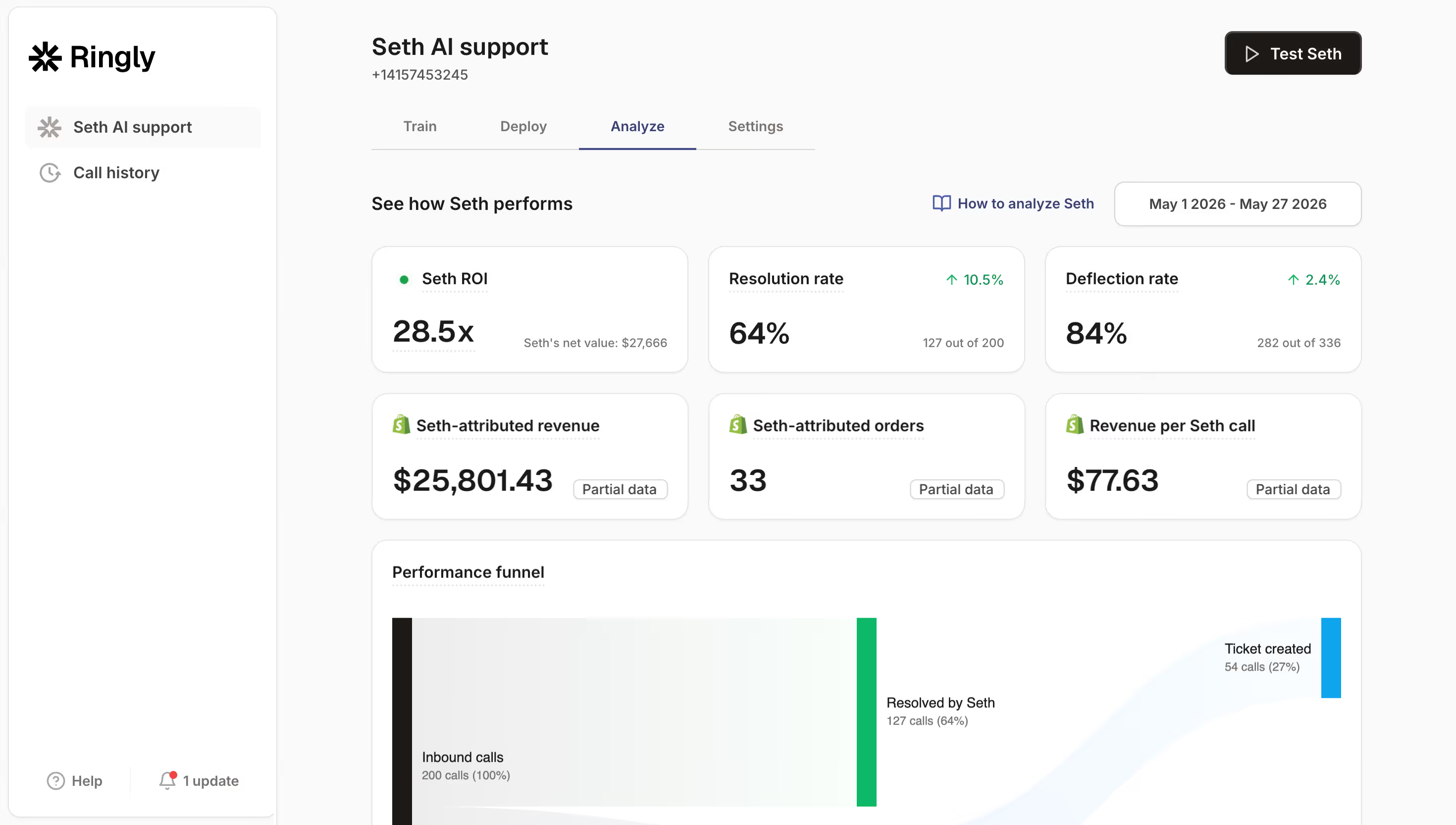
If you're looking for an alternative approach to customer communication, Ringly.io offers AI-powered phone support designed specifically for ecommerce stores. It handles common questions automatically while routing complex issues to your team.
Whatever you choose, stop using your personal cell phone for business. Your customers (and your sanity) will thank you.
Frequently Asked Questions
What is the best business phone system for ecommerce stores just starting out?
For new ecommerce stores, Quo or Ooma offer the best combination of affordability and ease of use. Both provide professional phone capabilities without complex setup or high costs.
How much should I expect to pay for a business phone system for ecommerce?
Most quality business phone systems for ecommerce range from $15-35 per user per month. Entry-level plans from Zoom Phone start at $10, while feature-rich options like Aircall run closer to $30 per user monthly.
Can I use my existing business phone number with a new VoIP system?
Yes, all major providers support number porting. The process typically takes 7-10 business days, and most providers offer temporary forwarding so you don't miss calls during the transition.
Do I need a business phone system if I only sell through Amazon or Etsy?
Even marketplace sellers benefit from professional phone systems. You can handle supplier calls, wholesale inquiries, and customer service more professionally while keeping your personal number private.
What integrations should I look for in a business phone system for ecommerce?
Prioritize integrations with your ecommerce platform (Shopify, WooCommerce), your helpdesk software (Zendesk, Freshdesk), and your CRM (HubSpot, Salesforce). These connections give your team full customer context on every call.
Is it better to choose a business phone system with AI features?
AI features like automated answering and call transcription are increasingly valuable for ecommerce stores. They handle routine inquiries 24/7 and help small teams punch above their weight in customer service.
Can I use a business phone system for SMS marketing to my customers?
Yes, most modern business phone systems include SMS capabilities. However, be aware of limits (RingCentral caps texts at 25-200 per month depending on your plan) and ensure you comply with SMS marketing regulations like TCPA.
Also read: