


Running an eCommerce store means fielding customer calls about orders, returns, and product questions around the clock.
The right communication platform can make or break your customer experience.
Nextiva positions itself as an all-in-one solution for eCommerce businesses juggling voice, chat, email, and social media support.
But is it the right fit for your store?
This guide breaks down exactly what Nextiva offers for eCommerce, what it costs, and when a simpler alternative might make more sense.
Editor’s note: Want to hear some sample support calls made for your Shopify store?
- Just paste your store URL
- Get sample calls in under 20 seconds (no email required)
- Listen to demo calls for my store
What is Nextiva?
Nextiva is a unified customer experience management (CXM) platform that consolidates communication tools into a single cloud-based system.
The platform serves businesses from small teams to enterprise operations with integrated voice, SMS, chat, email, and social media capabilities.
For ecommerce specifically, Nextiva offers tools designed for online retail: omnichannel contact centers, conversational commerce features, and review management across platforms like Amazon and Google Store.
The company claims a 99.999% uptime SLA and provides 24/7 customer support.
The platform falls into the "extreme vendor reduction" category.
Instead of patching together separate tools for phone, chat, and social, Nextiva bundles 73 capabilities into one interface. That consolidation appeals to businesses tired of switching between apps and losing customer context along the way.
Nextiva ecommerce features explained
Knowing what Nextiva actually does for ecommerce helps you decide if it fits your needs.
Here's what the platform offers across its main feature sets.
Omnichannel contact center
Nextiva's contact center unifies all your customer communication channels into a single inbox.
Voice, chat, SMS, email, and social media interactions appear in one place.
The practical benefit: a customer can start a conversation on chat, switch to phone, and your agent sees the full history.
No asking "can you repeat what you told my colleague?"
Skill-based routing directs customers to agents who can actually help, whether that's based on language, product category, or issue type. Real-time analytics show you what's happening across channels.
You can track which channels get the most traffic, where customers drop off, and how long issues take to resolve.
Conversational commerce tools
Nextiva's conversational commerce features aim to turn support interactions into revenue opportunities.
The idea is simple: if a customer calls about a product question, why not help them buy it right there?
AI chatbots and voice bots handle 24/7 availability without staffing costs.
Customers can complete purchases without leaving the conversation, which reduces friction and abandoned carts.
Natural language processing helps the system understand what customers actually want, not just keyword matching.
When the AI can't handle something, it hands off to a human agent with full context preserved.
Ecommerce review management
Managing reviews across Amazon, Google Store, and other platforms usually means checking multiple dashboards daily.
Nextiva consolidates this into a unified inbox.
The Engage plan includes 3 ecommerce review accounts. Power Suite bumps that to 10.
You can set up automated routing so negative reviews go straight to your escalation team while positive reviews get a templated thank-you response.
Brand reputation monitoring tracks trends across platforms. You can spot problems before they snowball and identify what's driving positive feedback.
Call center for ecommerce
Phone support still matters for ecommerce, especially for high-value orders or complex returns. Nextiva's call center features address common online retail needs.
Inbound capabilities cover order tracking, payment processing, and return management.
IVR systems let customers self-serve on simple issues like "where's my order?" without waiting for an agent.
Outbound features support win-back campaigns for lapsed customers, upselling opportunities, and feedback collection.
Call recording and quality monitoring help you train agents and maintain service standards.
Automated call distribution handles high-volume periods without everything grinding to a halt.
The system routes calls based on agent availability, skills, and current workload.
Nextiva pricing for ecommerce businesses
Pricing is per-user, per-month. Annual billing saves around 20% compared to monthly.
| Plan | Monthly (Annual) | Monthly (Monthly) | Key Ecommerce Features |
|---|---|---|---|
| Core | $15/user | $23/user | Voice, SMS, email, video, basic IVR, voicemail transcription, 3 email accounts |
| Engage | $25/user | $50/user | Core features plus toll-free minutes, skills-based routing, 3 ecommerce review accounts, advanced analytics |
| Power Suite CX | $75/user | $75/user | Everything in Engage plus voice and web chat, blended inbound/outbound, advanced automation |
| Enterprise | Custom | Custom | Workforce management, AI routing, PCI-compliant IVR, call recording, video meeting recording |
Source: Nextiva pricing page
A few important notes on this pricing:
No free trial is publicly available. You'll need to contact sales for a demo.
This makes it harder to test before committing.
Add-on costs stack up. Voice call recording, live chat, and chatbot automation all require extra fees on lower tiers. Factor these into your budget.
Enterprise pricing isn't transparent. You'll negotiate directly with sales, choosing between usage-based, concurrent, or per-agent pricing models.
Check the enterprise pricing page for more details on what's included.

The Engage plan at $25/user is the minimum for ecommerce review management
Pros and cons of Nextiva for ecommerce
Here's a balanced assessment based on features and user feedback.
What works well
Unified platform reduces tool sprawl. Instead of managing separate subscriptions for phone, chat, email, and social, everything lives in one place.
Customer context follows conversations across channels.
Strong omnichannel capabilities. The seamless channel switching is genuinely useful. Customers don't have to repeat themselves, and agents see the full picture.
Comprehensive analytics. Real-time dashboards and custom reports give you visibility into performance across all channels.
Conversational analytics help identify trends and training opportunities.
Enterprise-grade reliability. The 99.999% uptime SLA backed by geo-redundancy means your support channels stay available during peak sales periods.
24/7 support included. All plans include round-the-clock customer support, which matters when you're troubleshooting during a holiday rush.
Limitations to consider
No public free trial. You can't test the platform yourself before buying.
This is a significant barrier for businesses that want to validate fit before committing.
Connectivity issues reported. Some users on SoftwareAdvice report reliability problems requiring frequent sign-in/sign-out cycles.
Multiple hours with tech support followed by recurring issues is a frustration you should weigh.
Add-on fees increase costs. Features like call recording, live chat, and chatbots require additional licensing.
Your actual monthly cost may exceed the base per-user price.
Enterprise pricing opacity. If you need advanced features, you're negotiating blind without published rates.
Complex for smaller operations. The full-featured platform may be more than a small ecommerce store needs. Setup and training require investment.
Phone automation limitations. While Nextiva offers AI features, its phone support automation is less sophisticated than specialized AI phone agent solutions.
If phone is your primary channel, you might find the capabilities underwhelming.
A simpler option for ecommerce phone support
Nextiva works well for businesses needing comprehensive omnichannel support. But for many ecommerce stores, phone support is the biggest pain point, and that's where a specialized solution can deliver faster results.
Ringly.io takes a different approach. Instead of trying to be everything, it focuses on one thing: automating phone support for ecommerce stores.

The core product, the AI, is an AI phone agent that handles inbound customer calls.
It answers questions, looks up orders, processes returns, and only escalates to humans when necessary.
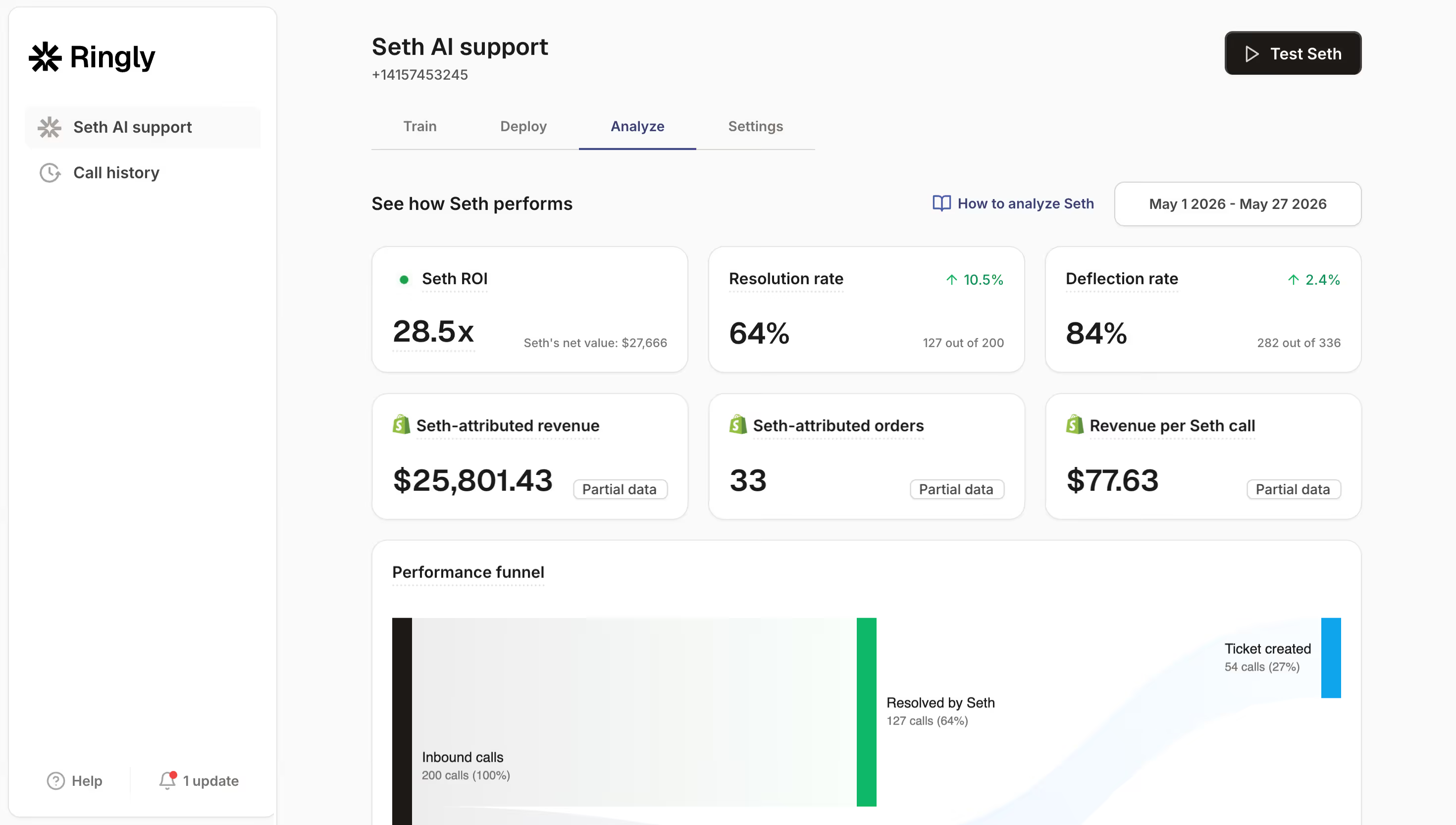
In real deployments across Shopify stores, The AI resolves about 70-73% of calls without human intervention.
Here's what makes this approach different:
Native Shopify integration. the AI pulls live order data directly from your Shopify store. When a customer calls about an order, the AI has accurate, real-time information without manual data entry.
Minutes instead of weeks to deploy. Complex contact center platforms take significant setup time.
Ringly.io's setup is designed for non-technical teams and launches in minutes.
Usage-based pricing. Instead of per-seat licensing, you pay for call minutes.
The Grow plan starts at $349/month for 1,000 minutes. Additional minutes cost $0.19 each.
Performance guarantee. Ringly doesn't charge until The AI resolves at least 65% of calls. If it doesn't hit that threshold, you pay nothing.
40+ language support. Global ecommerce operations can serve customers in their language without hiring language-specific agents.
When to choose what:
| Choose Nextiva if... | Choose Ringly.io if... |
|---|---|
| You need full omnichannel (voice + chat + social + email) | Phone support is your primary channel |
| You have 10+ support staff | You want fast, automated phone resolution |
| You want unified customer context across all touchpoints | You run a Shopify store |
| You have budget for enterprise-grade platform | You prefer usage-based over per-seat pricing |
The two aren't mutually exclusive. Some businesses use a platform like Nextiva for chat and email while running Ringly.io for automated phone support.
The key is matching the tool to the job.
Try the AI free for 14 days to see how much of your phone support it can handle.
Getting started with ecommerce customer support
Choosing the right support platform depends on your specific situation. Here's a framework to guide your decision.
Consider your channel mix. If customers reach you across phone, chat, email, and social in roughly equal measure, an omnichannel platform like Nextiva makes sense. If 80% of your support volume is phone calls, a specialized solution delivers faster ROI.
Evaluate your team size. Per-seat pricing favors larger teams where the cost spreads across more users.
Usage-based pricing works better for smaller operations or businesses with variable call volumes.
Think about integration needs. Deep integrations with your ecommerce platform (Shopify, WooCommerce, etc.) reduce manual work and improve accuracy. Native connections beat generic APIs for day-to-day operations.
Factor in implementation time. Enterprise platforms require significant setup, training, and configuration. If you need results in days rather than months, simpler tools get you there faster.
For high-volume, multi-channel operations, Nextiva's Engage or Power Suite tiers provide the comprehensive toolset you need.
For phone-heavy ecommerce stores wanting automated resolution, Ringly.io offers a focused solution that launches quickly and proves its value before you pay.
The best support platform is the one that actually gets used effectively. Start with your biggest pain point and solve that first.
Frequently Asked Questions
What does Nextiva offer for ecommerce businesses?
Nextiva provides ecommerce businesses with omnichannel contact center capabilities, conversational commerce tools for in-chat selling, ecommerce review management across Amazon and Google Store, and call center features like IVR and automated call distribution. Plans range from $15 to $75+ per user monthly.
How much does Nextiva ecommerce pricing cost per month?
Nextiva ecommerce pricing starts at $15/user/month for the Core plan with annual billing. The Engage plan at $25/user/month adds ecommerce review management. Power Suite CX costs $75/user/month. Enterprise pricing is custom and requires contacting sales.
What are the main limitations of using Nextiva for ecommerce?
Key limitations include no publicly available free trial, add-on fees for features like call recording, reported connectivity issues requiring frequent troubleshooting, non-transparent enterprise pricing, and phone automation capabilities that are less sophisticated than specialized AI phone solutions.
Can Nextiva integrate with ecommerce platforms like Shopify?
Nextiva offers REST APIs and CRM integration capabilities for connecting with ecommerce platforms. However, the integration is not as deep or native as purpose-built ecommerce support tools. You may need custom development or middleware to pull live order data from Shopify.
What's a good Nextiva alternative for ecommerce phone support?
Ringly.io is a Nextiva alternative specifically focused on ecommerce phone support automation. Its AI agent The AI resolves about 70% of calls without human intervention, has native Shopify integration, and uses usage-based pricing starting at $349/month for 1,000 minutes instead of per-seat licensing.
Does Nextiva offer a free trial for ecommerce businesses?
Nextiva does not offer a publicly available free trial. You need to contact their sales team for a demo. This differs from some alternatives like Ringly.io that offer 14-day free trials with a pay-nothing-until-it-works guarantee.
Is Nextiva suitable for small ecommerce stores?
Nextiva can work for small ecommerce stores, but the full-featured platform may be more than needed. The complexity requires setup time and training. Small stores focused primarily on phone support might find specialized solutions like Ringly.io more cost-effective and faster to deploy.