
Did you know that roughly 60% of your customers still want to pick up the phone when they have a problem?
You are likely spending a fortune on a support team that spends all day repeating the same order updates.
It is expensive to manage a growing brand while your team is stuck in a loop of basic tasks.
In this guide, we will go over how to set up a cloud phone system for eCommerce in 2026.
First, we will look at how modern cloud systems work.
Then, we will show you how AI can resolve 70% of your calls without hiring a single new person.
Editor’s note: Want to hear some sample support calls made for your Shopify store?
- Just paste your store URL
- Get sample calls in under 20 seconds (no email required)
- Listen to demo calls for my store
What is a cloud phone system for ecommerce?
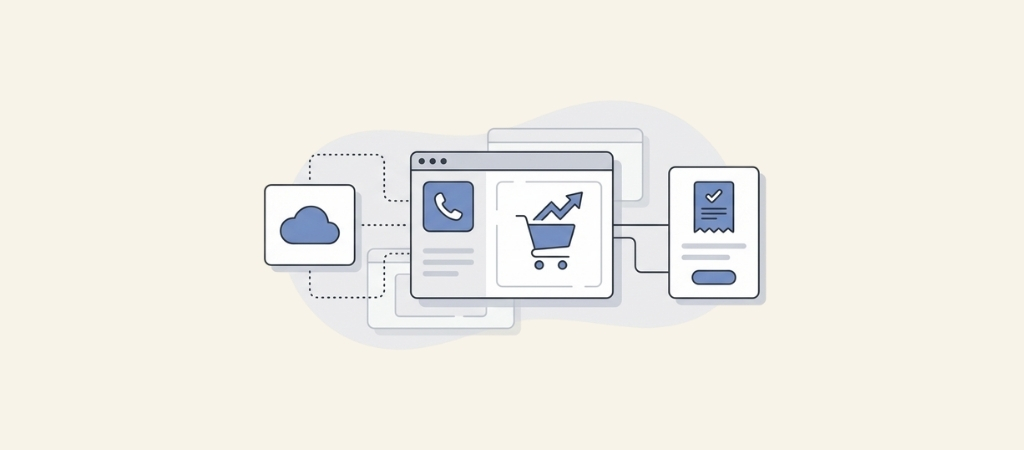
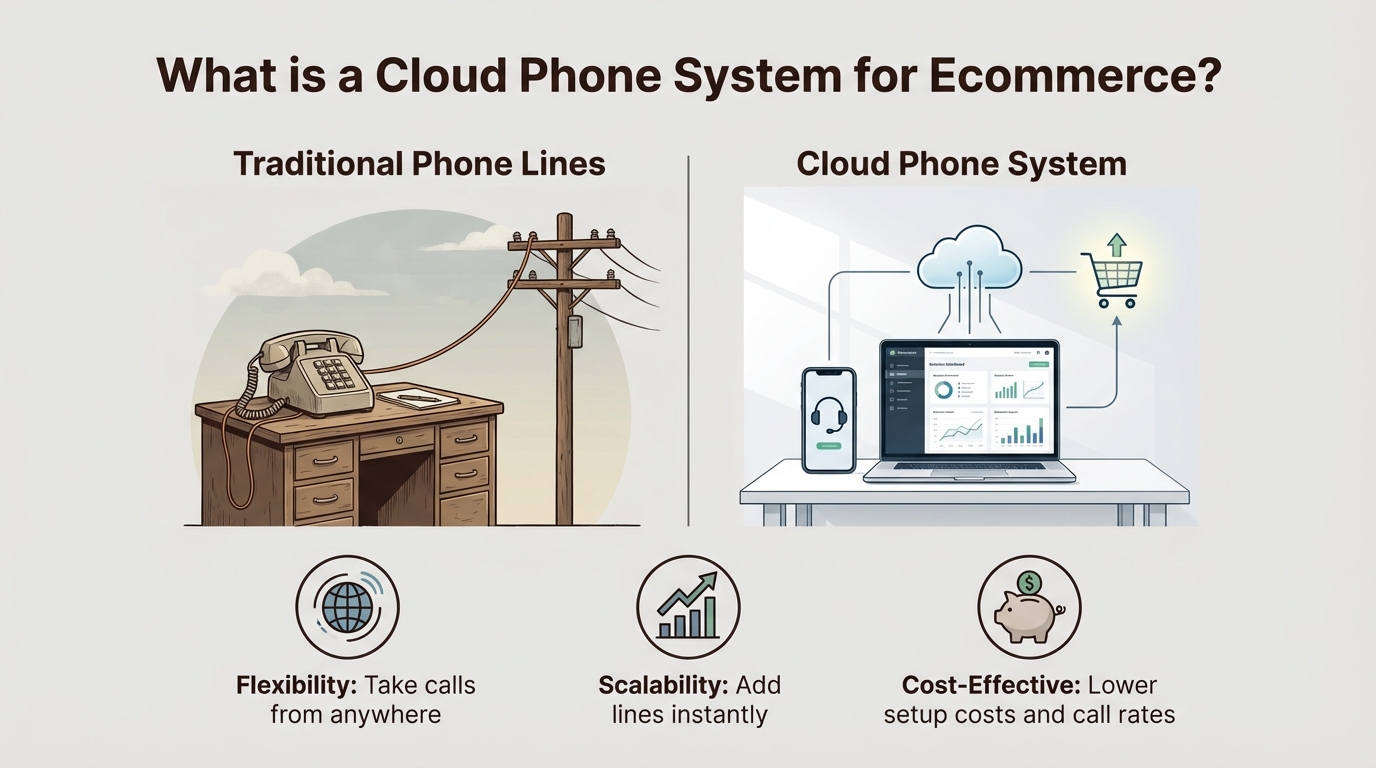
A cloud phone system is a phone service that works over the internet instead of old-school copper phone lines.
The technology behind it is called VoIP (Voice over Internet Protocol), and it’s a big deal for online businesses.
Even with chat and email being so popular, the phone is still a go-to for many. In fact, studies show that around 60% of customers still prefer to call a business over other methods.
For ecommerce stores, this tech opens up a new level of efficiency.
Support teams can take calls from anywhere with an internet connection, whether they’re at home or in the office. This flexibility is great for remote or hybrid teams.
You can also add or remove phone lines in minutes to handle busy times like Black Friday without buying new equipment.
Plus, cloud-based systems usually have lower setup costs and more affordable call rates than traditional business phone lines. A modern system does more than just handle calls; it connects with your other tools to create a smoother customer experience.
Key features for a cloud phone system in ecommerce
Not all cloud phone systems are created with the specific needs of an online store in mind. When you're looking for a solution, there are a few key features that can make a huge difference.
24/7 availability
Online shopping is a 24/7 thing, which means customers might need help long after your team has gone home for the day. Being available around the clock is a major plus.
Many systems have a feature called IVR (Interactive Voice Response), which you probably know as an auto-attendant.
It’s that familiar "Press 1 for sales, Press 2 for support" menu. While IVR can get callers to the right department, it doesn't solve their problems. It often just adds a step for customers who have a simple question and don't want to wait on hold.
A more modern approach is conversational AI. Instead of just routing calls, AI agents can understand what a customer is asking in plain language and give them an answer right away, anytime.
Deep ecommerce integration
One of the most common questions your support team gets is probably, "Where is my order?" A generic cloud phone system can't answer that.
It makes a human agent put the customer on hold while they look up the order in another system like Shopify. This is slow for the customer and repetitive for your team.
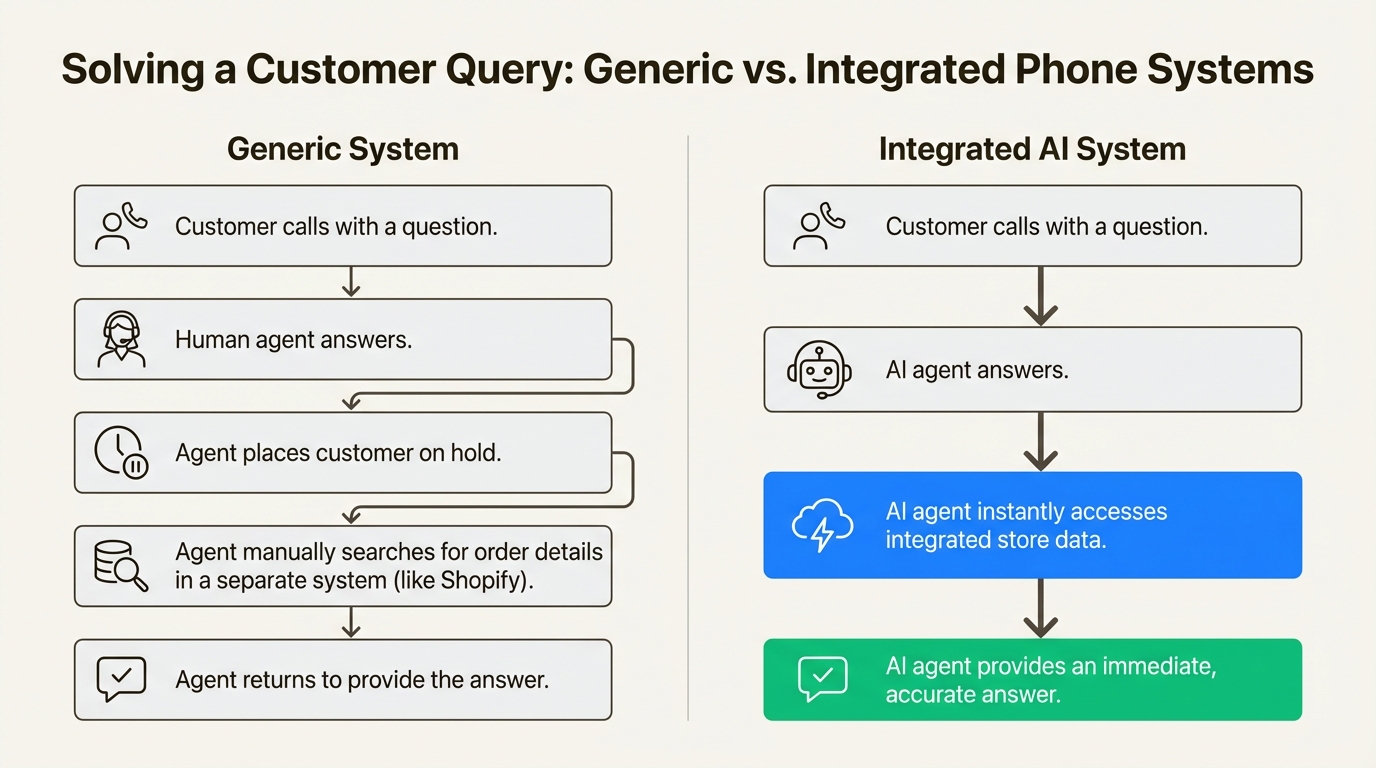
This is why a deep, direct integration with your ecommerce platform is a must-have.
A connected system can instantly pull up order details, check on return statuses, and find product information in real-time. Without this connection, your phone support is stuck in a silo, leading to slower service and a clunky experience for your customers.
Scalability and costs
Ecommerce has its peaks and valleys. Your call volume can shoot up during a sale and then quiet down the next week.
Your phone system needs to keep up with these changes without blowing up your budget.
Many providers charge a flat fee per user, per month. This model can get expensive as you hire more support agents or bring on temporary help for the holidays. A different approach is a system that focuses on automating calls.
An AI-powered agent can handle a nearly unlimited number of calls without needing more "users," giving you predictable costs and a better return as you grow.
Comparing popular cloud phone systems for ecommerce
To get a better idea of what’s available, let's look at a few popular cloud phone systems.
These platforms are powerful and often designed for general business use, so it's helpful to see how they fit the specific needs of ecommerce.
| Feature | RingCentral | Vonage | Quo (formerly OpenPhone) |
|---|---|---|---|
| Best For | Enterprises needing an all-in-one AI communications hub | SMBs requiring scalable APIs and reliable VoIP | Small, collaborative teams and fast-growing startups |
| Ecommerce Specialization | Moderate (Via RingCX for contact centers) | Moderate (Via "Conversational Commerce" solution) | Low (Focused on internal team collaboration) |
| AI Capabilities | RingSense & RingCX: AI-first contact center with real-time transcriptions and summaries. | Vee Assistant: Conversational AI for routing and managing routine account tasks. | Sona AI Agent: 24/7 AI receptionist that answers FAQs and qualifies leads. |
| Pricing Model | $20 - $35/user/mo (Standard plans); RingCX starts at $65/user/mo | Starts at $13.99/line/mo (Mobile) to $39.99/line/mo (Premium) | Starts at $15/user/mo (Core); $20 - $25/user/mo (Advanced) |
| Shopify Integration | Native via App Gallery (order/customer data screen-pops) | Deep via "Conversational Commerce" APIs & Zoho/Zapier | Via Zapier or custom API; no native order resolution |
Generalist platforms vs. specialized needs
The key difference often lies in how these generalist tools handle the specific, data-heavy needs of an online store compared to more specialized solutions.
RingCentral offers a wide range of tools for unified communications, including voice, video, and team chat.
Their AI contact center solution, RingCX, can route calls and answer basic questions.
As a generalist tool, deep ecommerce integrations for tasks like automatic order lookups may require connecting through higher-tier plans or separate CRM software.
Vonage is another well-known name in the industry, recognized for its reliability and its Virtual Receptionist.
It has over 50 features aimed at small businesses. It is designed for broad business use and can effectively route calls to the appropriate team member.
Deeper ecommerce integrations may be available through higher-tier plans.
Quo (formerly OpenPhone) is a modern, user-friendly option that's great for small, collaborative teams. It makes it easy to share phone numbers and manage conversations, and it includes an AI agent named Sona for 24/7 answering.
The platform is primarily built to improve human collaboration, so tasks requiring live data from Shopify are typically handled by a team member.

The role of AI phone agents in ecommerce
The capabilities of general-purpose systems highlight an opportunity for solutions built specifically for ecommerce.
For many online stores, the goal is shifting from simply routing calls to resolving them automatically.
How AI agents go beyond call routing
A true AI phone agent is much more than a fancy IVR menu. It uses conversational AI, including speech-to-text and natural language understanding, to figure out what a customer is saying and respond in a natural, helpful way.
Instead of being forced to "press 2," a customer can just say, "I need to check on my last order." The key difference here is resolution.
An AI agent designed for ecommerce can tap directly into your store's data to provide an instant answer, 24/7. This frees up your human agents to focus on the complex conversations that build real customer loyalty.
An example of a specialized AI agent: the AI
Specialized platforms like Ringly.io are designed to address these needs. Ringly.io provides an AI phone agent named the AI, which is created for Shopify stores.

the AI has several features designed for ecommerce:
- Deep Shopify Integration: the AI connects right to your Shopify store. It can look up orders, process returns, and answer product questions using your store's live data, giving customers accurate, real-time information.
- High Resolution Rate: In October 2025, it resolved 73% of all calls on its own across more than Shopify stores, with no human help needed.
- 24/7 Global Support: the AI is always working to help your customers. It also supports around 30 languages, so you can offer great service to your international customers, too.
- Cost-Effective Scaling: Ringly.io’s pricing is based on call minutes, not the number of human agents you have. The Grow plan starts at $349/month and includes 1,000 minutes, offering a much more scalable and predictable model for a growing business.
- Fast & Easy Setup: You can get the AI up and running on your store in about 3 minutes. There's no complex setup or development work needed.
Choosing the right cloud phone system for your store
A general cloud phone system can be a good starting point for any business.
As an ecommerce store grows, it often faces challenges like handling repetitive questions about orders and returns efficiently and at scale.
While many VoIP systems help teams manage calls, some AI-powered agents are designed to resolve them.
This shift from call management to call resolution can improve customer satisfaction and allow your team to focus on other business areas.
Ready to automate your phone support?
It's time to stop just routing calls and start resolving them. Ringly.io is the logical next step for any Shopify store that wants to deliver better customer service and scale more efficiently.
Give your customers the 24/7 support they deserve. Try Ringly.io free and see how the AI can transform your phone support.
Frequently Asked Questions
What's the main benefit of a specialized cloud phone system for ecommerce?
The biggest benefit is its deep integration with your store's platform, like Shopify. This allows the system to automatically answer common questions like "Where is my order?" without needing a human agent, which saves you a lot of time and money.
How does an AI-powered cloud phone system handle calls after hours?
An AI agent works 24/7. It can answer customer questions, look up order details, and even process returns at any time, day or night. This ensures your customers always get the help they need, whenever they need it.
Is a cloud phone system for ecommerce difficult to set up?
Not at all. Modern solutions, especially those built for ecommerce, are designed for a quick and easy setup. For example, a platform like Ringly.io can be up and running in just a few minutes without any complex configuration.
Can a cloud phone system scale with my business during busy seasons?
Yes, that's one of its key advantages. An AI-based system can often handle a large number of calls without per-user fees. This gives you predictable costs and lets you easily manage spikes in call volume during sales or holidays.
What kind of integrations should I look for in a cloud phone system for ecommerce?
The most important integration is a direct connection to your ecommerce platform (e.g., Shopify). This allows the system to access live data about orders, returns, and products to resolve customer issues instantly and accurately.