
Running an online store means wearing multiple hats.
You're the buyer, the marketer, the shipper, and somehow also the customer service department.
When returns start coming in (and they will), the phone calls follow close behind. "Where's my refund?" "How do I return this?" "Can I exchange instead?"
If you're handling this solo or with a tiny team, returns calls can eat up hours you don't have.
The good news? You don't need to hire a dedicated support team to manage it well.
Let's break down how to handle returns calls ecommerce without losing your mind or your margins.
Editor’s note: Want to hear some sample AI support calls made for your Shopify store?
- Just paste your store URL
- Get sample calls in under 20 seconds (no email required)
- Listen to demo calls for my store
Why returns calls eat up so much time
Returns are expensive. The National Retail Federation estimates $890 billion worth of retail goods were returned in 2024, with nearly 24.5% of online sales coming back. That's already painful for your bottom line.
But here's what the statistics don't capture: the time cost. Every phone call about a return pulls you away from inventory management, marketing, or actually growing the business.
A Pitney Bowes survey found that processing a return costs an average of 21% of the order's value.
When you factor in the time spent on calls, answering emails, and coordinating with your warehouse, the real cost is often higher for small operations.
The most common returns calls follow a pattern:
- "Where's my refund?" (customer hasn't waited long enough for processing)
- "How do I start a return?" (confused about the process)
- "Can I exchange for a different size?" (wants alternative to refund)
- "I never got my return label" (technical issue with portal)
- "Why was my return rejected?" (policy confusion)
Each call might only take five minutes. But ten calls a day is nearly an hour.
That's 25 hours a month spent repeating the same information.
Set up a self-service returns portal
The best way to reduce returns calls is to make them unnecessary.
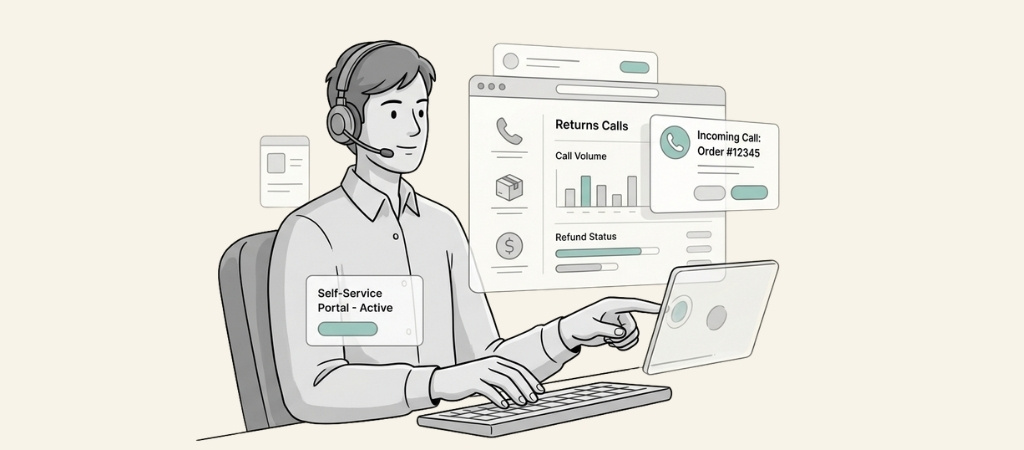
A self-service returns portal lets customers initiate returns, generate labels, and track status without ever contacting you.
Here's what a good portal should include:
- RMA generation: Customer enters order number, selects items to return, chooses reason
- Instant label printing: Prepaid return label generated automatically
- Exchange options: Let customers swap for different size/color instead of refunding
- Status tracking: Show exactly where their return is in the process
- Return reason tracking: Collect data on why items come back
For Shopify stores, several tools handle this well. Loop Returns focuses on exchange-first workflows that help you keep revenue.
ReturnLogic emphasizes analytics so you can spot problem products. Happy Returns offers box-free drop-offs at local locations.
The ROI is straightforward. When customers can self-serve, "how do I return?" calls drop by 60-70%. That's 15 hours back in your month.
Create clear returns policies that prevent calls
Here's a surprising statistic: 67% of shoppers check your return policy before making a purchase, according to Invesp.
A clear policy doesn't just reduce returns calls. It actually increases conversions because customers feel confident buying.
Your policy needs to answer these questions upfront:
- Return window: Exactly how many days? (30, 60, 90?)
- Condition requirements: Unopened? Tags attached? Original packaging?
- Refund timeline: When will they see the money? (5-10 business days after we receive it)
- Return shipping: Who pays? You, them, or conditional (free for defects, paid for change of mind)?
Display this policy everywhere: product pages, checkout flow, confirmation emails, and your footer.
The easier it is to find, the fewer "what's your policy?" calls you'll get.
Pro tip: Include an "expected refund date" in your confirmation emails. Instead of "refund processed in 5-10 days," say "refund expected by March 15." Specific dates reduce "where's my money?" calls significantly.
Use automation for common returns questions
Most returns calls aren't complex. They're the same five questions, asked repeatedly. This is where automation shines.
Chat: AI chatbots can handle "where's my order" and return status questions instantly.
Tools like Gorgias or Tidio integrate with Shopify to pull real-time order data.
Email: Auto-responders with links to your returns portal handle the bulk of email inquiries.
Set up rules so emails containing "return" or "refund" get an immediate response with next steps.
Phone: This is where many small stores struggle. You can't be available 24/7, but customers call at all hours.
AI phone agents like Ringly.io's the AI answer calls around the clock, handle returns questions, look up order status, and escalate complex issues to you.
Here's how AI phone agents work for returns specifically:
- Answer "where is my refund" by checking order status in real-time
- Walk customers through using your returns portal
- Process exchange requests and update inventory
- Capture return reasons for your analytics
- Escalate angry customers or edge cases to you via SMS or Slack
Ringly.io reports that The AI resolves about 73% of calls without human intervention.
For a small team, that means handling returns calls ecommerce without being tied to the phone.

Build a simple returns workflow
Even with great self-service options, some customers will need help. A clear workflow keeps you efficient when they do.
Step 1: Customer requests returnPortal preferred, phone as backup. Track the RMA number.
Step 2: Auto-approve if within policyDon't manually review every return.
Set rules: auto-approve if within 30 days, under $500, and customer has fewer than 3 returns in 90 days.
Step 3: Generate label instantlyNo waiting. The label should be available the moment they submit the return.
Step 4: Item arrives, quick inspectionUse a simple grading system:
- Grade A: Resellable as new
- Grade B: Repackage or minor refurbishment
- Grade C: Secondary channels (outlets, liquidation)
- Grade D: Dispose or recycle
Step 5: Process refund within 24 hoursSpeed matters. The faster you process, the fewer "where's my refund?" calls.
Tools to streamline: barcode scanners for intake, WMS integration for instant inventory updates, and automated customer notifications at each stage.
One tactic that saves money: returnless refunds. For items under $15-20, the shipping and processing costs often exceed the item's value. Let the customer keep it and refund anyway. You'll save on logistics and they'll remember the easy experience.
Handle returns fraud without alienating customers
Return fraud is real. Appriss Retail found that about 15% of ecommerce returns are fraudulent or abusive. But heavy-handed fraud prevention can damage relationships with legitimate customers.
Common fraud types to watch for:
- Wardrobing: Buying clothes, wearing them, returning as unworn
- Empty boxing: Returning a package weighted with junk instead of the product
- Serial returning: Customers who return 50%+ of what they buy
- Bracketing: Ordering multiple sizes with intent to return most
Red flags that warrant a closer look:
- Customer with 5+ returns in 90 days
- High-value items returned frequently
- Returns consistently just outside the policy window
- Pattern of "damaged" claims without photo evidence
The balanced approach: track return rates per customer, require photos for damaged item claims, and adjust policies for serial returners (shorter windows, restocking fees). But don't accuse customers. Let data drive policy adjustments, not confrontations.
Keep VIP customers happy with flexible policies. If someone has spent $5,000 and returns $200 worth, that's not fraud. That's a good customer who occasionally changes their mind.
When to hire help vs. automate more
At some point, you need to decide: hire support staff or invest more in automation?
Here are the threshold signals:
- 150+ returns/month: Consider dedicated returns management software
- 50+ returns calls/week: Consider an AI phone agent or part-time support
- 10+ hours/week on returns: Time to systematize or delegate
Cost comparison for context:
- Part-time support: $15-20/hr × 20 hrs/week = $1,200-1,600/month
- AI phone agent: $349-$799/month (Ringly.io's plans)
- Returns management software: $50-300/month depending on volume
For most small stores, automation wins on cost. But if your returns require judgment calls (custom orders, complex warranties), human support may be worth the investment.
Start handling returns calls more efficiently
Returns aren't going away. Ecommerce return rates are 3-4x higher than in-store, and customer expectations for easy returns keep rising. But the time you spend on them doesn't have to grow with your business.
Quick wins to implement this week:
- Audit your return policy: Is it easy to find? Does it answer the obvious questions?
- Set up a self-service portal if you haven't already
- Add an auto-responder for returns-related emails
- Consider AI phone support for after-hours calls
The compound effect is real. Saving 30 minutes daily on returns calls equals 15 hours monthly. That's time you can spend on marketing, product development, or just getting your evenings back.
If you're ready to stop being your own customer service department, try Ringly.io's AI phone agent free for 14 days. The AI handles the repetitive returns calls so you can focus on growing the business.
Frequently Asked Questions
How can I reduce returns calls ecommerce without hiring staff?
Set up a self-service returns portal, create clear policies that answer common questions upfront, and use automation like AI chatbots or phone agents to handle repetitive inquiries. These three tactics can reduce your call volume by 60-70%.
What are the most common returns calls ecommerce businesses receive?
The top five are 'where's my refund,' 'how do I start a return,' 'can I exchange instead,' 'I never got my return label,' and 'why was my return rejected.' Most of these can be automated or prevented with better self-service options.
How much do returns calls ecommerce actually cost a small business?
Beyond the 21% of order value that returns processing costs on average, factor in your time. Ten five-minute calls daily equals 25 hours monthly. At minimum wage, that's $362.50 in labor cost alone, not counting opportunity cost of time not spent on growth.
When should I consider AI phone agents for returns calls ecommerce?
Consider AI phone support when you're receiving 50+ returns calls weekly, spending 10+ hours monthly on phone support, or losing sales because you can't answer calls during business hours. AI agents like Ringly.io's the AI resolve about 73% of calls without human intervention.
What's the difference between returns management and reverse logistics?
Reverse logistics is the physical process of getting items back (carriers, warehouses, inspection). Returns management includes reverse logistics plus the customer-facing elements: policies, communication, refunds, and fraud prevention. You need both working together.
How do I prevent returns fraud without annoying good customers?
Track return rates per customer behind the scenes, require photos for damaged claims, and adjust policies for serial returners. Never accuse customers directly. Let data drive policy changes, not confrontations. Keep VIP customers happy with flexible exceptions.
What should I include in my returns policy to reduce calls?
Include your exact return window, condition requirements, refund timeline with specific dates, who pays for return shipping, and how to start a return. Display it on product pages, checkout, confirmation emails, and your footer. The easier it is to find, the fewer policy questions you'll get.