
This post in 30 seconds.
- A returns wave is two events, not one: the package coming back, and the call asking where the refund went. Most DTC playbooks only budget for the first.
- We pulled the real number a return costs a DTC brand once you count shipping, processing, and the support touch, plus 8 practices that shrink all three.
- Built for founders, COOs, and Heads of CX at $10M-$100M Shopify brands running a paid helpdesk and a phone line.
US shoppers sent back $849.9 billion of merchandise in 2025, and 19.3% of online orders came back according to the National Retail Federation. If you run a DTC brand on Shopify, you already feel that number on two sides. Reverse logistics is the side everyone budgets for. The side nobody budgets for is the phone. We run AI phone support for Shopify brands, and when we read the call logs, return-status and order-status questions are roughly 70% of the repeatable calls. A return doesn't just cost you a package coming back. It costs you a conversation.
If you're a founder or Head of CX at a Shopify brand doing $10M-$100M, the return wave you dread after a sale isn't only a warehouse problem. It's a phone backlog. The same five questions, over and over: where's my refund, can I exchange instead, do I pay return shipping. Book a 30-min call and we'll show you what that call wave is costing your team.
What a return actually costs a DTC brand
Most return-cost math stops at logistics. Return shipping runs $8 to $12 per item, and processing plus inspection another $5 to $8. Signifyd puts the all-in cost of processing one online return at about 21% of the order's value. For a $90 order, that's roughly $19 gone before you restock the unit.
But there's a third line nobody puts in the spreadsheet: the support touch. Every return that confuses a customer, takes too long, or doesn't update them generates a contact. Sometimes a ticket. Often a call. The return wave and the call wave are the same wave, arriving a few days apart.
Here's where it gets expensive. A US customer service rep loaded costs about $4,000/month. A six-rep team is $24,000/month, and most of that team's day is spent on the routine stuff: where's my order, where's my refund, how do I send this back. WashCo, a Shopify brand we launched, recovered $22,664 in its first 7 days on the phone, which gives you a sense of how much revenue is sitting inside calls a brand would normally route to voicemail.
So when you measure returns, measure all three lines: the shipping back, the processing, and the support. Tighten one and you make a dent. Tighten all three and you change the unit economics. The practices below are organized around exactly that. For a deeper breakdown of the per-order numbers, our ecommerce returns best practices guide runs the refund-call cost in detail, and the ecommerce returns management post covers the back-end workflow.
DTC return rates by category, and why yours might be fine
Before you panic about your return rate, check it against your category. A 25% rate is a crisis for supplements and totally normal for apparel. The online average sits near 19%, but the spread is enormous.
| Category | Typical DTC return rate | What drives it |
|---|---|---|
| Supplements / consumables | 2-6% | Low, mostly damaged or wrong item |
| Beauty / skincare | 4-12% | Shade, ingredient, reaction |
| Electronics / accessories | 8-15% | Defect, compatibility, buyer's remorse |
| Home goods / sporting | 10-18% | Size, expectation gap |
| Jewelry / specialty | 10-18% | Gift returns, fit |
| Apparel / footwear | 20-40% | Size and fit (shoes 31%+) |
Apparel and footwear carry the highest rates by far, mostly from size and fit uncertainty. If you're a low-return category seeing a high number, the problem is usually upstream: a product photo overpromising, a sizing chart nobody reads, or a launch that pulled in the wrong buyer. Your return rate is only a problem when it's high for your category, not high in the abstract. Once you know your baseline, you can decide which of the practices below actually move your number. Our ecommerce return statistics page has the full category benchmark set if you want to anchor your target.
The 8 DTC returns best practices
These are the eight that matter most for a $10M-$100M DTC brand, ranked by impact. Each one cuts cost, lifts retention, or shrinks the support load. The best ones do all three.
1. Write a return policy a customer can read in 20 seconds
Most return policies are written by a lawyer and read like one. That's a problem, because the policy page is the single most-read page in your returns flow, and confusion there becomes a call. State the window, who pays shipping, what's eligible, and how to start, in plain language, above the fold.
- One screen, no scroll. Window, shipping, eligibility, and the start link visible without scrolling.
- No conditional mazes. Every "unless" and "except" is a future support ticket. Cut them or make them obvious.
- Link it everywhere. Order confirmation email, shipping email, footer, and the help center.
A clear policy reduces the pre-purchase "can I return this?" question and the post-purchase "wait, am I eligible?" question in one move. If you need a starting point, our return policy generator drafts one you can edit, and the ecommerce return policy post walks through the structure.
2. Set the return window deliberately
The default for most DTC brands is 30 days. It's long enough to feel fair and short enough to keep your inventory current. Some brands extend to 60 days as a confidence play, and the data backs it: a generous return policy lifts conversion by around 34%, while liberal returns actually produce 23% fewer returns because customers who feel safe buy more carefully.
- 30 days is the safe default for most categories.
- 60 days works when fit anxiety is killing conversion (apparel, footwear).
- Avoid 14 days unless your category genuinely justifies it. It reads as stingy and triggers "is the window over?" calls.
A longer window doesn't mean more returns. It usually means more confidence and fewer panicked purchases. Don't shorten your window to cut returns. You'll cut conversion faster than you cut returns.
3. Go exchange-first and lead with store credit
A refund is revenue leaving the building. An exchange keeps it. Top Shopify stores convert 30-40% of return requests into exchanges or store credit, versus a 15-20% industry average. That gap is pure retained revenue.
- Default to exchange. When a customer starts a return, show the exchange path first, the store-credit path second, the cash refund last.
- Sweeten the credit. A small bonus on store credit (say 10%) converts a chunk of refunds into retained revenue.
- Make the exchange instant. The faster the swap ships, the fewer "where's my exchange?" calls you get.
Exchange-first is the highest-ROI policy change most DTC brands can make. Just remember it adds a few "how do I exchange instead?" questions to your support queue, which is the recurring theme here. Our Shopify exchanges guide covers the mechanics inside Shopify.
4. Decide free returns on the math, not the vibe
Free returns feel expensive, and they are: you eat the $8 to $12 shipping. But 82% of shoppers say free returns are a major purchase consideration, up from 76% the year before. For most $10M+ DTC brands, the conversion and retention upside beats the shipping cost.
- Free returns for apparel and high-consideration categories, where fit anxiety blocks the sale.
- Free exchanges, paid refund shipping as a middle path that nudges toward exchange.
- Paid returns only for low-margin or high-abuse categories, and say so clearly.
Run the number for your AOV and margin before you copy a competitor's policy. The right answer for a $40 supplement brand is not the right answer for a $200 outerwear brand.
5. Refund fast and kill the "where's my refund" call
This is the practice that protects your phone line. 85% of shoppers expect a refund within a week, and 45% within three days, yet most brands take 9 to 10 days. Every day in that gap is a customer wondering where their money is, and a slow refund becomes a call, then a ticket, then a Trustpilot line about how nobody picked up.
- Refund on scan, not on receipt where fraud risk allows. The moment the carrier scans the return, start the clock.
- Send a "we got it, refund is processing" email the day the package arrives. Most "where's my refund" calls come from silence, not slowness.
- Show the refund timeline on the policy page so the expectation is set before the return even starts.
The fastest way to cut return-related calls isn't a better script. It's a refund the customer already saw coming. This is the single biggest lever on the support side, and it's mostly a process fix, not a headcount fix. Our Shopify refunds post covers the timing inside Shopify.
6. Put returns on self-serve
If a customer has to email you to start a return, you've already created a support thread. A self-serve returns portal lets them start it, pick exchange or refund, print a label, and track the status without ever talking to a human. A returns app handles most of this on Shopify.
- Self-start. Customer initiates from their order page, no email required.
- Status visibility. A tracking link for the return mirrors the one for the original order, so they stop calling to check.
- Reason capture. The portal asks why, which gives you the data for practice 7.
A good portal removes the easy contacts. The hard ones, a damaged item, a wrong product, an exception that needs a human, still come in by phone. That's the queue practice 8 is about.
7. Reduce returns at the source
The cheapest return is the one that never happens. Most avoidable returns trace to an expectation gap set before purchase, so fix the inputs:
- Better photos and video. Show scale, texture, and fit on real bodies. Size issues drive a huge share of apparel returns.
- Sizing tools. Fit finders and size charts that actually get read pull apparel and footwear returns down measurably.
- Honest copy. Overpromising lifts conversion and craters retention. The return is just the bill coming due.
- Post-purchase education. A "how to use it" sequence cuts the "this isn't what I expected" return, especially in beauty and supplements.
Our how to reduce product returns guide goes deep on the pre-purchase fixes. The thing to remember is that returns and retention move together. 92% of customers buy again after an easy return, so the goal isn't zero returns, it's a returns experience that keeps the customer.
8. Staff the return support wave
Here's the practice the other returns guides skip. Even with a clean policy, a fast refund, and a self-serve portal, returns generate phone calls. After a sale or a launch, the call volume spikes right when your team is already stretched, and the questions are almost entirely repeatable: where's my refund, can I still exchange, did you get my return.
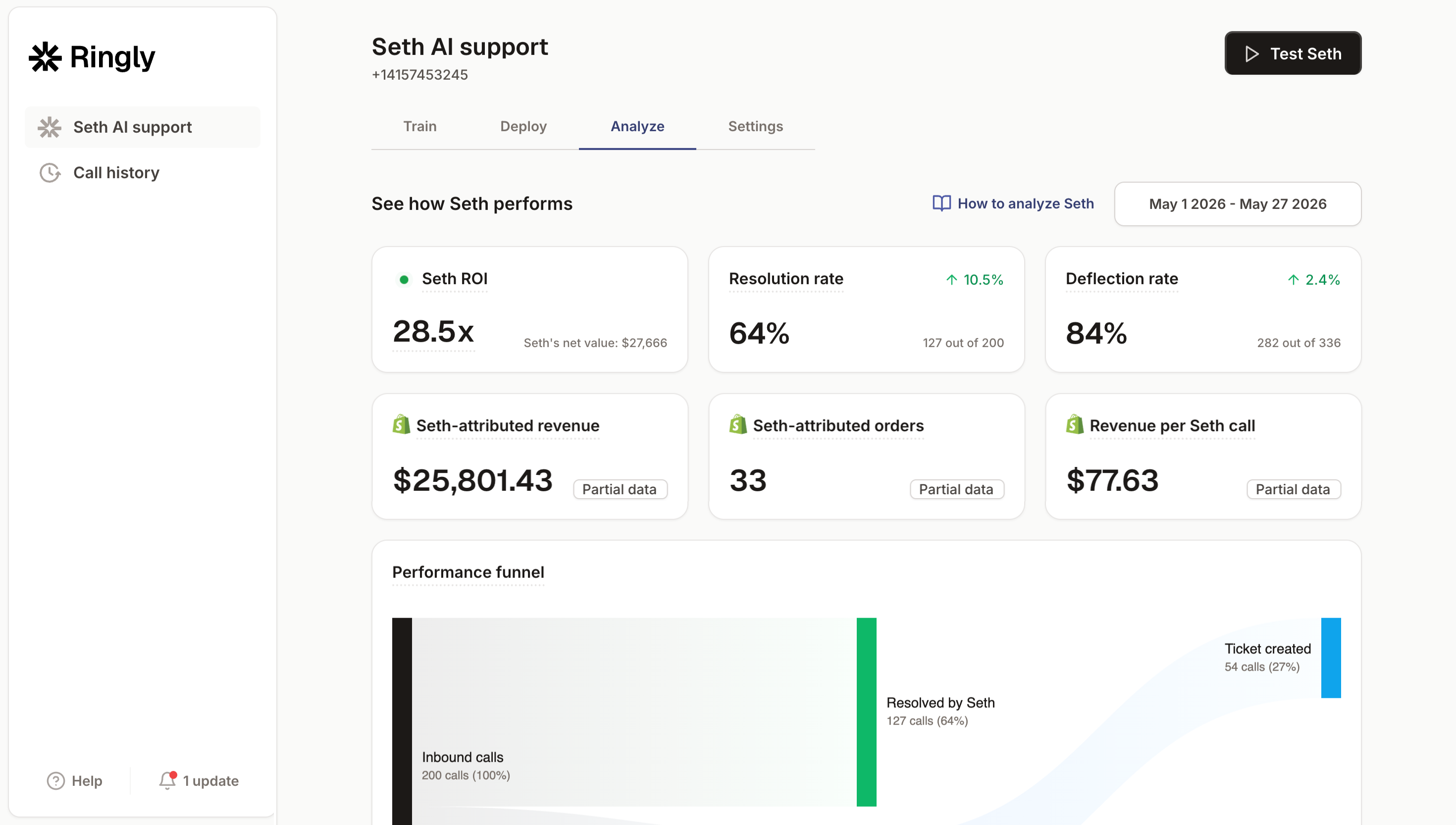
This is what AI phone support is built for. Ringly.io is AI phone support for Shopify brands. The AI answers inbound calls 24/7, finds the order in your Shopify store, checks return and refund status, answers policy questions from your knowledge base, and escalates the genuinely hard call to a human. Seth resolves up to 90% of calls autonomously for $1.99 a call after the first 50, versus $7 to $16 per call for human BPO. Your team stops answering "where's my refund" for the hundredth time and gets the calls that actually need them.
"My customers also feel like it's a normal person. They feel like they can communicate if they have questions."
Claudia Droge, TechCraft Studio
TechCraft Studio handles 88% of calls without a human, which is the kind of number that only matters because the customer never feels handed off to a robot. That's the whole point of routing the return wave: the routine call gets answered instantly, and your reps get their day back. If you want to see how this maps to your call volume, our automated phone support for DTC brands page and the check order status feature show the return-call workflow.
What the return support wave costs, and what changes when you route it
Put real numbers on it. Take a typical $50M Shopify DTC brand running a 6-rep CS team:
| Line item | Today | With Ringly |
|---|---|---|
| 6 reps x $4K loaded per rep | $24,000/mo | n/a |
| Ringly (~$5K/mo illustrative) | n/a | $5,000/mo |
| Net monthly CS spend | $24,000/mo | $5,000/mo |
| Monthly savings | n/a | $19,000/mo |
| Annual savings | n/a | $228,000/yr |
Roughly 70% of those repeatable calls are return and order status, the same five questions over and over. Route those to the AI and your team keeps the 30% that genuinely need a human: the damaged item, the angry escalation, the exception. Per call, in-house support runs about $2.70 loaded versus $1.20 to $2.00 on Ringly, and you get 24/7 coverage your team can't match.
The math is never really about the price of the tool. It's about how much of your CS payroll is doing return-status work a system could handle. If you want to compare this to your current setup, book a 30-min call and we'll do the math live on your numbers. You can also see the published tiers on the pricing page.
Frequently asked questions
What's a good return rate for a DTC brand?
It depends entirely on your category. Supplements and consumables run 2-6%, beauty 4-12%, electronics 8-15%, and apparel or footwear 20-40%. Compare your rate to your category, not to the 19% online average.
Should DTC brands offer free returns?
For most $10M+ brands, yes, because 82% of shoppers weigh free returns heavily and the conversion lift usually beats the shipping cost. The exceptions are low-margin or high-abuse categories, where you can steer toward exchanges and store credit instead of eating cash-refund shipping.
What return window should a DTC brand use?
Thirty days is the safe default. Extend to 60 days when fit anxiety is hurting conversion, since a generous window tends to lift sales and doesn't meaningfully raise return rates. Avoid 14 days unless your category genuinely demands it.
How do I cut down on "where's my refund" calls?
Refund faster and communicate sooner. Send a "we received your return, refund is processing" message the day the package arrives, refund on carrier scan where fraud risk allows, and show the timeline on your policy page. Most of those calls come from silence, not slowness.
Does a generous return policy actually increase sales?
Yes. A generous, clearly stated policy lifts conversion by roughly 34%, and customers who feel safe at checkout tend to return less, not more. The trick is making the policy easy to read so the confidence shows up before the sale.
How much does a single return cost a DTC brand?
Count three lines: return shipping ($8-12), processing and inspection ($5-8), and the support touch most brands ignore. All-in, processing one online return runs about 21% of the order's value, and that's before the cost of the call it often generates.
Talk to us

If returns are generating a call wave your team can't keep up with, a 30-min call is the fastest way to see what it's costing you. We'll pull the kind of return-status and refund calls your store is fielding and show you what routing the routine ones would save.
Our 3 promises.
- Live in under 1 hour. Setup and test calls are free.
- 30-day money back on the $99 plan fee.
- 65% resolution guarantee: if Seth resolves under 65% of your support calls in a month, that month comes back as credit (after 90 days on Pay per call).
Ruben (Ringly co-founder) takes these calls personally.