

I run Ringly.io, an AI phone agent for Shopify stores, and I talk to store owners every single week about their support setup. What I hear over and over is the same problem: tickets pile up, phones ring to voicemail, and the tools they're paying for only cover half the channels their customers actually use.
The average Shopify store gets 5 to 15 support tickets per 100 orders. That number climbs fast once you run ads or hit a seasonal spike. Miss those tickets (or worse, miss the phone calls that come with them) and you're bleeding revenue you already paid to acquire.
I installed and tested 8 customer service apps across helpdesks, live chat, AI phone agents, and self-service tools. This is what I found.
How I evaluated these apps
I didn't just read feature pages. I installed each app on test Shopify stores and ran them through real customer scenarios. Six criteria drove every ranking:
- Shopify integration depth: can it pull orders, process refunds, and check inventory from inside the app, or does it just show a sidebar?
- Channel coverage: email, chat, phone, social, or some combination? Most stores need at least two channels covered.
- AI and automation: does it actually deflect tickets, or does it just organize them into a nicer inbox?
- Pricing transparency: does the price on the page match what you actually pay at scale? (Spoiler: for most apps, it doesn't.)
- Setup time: can a non-technical store owner get running in under a day?
- Scale trajectory: what happens to your bill when you 3x your order volume during Black Friday?
Across 2,100+ stores using Ringly.io, I see firsthand which support gaps cost store owners the most revenue. That perspective shaped how I weighted these criteria.
Quick comparison of the top Shopify customer service apps
| App | Best for | Starting price | Channels | G2 rating |
|---|---|---|---|---|
| Gorgias | Deep Shopify helpdesk | $10/mo (50 tickets) | Email, chat, social, phone | 4.6/5 |
| Ringly.io | AI phone support | $349/mo (1,000 min) | Phone (AI agent) | N/A |
| Tidio | Chat + chatbot automation | Free (limited) | Chat, email, Messenger | 4.7/5 |
| Zendesk | Enterprise scale | $55/agent/mo | All channels | 4.3/5 |
| Help Scout | Simple shared inbox | Free (5 users) | Email, chat | 4.4/5 |
| Richpanel | Customer self-service | $29/seat/mo | Email, chat, self-service | 4.4/5 |
| Freshdesk | Budget helpdesk | Free (2 agents) | Email, chat, phone | 4.4/5 |
| Shopify Inbox | Free starter chat | Free | Chat only | N/A |
The 8 best Shopify customer service apps
1. Gorgias
Best for: Mid-size Shopify stores processing 100+ tickets per day that need deep order management inside their helpdesk.
Every "best Shopify helpdesk" list puts Gorgias near the top, and honestly, for pure ecommerce ticketing they've earned it. I've tested a lot of helpdesks. Gorgias is the one that actually feels like it was built for Shopify, because it was.
Agents can view order history, process refunds, cancel orders, and apply discount codes without ever leaving the conversation window. Tested it myself. No tab-switching, no copy-pasting order numbers. That level of integration is something Zendesk and Freshdesk still can't match.
The unlimited agents model is genuinely smart. You pay per ticket volume, not per head. So you can hire seasonal reps without your bill jumping. But that ticket-based pricing has a dark side. One store owner I talked to went from $300/month to $1,200 during Black Friday. Which, yeah, that's a lot.
And then there's the AI Agent. At $0.90 per resolved interaction, heavy usage can double your monthly bill before you notice. I'd argue the AI is worth testing, but budget for it from day one or you'll get a surprise invoice.
Pricing
| Plan | Monthly price | Tickets included |
|---|---|---|
| Starter | $10 | 50 |
| Basic | $60 | 300 |
| Pro | $360 | 2,000 |
| Advanced | $900 | 5,000 |
AI Agent interactions cost $0.90 each on annual plans. All plans include unlimited agents. For a deeper breakdown, see our Gorgias pricing analysis.
No phone support included. Voice is an add-on, and Gorgias doesn't offer AI-powered call handling. That's the gap that made me build Ringly in the first place.
If your primary challenge is email and chat ticket volume, Gorgias is the most Shopify-integrated helpdesk you'll find. Just budget carefully for peak seasons.
2. Ringly.io
Best for: Shopify stores where customers call and nobody picks up (or where hiring phone staff isn't realistic).
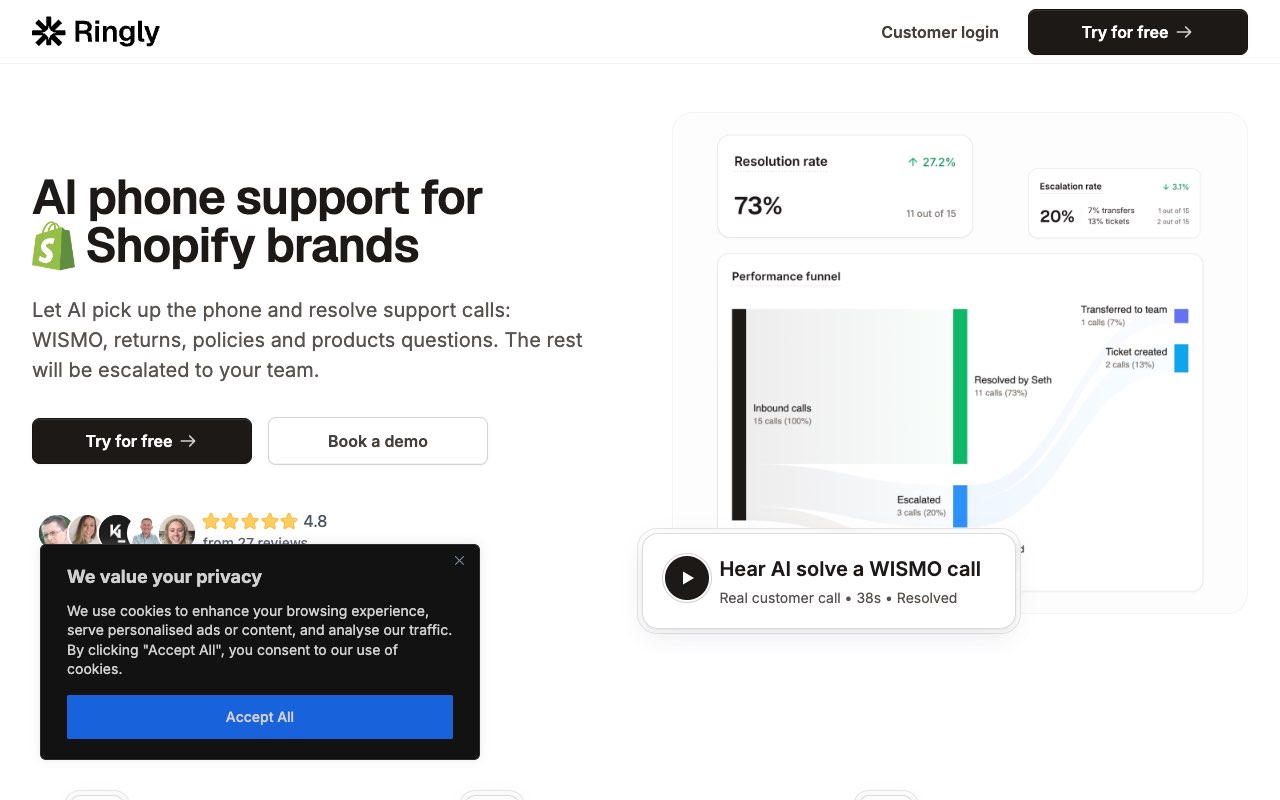
Every other app on this list handles tickets, chats, and emails. None of them answer your phone. That's why I built Ringly.io.
Full disclosure: this is my product. I obviously have a bias, so take my take with appropriate salt. But I built it because I kept hearing the same thing from Shopify store owners: "My customers call, and I can't afford to hire someone to answer the phone."
Our AI phone agent picks up inbound calls 24/7, looks up orders in your Shopify store in real time, answers product questions, processes returns, and transfers to a human when the situation calls for it. Speaks 40 languages. Takes about 3 minutes to set up. According to Salesforce's 2025 State of Service report, 30% of customer service cases are already resolved by AI, with that number projected to hit 50% by 2027. Phone support is following the same trajectory.
Across 2,100+ stores, about 73% of calls get resolved without a human touching them. That's the number I'm most proud of.
But Ringly is phone only. You'll still need a helpdesk like Gorgias or Freshdesk for your text channels. If Gorgias is the Swiss Army knife for Shopify support, Ringly is the scalpel for phone.
Pricing
| Plan | Monthly price | Minutes included | Overage |
|---|---|---|---|
| Grow | $349 | 1,000 | $0.29/min |
| Pro | $799 | 2,500 | $0.19/min |
| Enterprise | Custom | 5,000+ | Contact sales |
Pro includes a 14-day free trial, done-for-you setup, and AI call insights. You can check the full pricing breakdown here, and Ringly guarantees a 65% resolution rate: if Seth resolves under 65% of calls after 90 days, they refund your last 3 months.
What works
- Only Shopify-native AI phone agent: no other app on this list handles calls with AI. Not one.
- Real-time order lookups: pulls order status, tracking info, and return eligibility directly from your Shopify admin during the call
- 73% resolution rate
- 40-language support: covers international callers without hiring multilingual staff
- 3-minute setup: connect your Shopify store, customize your agent's knowledge base, and go live. No developer needed.
What doesn't
- Phone only: no emails, no chat
- Ecommerce focus: built specifically for Shopify. Not on Shopify? Not your tool.
- Newer player: founded in 2024, so the track record is shorter than Gorgias or Zendesk (though 2,100+ stores is meaningful traction)
If your missed-call rate is high, this is the fastest win on the list. Want to see if it works for your store? Start a free trial and go live in under 3 minutes.
3. Tidio
Best for: Small Shopify stores that want live chat and chatbot automation without a big budget.
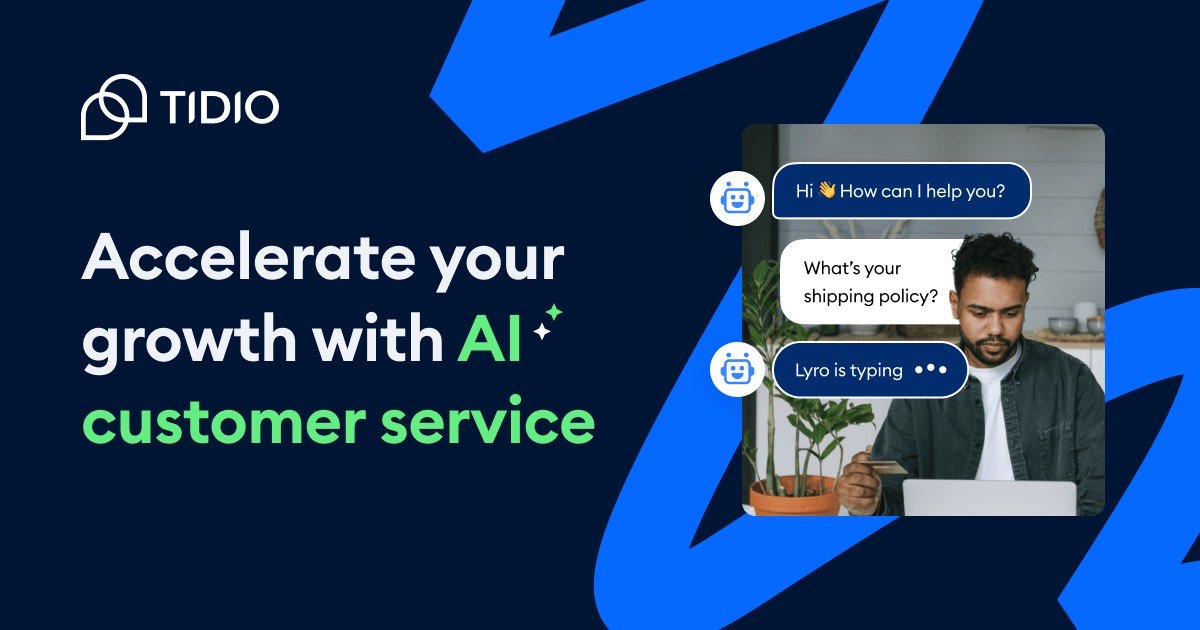
Tidio is where a lot of Shopify store owners start. The chat widget looks clean, the visual chatbot builder is genuinely easy to use, and Lyro (their AI chatbot) can handle routine questions about shipping, returns, and order status. With 4.7 stars and over 1,150 reviews on the Shopify App Store, it's one of the most popular customer service apps in the ecosystem.
Here's what most reviews skip though. Tidio's free plan gives you 50 AI conversations total. Not per month. Total. Once those 50 are gone, you're either upgrading or your chatbot goes silent. And Lyro's AI add-on starts at $39/month on top of your base plan, which means your "free" tool can quickly cost $70-100/month.
I've talked to store owners who got burned by this. They set up Tidio thinking it was free, the bot worked great for two weeks, then it just stopped responding. Not a great experience.
Pricing
| Plan | Monthly price | Included |
|---|---|---|
| Free | $0 | 50 AI conversations (total), basic chat |
| Starter | $29 | 100 conversations/mo |
| Growth | $59-349 | Scaled conversations, analytics |
| Plus | $749 | Advanced features |
Lyro AI add-on: $39+/month for 50 AI conversations (on top of base plan price).
What works
- Visual chatbot builder: drag-and-drop flows without writing code. Genuinely beginner-friendly.
- Strong Shopify App Store presence: 4.7/5 with 1,150+ reviews
- Multichannel chat: covers live chat, email, Messenger, and Instagram in one tool
- Affordable entry point: the Starter plan at $29/month is reasonable for what you get
What doesn't
- Free plan AI is basically a demo: 50 total conversations is barely enough to evaluate whether it works
- Real costs are 2-3x advertised: between base plan + Lyro add-on + scaling conversations, budget $80-150/month for meaningful use
- Not a helpdesk: limited ticketing, no deep order management, no phone support
Why it ranks third
Solid live chat and chatbot tool, especially for stores under 500 orders/month. Just go in knowing that the free plan is a trial in disguise, and budget for the AI add-on from day one.
4. Zendesk
Best for: Shopify Plus stores with support teams of 10+ that need enterprise-grade workflows and reporting.
If Gorgias is the Shopify specialist, Zendesk is the everything machine. It does email, chat, phone, social, knowledge base, community forums. With over 1,000 marketplace integrations and some of the most advanced reporting in the category, it's the go-to for large support operations.
The tradeoff is complexity and cost. Zendesk charges per agent, starting at $55/month per person. A 5-agent team on the Suite Team plan pays $275/month before any AI add-ons. Move to Professional and that jumps to $575/month. For a full breakdown, see our Zendesk pricing guide.
Pricing
| Plan | Price per agent/mo | Key features |
|---|---|---|
| Suite Team | $55 | Ticketing, messaging, voice, help center |
| Suite Professional | $115 | Custom reporting, CSAT, SLA |
| Suite Enterprise | $169 | Sandbox, 300 help centers |
Advanced AI agents: +$50/agent/month. Annual billing saves about 20%.
What works
- Proven at enterprise scale: handles millions of tickets. If you're processing thousands per day, it won't buckle.
- Most customizable platform: workflows, triggers, and automations for nearly any scenario
- Broad integration ecosystem: 1,000+ apps in the marketplace
What doesn't
- Per-agent pricing stings: five agents on Professional costs $575/month. Ten agents hits $1,150/month.
- Overkill for most Shopify stores: if you're handling under 100 tickets/day, you're paying for features you'll never touch
Why it ranks fourth
Zendesk is the right tool when you've outgrown Gorgias or need to support multiple brands from one platform. For most Shopify stores under $1M in annual revenue, it's more than you need (and more than you want to pay). Read more in our Zendesk alternatives comparison.
5. Help Scout
Best for: Small teams (2-5 people) that want a clean shared inbox without the complexity of a full helpdesk.
Help Scout takes the opposite approach from Gorgias and Zendesk. Instead of cramming in every possible feature, it focuses on doing email support really well. The interface is one of the cleanest in the category. Their Shopify integration shows order details in a sidebar alongside conversations, and the free plan supports up to 5 users.
That simplicity is both the appeal and the limitation. Help Scout's Shopify integration is more about viewing order data than acting on it. You can see what a customer ordered, but processing refunds or editing orders typically requires jumping to your Shopify admin. For stores where email is the primary support channel, that tradeoff is worth it.
Pricing
| Plan | Price per user/mo | Key features |
|---|---|---|
| Free | $0 (5 users) | Email, docs, Shopify integration |
| Standard | $25 | All channels, reporting |
| Plus | $45 | Advanced permissions, teams |
What works
- Generous free plan: five users with Shopify integration at no cost. That's rare.
- Clean interface: onboarding takes minutes, not days. Your team will actually use it.
- Good knowledge base builder: Docs feature helps reduce incoming ticket volume
What doesn't
- Shallow Shopify integration: view-only for the most part. Can't process refunds or edit orders inline.
- Limited automation: no AI chatbot, basic rules compared to Gorgias
Why it ranks fifth
Help Scout is the best option if you value simplicity over power features. Ideal for stores running 20-50 tickets/day where email is the main channel.
6. Richpanel
Best for: Shopify stores that want customers to resolve issues themselves through a self-service portal.
Richpanel's big bet is on self-service. Their customer-facing portal lets shoppers track orders, initiate returns, check policies, and get answers without ever opening a ticket. They claim it resolves up to 50% of inquiries automatically.
The pricing, though. Base plans start at $29/seat, which sounds affordable. But the self-service portal (the feature most people want Richpanel for) is a separate add-on costing $99-500/month depending on order volume.
The AI assistant, Sidekick, adds another $20/user/month. Your $29/seat plan can easily become $150-600/month all in. Looked at the real numbers. Doesn't add up for most small stores.
What works
- Strong self-service portal: customers genuinely use it, which reduces ticket volume
- Good Shopify integration: order data flows into conversations and the self-service portal
What doesn't
- Self-service is an expensive add-on: the feature you want most costs $99-500/month on top of base pricing
- Total cost is misleading: budget 3-5x the advertised per-seat price for real-world usage
Why it ranks sixth
If self-service deflection is your top priority and you're willing to pay for the portal add-on, Richpanel can meaningfully reduce your support workload. Just calculate the total cost before committing.
7. Freshdesk
Best for: Budget-conscious stores wanting a proven, general-purpose helpdesk.
Freshdesk sits in the gap between Shopify Inbox (too basic) and Zendesk (too expensive). The free plan supports 2 agents, and the Growth plan at $15/agent/month is one of the most affordable paid helpdesk options for Shopify. It's part of the larger Freshworks suite, which means you can add sales, marketing, and IT tools later if needed.
The Shopify integration works but it's not as deep as Gorgias. You can view order data inside tickets, but refund processing and order editing are limited compared to ecommerce-specific tools.
What works
- Affordable paid plans: $15/agent/month for the Growth plan. Hard to beat at that price.
- Free tier available: two agents at no cost for stores just getting started with ticketing
- Established platform: part of Freshworks, ongoing development and stability
What doesn't
- Shopify integration is adequate, not deep: order viewing works. Advanced ecommerce actions don't.
- AI add-ons cost extra: Freddy AI Copilot is $29/agent/month. Freddy AI Agent is $100/1,000 sessions.
Why it ranks seventh
Freshdesk is a reliable, affordable helpdesk for stores that don't need Gorgias-level Shopify depth. If your budget is tight and you need more than Shopify Inbox can offer, it's a solid middle ground.
8. Shopify Inbox
Best for: Brand new stores testing live chat for the first time at zero cost.
Shopify Inbox is free, native, and already installed on your store. It lets customers start live chat conversations, and you can see their cart contents, order history, and browsing session right in the conversation. For a store doing 10-20 chats per day, it's perfectly fine.
The problems show up when you scale. No email ticketing, no phone support, no knowledge base, and no real chatbot builder. Most stores outgrow Inbox within 6-12 months of serious use.
What works
- Completely free: zero additional cost beyond your Shopify subscription
- Native integration: cart contents and order data visible in every conversation
- Zero setup effort
What doesn't
- No phone or email support: chat only. Your other channels are uncovered.
- Very basic automation: no AI chatbot, no complex flows, no routing rules
- Outgrown quickly: most stores need more within a year
Why it ranks eighth
Start with Shopify Inbox to test live chat. Move to Tidio for better chatbots or Gorgias for a full helpdesk when you're ready. It's a starting point, not a destination.
How to choose the right app for your store
The right app depends on your biggest support gap, not on which one has the most features. Here's the framework I use:
- Choose Gorgias if: you handle 100+ tickets/day and need to process refunds, edit orders, and manage conversations without switching tabs
- Choose Ringly.io if: your customers call and nobody picks up, or you want 24/7 phone coverage without hiring staff
- Choose Tidio if: you want a chat widget with AI chatbot automation and your budget is under $100/month
- Choose Zendesk if: you're on Shopify Plus with a support team of 10+ and need enterprise reporting
- Choose Help Scout if: your team is small, email is your main channel, and you want something that just works
- Choose Richpanel if: customer self-service deflection is your top priority and you're willing to invest in the portal add-on
- Choose Freshdesk if: you need a solid helpdesk at a lower price point than Gorgias
- Choose Shopify Inbox if: you're just getting started and want to test live chat at zero cost
Most successful Shopify stores I work with use two tools: one for text-based channels (helpdesk or chat) and one for phone support. The stores running Gorgias + Ringly.io, for example, cover email, chat, and phone with two apps and zero gaps.
What most "best of" lists miss about Shopify customer service
Every competitor article for "best Shopify customer service apps" covers the same territory: helpdesks, live chat, chatbots. Not one of them addresses phone support. I've read probably 30 of these lists. Same blind spot every time.
The data backs this up:
- 76% of consumers prefer phone calls when they need support, according to Shopify's own customer service statistics
- Phone scores a 91% satisfaction rate, beating live chat at 85% by a wider margin than most people assume
- Salesforce research projects AI will handle 50% of all customer service cases by 2027, and phone is the next channel to see wide adoption
Yet the typical Shopify store either sends calls straight to voicemail or doesn't publish a phone number at all. That gap exists because phone staffing is expensive. A single support rep costs $35-50K/year, and you need coverage across time zones and languages.
AI voice agents are closing that gap by handling routine calls at a fraction of the cost. The point isn't that you should drop your helpdesk. It's that the best Shopify customer service setup in 2026 covers both text and voice channels. You can track the latest numbers in our AI customer service statistics roundup.
Frequently asked questions
What is the best free customer service app for Shopify?
Shopify Inbox is the best fully free option since it comes included with every Shopify plan. Help Scout's free plan (5 users, 100 contacts/month) is a strong upgrade if you need email ticketing. For stores doing real volume, free plans are training wheels, and you'll want to budget for a paid tool within 6-12 months.
How much should a Shopify store spend on customer service apps?
Most stores spend $50-300/month on customer service tools, depending on their support volume and channels. A small store might get by with Tidio's Starter plan ($29/month), while a mid-size operation running Gorgias + a phone solution could spend $200-400/month combined. Budget roughly 1-3% of your monthly revenue for support tooling.
Can AI handle Shopify customer service calls?
Yes. AI phone agents like Ringly.io handle inbound calls with real-time Shopify data access, resolving about 73% of calls without a human. They can check order status, process returns, and answer product questions. For complex issues, AI agents transfer to a human with full call context.
Do I need a helpdesk if I already use Shopify Inbox?
Under 20 conversations per day, Inbox works fine. Once you hit 50+ daily interactions across email, chat, and social, you'll need a real helpdesk like Gorgias or Freshdesk for proper ticketing and automation. Most stores make that switch around the 200-order-per-month mark.
Which Shopify customer service app has the best Shopify integration?
Gorgias has the deepest Shopify integration by a significant margin. Agents can view orders, process refunds, apply discounts, and cancel orders directly inside the helpdesk. Richpanel and Tidio offer solid integrations too, but Gorgias lets you take action on orders without switching to your Shopify admin.
How do I set up a customer service app on Shopify?
Most apps install through the Shopify App Store in under 10 minutes, where you'll authorize the connection and configure your channels. Ringly.io takes about 3 minutes to go live since it only requires connecting your store and setting up your AI agent's knowledge. More complex platforms like Zendesk can take 1-2 weeks for a full rollout.
Is Gorgias worth the price for small Shopify stores?
For very small stores, the Starter plan ($10/month, 50 tickets) works, but most growing stores need the Basic plan at $60/month minimum. If you're under 100 tickets/month, Help Scout's free plan or Freshdesk's free tier are smarter starting points. Gorgias earns its price once you're processing 200+ tickets/month and need deep Shopify order management.
So what should you pick?
There's no single "best" Shopify customer service app. The best setup is the one that covers the channels your customers actually use.
If your support is mostly email and chat, Gorgias is the strongest helpdesk for Shopify stores. If you're getting calls that go unanswered, Ringly.io fills that gap. And if you're early-stage and bootstrapping, Shopify Inbox plus Tidio's free plan is a decent place to start.
The store owners who build real loyalty are the ones whose customers can reach them however they want, whether that's email, chat, or picking up the phone. Pick the tools that close your gaps, and skip the rest.
Ready to stop missing customer calls? Start your free Ringly.io trial and go live in under 3 minutes.